Home » Contract » Recent Articles:

AT&T Workers in Nevada, California and Connecticut Call Two-Day Strike

Phillip Dampier August 7, 2012 AT&T, Consumer News, Video Comments Off on AT&T Workers in Nevada, California and Connecticut Call Two-Day Strike

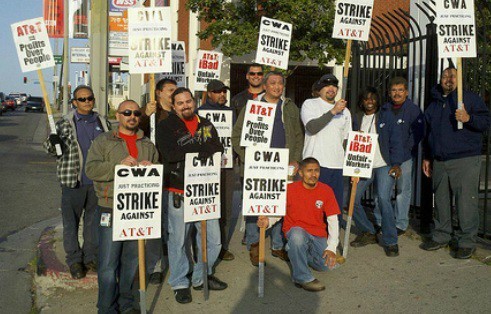
AT&T workers launched a two-day strike impacting operations in Connecticut, Nevada, and California.

Around 20,000 AT&T workers in Connecticut, Nevada and California are striking this afternoon in a two-day action to protest what union officials call the company’s lack of good faith during contract negotiations talks.

“Contract negotiations are never easy,” said CWA District 9 vice president Jim Weitkamp. “But when AT&T violates the law repeatedly, the process really can’t work. Given AT&T’s record profits, tax breaks and jaw-dropping executive compensation, there is no reason for them to insist on lowering the standard of living of a single worker.”

While 17,000 workers in the west and 3,000 employees in Connecticut walk picket lines, fellow AT&T employees in the southeast are still on the job after the company reached tentative deals with unions representing those workers.

AT&T says the new three-year deals with the Communications Workers of America and the International Brotherhood of Electrical Workers in Alabama, Georgia, Louisiana, Mississippi, Tennessee and North and South Carolina  bring wage and “modest pension increases,” according to the company.

Connecticut workers say AT&T’s proposed package in the northeast is not sufficient to address the high cost of living in the state.

But AT&T says declining numbers of landlines means cuts are inevitable. AT&T said in a statement Tuesday’s walkout was not in anyone’s best interest.

Connecticut picketers have been blocking the entrances of several AT&T facilities including in New Haven, where replacement workers appear to be honoring the picket lines after talking with striking workers. Unions are requesting customers not do business with AT&T during the strike.

Late reports indicate several cars with New Jersey license plates have hit three persons on one picket line. The union claims the vehicles were being driven by replacement workers, but no independent confirmation was available.

[flv width=”480″ height=”290″]http://www.phillipdampier.com/video/New Haven Register ATT UNION ON STRIKE 8-7-12.mp4[/flv]

The New Haven Register talked with Tim Smith, a union worker on a picket line outside of an AT&T facility. The video shows picketers encouraging replacement workers to honor the picket line and not report for work.  (3 minutes) 

A Lesson for Municipalities Enduring Statewide Cable Franchises: Get it in Writing, Carefully

Phillip Dampier July 18, 2012 AT&T, Consumer News, Editorial & Site News, Mediacom, Public Policy & Gov't, Verizon Comments Off on A Lesson for Municipalities Enduring Statewide Cable Franchises: Get it in Writing, Carefully

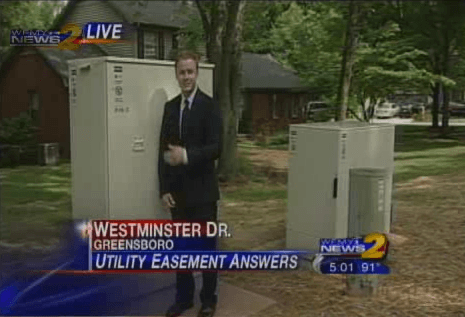
Several years ago, phone companies like AT&T and Verizon discovered providing competing cable service over U-verse and FiOS meant approaching each community, asking permission to tear up the streets and yards of local residents to deliver the service. AT&T’s U-verse requires enormous 4-6 foot ugly metal cabinets in the front or side yard of a customer every few blocks. Verizon’s FiOS network necessitates the replacement of the copper wire network with fiber optic cables in its place. More than a few yards and streets were torn up installing the new cables.

Dealing with individual town boards, city councils, and other franchising authorities became a nuisance for the companies, so both decided to invest some serious lobbying money to rip control away from local authorities. Understanding they would never get away with advocating for no oversight, they settled for the next best thing — advocating for a statewide franchise law. With that, both phone companies simply needed to obtain a single license from the state to operate.

U-verse cabinets often make the evening news when they are plunked down in your front yard. With statewide video franchise laws, you and your local community leaders no longer have a say.

AT&T has been especially successful in passing such “reforms” in their service areas. Verizon has fought less successfully in the more-skeptical northeastern states unwilling to give the company carte blanche-benefit of the doubt.

Illinois is definitely AT&T territory, and the company’s successful push for statewide franchising in 2007 was tied to promises AT&T would hurry out its U-verse service across Illinois. Instead, with many Illinois customers still without access to U-verse, the phone company recently announced its upgrade-expansion was over. But AT&T remains grateful to the Illinois legislature for keeping its end of the agreement — removing certain pesky consumer protection and local oversight laws.

AT&T also craftily defined limits on how much authority the state franchise body could have to operate. In some states, franchise authorities are little more than paper pushers issuing franchise agreements at-will to operators, leaving local communities stuck with whatever quality of service the phone and cable company is willing to offer.

While phone companies spent millions lobbying for franchise reform, the cable industry has occasionally fought their efforts, maintaining AT&T and Verizon should have to follow the same rules they do. Cable operators spent years negotiating franchise agreements with every community they service. In many cases, the cable industry lost the battle but, along with AT&T and Verizon, effectively won the war.

In Carbondale, cable customers quickly learned that statewide video franchise “reform” pushed by AT&T was no help to them. Soon after the law was passed, Mediacom closed the only local customer service center in the city, in direct violation of their local 2009 franchise agreement that required Mediacom to keep its service center open for at least a decade after signing.

In court, Mediacom argued their signed contract with Carbondale was null and void because of the changes to the Illinois Public Utility Act, which transferred franchise authority to the Illinois state government and out of the hands of local officials.

Carbondale officials sued Mediacom in 2010 over the franchise violation, and the cable company opened a temporary customer service center in a local shopping center as an interim measure.

Now two courts have found in favor of Carbondale’s carefully written franchise agreement, and have ruled Mediacom cannot simply tear up their local franchise agreement, state law or not.

What made the difference for Carbondale was language in the agreement that kept close to the consumer protection provisions now found in the statewide franchise law. Courts found that because Carbondale did not stray from the state’s standards, they were within their rights to expect Mediacom to continue operating under the terms of the franchise agreement the company signed.

“The circuit court correctly concluded that the plaintiffs and Mediacom ‘mutually agreed to contracts, both valid at the time of their formation, and valid after the enactment of the customer service and privacy protection standards of (statute),” Justice James M. Wexstten wrote in the appellate ruling.

That leaves Mediacom mulling extending its lease on their single local customer service center, at least until they decide whether or not to appeal the case to the Illinois Supreme Court.

Jackson County Assistant State’s Attorney Dan Brenner and Carbondale City Attorney Mike Kimmel, who fought Carbondale’s case in court told The Southern they would not be surprised to see Mediacom pursue the case.

“As far as we’re all concerned, they’ve got to keep that service center open in Carbondale until the contract ends or they get this thing reversed,” Brenner told the newspaper.

Verizon Wireless’ In-Store Support Hell – Crossed Signals, Mixed Messages, Long Wait

You gotta love Verizon’s $30 upgrade fee to provide customers with the level of service and support they have come to expect. I’d rather deal with “no credit, no refunds, no checks” CricKet.

Verizon Wireless customers pay a $30 “upgrade fee” when purchasing new equipment with a new two-year contract, ostensibly to “provide customers with the level of service and support they have come to expect.”

After losing more than an hour of my life yesterday afternoon inside a Verizon Wireless store, I am here to tell you it isn’t worth it.

For the second time in seven months, Verizon Wireless has taught me they specialize in keeping customers waiting, giving them conflicting information, and proving the employees should be availing themselves of the “Wireless Workshops, online educational tools, and consultations with experts who provide advice and guidance on devices that are more sophisticated than ever.”

The latest nightmare began with an upgrade to Samsung’s Galaxy S3 that arrived with two 4G SIM cards that were initially declared useless-on-arrival. Despite early assurances that a customer service representative should be able to manage the activation of the phones without loss of our coveted unlimited data plan, it turned out a visit to a local Verizon Wireless store was recommended to swap out the 4G SIM cards enclosed in the box as part of a slightly-complicated activation.

Walking into the Pittsford, N.Y. Verizon store brought a feeling of trepidation when I realized my friend “the Verizon Wireless Welcome Kiosk” that I had been signing in at during previous visits was now missing. Instead, the store manager, armed with an Apple iPad, registered me for the inevitable queue of customers waiting for assistance.

“The wait should be around 15 minutes,” the store manager promised.

Nearly 30 minutes later, as I watched what seemed to be the only employee not on break deal with Ms. I-Don’t-Know-and-I-Can’t-Decide, the store manager returned to ask why I bothered to show up in-store to activate phones I could have managed online or by phone.

“Because I was told to,” I explained. “I have two phones that require new SIM cards and special attention to ensure I don’t lose my unlimited data plan.”

“Well, you have to activate them first,” came the reply.

That was news to me, of course, when a Verizon Wireless phone representative an hour earlier warned me specifically not to activate the phones and let a store customer service representative handle everything.

“Please don’t even attempt to activate the phones because I have had customers doing that all day who forfeited their unlimited data plans when they tried,” urged the phone representative. “You need to bring everything to the store and make sure they do it for you because I don’t want you inconvenienced.”

Good intentions, but reality always intrudes.

Phillip “Kill Me Now” Dampier

By now, 35 minutes into my 15-minute wait, several additional frustrated customers trickled in, all with the same phone. One found he couldn’t activate it even when he tried. Another needed his assigned a different number. Again, the store manager insisted the customers activate their phones before approaching a store employee.

As I wearily watched Ms. Indecision -still- taking up the time of the employee that was going to serve me next, I heard other customers casually griping about upgrade fees, the new Share Everything plan, and Verizon’s idea of customer service these days. The consensus: Verizon was shaking down their customers for more cash and also punishing people forced to walk into a store to resolve a problem. Pittsford is one of Rochester’s wealthiest suburbs, and even here customers were tapped out.

I have literally been here before. Back in December, at the same store, a remarkably unhelpful Verizon Wireless employee insisted the problems with my last phone, intermittent they might be, were not his problem if he could not exactly duplicate it while I waited. Since he did not have time to try (but had at least 15 minutes to chat up a young lady that preceded me about his holiday pie-making experiences), I was on my own, just as my warranty was set to expire.

He no longer works there.

As each new customer arrived on this remarkably warmer July day, the store manager warned the wait was growing longer and longer. He didn’t mention the customer -still- at the counter contemplating this or that and holding up the entire free market wireless economy in the process.

At this point, I was advised I could activate my phones by dialing *228 and I’d be all set. Only a year earlier, a Verizon employee told me 4G LTE customers should burn their fingers with a cigarette lighter if they ever felt the urge to try, because it would “scramble the SIM card forever.” True or false, I felt burned already.

I decided instead to call Verizon Wireless customer service, ironically, from inside the Verizon Wireless store that was supposed to be giving me “the level of service and support I have come to expect.”

“Due to (incredibly) high call volumes, your wait (is likely to be until the snow flies before someone will pick up your call).”

I then realize there are two other customers doing precisely the same thing I am, which probably explained those high call volumes.

Mr. Store Manager returned to ask if I had activated my phones yet. I explained I could not get through, but was bemused to notice the phones had now powered up with messages indicating they were in the process of activating themselves.

An hour into my 15 minute wait…

“That’s because you had your phones turned on,” came the odd explanation. “You have to turn the phones off before you call customer service.”

“I don’t think so, I seem to recall my Samsung Droid Charge activated itself in a similar fashion,” I replied.

“No, that isn’t how it works.”

Two minutes later, the phones activated themselves. I’m not certain I’ll ever know exactly why, especially after being told I had dud 4G SIM cards. But I also found it ironic that even a confused customer like myself, now dying in my personal Verizon hell, seemed to know more than the people working there, and I didn’t even take that Wireless Workshop.

Regardless, I was elated that stage of my trial had come to an end. Now I only had to have an employee swap those SIM cards out to assign the phones to the proper phone numbers. Then I could escape my excellent customer experience for good.

But there was Ms. Should-I-or-Shouldn’t-I, still tying up the growing line (the wait had now grown to perhaps an hour for customers entering the store… at their own risk.)

Suddenly, an employee miraculously returned from break and I was finally helped.

“You want insurance on these phone, right?”

“No.”

“But you have 14 days to change your mind.”

“No.”

“Which phone do you want on which number.”

“Since the phones are precisely the same, it does not matter to me.”

Those were the days.

Long pause.

The employee kept dropping below the counter to deal with an interminable number of snake-long thermal cash-register-like receipts that kept spitting out of the printer whenever he did anything on the slowly-responding computer.

After another 15 minutes, the new 4G SIM cards were in.

“Now let me show you some of the cool new features on your phone, but first enter your name and password.”

I compromised by entering my name and password but suggested we skip the training course. Besides, my personal lease renting space inside the store (and my new 2-year contract) was likely to expire before I would finally get out of there.

“We have some nice new cases to show you to protect your phones.”

“No thanks.” Now I am questioning why I bought the phones in the first place.

“Okay, now it is time to restore your apps.”

Kill me now.

As soon as the phones were up and running, back into the boxes they went, and polite thank-yous were delivered to all concerned. I then busted out of the store, more than an hour after my promised 15-minute wait, like a prisoner escaping Attica. Sure I realize I am not “free at last,” stuck on a new contract with Verizon for another two years, but I can do my time standing on my head so long as I can avoid ever dealing with another Verizon Wireless store… and keep my unlimited data.

They should pay me $30 to go through upgrading anything with them. Oh wait, just a year or so ago they did — $100 as part of Verizon’s long-gone “New Every Two” program… exorcised right along with their budget-minded voice calling options, unlimited data, and text plans suitable for the occasional text here and there. In their place, the all-new, super exciting $90 Share Everything plan… including $50 for a “generous” 1GB data allowance.

Thanks Verizon Wireless!

Rogers Doubles Maximum Overlimit Usage Fee from $50 to $100 to “Protect Customers”

Phillip Dampier July 5, 2012 Canada, Consumer News, Data Caps, Editorial & Site News, Rogers Comments Off on Rogers Doubles Maximum Overlimit Usage Fee from $50 to $100 to “Protect Customers”

Lowering the bar on customers by increasing the maximum overlimit fee. It’s another example of Rogers’ Broadband Limbo Dance.

Rogers Communications is quietly notifying its broadband customers it is doubling the overlimit fee for excessive use of its broadband service from $50 to $100, effective Aug. 16, 2012.

The company characterizes the new maximum fee as “protecting you from unexpected high charges,” but of course does nothing of the sort. Rogers’ charges eastern Canada some of the continent’s most expensive prices around for usage-limited broadband. Its Internet Overcharging scheme has relied on all of the classic tricks of the trade to get consumers to pay higher and higher prices for broadband service, while assuring investors the company can rake in additional profits at will just by adjusting your allowance and overlimit fee.

Companies that introduce usage caps and consumption billing are monetizing broadband usage. By adjusting prices upwards and reducing usage allowances, customers can find themselves paying confiscatory overlimit fees. But until recently companies in Canada capped the maximum overlimit penalties. Over the last three years, those maximum fees have increased dramatically, and some companies like Cogeco have removed the maximum limit altogether.

While Rogers’ cost to deliver service continues to decline, these kinds of policy changes can cause broadband bills to soar, especially when customers are in overlimit territory.

Rogers (with thanks to Broadband Reports readers who shared the text):

“To protect you from unexpected high charges, we currently cap the maximum monthly amount you can be charged for additional internet usage at $50 in addition to your Hi-Speed Internet plan’s monthly service fee, modem rental fee (if applicable) and taxes. Effective August 16, 2012 this monthly limit will be increased to $100 in addition to your plan’s monthly service fee, modem rental fee (if applicable) and taxes. If you exceed the monthly usage allowance included in your Hi-Speed Internet plan you will begin to see charges up to the new limit beginning on your first invoice on or after September 16, 2012. All other aspects of your Rogers service(s) will remain the same. Remember, you can track your internet usage online by signing into My Rogers at rogers.com/myinternetusage. For more information or questions please contact us in any of the ways listed on page 2 of this invoice. Thank you.”

Customers can use the occasion of Rogers’ contract changes to potentially switch providers without paying early cancellation fees. This process is more straightforward in Quebec, according to the company’s terms and conditions.

Quebec Residents Only

Unless otherwise specified in the Service Agreement, we may change, at any time, but upon no less than 30 days’ prior written notice to you:

  • a) with respect to a  plan or Service not subscribed to for a Commitment Period (as defined below), any charges, features, content, functionality, structure or any other aspects of the plan or Service, as well as any term or provision of the Service Agreement, and
  • b) with respect to a plan or Service subscribed to for a Commitment Period, any aspect of the plan or Service, as well as any term or provision of the Service Agreement, other than essential elements of the plan, Service or Service Agreement.

If the change entails an increase in your obligations or a decrease in our obligations and if you do not accept such a change, you may terminate your Services without an ECF (as defined below) by sending us a notice to that effect no later than 30 days after the amendment takes effect.

Rogers’ Customers Elsewhere in Canada

Unless otherwise specified in the Service Agreement, we may change, at any time, any charges, features, content, functionality, structure or any other aspects of the Services, as well as any term or provision of the Service Agreement, upon notice to you. If you do not accept a change to the affected Services, your sole remedy is to terminate the affected Services provided under the Service Agreement, within 30 days of your receipt of our notice of change to the Services (unless we specify a different notice period), by providing us with advance notice of termination pursuant to Section 34. If you do not accept a change to these Terms, your sole remedy is to retain these Terms unchanged for the duration of the Commitment Period (as defined below), upon notice to us within 30 days of your receipt of our notice of change to these Terms.

While Quebec residents have a clear path to avoid Rogers’ ECF, customers elsewhere may be subject to an early cancellation fee because of Section 9 of Rogers’ agreement:

Unless otherwise set out in the Materials, if you agree to subscribe to one of our plans or Services for a committed period of time (the “Commitment Period”), you may be subject to an early cancellation fee (“ECF”) for each Service. Any decrease in your Commitment Period may be subject to a fee. If your Service is terminated prior to the end of the Commitment Period, you will pay us an ECF as specified in the Service Agreement, plus taxes.

Customers outside of Quebec may want to check with Rogers directly to determine if an early cancellation fee will apply when canceling service because of the change in maximum overlimit fees.

Customers leaving Rogers can find better deals for broadband services from independent ISPs like TekSavvy or Start.

Frontier “Passes the Buck” On Phone Cramming in Oregon; Tries to Charge $300 Disconnect Fee

Phillip Dampier June 28, 2012 Consumer News, Frontier 1 Comment

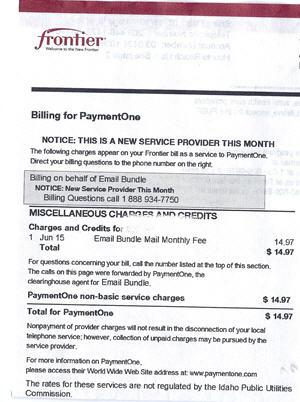
Frontier has dealt with PaymentOne for years. This bill shows unauthorized cramming charges billed to a Frontier customer in the fall of 2010.

An Oregon man found himself facing $300 in early termination fees from Frontier Communications after the phone company first refused to intervene on his behalf and credit his account for unauthorized “phone cramming” charges.

Tim Curns was with Frontier since the 1990s, but not anymore.

“I pulled the plug,” Curns told KGW-TV after unsuccessfully trying to get Frontier to help remove an unauthorized charge from his land line phone bill.

Curns found a $14.95 charge on his bill from something called “PaymentOne.” When he called Frontier, they could not tell him what the charge was for and at first refused to credit him for the unauthorized charge. That is surprising because Frontier has been billing customers on behalf of PaymentOne for more than two years.

With Frontier uninterested in investigating the phone cramming incident, Curns was told he would be on his own trying to stop PaymentOne from billing his phone line every month.

Curns tried to tackle the problem himself, first calling PaymentOne and learning the company had enrolled his line for the service despite having the wrong mailing address on file. Frontier, upon learning that, eventually agreed to a one-time courtesy credit but could not promise additional charges would not be forthcoming the following month.

Engraged, Curns said if Frontier could not stop unauthorized charges, he could stop being their customer. At that point, the Frontier representative surprised Curns with news he was unknowingly committed to a two-year service contract, and he could cancel his service… if he paid around $300 in early termination fees.

That would leave PaymentOne with their money, Frontier enriched on an early termination fee the customer never knew he would owe, and little left in Curns’ wallet.

“My question to the phone company was, okay, if you make an adjustment on this bill for 14.95 what are you going to do to stop this from being a recurring charge,” Curns said, “and they said there’s nothing they can do, you have to call these people.”

So Curns called and said PaymentOne told him the name of that company is My Global 4-1-1, which is a front company for a firm called Doink Media LLC, which the Federal Trade Commission been chasing all over the country.

Kyle Kavas, Spokesperson for The Better Business Bureau said, “most of the time it’s just companies that are randomly picking out phone numbers and charging them. Those cramming charges are very dangerous because they come from companies that are usually scammers.”

KGW received this less-than-helpful statement from Frontier:

“Frontier takes customer concerns very seriously and always tries to make things right. Our normal policy on a ‘cramming’ issue, which is an unauthorized charge on a customer’s account, is to assist the customer in contacting the 3rd party company who added the charge. These 3rd party companies get a customer authorization from the customer although in some cases the customer doesn’t realize they’ve authorized the charge. An easy way to avoid these is to have a 3rd party block put on your account by calling Frontier Customer Service.”

Curns called Frontier and learned although the company does not currently charge a fee for third party charge-blocking, it might in the future.

What Frontier doesn’t admit is that it earns a piece of the action from every phone cramming charge found on a customer’s bill.

Curns ultimately decided to pull the plug on Frontier for good, paid a pro-rated early termination fee, and recommended other customers follow in his footsteps before unauthorized third party charges make their way to another phone bill.

For now, customers can call Frontier customer service and request all third party charges be blocked from your phone line. The service is free of charge, although there are no guarantees it will always remain that way. It would also be a good time to review your current account and learn if Frontier has put you on a contract plan with an early termination fee attached. If you did not authorize this, demand it be removed from your account at once. If you did authorize it, have Frontier note your account that you do not want it automatically renewed at the end of the term, a practice Frontier regularly engages in, and note your contract expiration date.

[flv width=”640″ height=”380″]http://www.phillipdampier.com/video/KGW Portland Frontier Cramming 6-26-12.mp4[/flv]

KGW-TV visits with Tim Curns to discuss Frontier’s “look the other way” attitude about phone cramming charges.  (2 minutes)

Search This Site:

Contributions:

Recent Comments:

Your Account:

Stop the Cap!