Home » Contract » Recent Articles:

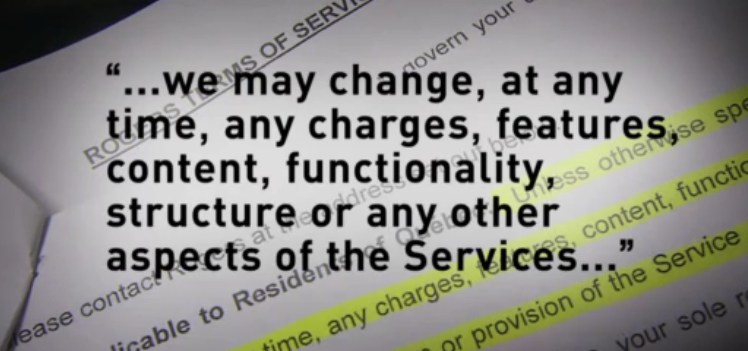
Rogers to Customer: We Are “Not Required to Honor What An Agent Says”

Phillip Dampier June 5, 2012 Canada, Consumer News, Rogers 2 Comments

Adam, a Rogers Wireless customer in Saint-Laurent, Quebec, got the customer service shock of his life when he called the telecommunications company after noticing a previously promised promotion on his wireless account was suddenly set to expire.

“Last year I was promised 100 long distance minutes for free, so long as I keep renewing my contract,” Adam told the Rogers forum on Broadband Reports. “The value was $5, balanced by a $5 credit. Last month an expiry date magically appeared next to the credit, so I called today to find out why.”

That was his first mistake, immediately apparent after the conversation with a Rogers manager quickly degenerated into petulant obstinance.

Some of the shocking things I was told include:

  • “This wasn’t documented last year.”
  • “According to the terms of service, Rogers is not required to honor what an agent says.”
  • “Recordings are not valid in a court of law for this circumstance.”
  • “We will not look at the terms of service to support our statements.”
  • “We will not listen to your recording of the original call because it doesn’t have an interaction ID.”

A follow-up with Rogers’ Office of the President brought no relief, instead provoking more testy replies from the company’s customer service agents starting with an accusation the customer was lying about the ongoing credit he was promised. Adam helpfully offered to play the original recording of the phone call where the agent made the promise, but Rogers’ executive customer service was having none of it.

“I can’t listen to the call because I’m uncertain of the legality of it,” the Rogers representative replied.

A request to clarify the situation with Rogers’ legal department left Adam on hold for several minutes followed by a frank declaration when the representative returned to the line.

“We’re not going to honor the credit, regardless of what the agent offered you,” said the Rogers senior customer service representative.

Adam was a Rogers wireless customer for 11 years, and remains shocked the company would adopt a “take no prisoners” stance over a $5 monthly credit for calling minutes. But Rogers’ reputation has been questioned by many Canadians for years. One Broadband Reports reader offered:

“Rogers reputation is so bad that it is already 50 miles below the earth’s surface. I guess they want to make it 500.”

AT&T Forcing Some DSL Customers to Upgrade to U-verse or Face Service Suspension

Phillip Dampier May 29, 2012 AT&T, Broadband Speed, Competition, Consumer News 6 Comments

Upgrade or else.

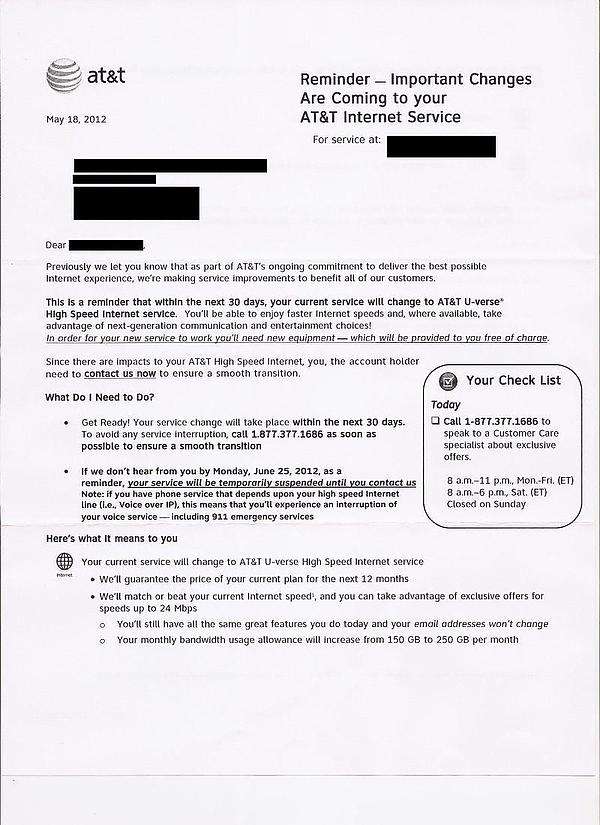
AT&T is now forcing some of their customers relying on the company’s traditional DSL service to upgrade to AT&T U-verse or face service suspension.

The latest customers impacted by AT&T’s forced upgrade are in parts of Connecticut.

“This is a reminder that within the next 30 days, your current service will change to AT&T U-verse High Speed Internet,” reads the letter mailed to customers facing the mandatory transition. Unfortunately, customers have to call AT&T to arrange for new equipment if they want their service to continue uninterrupted — existing DSL modems don’t work with U-verse.

Callers who dial the toll-free number in the letter get to order the U-verse equipment for free, but they routinely endure a hard sales pitch selling U-verse video and phone service as well, at a corresponding higher price. Customers are sent self-install kits at no charge and are offered the same rate they currently pay for DSL, sometimes with faster speeds on the U-verse network. But after one year, regular U-verse prices apply, and they are often significantly more expensive than traditional DSL service.

A Broadband Reports reader in Conn. shared a copy of the AT&T U-verse upgrade letter posted on that site's AT&T forum.

The promotional prices offered to Stop the Cap! reader Ralph were not as good as what he was currently paying for basic DSL on a promotion he purchased earlier.

“I am now paying $14.95 a month under the promotion I am on now and AT&T first tried to sell me a plan that cost $5 more,” Ralph writes. “They quickly agreed to keep my current promotional price after I told them about it, but what they will not tell me is what I will pay after the one year is up, nor can I find U-verse regular pricing on AT&T’s website.”

This special offer bundle comes with a surprise after the promotion ends -- a much higher bill.

AT&T is currently promoting Internet-only promotional pricing as follows: Basic Internet: $19.95, Express Internet: $19.95, Pro Internet: $19.95, Elite Internet: $24.95, Max Internet: $29.95, Max Plus Internet: $34.95, Max Turbo Internet: $44.95. We could not find a disclosure of what the regular prices would be after the one-year contract expired, and that bothers Ralph.

“I realize they are going to match my 3Mbps service on U-verse, but somehow I suspect the regular U-verse price is going to come higher than the DSL service I have been using,” he says.

Ralph’s intuition is correct. Stop the Cap! called AT&T at the number provided on the letter and spoke with a customer service representative at the AT&T Web Sales Center. Although AT&T will ship the required equipment (a wireless router/modem combo) at no charge, AT&T will eventually make that money back charging customers higher prices for Internet service.

Current regular pricing for Ralph’s DSL service after his promotion ends will cost him $24 a month for 3Mbps service.  U-verse charges $38 a month (off promotion) for the same speed service — a $14 monthly difference.

“That sucks,” Ralph said after we shared the news. “Why should I have to change what works fine right now?”

AT&T says keeping DSL in certain U-verse upgrade areas is not possible. In fact, AT&T’s letter warns, if customers do not call to arrange for the U-verse “upgrade” by a certain date, their broadband service will be suspended. That could be a problem for customers who also use their broadband account with an Internet-based phone line.

“There goes 911 or any other emergency calling,” Ralph reminds us. “Thanks, AT&T.”

Some customers who have completed their U-verse upgrade report AT&T messed up their subsequent billing, charging full price instead of an agreed-upon promotion. Slickdeals members report AT&T often requires constant reminding to fix billing errors that generally hand customers higher bills than they expected.

“I am trying real hard to figure out how this represents the ‘next evolution of communications’ AT&T writes about in their letter,” Ralph concludes. “All I am going to eventually get is a much higher bill for a service I don’t want or need. I guess it’s time to call the cable company again.”

Rogers’ “Unconscionable” Service Contracts & Bell’s Touch-Tone Fee Ripoff

Phillip Dampier May 29, 2012 Bell (Canada), Canada, Consumer News, Rogers, Video Comments Off on Rogers’ “Unconscionable” Service Contracts & Bell’s Touch-Tone Fee Ripoff

Rogers' "unconscionable" service contract allows the company to do just about anything.

Did you know that signing a contract with Rogers Communications for your broadband, phone, and cable television service will not protect you from the company’s annual rate increases?

It represents a classic example of an “unconscionable term” in a contract, according to Anthony Daimsis, a contract law professor at the University of Ottawa. Not because Rogers has inserted language that allows the company to raise rates on contract customers at will, but rather because consumers cannot escape the contract without paying a stiff early termination fee, usually approaching $200.

Rogers says its service contracts do not guarantee stable rates, instead providing a discount for bundling its services together. Most Canadians asked by CBC’s Marketwatch thought otherwise, believing it should lock in current rates for the term of the agreement.

The consumer show also chases Bell for charging Canadians $2.80 a month for touch-tone service — a fee that disappeared off most other phone company bills 20 years ago. Bell claims the touch-tone fee was introduced because the company met opposition from rotary phone customers when it tried to bundle the fee into its general price for phone service.

These days, buying a rotary dial phone requires a visit to an antique shop, but should you acquire one just to escape paying the phone company an extra $33 a year, it won’t work. Bell says the fee is now mandatory for all customers, rotary or otherwise — no one can “opt out.”

Bell’s touch tone bill padding rakes in an extra $100 million a year in revenue, all for a service upgrade paid for decades ago.

[flv width=”640″ height=”380″]http://www.phillipdampier.com/video/CBC Busted 04-2012.flv[/flv]

CBC Marketplace presents “Busted,” a special marathon edition exposing consumer ripoffs and deceptive advertising. In this clip, the show chases down Bell’s bill padding touch tone fee and Rogers’ notorious service contracts that lock customers in place -and- subject them to annual rate increases.  (13 minutes)

‘Well’-Connected Nation Still Producing Questionable Broadband Maps in Florida Scandal

Phillip Dampier May 22, 2012 Consumer News, Editorial & Site News, Public Policy & Gov't, Rural Broadband Comments Off on ‘Well’-Connected Nation Still Producing Questionable Broadband Maps in Florida Scandal

They're not so great at broadband mapping, but they are excellent at connecting the political dots to get their contract renewed.

The telecommunications industry-dominated Connected Nation, a group created to spur industry-friendly broadband expansion, is at the center of a scandal that cost taxpayers nearly $4 million to produce a broadband availability map critics contend is error-ridden and incomplete.

The non-profit Kentucky company, which historically has close ties to some of the nation’s largest phone companies, has learned how to play political games to win lucrative contracts while producing less-than-useful results, according to a new investigation by the Miami Herald.

When Florida’s Department of Management Services (DMS) decided Connected Nation’s performance in the state was lacking, it decided to let the state’s contract with the group expire and seek other bidders.

That is a remarkable turnaround for an agency that three years earlier took bids from the group’s state chapter — Connect Florida, who estimated the cost of mapping broadband in the state at around $7.1 million.  Another bidder, ISC of Tallahassee was a real bargain, offering to do the project for $2.8 million.  Connected Nation won. So much for awarding contracts to the lowest bidder.

It turned out the judges scoring the two groups were split, until a former BellSouth (AT&T) executive serving as a judge on the panel put his thumb on the scale, awarding an astounding 51 points to Connected Nation, itself shown to have past ties to AT&T.  The other judges scored no more than 15 points in either direction.

Undercut Connected Nation's bid by millions but still lost.

ISC, a homegrown Florida business, was stunned. Managing Partner Edwin Lott told Public Knowledge in 2009:

“Florida’s small businesses are working harder than ever to survive in this challenging economy. ISC, like other small businesses around the country, have had our hopes raised with Congress’s efforts to stimulate the economy with the Reinvestment Act and other initiatives. It originally appeared these initiatives were going to provide regional funding to sustain and promote jobs in the communities served by local and state governments.

“Our raised hopes were dashed as Connected Nation appeared to use its ‘connections’ in Florida to ensure its success in what was supposed to be a competitive procurement.”

DMS officials have apparently learned their lesson (at taxpayer expense), but Connected Nation isn’t going quietly. The non-profit group unleashed a high-powered lobbying campaign directed at the state legislature in Tallahassee to get its contract renewed to continue mapping Florida’s broadband future.

Williams

It worked, but only after the group’s critics at DMS were effectively bypassed. The legislature approved and Florida governor Rick Scott signed legislation that transferred broadband mapping away from the agency altogether, launching a new one — the Department of Economic Opportunity, to handle broadband matters effective July 1.

At least this time, taxpayers will have to pay less. Connected Nation’s latest bid was half of its original price, undercutting other bidders.

Rep. Alan Williams, a Tallahassee Democrat told the Herald price does not matter as much as political connections in the state legislature.

“Is this a favor to Connected Nation and a lobbyist or is this really good government?’’ Williams asked. “Is this really being accountable and efficient to the state of Florida the way the governor wants to be?”

Sen. Don Gaetz (R-Niceville) told the newspaper Florida state government is rife with insider influence peddling, and that appears to be the case with Connected Nation’s contract.

The group’s potent lobbying team included Lanny Wiles, the husband of the governor’s campaign manager; Al Cardenas, the former chairman of the Republican Party of Florida and head of the Conservative Political Action Committee; and Slater Bayliss, a one-time aide to former Gov. Jeb Bush.

Frontier’s Billing Mess in Oregon Upsets Customers; $20 “Rate Increase” for Some

Phillip Dampier May 21, 2012 Consumer News, Frontier, Public Policy & Gov't, Rural Broadband Comments Off on Frontier’s Billing Mess in Oregon Upsets Customers; $20 “Rate Increase” for Some

Frontier bills are often confusing, as this example from 2009 illustrates.

Some of Frontier Communications’ 230,000 customers in Oregon are enduring billing snafus after the company accidentally cancelled promotional discounts, resulting in higher bills.

Frontier recently completed a billing system change for those formerly served by Verizon Communications, but The Oregonian reports some customers found bundled service promotions and service contracts established with the former owners suddenly canceled, eliminating discounts that delivered de facto “rate increases” as much as $20 a month.

Frontier had promised customers their “services and pricing plan will remain the same” after the billing system conversion.

Many of the worst-impacted customers subscribe to Frontier’s adopted FiOS fiber-to-the-home service.

Albert, a Stop the Cap! reader with Frontier FiOS, says the “abuse of FiOS customers” has continued since Frontier bought Verizon’s landline and fiber network in the state.

“First they wanted to jack the rates up, then they tried to sell us an ‘upgrade’ to satellite TV, and now it’s just the latest in a series of bill screw-ups from a company that couldn’t run things right if it tried,” Albert tells us. “My contract with the company says ‘no rate hikes while the contract is in effect,’ so they just made it no longer in effect and presto, a rate hike.”

It took four phone calls to straighten things out.

“Frontier’s customer service offices are apparently in other states, and a lot of their people don’t seem to know about FiOS, need supervisors to intervene on everything, and still cannot fix things,” Albert writes. “On the fourth call, I finally got someone who was able to cross-reference my older bills and find the promotion I was supposed to be on, and got me back on it.”

Albert says Frontier really has not offered much to sell people on the company’s fiber optic network.

“Frontier FiOS is a big secret with the company, and the last thing in the world they want to sell you is Frontier FiOS TV,” he reports.

The newspaper reports Frontier’s confusion over promotions and billing have impacted others as well.  Some of the problems have prompted customers to file complaints with the Oregon Public Utility Commission (PUC), which says it has seen “a big increase” in consumer issues since Frontier’s billing system changeover.

Frontier promised the state it would not raise any rates in Oregon without notifying the Commission, and so far the company has kept its word. But that doesn’t hold true for Albert.

“Dropping the ball on promotions represents a hidden rate increase, and many people will just pay the bill no matter what it says,” Albert said. “Then Frontier will try the backdoor rate increase with more surcharges and rental fees on other services.”

While Frontier executives have heralded the billing system conversion as a major accomplishment that opens the next chapter on Frontier Communications’ future, some customers are less celebratory.

Oregonian reader Max Gramm:

Frontier is perhaps the worst phone companion in history. Twice now they have changed my account number and never informed me, then refused to apply the money I had continued to pay to the old account number to the bill. I would get bill saying I owed $180 dollars even after proving to them I had made payments every single month. They shut off my service for over a week during one of these disputes. Though part of this could be due to Verizon (when they hear I am from Oregon, I get sent to a different department) Frontier has been absolutely awful to work with.

The newspaper recommends customers check their bills for sudden increases and contact Frontier with any questions. If Frontier has no satisfactory answers, file a complaint with the PUC (800-522-2404 or online).

Search This Site:

Contributions:

Recent Comments:

Your Account:

Stop the Cap!