Home » Contract » Recent Articles:

Communities Ponder Renewing Comcast Franchises Amidst Complaints

Phillip Dampier September 25, 2012 Comcast/Xfinity, Community Networks, Competition, Consumer News, Editorial & Site News, Public Policy & Gov't Comments Off on Communities Ponder Renewing Comcast Franchises Amidst Complaints

Comcast cable subscribers in Mattapoisett want less bundling and fewer fees.

They and everyone else.

This month, the 6,000 local residents of the small coastal town in southeastern Massachusetts got the opportunity to voice their concerns about Comcast Cable’s performance before the Board of Selectmen at an open town meeting contemplating the renewal of the cable operator’s five year franchise agreement.

The Sippican Week covered the proceedings:

Subscription plans and fees were the main concerns voiced by residents at the meeting.

“I’m just here to see if there is any way we can unbundle or offer some of the channels a la carte, rather than have to pay an exorbitant fee for the channels that are bundled at the different levels,” said Herb Webb.

“Instead of these large packages you have to buy, they could break them up into smaller sub-packages,” said Selectman Tyler Macallister. “Get some feedback from the town and develop packages specially for Mattapoisett.”

Resident Bob Spooner also questioned the $2 fee subscribers are charged for each cable box in addition to their main TV.

“What about the people who have four or five TVs,” said Spooner. “That’s another six or eight dollars a month.”

Macallister agreed, “I’m already paying for those channels, but now I have to pay $2 to get it.”

Selectmen chair Jordan Collyer tried to answer residents’ concerns, much like any local town or city official facing similar complaints would — with understanding and little else. After all, Comcast operates in a largely deregulated marketplace and need not fear threats from elected officials.

Local governments have no say over a cable company’s pricing for its most popular tiers of service, cannot dictate matters of channel bundling or equipment fees, and have little recourse beyond taking bids from other operators willing to serve when an incumbent company’s franchise goes unrenewed.

But that almost never happens. No major cable operator will offer to replace another major operator, meaning the chances that Time Warner Cable, Cox, Cablevision, or Bright House Networks would respond favorably to a request are effectively zero.

But parts of Mattapoisett are lucky enough to at least have a competitive option — Verizon FiOS, although that company also charges for set top equipment and bundles channels together. The local government has little control over Verizon’s service either.

One alternative open to residents and the local government is to support the construction of a community-owned provider that could, as much as programming contracts allow, respond more effectively to these kinds of concerns. Under current regulatory policies, that is about the only way Mattapoisett, and towns like it, can guarantee the presence of a responsive provider ready to meet the collective needs of the community.

An Apple a Day Keeps Wireless Profits Away… Until They Charge You More

Phillip Dampier September 25, 2012 AT&T, Competition, Consumer News, Data Caps, Sprint, Verizon, Video, Wireless Broadband Comments Off on An Apple a Day Keeps Wireless Profits Away… Until They Charge You More

Apple’s newest iPhone is proving to be a mixed blessing for wireless carriers and their Wall Street investors as company margins suffer from the subsidies paid to woo customers with discounted phones.

The biggest winner remains Apple, which charges between $649-849 for an iPhone 5 that IHSiSuppli estimates costs between $207-238 to manufacture, depending on the amount of memory included. Regardless of how much you pay for your next iPhone with a 2-year contract, Apple gets a much larger wholesale price, upfront.

Barclays analyst James Ratcliffe estimates AT&T, Verizon Wireless, and Sprint are providing nearly $400 in advance subsidies to reduce the contract price of the iPhone to between $199 and $399. That subsidy is 60 percent higher than comparable Android smartphones.

“We always say an Apple a day keeps the profits away,” Neil Montefiore, chief executive of Singapore wireless carrier Starhub said during an August earnings conference call.

Wireless carriers have to report the subsidy on balance sheets as a drop in earnings before interest, tax, depreciation and amortization (called EBIDTA on Wall Street). AT&T and Verizon typically don’t see profits from Android smartphone customers until 5-6 months after selling them a new phone. Apple iPhone customers are unprofitable for up to nine months.

According to Reuters, profit margins will fall for America’s two largest cell phone companies because of the newest iPhone.

AT&T’s margin is expected to fall from 45 percent in the second quarter to 40.8 percent in the third quarter and 35.7 percent in the fourth quarter. Verizon’s margin is expected to fall from 49 percent in the second quarter to 47.4 percent in the third quarter and 43.6 percent in the fourth quarter.

Sprint CEO Dan Hesse

Under pressure from investors, wireless carriers are trying harder than ever to reduce the financial hit from the endless two-year upgrade cycle most North Americans have gotten used to over more than a decade.

For most, changing data pricing has been the key to earlier profits. Both AT&T and Verizon Wireless have eliminated unlimited data plans for new customers, and Verizon has taken away subsidies for customers holding onto a grandfathered unlimited plan. As contracts expire, customers seeking upgrades must either purchase their next phone at the unsubsidized price or give up their unlimited plan for good.

Sprint continues to bank on its unlimited data offer bundled with Apple’s iPhone 5 as an important marketing tool to attract new customers. It has worked for them, but the company may eventually capitalize on that growth with increased prices, but not before Sprint completes an ambitious upgrade to a 4G LTE nationwide network.

“We have a competitive disadvantage in terms of LTE footprint,” CEO Dan Hesse told investors. “You don’t increase your price when you have a network footprint disadvantage. You want to wait and think of that until you get to that point.”

The foundation for future profits come from data usage.

Verizon’s chief financial officer Fran Shammo believes Verizon Wireless’ foundation for higher profits will come from their new family shared data plans.

“When you think about revenue growth into the future, the shared revenue plan and what I’ll call revenue per account if you will, is really the critical piece because there are two functions,” Shammo told investors last week. “One is get people to share so that data becomes the most significant piece of the plan and the more data they consume the more they will have to buy up in bundles.”

“And the second one is make it easier for customers to attach more devices. So when you think about that future of the car, the home, medical devices, and anything else that you want to attach to that wireless network, […] I get incremental dollars for each device that’s attached and that is really what drives the future revenue growth.”

[flv width=”640″ height=”380″]http://www.phillipdampier.com/video/CBS Sprint CEO talks iPhone 5 and unlimited data strategy 9-20-12.flv[/flv]

Sprint CEO Dan Hesse last week appeared on CBS’ “This Morning” to discuss the arrival of Apple’s newest iPhone and the company’s unlimited wireless data plan.  (4 minutes)

Texas Judge Allows Time Warner Cable to Maintain Local Station “Replacements” During Disputes

Phillip Dampier September 10, 2012 Consumer News, Public Policy & Gov't Comments Off on Texas Judge Allows Time Warner Cable to Maintain Local Station “Replacements” During Disputes

When Time Warner Cable can’t reach a retransmission consent agreement with local broadcasters, it can thank a loophole left in a badly-written contract the cable company has with Nexstar Broadcasting, a Texas station owner group, for providing a stop-gap solution.

A federal judge ruled late last week Time Warner Cable was allowed to replace local affiliates with Nexstar-owned stations because their contract does not prohibit the cable operator from the practice.

When the cable company’s carriage agreement with Hearst Corporation expired in July, Time Warner replaced affected local stations in Ohio, Kentucky, Florida, North Carolina, Vermont and New York with Nexstar-owned stations based in Terre Haute, Ind. (NBC affiliate, WTWO-TV), Wilkes-Barre, Pa. (NBC affiliate, WBRE-TV), and Rochester, N.Y. (CBS affiliate, WROC-TV).

Viewers in Kentucky ended up getting the local news from a station in western New York, located hundreds of miles away, but cable subscribers still got to watch their favorite network shows.

Nexstar sued Time Warner in federal court to stop the practice.

But Judge Jorge Solis could find nothing in Nexstar’s agreement prohibiting the cable company from importing the distant stations.

“Nowhere in the [agreement] does Nexstar limit its retransmission consent,” Solis wrote. “It appears the language limiting the broadcast […] is not present when Nexstar gives its retransmission consent under Section 1. In fact, it is specifically omitted when describing the ‘retransmission consent’ under Section 1.”

Solis refused to grant a request for a temporary restraining order and preliminary injunction stopping Time Warner from carrying Nexstar stations outside of their designated local broadcast areas.

AT&T: No More Subsidized Tablets and We’re Restricting Your Use of FaceTime

AT&T and Verizon: The Doublemint Twins of Wireless

In an unsurprising move, AT&T has followed Verizon Wireless and announced it has discontinued subsidies for wireless tablet devices.

Engadget received word from an AT&T insider the company has withdrawn subsidies often amounting to $150 off the devices in return for a two-year contract. The subsidies helped defray the more costly ($400+) 3G/4G-capable units most consumers bypass in favor of less expensive Wi-Fi-only tablets. Verizon Wireless stopped subsidizing tablets in June.

Consumers can still buy the devices at full price from AT&T, and in another move, AT&T slightly reduced its DataConnect pricing by $5:

  • 250MB for $14.99
  • 3GB for $30
  • 5GB for $50
  • Tethering to an existing shared data plan is available for an extra $10

AT&T also announced it was planning to limit the use of Apple’s FaceTime exclusively to those who agree to switch to the company’s new “Mobile Share” plans. AT&T will not allow customers with older individual or family use plans to use the popular video conferencing service over its mobile broadband network at any price.

The official statement, first reported by 9 to 5 Mac:

AT&T will offer FaceTime over Cellular as an added benefit of our new Mobile Share data plans, which were created to meet customers’ growing data needs at a great value. With Mobile Share, the more data you use, the more you save. FaceTime will continue to be available over Wi-Fi for all our customers.

AT&T is able to introduce these types of restrictions because of the failure of the Federal Communications Commission to enforce Net Neutrality protection on wireless networks. Net Neutrality would require carriers to treat online content, applications, and services equally, allowing customers to use and pay for the services of their choice.

Wireless carriers fought Net Neutrality claiming it would harm efforts to technically manage their networks and would ultimately discourage investment. But AT&T’s arbitrary, non-technical restriction of FaceTime suggests the company is actually pushing customers to the more-profitable service plans AT&T favors.

Wood

Consumer group Free Press policy director Matt Wood:

“These tactics are designed with one goal in mind: separating customers from more of their money each month by handicapping alternatives to AT&T’s own products.  If customers want to use FaceTime on AT&T’s mobile network, then they have buy a more expensive monthly data plan with extra voice minutes and texts they’ll never use thrown in. Blocking mobile FaceTime access for much of its user base may be a win for AT&T but it’s a losing proposition for the rest of us.

“It’s not supposed to be this way. The Net Neutrality protections in place today for wireless are too weak, but at least prevent carriers from blocking these types of apps. The FCC’s rules prohibit such blatantly anti-competitive conduct by wireless companies. Such behavior would be a problem no matter what Internet platform you choose. It would be unimaginable on your home broadband connection. Apple’s FaceTime comes pre-installed on a Macbook Pro, too, but no home broadband provider would dream of blocking the app there unless you’d signed up for a more expensive data plan.

“The FCC’s Open Internet order aside, AT&T’s latest scheme to make you pay more for less would never fly if we had real competition in the wireless marketplace. Instead, we have Ma Bell’s twin offspring running amok and forcing consumers onto ridiculous plans that make them pay for the same data twice. It’s only going to get worse until lawmakers recognize the problem and act to solve this competition crisis.”

While AT&T will block many customers from using FaceTime, a competing service from Skype remains unaffected.

Pay $150 for Discounted Comcast Cable; 5 Arrested, 18 Wanted, 5,795 Accepted the Offer

Phillip Dampier August 9, 2012 Comcast/Xfinity, Consumer News, Video 1 Comment

Comcast faces $2.4 million in lost sales after a Philadelphia area crime ring sold nearly 6,000 cable customers discounted cable service and free premium channels in return for a one-time fee they pocketed themselves.

Authorities have arrested five men and are looking for 18 others after uncovering the scheme. Prosecutors have been pouring over streams of text messages sent back and forth between members of the “sales crew” referencing strippers, weapons, and luxury goods. One exchange advised one alleged member to destroy “the book” naming customers as police closed in.

Despite pleas to stay “off the map” to avoid attracting attention, at least some of the alleged crooks could not help themselves, some splurging on top dollar luxury watches, autos, technology, and weekends in Atlantic City and Miami Beach.
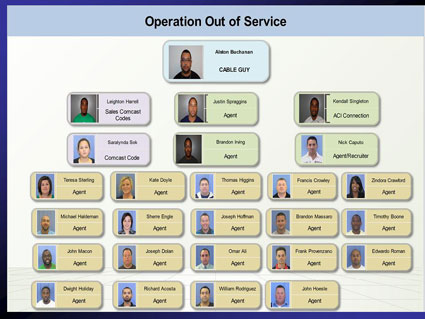
Prosecutors dubbed the busting of the alleged crime ring “Operation Out of Service.” (Image: Montgomery County District Attorney)

Authorities have since learned the scam was run through “a secret computer” installed in a Comcast subcontractor’s office in Upper Moreland. Customers were approached on the street or in area establishments and offered discounted cable service with free premium movie channels in return for $150.

After payment, the alleged perpetrators logged into Comcast’s account management system and activated channels and changed customer records.

Comcast did not catch on until one of their own employees was solicited while she sat in a beautician’s chair. The employee reported it to Comcast’s security department.

Prosecutors have since released many additional sordid details, primarily focused around another Comcast subcontractor, which appears to be the cable company’s latest weak link:

This corrupt organization was headed by Alston Buchanan of Philadelphia, PA (DOB 10/07/1983). Buchanan designed, implemented and controlled the organization that utilized compromised Comcast technician identifications (IDs) to apply promotional discounts onto Comcast customer accounts.  When used legitimately, the IDs allow Comcast personnel to authorize services, such as premium cable channels or other promotions, to new or existing customers.  Buchanan obtained these unique IDs from a number of sources, including from a terminated employee and an employee on disability. In one instance, Buchanan paid a Comcast subcontractor $5,000 in exchange for her user ID.  This arrangement was brokered by Leighton Harrell of Philadelphia, PA (DOB 1/17/1986).

Once Buchanan had the IDs, he could access the billing accounts for Comcast customers and lower their payments and/or provide them with additional services without Comcast’s knowledge. Those involved in the scheme paid various amounts to Buchanan and his agents ranging from $100.00 – $200.00 to manipulate the billing and services of their Comcast accounts.  The investigation determined there were 5,795 accounts affected over the course of a year from April 2011 to April 2012, with a revenue loss to Comcast Cable of $2,401,673. The effected Comcast accounts were located throughout the Delaware Valley with the majority in Montgomery, Philadelphia, Delaware and Bucks counties.
Buchanan was familiar with Comcast’s billing system, because he was employed by Comcast as a dispatcher from May 2007 through March 2008 and as a dispatcher for Advanced Communications, Incorporated (ACI), a Comcast subcontractor, from October 2009 to July 2010.  In 2010, Comcast began investigating an identical scheme of billing manipulation through unauthorized promotions and believed that Buchanan was responsible.

Earlier this year, Comcast learned this same scheme was being perpetrated when a Comcast employee reported the fraudulent use of IDs to obtain services.  An internal investigation by Comcast revealed that Nicholas Caputo of Virginia Beach, VA (DOB 5/28/1981) was soliciting customers to provide one-time payments in exchange for a reduction of their Comcast bills.  Comcast Security, working with ACI, determined that the account manipulations were originating from the ACI Business Services Router located in the local office for ACI in Hatboro, Upper Moreland Township.

On April 9, 2012, ACI searched the data closet where the Business Services Router was stored.  Upon checking the closet, an unauthorized computer tower was discovered secreted in the corner.   This unauthorized computer tower was hardwired to the modem in the data closet which, in turn, was connected to the Business Services Router in the closet.  Accordingly, the hidden computer tower provided unauthorized access into the Comcast billing accounts.  The investigation revealed that the website “LogMeIn” was used to gain remote access to the unauthorized computer tower.  Ultimately, the computers located in Buchanan’s apartment were found to have accessed the “LogMeIn” accounts associated with the hidden computer tower.
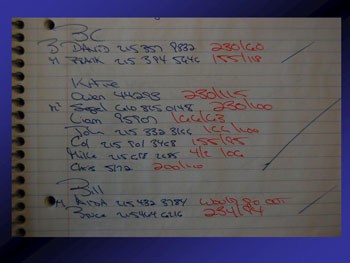
“The Book” the alleged ringleaders wanted destroyed at all costs. (Image: Montgomery County District Attorney)

Comcast’s investigation revealed that Buchanan had an inside connection to ACI through Kendall Singleton of Philadelphia, PA (DOB 7/03/1986), an ACI employee.  On April 9 2012, an unrelated power outage occurred at the ACI office which caused the shutdown of the unauthorized tower.  Knowing that the unauthorized tower would have to be turned-on, Comcast Security installed a hidden camera to monitor the closet.  The next day, Singleton was seen on the camera entering the area of the closet and stooping down in the area of the unauthorized computer tower.  After the computer was re-booted, 96 customer billing accounts were accessed and manipulated within the following hour.

During the course of the investigation, Montgomery County Detectives served search warrants in several locations including the Philadelphia home of Buchanan and Richard Justin Spraggins (DOB 5/22/1983), resulting in the recovery of $103,000.00 cash in an attaché case, computers, cell phones and handwritten ledgers that contained records of the theft scheme, including the agents working for them.  Both Buchanan and Spraggins were in possession of these ledgers.  Analyses of the phones, computers and ledgers revealed the depth and scope of this corrupt organization, and extensive internal communications within the organization pertaining to the illegal scheme.

An investigation into the bank accounts of Buchanan and Spraggins revealed additional evidence of the profitability of the organization’s illegal scheme.  For example, a review of Buchanan’s checking account from December 2010 through April 2012 revealed 748 deposits totaling $221,133.29.  Of these 748 deposits, only 175 were not deposits of $150.00 or increments thereof.  Notably, $150.00 was the usual fee charged for the illegal billing manipulation.

Buchanan, Spraggins, Caputo, Harrell, Irving and Singleton are charged with Corrupt Organizations, Dealing in Proceeds of Unlawful Activity, Criminal Conspiracy, Theft of Services, Theft by Unlawful Taking, Receiving Stolen Property, Unlawful Use of Computer, Computer Theft, Computer Trespass, Criminal Use of Communication Facility and Possessing Instruments of Crime.  Arrest warrants have been issued for more than a dozen others who served as agents in this corrupt organization.

Preliminary hearings are scheduled for September 14, 2012 at 9:30 AM before Magisterial District Judge Jay S. Friedenberg in Willow Grove, Upper Moreland Township.  These cases will be prosecuted by the Captain of the Economic Crimes Team, Assistant District Attorney John F. Walko.

Comcast has obtained a complete list of customers who paid for the discounts or free channels, but does not expect to pursue charges or retroactive payments. The company said it would work with customers to transition them to “authorized packages” in the coming weeks.

[flv width=”640″ height=”380″]http://www.phillipdampier.com/video/KYW Philadelphia Cable TV Conman 8-8-12.mp4[/flv]

KYW in Philadelphia managed to score a short interview with alleged ringleader Alston Buchanan, who called himself a modern day Robin Hood. Of course, Robin Hood didn’t splurge on cars, hookers, and fancy watches, as prosecutors allege members of the cable crime ring did.  (2 minutes)

Search This Site:

Contributions:

Recent Comments:

Your Account:

Stop the Cap!