Home » Contract » Recent Articles:

Rep. Eshoo Reintroducing Wireless Speed Disclosure Bill GOP, Carriers Will Consider DOA

Phillip Dampier January 16, 2013 Broadband Speed, Competition, Data Caps, Public Policy & Gov't, Wireless Broadband Comments Off on Rep. Eshoo Reintroducing Wireless Speed Disclosure Bill GOP, Carriers Will Consider DOA
Eshoo

Eshoo

Rep. Anna Eshoo (D-Calif.), the ranking member on the House Energy and Commerce Communications Subcommittee, will shortly reintroduce legislation that will require wireless companies to disclose more information about the anticipated speeds of their 4G wireless networks.

Eshoo announced her legislative intentions Tuesday at the Broadband Breakfast Club, telling attendees it was important for consumers to know what they are getting before signing a two-year contract.

The anticipated legislation is expected to mirror Eshoo’s 2011 bill — the Next Generation Wireless Disclosure Act (HR 2281), which never made it out of the Republican-dominated House committee.

Eshoo said consumers need clear and concise explanations of data limits, caps, or network management policies that can turn a fast 4G connection into a very slow or expensive one.

Many of the former bill’s supporters echoed carriers use “4G” as a marketing tool which can lead to consumer confusion. Networks ranging from Clearwire’s WiMAX service to T-Mobile’s HSPA+ to Verizon Wireless’ LTE network have all been dubbed “4G,” despite offering widely varying maximum speeds.

Consumers have also faced bill shock when they do not understand their monthly data limits.

Like the last bill, Eshoo’s newest effort is expected to face stiff opposition from wireless carriers and House Republicans, but may raise the temperature on data caps at the Federal Communications Commission, which has faced increasing pressure to become more involved in the issue of usage limits and consumption pricing.

Let The Slashing Begin: Time Warner Cable Cuts Ovation, Current TV

Phillip Dampier January 3, 2013 Consumer News, Video Comments Off on Let The Slashing Begin: Time Warner Cable Cuts Ovation, Current TV

currenttvTime Warner Cable CEO Glenn Britt warned programmers in early December that low-rated cable channels were at risk of being dropped from the second-largest cable operator in the country.

Ovation and Current TV now understand he meant it.

Customers are now being notified that the cable company has dropped both networks. Most customers will never notice the loss — only about 1% of Time Warner customers, around 33,000 nationwide — watched Ovation last month and about as many parked their remotes on Current TV.

Time Warner Cable released a statement explaining escalating programming costs are forcing the company to closely assess each network as it comes due for renewal. The cable company called Ovation one of the worst performing networks on its lineup. It was more abrupt about Current. The company claimed it dropped the network simply because “it was sold.”

Several weeks ago, Britt hinted networks that began offering one type of programming but shifted to another in a bid to win more viewers are especially vulnerable to being dropped. Britt appeared to be thinking about Ovation, which calls itself a cultural fine arts channel but last month devoted 70 percent of its schedule to infomercials, reruns from TV networks that hardly qualify as “fine arts,” and endless repeats of PBS’ ‘Antiques Roadshow.’ For this kind of programming, Time Warner Cable has paid Ovation $10 million over the past several years.
ovation

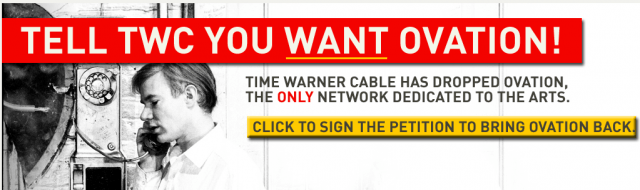
Ovation has gotten 25,000 signatures on its petition drive to try and convince Time Warner Cable to bring the network back to its lineup.

“They’ve had ample opportunity to improve the ratings and the content, and have failed to deliver,” Time Warner said in a statement.

Current TV, which was partly founded by former Vice President Al Gore as a broadcast home for viewer generated content (think YouTube on the airwaves) has always turned in dismal viewership numbers. More recently, the channel has shifted its format, airing a variety of liberal political talk radio and television shows deemed too left-wing for MSNBC, which has helped win the network some additional viewers, but not in every case. Disgraced former New York governor Eliot Spitzer, formerly with CNN, has a TV show on Current he admits doesn’t draw flies.

“Nobody’s watching, but I’m having a great time,” Spitzer said.

twcOn Wednesday, the network announced it was acquired by Qatar-based Al-Jazeera, a kiss of death for most mainstream cable systems that are still unwilling to carry programming from a network the Bush Administration came close to calling ‘with the terrorists.’

Time Warner Cable dropped the network from its lineup the moment the sale was announced.

Current TV intends to gradually rebrand itself as Al Jazeera America, with a 24-hour English language news and information format. Al Jazeera has won respect for its international news coverage, but continues to be saddled with the perception it has a subtle anti-American bias.

But not every network with low viewer numbers is at immediate risk of being placed on Time Warner’s chopping block.

The Kremlin’s subtle hands of influence have kept RT — Russia Today — closely aligned with Vladimir Putin’s policies as relations cool between Moscow and Washington. But that network remains on the Time Warner Cable lineup.

aljazeera

The new owner of Current TV.

One thing all threatened networks have in common is that they are independently owned and operated and are not a part of a much larger network or studio conglomerate. That makes them low-hanging fruit for cable operators to pick off because the owners lack leverage to force renewal.

Fox Business Network, which has continuously turned in abysmal numbers since its inception is a case in point. Despite often having fewer than 15,000 viewers in its target demographic, it safely maintains its place on Time Warner Cable’s lineup because it was included in a carriage agreement deal that bundled the much larger Fox News Channel. As long as Time Warner agrees to contracts that tie the fate of both networks together, Fox Business Network will have a home on the cable system even if nobody watches.

With the writing on the wall, other low-rated networks have responded by easing their hard-line tactics at contract renewal time. The parent owner of IFC and WEtv have agreed to a temporary contract extension as the two networks fight to remain on Time Warner’s lineup. Hallmark TV and Hallmark Movie Channel may be in a similar position soon enough.

[flv width=”640″ height=”380″]http://www.phillipdampier.com/video/Citizens for Access to the Arts Fights to Keep Ovation 12-12.mp4[/flv]


Wireless Carriers’ Dream Come True: The End of the Phone Subsidy; T-Mobile May Start Trend

Phillip Dampier December 11, 2012 Competition, Consumer News, T-Mobile, Wireless Broadband 8 Comments

Riding away with your phone subsidy.

T-Mobile USA has thrown down the gauntlet, announcing it intends to end the kind of phone subsidies that have allowed customers to pick up pricey smartphones like the iPhone for as low as $99, with a two-year contract.

Wireless subsidies have been part of the North American wireless experience for nearly two decades. In an effort to bring new customers on board, carriers wanted the upfront cost to consumers to be as low as possible. Until expensive smartphones arrived, consumers were assured they could get a new, cutting-edge phone at contract renewal time for very little money. Carriers tolerated the subsidy even for existing customers because the difference between the company’s cost and the amount consumers paid wasn’t large enough to negatively affect a carrier’s balance sheet.

Companies gradually earn back the subsidy over the course of a typical two year contract by artificially inflating prices for service plans and add-ons. Because wireless rates have been set with the assumption a customer has received a subsidized phone, it made sense to keep getting new equipment every two years, because customers pay for it on each monthly bill.

In most countries outside of North America, it works very differently. Most customers either pay for a phone outright or agree to finance its purchase through a wireless company, paying monthly installments for smartphones that often cost more than $600. Some companies offer more aggressive discounts if one agrees to a 1-3 year contract, but buyers still cover much of the cost themselves. In return, wireless companies abroad typically charge much lower rates for service and do not force people into lengthy contracts. Customers also find they can switch companies as easily as replacing a SIM card, activating an old phone on a new carrier’s network.

There are pros and cons to the subsidy model:

PROS

  • Consumers get the latest phones at a reduced up-front cost up to every two-years;
  • The subsidy win-back is collected gradually over the course of 24 months;
  • Carriers aggressively compete on huge subsidies for popular phones;
  • The reduced price of a subsidized phone brings reticent consumers into the market;
  • Carriers have increased control over the equipment that is used on their network through price incentives;

CONS

  • The subsidy model gives carriers an incentive to lock discounted phones to their network;
  • Customers pay artificially higher prices for service, whether they take advantage of a subsidized phone offer or not;
  • Consumers don’t realize the true cost of the phones and expect them to cost less than $200 regardless of their retail price;
  • Customers are locked into lengthy contracts with stiff early termination fees to protect the subsidy win-back structure;
  • Without a subsidy, equipment manufacturers would face natural market pressure to cut costs to remain affordable;

Legere

T-Mobile announced last week it was ending its phone subsidy program next year, and customers will be expected to bring their own phone, buy one at an unsubsidized rate, or finance a full price phone with the carrier. In return, customers will get a lower priced T-Mobile calling and data plan.

Some in the tech press are heralding the announcement as a consumer victory and a breakthrough for lower priced service plans. But before throwing the confetti, consider this.

T-Mobile is making customers bring or buy their own phones, but will still lock them into a two year contract with a $200 early termination fee.

T-Mobile’s retention of its contract plans might delineate the postpaid side of its business and its month-to-month, contract-free, prepaid business. But that does not mean much for customers.

John Legere, the new CEO of T-Mobile USA hinted the measure is designed to reduce customer churn — customers coming and going. Locking a customer in place with termination penalties assures shareholders customers are more likely to remain with T-Mobile for the life of their contract.

That represents a win for T-Mobile, but not for customers. Legere explained the benefits to investors:

“[We are going] to have a lower device subsidy obviously and overall value,” Legere told attendees at the Capital Markets Day Conference. “[… because of the] device margin — $200 to $250 — which we do not have to eat. Over a 24-month period [we get] a customer life value that is the difference between $550 on a Classic [traditional subsidy contract] plan and $600 on a Value [no-subsidy] plan.”

In other words, T-Mobile doesn’t have to front a device subsidy, still holds a customer with a two-year contract, and despite the lower-priced service plans, comes out $50 richer when the contract expires.  T-Mobile is essentially admitting it does not return the entire value of its former subsidy back to the customer.

What is more, T-Mobile may pave the way for other carriers to also drop handset subsidies, keep the traditional two-year contract, and only slightly lower prices.

Nothing peeves Wall Street more than the huge subsidy costs carriers pay up front to discount the latest smartphones. Getting rid of subsidies while only mildly adjusting prices could be the next hidden “price increase,” the perfect gift for an investor that demands higher revenue from every customer.

AT&T Once Again America’s Worst Cell Phone Company, Verizon Tumbles Too

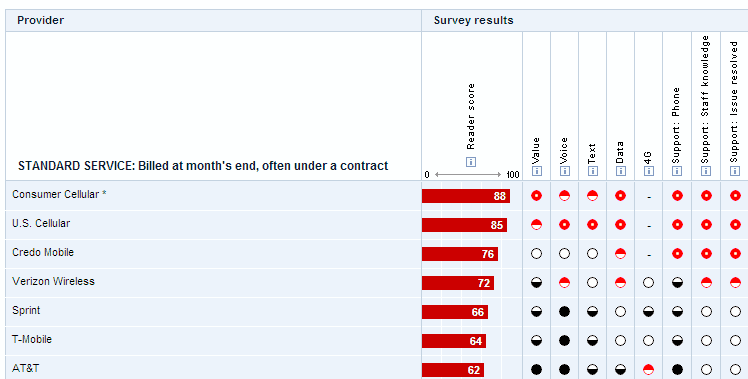
AT&T has once again received the dubious distinction of being America’s worst cell phone company, according to ratings (sub. required) from Consumer Reports.

AT&T’s bottom-of-the-barrel status has become something of an annual tradition in the consumer magazine’s ratings, as the company remains in last place year after year for dreadful performance, poor value, and downright lousy customer service. Its one bright spot: the company’s new 4G LTE service, which gets top marks for speed, although that rating comes before the majority of its customers are on the new network.

Verizon Wireless also took a tumble in the ratings published in the January 2013 issue. Verizon got downgraded for its new Share Everything plan, rated as only a fair value. Verizon’s vaunted customer service also declined significantly.

The highest ratings went to companies many never heard of:

  • Consumer Cellular: This company resells AT&T service. The disparity between this top-rated, no contract provider and AT&T demonstrates that a bad customer experience with AT&T’s high prices and poor customer service can topple your ratings across the board. Consumer Cellular will face the same growing pains AT&T’s customers do in congested cities, but their customers seem to tolerate them better;
  • U.S. Cellular: Top rated last year, this regional carrier provides service in the Pacific Northwest, Midwest, parts of the East and New England. The carrier, like the southern U.S. provider C-Spire, would probably have been acquired by one of the top-four carriers if the Justice Department seemed willing to accept further market consolidation. Its customers benefit from the company’s independence.
  • Credo Mobile: Resells the Sprint network, but delivers superior customer service, which boosts its overall ratings. Formerly known as Working Assets, this progressive organization also enjoys loyalty because customers approve of the political and social causes with which it affiliates.

Overall, the magazine increasingly recommends consumers investigate no-contract or prepaid service plans before signing an expensive 2-year contract with the major four carriers. Pricing changes in 2012 have caused many subscribers to see bills rise, even as perks and benefits continue to erode. Device activation fees, upgrade fees, limits on early upgrades, restricted data plans, and all-or-nothing offerings that deliver (and charge) for features many consumers don’t use much have all reduced the value of contract service.

What keeps most customers coming back to another two-year contract is the chance to grab the hottest new smartphone at a discount. But consumers ultimately pay back whatever they have saved in higher fees over the life of the contract, which may make buying your own device at full price a better value with a no-contract plan.

Community Wins FiOS Fiber Expansion By Offering Verizon Lengthy Franchise Agreement

Phillip Dampier November 26, 2012 Broadband Speed, Competition, Consumer News, Public Policy & Gov't, Verizon Comments Off on Community Wins FiOS Fiber Expansion By Offering Verizon Lengthy Franchise Agreement

Can Verizon be enticed to puts its FiOS trucks back on the road to expansion?

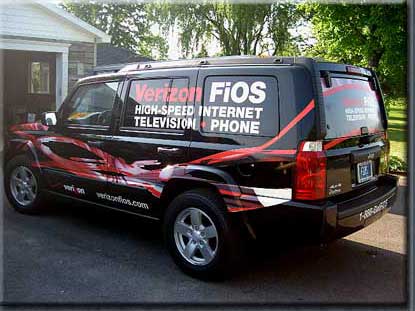
Despite the fact further expansion of Verizon FiOS has been stalled for more than two years as a result of a company directive, local officials in one Massachusetts community won a commitment from Verizon to extend its fiber to the home service to every home and business in return for a lengthy contract renewal.

Just nine months after local officials in Medford, north of Boston, first signed an agreement with Verizon, The Medford Transcript reports the two were back at the negotiating table with an amended agreement to extend Verizon FiOS beyond the 71 percent already served in return for a franchise that will not expire until 2025.

Verizon originally left large sections of West Medford and several neighborhoods scattered around the area without a fiber upgrade.

Verizon regional president Donna Cupelo acknowledged Medford is the only community in the state that has won a second round of FiOS expansion.

Like many cable franchise agreements, Verizon has agreed to contribute towards the operation of the community’s Public, Educational, and Government access channels available to subscribers of both Comcast and Verizon FiOS.

The amended agreement will expire at the same time Comcast’s current franchise agreement ends, giving both providers parity.

Verizon’s agreement to expand its FiOS network under certain conditions may provide the first visible path for other communities with incomplete fiber service to entice Verizon to keep building its fiber network.

Search This Site:

Contributions:

Recent Comments:

Your Account:

Stop the Cap!