Home » Contract » Recent Articles:

Verizon Wireless Quietly Introduces 24-Month Upgrade Policy (No More Early Upgrades)

Phillip Dampier April 23, 2013 Competition, Consumer News, Verizon, Wireless Broadband 1 Comment

The foundation for future profits come from data usage.

Verizon Wireless is continuing its efforts to pull back on customer promotions that lower the price of your next phone. After eliminating discounts for loyal customers renewing their contracts, introducing a $30 “upgrade fee” for each new phone activated on an account, and eliminating one-year contracts, the wireless carrier is ending its 20-month upgrade policy, requiring customers to complete a full two-years of service before they can get their next subsidized phone.

The change was a point of contention on Verizon’s quarterly earnings conference call, as investors fretted about dissatisfied customers already upset that the wireless industry relies on two-year contracts while phone manufacturers release coveted device upgrades at least annually.

The wireless industry is already under pressure from Wall Street, prepaid providers and T-Mobile to abandon the traditional ‘subsidized phone for a two-year contract’-business model in favor of no-contract, carrier-financed phones.

In response to that pressure, Verizon Wireless has also introduced a 12-month optional financing plan targeting early upgraders, those who have lost or damaged their phones, or customers trying to hang on to their grandfathered unlimited data plans.
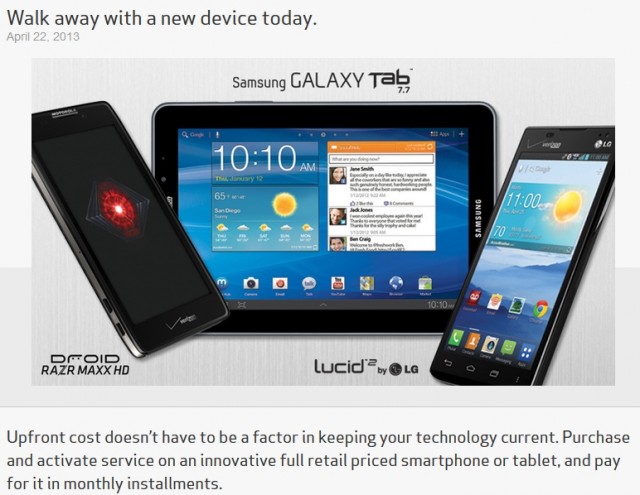
Verizon Wireless introduces its 12-month financing plan for devices.

Verizon Wireless introduces its 12-month financing plan for devices.

Under the plan, credit-qualified customers can finance devices starting at $349.99 for 12 equal installments (and a $2 monthly finance charge) charged to your Verizon Wireless bill (first payment due at time of purchase).

Customers can prepay a portion of their purchase upfront to cut the monthly payment — an important option for premiere smartphones like the Apple iPhone 5 ($650) and the Samsung Galaxy S3 ($600). Finance that iPhone and your Verizon Wireless bill will increase by $56.25 a month, including the finance charge, for the next year. You will still pay Verizon’s regular plan prices, which are artificially inflated to recoup a device subsidy customers are not getting under Verizon’s finance plan.

Verizon Wireless says the total owed balance cannot exceed $1,000 per customer, which makes it less useful for families (and even for those two-person households who want the latest and greatest). There is also a limit of two financed devices at any one time. But customers can pay off the plan balance early, which stops the $2 monthly finance charge and opens the door to finance something else.

Shammo

Shammo

Verizon confirmed customers grandfathered on discontinued unlimited data plans can also take advantage of the financing offer and not lose their unlimited data service. Verizon earlier announced it would allow customers to keep those plans indefinitely, as long as they paid the full price for subsequent device upgrades.

A $30 upgrade fee still applies for each new device activated on your account.

Revenues at Verizon Wireless rose 8.6 percent to $16.7 billion in the last quarter, accounting for more than half of Verizon’s overall revenue. The company has received accolades from Wall Street for implementing its revenue-enhancing Share Everything plans, which have turned into a major money-maker for the wireless carrier, even though only 30 percent of existing Verizon Wireless customers have been enrolled in the new plans to date. Verizon expects to shepherd an increasing number of existing customers to the Share Everything plans in future quarters.

Verizon chief financial officer Fran Shammo said he does not expect much pushback from Verizon Wireless customers upset about the promotional cutbacks.

“We don’t anticipate a lot of dissatisfaction,” Shammo told investors. “We’re not seeing a lot of resistance here.”
AT&T Mobility Adds New “Because We Can” Mobile Administrative Fee in May

att feesAT&T Mobility will add a new “Mobile Administrative Fee” to wireless customer bills beginning this May to defray the costs of doing business.


Broadband Reports notes the new fee amounts to jacking up the cost of service without raising advertised rates.

In most states, the new “Administrative Fee” will amount to $7.32 a year, billed monthly.

AT&T’s website explains the new charge this way:

The Administrative Fee helps defray certain expenses AT&T incurs, including but not limited to: (a) charges AT&T or its agents pay to interconnect with other carriers to deliver calls from AT&T customers to their customers; and (b) charges associated with cell site rents and maintenance.

This is by no means the only “junk fee” AT&T slaps on customer bills that can add up to more than 8.5 percent of your average monthly bill. Among the others:

      • Federal Regulatory Fee
      • Telecommunications Relay Service Recovery Fee
      • Wireless Number Portability and Number Pooling Recovery Fee
      • Enhanced 911 Recovery Fee
      • Wireless Tower Mandates Costs
      • State Area Code Relief Costs
      • Customer Proprietary Network Information Notification Costs
      • Network Outage Reporting Costs
      • State Commission Annual Reporting Costs (Applies only in IN, KY, LA, NM, OH, VA, WI, WV WY)
      • Gross Receipts Surcharge (Missouri only)
      • Puerto Rico Regulatory Fee (Puerto Rico only)
      • Property Tax Surcharge (Puerto Rico only)

Some customers have attempted to break two-year service contracts penalty-free over the addition of new fees, but wireless carriers have made it increasingly difficult to escape, usually because they claim the imposition of new, non-mandated fees do not violate the fine print of their service contract. But complaining customers can usually get carriers to waive the fees as a courtesy. It could not hurt to ask.

Time Warner CEO Earned a Cool $17.4 Million in 2012; Other Execs Also Got Pay Hikes

Phillip Dampier April 9, 2013 Consumer News Comments Off on Time Warner CEO Earned a Cool $17.4 Million in 2012; Other Execs Also Got Pay Hikes
Another happy year for most TWC executives.

Another happy year for most TWC executives.

Time Warner Cable handed CEO Glenn Britt an effective $1 million raise in 2o12, compensating Britt with $17.4 million, up from $16.4 million paid a year earlier. The disclosure came in a statement filed with the Securities and Exchange Commission.

Britt, who is reportedly considering leaving Time Warner at the end of the year, also had his employment contract extended to Dec. 31, 2013.

Some other Time Warner Cable executives also walked home with substantial pay increases this year:

  • Chief operating officer Robert Marcus made $10.1 million, up from $8.4 million last year;
  • Chief technology officer Michael LaJoie took home $2.7 million, up from $2.6 million;
  • General counsel Marc Lawrence-Apfelbaum cashed in $3.3 million in earnings, up from $2.8 million.

Only chief financial officer Irene Esteves saw a pay decrease. She earned $5.5 million this year, down $400,000 from a year earlier.

Is T-Mobile’s No-Contract, Buy Your Own Phone Pricing a Good Deal?

tmobile

T-Mobile has scrapped the traditional two-year cell phone contract.

T-Mobile’s shift away from subsidized smartphones and standard two-year contracts could be a game-changer for American wireless consumers, but does the scrappy carrier have a good deal for you or mostly for itself?

T-Mobile is and has been America’s fourth largest carrier — the smallest among those offering nationwide home coverage. The provider has lost contract customers for years. T-Mobile’s coverage has been less than great in many areas and it often did not offer the latest and most popular smartphones. After its merger effort with AT&T was shot down by the Department of Justice for anti-competitive reasons, T-Mobile has attempted to remake itself by changing the rules under which most of us buy mobile service.

The biggest change of all is the end of the subsidized phone. For years, cell phone companies have offered free or low-cost phones to customers, earning back that subsidy by charging higher monthly rates and locking customers to two-year contracts with early termination fees. T-Mobile will still give you an affordable phone, only now you will pay it off in small installments over a two-year financing agreement.

What difference does this make? Customers who bounce from one two-year contract to the next may not see much difference. But if you keep your phone longer than two years or buy one elsewhere, your monthly rate with T-Mobile will no longer include an artificially higher price designed to recover the phone subsidy you no longer receive.

It also means nothing traps you with T-Mobile. If after six months you find their service unbecoming, you can leave without hundreds of dollars in termination fees. But customers on financing agreements will continue to make their payments for equipment purchases, and those phones will not be unlocked for use on another carrier until the remaining balance is paid off.

data

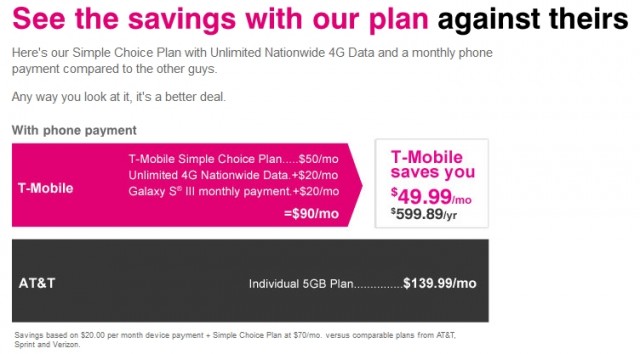
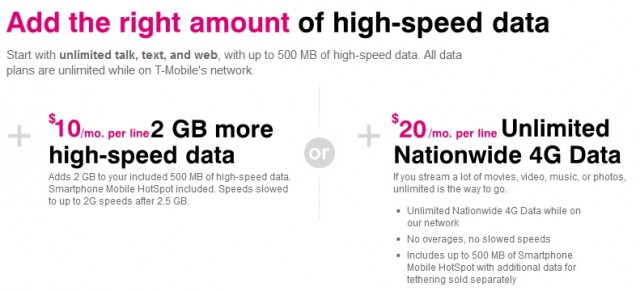
A typical T-Mobile customer looking for the latest iPhone will pay a $100 down payment and then finance the remaining balance, paying $20 a month for 24 months. Your monthly rate will start at $50 a month, which includes unlimited talk and texting, and a 500MB data allowance. If that is insufficient, an extra $10 a month will buy you an extra 2GB of data. If you want unlimited data, that plan is available for an extra $20 a month.

T-Mobile says their plans will save you $1,000 over the life of a two-year contract with AT&T or Verizon. We think they are exaggerating a bit.

Like their competition, T-Mobile is moving away from budget-minded “minute plans” that bundle calling, text and data. Instead, T-Mobile charges at least $50 a month for unlimited talk/text and a small data plan whether you want those features or not.

savings

The Associated Press found that although T-Mobile ends up being the cheapest, the savings over its rivals is closer to $700 on average. The price over two years for a 16-gigabyte iPhone 5 with unlimited calling, unlimited texting and 2.5 gigabytes of data usage per month, excluding taxes, is:

  • T-Mobile: $2,020
  • AT&T/Verizon: $2,635 (2-3GB data plan)
  • Sprint: $2,840 (unlimited data plan included)

Some other things to consider:

  • Once your phone is paid off, your ongoing T-Mobile bill will no longer show a phone subsidy payback built into prices charged by other carriers;
  • You can pay your phone off early, with no penalty;
  • T-Mobile’s 4G network is a mix of HSPA+ and LTE. The more commonly encountered HSPA+ network gets good marks for speed, but a number of densely populated T-Mobile coverage areas surprisingly often default to their older 2G network, which is painfully slow. LTE is only available in about seven cities at the moment, so it is still a rarity;
  • T-Mobile’s unlimited service is free from tricks and traps like soft caps and speed throttles. It also performs better than Sprint’s unlimited service on its overloaded 3G and spotty Clearwire 4G WiMAX network. Sprint’s LTE network is on the way… slowly. It seems to be rolling out first in small cities you have never heard of;
  • T-Mobile’s coverage in rural and exurban areas is frankly terrible. Travelers on main highways may not encounter many signal gaps, but those living in small towns or off the beaten path may get a roaming signal or poor or no reception from T-Mobile’s own towers at all. The frequencies used for its data service also do not work as well indoors as its larger rivals.

[flv width=”640″ height=”380″]http://www.phillipdampier.com/video/T-Mobile Ad 4-2-13.flv[/flv]

T-Mobile channels Oprah in this new ad as the big four wireless cowboys get in touch with their feelings. But only one is ready to don a pink hat and ride off on his own. (1 minute)

FreedomPop Set to Introduce Free 500MB of Data a Month on Sprint’s LTE Network

freedompopFreedomPop, which offers 500MB of free wireless data service a month via Clearwire’s WiMAX service on a range of devices, has a better offer for tablet owners coming in the second half of this year.


The FreedomPop Clip is designed to attach to Wi-Fi only tablets and provides wireless Internet connectivity when away from Wi-Fi. Better still, the service will be free for the first 500MB of usage each month and will support Sprint’s up-and-coming 4G LTE network for faster browsing. The add-on hardware only weighs 2.5 ounces and has its own built-in rechargeable battery estimated to last up to six hours.

Tablets enabled with support for mobile data networks have never sold particularly well because of the added cost and expensive two-year contract required to maintain the service. Instead, some customers tether their tablets or enable an add-on Mobile Hotspot feature on their smartphone, which can cost $30 extra per month. The new FreedomPop Clip does not come with a contract or a monthly fee when users keep browsing to under 500MB each month. The forthcoming device will also support up to eight extra connections, in case you want to share.

Those who want more data, and around 30 percent of FreedomPop’s customers reportedly do, they can buy it on-demand without any contract or commitment. If you bug your friends to also buy the device, you can earn additional free browsing. In fact, FreedomPop will try and encourage sharing by including a new “open Wi-Fi” Internet service on a separate SSID. Those connecting through the open feature will likely get a marketing message encouraging them to get their own FreedomPop device, and their usage won’t count against your allowance.

FreedomPop Clip supports Sprint's up and coming LTE 4G network.

FreedomPop Clip supports Sprint’s up and coming LTE 4G network.

Stop the Cap! has FreedomPop’s $99 iPod Touch add-on device, which works exclusively on Clearwire’s network. We’ve used it for about five months and can report the device works well whether you actually have an iPod or not. It is simply a portable hotspot shaped to clip to the back of the 4th generation iPod Touch (it won’t fit ours). But even if it cannot clip on, it still delivers excellent signals up to 12 feet away from the MP3 player.

Its biggest weakness is Clearwire’s hit or miss network. Here in suburban Rochester, N.Y., Clearwire provides service through a nearby cell tower about a mile away. At home, the device works with fair reception indoors, but really needs to be near a window to perform reliably. Outdoors, the device works much better. We found more trouble trying to use the device in a nearby restaurant and while in downtown Rochester because Clearwire reception proved spotty. When it does work, it provides an average of 800kbps-1Mbps downstream speeds, which is superior to most 3G networks, but does not come close to what Verizon’s LTE network can deliver. But then, FreedomPop data comes free.

Just remember to keep usage at 400MB or less every month. As you approach 500MB of usage, FreedomPop will “conveniently” bill you for additional usage it anticipates you will use unless you remember to shut this auto top-up feature off on FreedomPop’s website control panel. You must also use at least 5MB a month to keep the device active, so remember to power it up at least once a month and do some browsing.

The FreedomPop LTE-capable Clip will also reportedly work with 3G service, according to Forbes. This is an important consideration because Sprint’s 4G LTE network is still in its infancy and not yet available in most major metropolitan areas. But if it relies on Sprint’s overwhelmed 3G network, expect much slower performance.

The selling price for the device itself has not yet been announced, but we expect it will be available later this year at $99 or slightly higher.

Thanks to Stop the Cap! reader Jerry for sending this news tip.

Search This Site:

Contributions:

Recent Comments:

Your Account:

Stop the Cap!