Home » consumer groups » Recent Articles:

Cablevision’s Rate Freeze A Lesson for Cable Operators Trying to Raise Rates

Phillip Dampier March 5, 2012 Cablevision (see Altice USA), Comcast/Xfinity, Consumer News, Editorial & Site News, Public Policy & Gov't Comments Off on Cablevision’s Rate Freeze A Lesson for Cable Operators Trying to Raise Rates

Last week’s shocking development that Cablevision, a major cable operator in greater New York City, New Jersey and Connecticut is not going to raise rates in 2012 is bad news for other cable operators itching to raise rates once again this year.

Cablevision’s decision was made as the company continues to battle Verizon FiOS, the phone company’s fiber-to-home-service across its service area.  Verizon has been playing hardball with Time Warner Cable, Comcast, and Cablevision in its metro New York service area, offering up to $500 in rebates to sign new customers.  That level of vicious competition has been great for consumers, but lousy for Wall Street.

Investors were not pleased with Cablevision’s pass on rate hikes and its intention to invest a lot more in system upgrades than originally planned.  Wall Street loves increased revenue and hates it when companies spend it on their customers.

With all of this competition breaking out, Comcast and Time Warner Cable may be more than a little uncomfortable sitting down at an antitrust hearing later this month to discuss their new agreement with Verizon to cross-market cable and mobile service.  In return for the cable industry signaling they will never compete with Verizon’s mobile phone offering, Verizon has generously purchased the cable industry’s leftover spectrum and agreed to pitch cable TV subscriptions to Verizon Wireless customers.  With this new “non-aggression treaty,” will there still be a need to offer $500 gift cards and cut-rate prices to attract new customers?  Consumer groups think not.

A greater percentage of Cablevision’s service area is served by Verizon’s fiber network than either Time Warner Cable or Comcast.  Competition is forcing Cablevision to rethink the usual cable industry plan for financial success — force channels customers don’t want and raise rates up to 5% a year to pay for the “increased costs of doing business.”  Consumers are fed up with $150 monthly cable bills and will take Verizon up on an offer than cuts rates $50 a month and hands over up to $500 just for saying “yes” to FiOS.

Boxee Goes On Offensive Against Basic Cable Encryption: What a Waste of Money and Energy

Phillip Dampier February 8, 2012 Consumer News, Online Video, Public Policy & Gov't 1 Comment

Boxee, the manufacturer of an Internet-enabled tuner that works like a set top box, has launched an attack against a cable industry plan to encrypt basic cable channels, calling it costly to consumers and the environment:

Amidst flat and declining cable TV subscription numbers, Cable companies are lobbying the FCC to force every cable subscriber to rent cable boxes or cable cards even if they don’t want or need them now.

Currently cable companies must deliver broadcast channels in a way that enables tuners like Boxee Live TV (and the ones in your TV) to display those channels without any extra hardware.

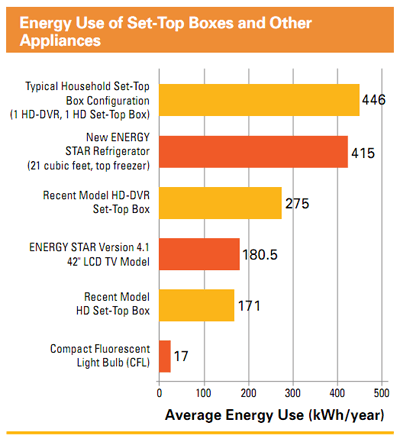
Now the cable companies are asking the FCC to change the rules and turn access off. Their main excuse being that it will reduce the need for the cable guy to drive to your house to disconnect your cable and thus be better for the environment. Considering this ruling would also mean millions more set top boxes and cable cards are manufactured, distributed, and attached to electric outlets (see below for consumption), their argument doesn’t hold water. It’s akin to a cable executive taking a private jet to an FCC meeting, but insisting on having recycled toilet paper on-board to help save the environment.

Boxee

Boxee and other consumer groups oppose the industry’s encryption plan because they say it would deliver no tangible benefits to consumers — just higher cable bills for new equipment that rents for $5-15 a month for each box.  It will also render third-party devices like Boxee, Slingbox, and TiVo almost useless for watching cable television.

Boxee claims cable companies like Time Warner Cable could earn hundreds of millions in new revenue leasing an estimated 10-21 million additional set top boxes to their customers nationwide — more than double the existing number.  Boxee also believes the cable industry is effectively trying stop QAM reception — watching digital cable channels over a television equipped with a basic tuner without a set top box.

Consumers faced with a choice between a cable company-owned set top box or an independent third-party tuner like Boxee may find few reasons to consider the latter when it also requires the former to work properly. The additional equipment also represents an increase in energy consumption.  Set top box electricity consumption can rival major home appliances, Boxee says.

Rural Broadband Stimulus Under Fire, But Is It All Really an AT&T-Sponsored Smoke Screen?

One of the things we have tried to teach readers over the last few years is how important it is to follow the money trail when encountering a group, politician, or researcher counter-intuitively arguing “up is down” or “right is left.”  So when a business columnist in the Press of Atlantic City slammed rural broadband as a service provided “to a group of people who mostly don’t want it,” we started digging:

The FCC claims this effort will give 7 million rural people reliable access to high-speed Internet connections. So the hundreds of millions of urban and suburban Americans who wish their Internet was faster and more reliable will pay for 2 percent of us to get just that.

Or maybe we’ll be paying for redundant, overpriced telecom work by companies that donate to rural politicians.

Federal stimulus spending in response to the recession already included $7.2 billion for this same purpose. An analysis by Navigant Economics of three big projects under that Broadband Initiatives Program found:

Even “areas in which very high proportions of households were already served by multiple existing broadband providers” were eligible for subsidized broadband work.

The author’s suspicion that money was involved in all this was correct, but he completely missed who was boarding the money train.

Navigant Economics, the “research group” that produced the inflammatory report slamming rural broadband funding, happens to count AT&T as one of its important clients.

The group, a subsidiary of Navigant Consulting, provides economic and financial analysis of legal and business issues to law firms, corporations and government agencies.

In fact, Navigant pitches its services to a range of corporate clients:

Navigant Economics provides economic analysis in litigation and regulatory proceedings involving competition issues. Our experts have provided testimony in proceedings before District Courts, the Department of Justice, the Federal Trade Commission, the Federal Communications Commission, the Federal Energy Regulatory Commission, and numerous state Public Utilities Commissions.

We provide economic analysis and testimony in connection with mergers and acquisitions and antitrust claims of:

  • Anticompetitive horizontal agreements (price fixing, bid rigging, potential anticompetitive effects of joint ventures)
  • Unilateral conduct (predatory pricing, refusals to deal, monopolization via patent fraud)
  • Vertical restraints (exclusive dealing, requirement contracting, tying and bundling)

We also offer economic analysis and testimony on issues of price and rate of return regulation, mandatory access, quality of service, and benefit-cost analysis, with especial expertise in regulatory proceedings involving communications and the Internet (software and hardware sectors, network unbundling and “net neutrality” issues affecting telecom and cable firms, retransmission consent and other content-related issues, and the range of wireless spectrum issues) and all types of energy markets.

Phillip "Making Sense, Not Dollars" Dampier

The result is what critics refer to as “dollar a holler research” — bought-and-paid-for-results that coincidentally fit the framework of a client’s public policy agenda.  In this case, AT&T (among other phone companies) has fretted about broadband stimulus funding ever since the Obama Administration made it clear the industry would not collectively control the program or reward themselves at taxpayer expense.  In addition to criticizing the decision-making process, phone and cable companies have objected to numerous applicants who applied for grants to build networks serving communities those companies have ignored or under-served for years.

To say AT&T has no vested interest in the outcome of rural broadband would be the first major understatement of 2012.

Martyn Roetter with MFR Consulting said Navigant was giving a bad name to researchers.

“Navigant Economics as well as other economists in academia and the consulting profession seem increasingly prepared to support arguments in favor of their clients’ desires and goals regardless of whether they are reasonable or preposterous,” Roetter wrote. “Unfortunately this behavior tends to blur the distinction between (a) respectable advocacy with findings based on evidence and rational arguments and (b) indefensible nonsense, discrediting both academics and consultants.”

Navigant spent much of 2011 trying to convince regulators and the public that T-Mobile actually doesn’t compete with AT&T, so there should be no problem letting the two companies merge.  Readers win no prizes guessing who paid for that stunner of a conclusion.  Thankfully, the Department of Justice quickly dismissed that notion as a whole lot of hooey.

Navigant’s second ludicrous conclusion is that there is no rural broadband availability problem.  Navigant has a love affair with slow speed, spotty DSL (sold by AT&T) and heavily-capped 3G wireless (also sold by AT&T) as the Frankincense and Myrrh of rural Internet life.  With those, you don’t need any broadband expansion (particularly from a third party interloper).

“The notion that a nominal maximum speed in a shared radio access network is comparable to a nominal maximum speed of a fixed broadband line to a location is a striking example of ignorance, wilful or otherwise, of the very different operating characteristics and capabilities of these two transmission media,” Roetter soberly observed.

But he knows better.

Roetter

Kevin Post, columnist for the Press of Atlantic City, bought Navigant’s conclusions hook, line, and sinker and repeated them in the press.  In fact, he upped the ante parroting the time-honored provider argument that rural America doesn’t need 21st century broadband because, well, they just don’t want it:

This costly effort is aimed at bringing broadband to a group of people who mostly don’t want it, according to a 2010 Pew Internet survey.

Half of Americans who don’t use the Internet told Pew that the main reason is they don’t find it relevant to their lives.

Only one in 10 nonusers said they would be interested in starting to use the Internet sometime in the future.

Actually, the Pew Internet survey came well before Navigant’s outlandish conclusions, and didn’t directly address the rural broadband availability problem.  Instead, Pew was looking at broadband adoption rates, primarily in places that already have one or more broadband providers.  Pew found what providers have already realized themselves: broadband growth and adoption is slowing; everyone who wants the service in urban America already has it or wants it.  Those that don’t are typically older and lack computers or are too poor to afford the asking price.

Post’s suggestion that a Pew Study concluded rural America does not want broadband service is an exercise in fixing the facts.

That’s the magic of the Dollar-a-Holler Echo Machine.  Big telecom companies hire public policy consultants and researchers to find their way to “scientific” evidence proving their corporate agenda, and then feeds the “facts” and “research” to receptive reporters, astroturf “consumer groups,” and politicians to bolster their case.  It’s not AT&T suggesting there is no rural broadband problem — it’s Navigant Economics.

As Roetter writes, “A basic knowledge of wireless markets exposes the […] indefensible nature of the positions outlined above. A policy based on ‘tell me what you want to hear, pay me, and I will reproduce it all regardless of its merits’ is a disservice to professionals who try to remain objective and independent, i.e. professional.”

The Wall Street Journal’s Revisionist History: AT&T Isn’t the Problem, the Government Is?

Phillip Dampier December 8, 2011 Astroturf, AT&T, Competition, Editorial & Site News, HissyFitWatch, History, Public Policy & Gov't, Rural Broadband, T-Mobile, Wireless Broadband Comments Off on The Wall Street Journal’s Revisionist History: AT&T Isn’t the Problem, the Government Is?

Haven't we been here before?

History is best ignored when a Wall Street Journal columnist frames an argument in favor of strengthening the hegemony of Ma Bell, and darn ‘ole past precedent gets in the way of the writer’s “facts.”

Gordon Crovitz is a media and information industry adviser and executive, including former publisher of The Wall Street Journal, executive vice president of Dow Jones and president of its Consumer Media Group.  But today he’s unofficially, unabashedly AT&T.

In a column published this week, Crovitz hosts a whine and cheese festival on behalf of poor and abused AT&T, whose multi-billion dollar takeover of T-Mobile is in tatters. Crovitz places the blame squarely on the government for ruining everything:

How soon we forget the risks of overregulation: Last week, the Federal Communications Commission flexed the same muscle it once used to quash market forces in the phone industry to quash market forces in the wireless industry.

Today’s AT&T, a spinoff from the original, needs more spectrum to catch up with market leader Verizon, also a Ma Bell descendant, to support iPhones, Androids and other devices that feature video and sophisticated apps. It wants to buy T-Mobile, a division of a German company, which doesn’t have the resources to compete in the United States on its own. But the FCC decided to apply antitrust theory from the industrial era and claims to know better than wireless companies how they should operate their businesses.

AT&T’s proposed acquisition is best understood as a private-sector solution to a government-created problem. The FCC has not been able to get Congress to approve auctions to reallocate spectrum to wireless from less valuable uses. AT&T wants T-Mobile’s bandwidth so it can extend the latest fourth-generation network to 97% of the country from 80% and improve its spotty service in congested areas.

Under laws dating to the 1920s, the FCC gets to decide if a merger is in the “public interest,” a vague standard for top-down decision making. Government is the last institution in this era of fast technological innovation to act as if it has the information and power to dictate how change happens.
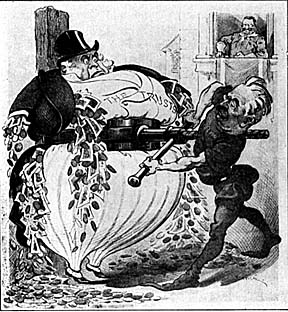
Crovitz apparently prefers AT&T and its phone pal Verizon Wireless dictate how “change happens,” because the two companies control the vast majority of wireless telecommunications in the United States.  Both also charge near-identical prices for near-identical levels of service.  AT&T & VZW are completely comfortable with that status quo, especially if disruptive competitor T-Mobile is dealt with in the usual industry manner (merger/buyout).

There is nothing vague about the FCC report that condemns the merger of AT&T and T-Mobile for the anti-competitive monstrosity it represents.  In hundreds of pages Crovitz evidently never read, a careful and credible argument against the deal was laid out for all to examine.  That evidence is far more persuasive than AT&T’s heavily-redacted filings the public was not authorized to see (for ‘competitive reasons’), and a multi-million-dollar-a-holler public relations distortion strategy based on hollow promises.

Playing Catch-Up With Verizon Wireless?  Hardly.

AT&T hardly needs to “catch up” with Verizon Wireless.  Both companies own wireless spectrum they have warehoused for “future use.”  As a backdrop to the merger, FCC Chairman Julius Genachowski has already indicated the agency is hard at work carefully re-allocating spectrum to make more room for wireless services.  The “bandwidth crisis” AT&T talks about is a convenient argument for a merger, until you realize T-Mobile’s mostly-urban wireless network won’t help AT&T achieve its goal of rural wireless expansion.  T-Mobile has never provided service in rural America and never will.

Crovitz attempts to leverage Verizon Wireless’ recent deal with America’s largest cable companies as an argument for the AT&T and T-Mobile merger, suggesting that deal was a game changer.  What goes unsaid is the fact AT&T could have pursued that deal for themselves.  Did they?  No.  Despite AT&T’s public relations spin, the proposed merger with T-Mobile is much more than a spectrum acquisition. As the FCC and the Justice Department have argued, this merger is about ridding AT&T of a competitor willing to offer more services at lower prices.  That forces AT&T to respond in kind to compete, and consumers have benefited greatly from that competition. Verizon Wireless is hardly competition at all considering both companies price services nearly identically.  Beyond that is Sprint, already saddled with the financial albatross Clearwire and questions about its long term viability in a duopolistic wireless market.

Crovitz is wrong on his other “facts” as well:

Deutsche Telekom is hardly short on cash.  The company has plenty of resources and could bolster T-Mobile USA to compete if it saw fit.  It doesn’t, preferring to focus on its more lucrative European markets.  Instead of selling the operation on the open market to other players, which could include foreign providers interested in competing in the high-priced American market, it elected to be courted by AT&T.

Overconfident AT&T
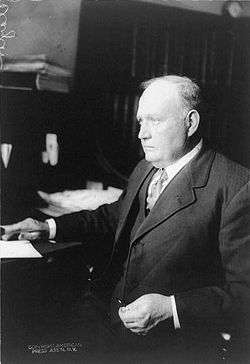
Henry De Lamar Clayton, Jr.: Author of the Clayton Act

The merger illustrates AT&T’s unparalleled level of overconfidence it could deal with regulators and consumer groups who would certainly object to the deal.  The company has since spent millions it could have used to improve its network on campaign-contribution-fueled support building on Capitol Hill, a shameless dollar-a-holler astroturf campaign that pays off non-profit groups to sing the deal’s praises, and an expensive ad campaign to sucker Americans into thinking reduced competition will somehow deliver lower prices and better service.

Even former Republican FCC Chairman Kevin Martin would have likely paused over such an obvious monopoly-building operation.  The Obama Administration’s FCC chairman — Julius Genachowski —  while often too timid for our tastes, at least knows when it is time to join the chorus of opposition.

The FCC doesn’t pretend to tell AT&T how to run its business.  It does, however, serve the public interest by providing checks and balances to unfettered corporate power.  While the Wall Street Journal‘s world view of capitalism would have been favored by the most egregious robber barons, history has taught us that when big corporations get a stranglehold on vital industries, the entire economy can suffer.

Crovitz would have us ignore the massive corporate abuses of 100 years ago that eventually provoked Congress into trust-busting legislative reform, breaking up the monopolies and oligopolies that presided over the railways, early telecommunications networks, and industrial raw materials like oil and steel.  Restrained competition brought monopoly prices and blockades against would-be competitors.  What was true then is still true now, only the technology has changed.

In 1911, the economy was powered in part by railroads, which transported goods and raw materials.  Telecommunications networks like the telegraph and early telephone helped conduct business and coordinated the movement of goods.  In 2011’s growing digital economy, telecommunications increasingly represents the railroads, telegraph, and telephone all combined-into-one.  Some of America’s richest tech companies depend on broadband and communications to fuel demand for their products.  Allowing AT&T to control the largest part of that pipeline could be disastrous to everyone but that company and their shareholders.

History Repeats Itself

In 1914, the Clayton Act was passed to put a stop to increasing anti-competitive activity and abusive market tactics.  Amazingly, the problems being solved a century ago are back with a vengeance today, all thanks to the endless drumbeat for deregulation, which has fueled mergers, acquisitions, and increased concentration of market power.  That Act cracked down on:

  • Price discrimination: selling products and services at different prices to similarly situated buyers;
  • Tying and exclusive-dealing contracts: sales on condition that the buyer sign exclusive contracts that force an end to dealing with the seller’s competitors;
  • Corporate mergers: acquisitions of competing companies to reduce competition; and
  • Interlocking directorates: Boards of directors of competing companies, packed with common members.
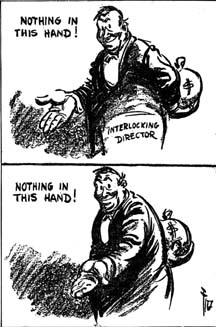
Today’s laissez-faire attitude towards government checks and balances helped provoke the Great Recession, corporate scandals of epic proportions, and a revolving door in Washington where regulators end up working for the companies they used to regulate. Just ask former FCC chairman Michael Powell. Three years ago he worked for us.  Today he works for Big Cable’s largest lobbying group — the National Cable & Telecommunications Association.  FCC Commissioner Meredith Attwell Baker went to work for Comcast shortly after green-lighting their super-merger with NBC-Universal.

It’s All About the Money. Always.

The only thing stopping AT&T from providing wireless nirvana to rural America is its own unwillingness to spend money on behalf of customers to upgrade its network.  The company claims it didn’t see the value of spending nearly $4 billion needed to deliver expansive 4G service, but suddenly had no trouble at all finding nearly ten times that amount to purchase T-Mobile USA.

Did AT&T suddenly win PowerBall?

AT&T saw crushing a competitor Job #1.  Central Idaho’s 4G service could wait.

Crovitz later notes AT&T “was unusually blunt” criticizing the FCC report, a classic case of protesting too much.  The company got caught with its rhetorical pants down, with a series of evolving arguments for a deal that never made the first bit of sense once you began to dig deeper into their case.

In the end, Mr. Crovitz wants you to blame Big Government for AT&T’s pervasive dropped-call problem that its competitors don’t seem to have.

It’s not the company that owns and runs the network, it is that Obama and his nasty henchmen at the FCC who are responsible!  Who knew?

[flv width=”360″ height=”290″]http://www.phillipdampier.com/video/Bloomberg FCC Says ATT Failed to Show Public Benefit of Merger 11-30-11.mp4[/flv]

Bloomberg News reports the FCC found AT&T failed to demonstrate any real public benefit of its merger with T-Mobile USA.  (2 minutes)

The Consumer’s Guide to Universal Service Fund Reform: You Pay More and Get Inadequate DSL

Phillip Dampier November 1, 2011 Broadband Speed, Competition, Consumer News, Editorial & Site News, Public Policy & Gov't, Rural Broadband, Video, Wireless Broadband Comments Off on The Consumer’s Guide to Universal Service Fund Reform: You Pay More and Get Inadequate DSL

Phillip Dampier on USF Reform: It might have been great, it could have been a lot worse, but ultimately it turned out to be not very good.

Last week, the Federal Communications Commission unveiled their grand plan to reform the Universal Service Fund, a program originally designed to subsidize voice telephone service in rural areas deemed to be unprofitable or ridiculously expensive to serve.  Every American with a phone line pays into the fund through a surcharge found on phone bills. Urban Americans effectively subsidize their rural cousins, but the resulting access to telecommunications services have helped rural economies, important industries, and the jobs they bring in agriculture, cattle, resource extraction, and manufacturing.

The era of the voice landline is increasingly over, however, and the original goals of the USF have “evolved” to fund some not-so-rural projects including cell phone service for schools, wireless broadband in Hollywood, and a whole mess of projects critics call waste, fraud, and abuse.  For the last several years, USF critics have accused the program of straying far from its core mission, especially considering the costs passed on to ratepayers.  What originally began as a 5% USF surcharge is today higher than 15%, funding new projects even as Americans increasingly disconnect their landline service.

For at least a decade, proposals to reform the USF program to bridge the next urban-rural divide, namely broadband, have been available for consideration.  Most have been lobbied right off the table by independent rural phone companies who are at risk of failure without the security of the existing subsidy system.  Proposals that survived that challenge next faced larger phone company lobbyists seeking to protect their share of USF money, or by would-be competitors like the wireless industry or cable operators who have generally been barred from the USF Money Party.

This year, FCC Chairman Julius Genachowski finally achieved a unanimous vote to shift USF funding towards the construction and operation of rural broadband networks.  The need for broadband funding in rural areas is acute.  Most commercial providers will candidly admit they have already wired the areas deemed sufficiently profitable to earn a return on the initial investment required to provide the service.  The areas remaining without service are unlikely to get it anytime soon because they are especially rural, have expensive and difficult climate or terrain challenges to overcome, or endure a high rate of poverty among would-be customers, unable to afford the monthly cost for the service.  Some smaller independent phone companies are attempting to provide the service anyway, but too often the result is exceptionally slow speed service at a very high cost.

The new Connect America Fund will shift $4.5 billion annually towards rural broadband construction projects.  Nearly a billion dollars of that will be reserved in a “mobility fund” designated for mobile broadband networks.

The goal is to bring broadband to seven million additional households out the 18 million currently ignored by phone and cable operators.

The FCC believes AT&T will take a new interest in upgrading its rural landline networks, even as the company continues to lobby for the right to abandon them.

Unfortunately, the FCC has set the bar pretty low in its requirements for USF funding.  The FCC defines the minimum level of “broadband” they expect to result from the program — 4/1Mbps.  That’s DSL speed territory and that is no accident.  The phone companies have advocated a “less is more” strategy in broadband speed for years, arguing they can reach more rural customers if speed requirements are kept as low as possible.  DSL networks are distance sensitive.  The faster the minimum speed, the more investment phone companies need to make to reduce the length of copper wiring between their office and the customer.  Arguing 4Mbps is better than nothing has gotten them a long way in Washington, but it also foreshadows the next digital divide — urban/rural broadband speed disparity.  While large cities enjoy speeds of 50Mbps or more, rural towns will still be coping with speeds “up to” 4Mbps.

The FCC does not seem too worried, relying heavily on a mild incentive program to prod providers to upgrade their DSL service to speeds of 6/1.5Mbps.

The irony of asking AT&T to invest in an aging landline network they are lobbying to win the right to abandon is lost on Washington, and future speed upgrades for rural America from companies like Verizon are in serious doubt when they sell off their rural areas to companies like FairPoint and Frontier and leave town.

Critics of USF reform suggest the program is still stacked in favor of the phone companies, and considering the state of their copper wire networks, would-be competitors are scratching their heads.

The cable industry, in particular, is still peeved by reforms they feel leave them at a disadvantage.  Of course, Washington may simply be recognizing the fact cable companies are the least likely to wire rural America, but when they do, the service that results is often faster than what the phone company offers.  The nation’s biggest cable lobbyist — ironically also the former chairman of the FCC, Michael Powell — still feels a little abused after reading the final proposal.

“While we are disappointed in the Commission’s apparent decision to ignore its longstanding principle of competitive neutrality and provide incumbent telephone companies an unwarranted advantage for broadband support,” said National Cable & Telecommunications Association President Michael Powell, “we remain hopeful that the order otherwise reflects the pro-consumer principles of fiscal discipline and technological neutrality that will bring needed accountability and greater efficiency to the existing subsidy system.  We are particularly heartened by the Commission’s efforts to ensure that carriers are fairly compensated for completing VoIP calls.”

Wireless operators are not happy either, because the arcane requirements that come with the USF bureaucracy were written with the phone companies in mind, not them.  Small, family-owned providers find it particularly difficult to do business with the USF, if only because they don’t have the staff or time to navigate through endless documents and forms.  Phone companies do.

Your phone bill is going up.

Many consumer groups are relieved because it could have been much worse.   The FCC could have simply capitulated and adopted the phone companies’ wish-list — the ABC Plan.  Thankfully, they didn’t, but the FCC has naively left the door open to substantial rate increases for consumers by not capping the maximum annual outlay of the fund.  That follows the same recipe that invited higher phone bills and questionable subsidies awarded in an effort to justify the original USF program even after it accomplished most of its goals. Consumers may face initial rate increases of $0.50 almost immediately, and up to $2.50 a month five years from now.

The FCC, unjustifiably optimistic, suspects phone companies and other telecommunications interests won’t gouge customers with higher prices.  They predict rate increases of no more than 10-15 cents a month.  I wouldn’t take that bet and neither will consumer groups.

“We’re going to press the FCC to ensure that these are temporary increases, because history has shown that these types of costs tend to stick around and go on and on and on,” said Parul Desai, policy counsel for Consumers Union.

An even bigger question left unanswered is just how far the FCC will get into the broadband arena when it refuses to take the steps necessary to ensure it has an admission ticket.  The agency has avoided classifying broadband as a telecommunications service, an important distinction that would bolster its authority to oversee the industry.  Without it, some members of Congress, and more importantly the courts, have questioned whether the FCC has any business in the broadband business.  Just one of the many high-powered players in the discussion could test that theory in the courts, and should a judge throw the FCC’s plan out, we’ll be back at square one.

[flv]http://www.phillipdampier.com/video/C-SPAN Tom Tauke from Verizon on Changes to the Universal Service Fund 10-29-11.flv[/flv]

Verizon’s chief lobbyist Tom Tauke spent a half hour last weekend on C-SPAN taking questions about USF reform and the side issues of IP Interconnection and Net Neutrality policies. Tauke supports consolidation of small phone companies into fewer, larger companies.  He also expands on his company’s lawsuit against Net Neutrality, which fortuitously (for Verizon) will he heard by the same D.C. Court of Appeals that threw out the FCC’s fines against Comcast for throttling broadband connections.  Politico’s Kim Hart participates in the questioning, which also covered wireless spectrum issues impacting Verizon Wireless, AT&T’s stumbling merger deal with T-Mobile, and Verizon’s latest lawsuit against the FCC for data roaming notification rules.  (28 minutes)

Search This Site:

Contributions:

Recent Comments:

Your Account:

Stop the Cap!