Home » Cell site » Recent Articles:

Cell Phone Service Fails Tornado Victims in Moore, Okla.; Landlines Still Working in Many Areas

Phillip Dampier May 20, 2013 AT&T, Consumer News, Video, Wireless Broadband Comments Off on Cell Phone Service Fails Tornado Victims in Moore, Okla.; Landlines Still Working in Many Areas
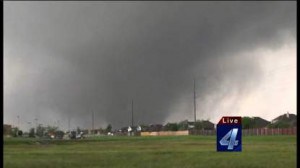
KFOR-TV in Oklahoma City captured this image of the destructive tornado that flattened parts of Moore, Okla.

KFOR-TV in Oklahoma City captured this image of the destructive tornado that flattened parts of Moore, Okla.

Widespread cell phone outages and overcongested wireless networks are hampering efforts to find missing loved ones or call for help in areas hard-hit by this afternoon’s devastating tornado affecting Moore, Okla., a suburb of Oklahoma City. But in many areas escaping the worst of the storm, landline service is performing normally.

“We have no coverage and no signal from any cell phone provider in this part of Moore, despite the fact we escaped the tornado with no damage,” reports Susan Ramos, who was staying in Moore to deal with a family emergency. “We have borrowed a nearby neighbor’s home phone which is still working fine. My relatives back home in Texas have been worried sick not hearing from us that we are okay.”

One of the first victims of the tornado touchdown were communications towers, some damaged by the wind, others now missing a wired connection back to the network provider. Many of those still in service are overloaded with callers. Some cell towers are performing double or triple duty, handling calls from neighborhoods that would have been ordinarily served by other towers no longer functioning. The result is a cell network clogged with calls, making it next to impossible to reach storm-affected areas.

Some residents are traveling by foot or vehicle on debris-cluttered roadways looking for a cell tower that can still handle calls.

Oklahoma City media reports AT&T is asking residents to refrain from making or receiving wireless voice calls. Instead, the company is asking cell customers to only use text messaging until further notice.

Although landline infrastructure was also destroyed in and around the direct path of the tornado, adjacent areas still have service, including areas where cell phone service has failed.

no service

“Finding pay phones in this area is not easy, and I don’t know Moore too well and many businesses closed down early after the storm, so we are grateful to a nearby neighbor we don’t even know who kept their phone service and let us use it.” Ramos added. “Now we know canceling our own wired home phone was probably a mistake after seeing what happens in emergencies.”

Cell phone providers are coordinating to transport portable cell towers into Moore and other affected areas within the next day or so if normal cell service cannot be quickly restored. But for residents desperate to communicate, the failure of the local cell phone network, either because of storm damage or insufficient capacity, has proved frustrating.

[flv width=”596″ height=”356″]http://www.phillipdampier.com/video/NBC News Moore Residents Cell Phone Service 5-20-13.flv[/flv]

NBC News talks with storm survivors frustrated by the lack of cell phone service in Moore, Okla.  (2 minutes)

The Phony Wireless Bandwidth Crisis: Two-Faced Data Flood Warnings

two faced wireless

Wireless Industry: We’re running out of spectrum!
Wireless Industry: We’ve got plenty to room for unlimited ESPN!

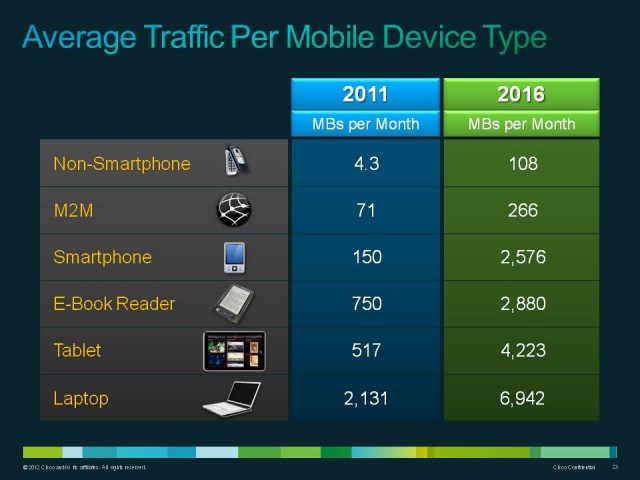
America is on the verge of a wireless traffic data jam so bad, it could bring America to its knees.

Or not.

Stop the Cap! notices with some interest that while wireless carriers continue to sound the alarm about a spectrum crisis so serious it necessitates further compressing the UHF television dial and forces other spectrum users to become closer neighbors, the same giant phone companies warning of impending doom are negotiating with online video producers to offer customers “toll-free,” all-you-cat-eat streaming video of major sports events that won’t count against your usage allowance.

ESPN is in talks with at least one major carrier (AT&T or Verizon Wireless) to subsidize some of the costs of its streamed video content so that customers can watch as much as they want without running into a provider’s usage limit. Both Verizon and AT&T have signaled their interest in allowing content producers to pay for subscribers’ data usage. In fact, they don’t seem to care who pays for the enormous bandwidth consumed by streaming video, so long as someone does.

At a recent investment bank conference Verizon Wireless chief executive Dan Mead explained the next chapter in monetizing data usage will allow the company to rake in more revenue from third parties instead of customers already struggling with high wireless bills.

“We are actively exploring those opportunities and looking at every way to bring value to our customers,” said Mead.

Content producers are increasingly frustrated with the stingy caps on offer at AT&T and Verizon Wireless because customers stop accessing that content once they near their monthly usage limit. One large provider admitted to ESPN that “significant numbers” of customers are already reaching their cap before the end of their billing cycle, after which their online usage plummets to limit the sting of overlimit charges.

Offering “toll-free” data could dramatically increase the use of high bandwidth applications and increase profits at wireless providers based on new fees they could collect from content producers. Customers would still be subject to usage limits for all non-preferred content, a clear violation of Net Neutrality principles.

The buffet is open.

The buffet is open.

But in case you forgot, wireless carriers won exemption from Net Neutrality, arguing their networks lack the capacity to sustain a Net Neutral Internet experience. These same companies claim without more frequencies to handle the massive, potentially unsustainable amount of wireless traffic, the wireless data apocalypse could be at hand in just a few years. It was also the most-cited reason AT&T and Verizon discontinued their unlimited use data plans.

But unlimiting ESPN video? No problem.

In January 2010, Verizon Wireless was singing a very different tune to the FCC about the need to control and manage high bandwidth applications like the “toll-free” streaming video service ESPN proposes (underlining ours):

Wireless broadband services face technological and operational constraints arising from the need to manage spectrum sharing by a dynamically varying number of mobile users at any time. Thus, unlike, for example, cable broadband networks, where a known and relatively fixed number of subscribers share capacity in a given area, the capacity demand at any given cell site is much more variable as the number and mix of subscribers constantly change in sometimes highly unpredictable ways.

Are wireless carriers now part of the problem?

Are wireless carriers now part of the problem?

For example, as a subscriber using a high-bandwidth application such as streaming video moves from range of one cell site to another, the network must immediately provide the needed capacity for that subscriber, while not disrupting other subscribers using that same cell site. Of course, the problem is magnified many times over as multiple subscribers can be moving in and out of range of a cell site at any given moment. Moreover, the available bandwidth can fluctuate due to variations in radio frequency signal strength and quality, which can be affected by changing factors such as weather, traffic, speed, and the nearby presence of interfering devices (e.g., wireless microphones).

These problems compound those resulting from limited spectrum. As the Commission has repeatedly recognized in proclaiming an upcoming spectrum crisis, “as wireless is increasingly used as a platform for broadband communications services, the demand for spectrum bandwidth will likely continue to increase significantly, and spectrum availability may become critical to ensuring further innovation.”

A wireless carrier cannot readily increase capacity once it has exhausted its spectrum capacity. Thus, wireless broadband providers are left to acquire additional spectrum (to the extent available) or take measures that use their existing spectrum as efficiently as possible, which they do through a combination of investing in additional cell sites and network management practices that optimize network usage and address congestion so as to provide consumers with the quality of service they expect.

Regulators need to ask why wireless companies are telling the FCC there is a bandwidth crisis of epic proportions that requires the Commission to exempt them from important Net Neutrality principles while telling investment banks, shareholders and content producers the more traffic the merrier, as long as someone pays. Customers also might ask why their unlimited use data plans were discontinued while carriers seek deals to allow unlimited viewing with their preferred content partners.

What is the real motivation? The Wall Street Journal suggests one:

“Creating a second revenue stream for mobile broadband is the holy grail for wireless operators but collecting fees from content companies would probably make the FCC take a close look into the policy implications,” said Paul Gallant, managing director at Guggenheim Securities. An FCC spokesman declined to comment.

[flv width=”512″ height=”308″]http://www.phillipdampier.com/video/WSJ ESPN Toll Free Data 5-9-13.flv[/flv]

The Wall Street Journal takes a closer look at a plan to manage an end run around Net Neutrality by allowing preferred content partners to offer streaming video services exempt from your usage cap. (4 minutes)

AT&T Approved to Install Distributed Antenna System ‘Mini-Cell’ Antennas In Palo Alto

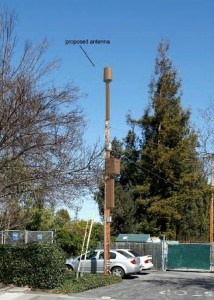
AT&T's proposed DAS antenna

AT&T’s proposed DAS antenna

AT&T’s ambitious plans to fill in cellular coverage gaps with smaller cellular antennas won approval in Palo Alto, Calif. last week, despite protests from residents who live adjacent to one of the 75 future antenna sites.

AT&T’s new Distributed Antenna System (DAS) is designed to cover reception gaps and cope with congestion-related issues in urban and residential areas. The new antennas will be mounted on top of existing utility poles, extending their height approximately nine feet.

AT&T said the new DAS system was necessary in Palo Alto because of the city’s unique topography and building density. The company hopes the lower profile antennas, designed for neighborhood-wide coverage, will also reduce traffic on its existing cellular network. AT&T expects to install one DAS antenna every 1/4 to 1/3 of a mile.

The new antennas will be serviced from a cabinet mounted on the pole or sidewalk-based concrete pad. This cabinet houses a fiber connection from AT&T’s U-verse network as well as power and monitoring systems necessary to operate the antenna.

AT&T earlier announced it intended to deploy smaller, more-localized cell sites to bolster coverage and network capacity. Many of these antennas will be located in residential and suburban areas that have traditionally rejected large cell towers.

Although the antennas are designed to be fitted to pre-existing utility poles, some residents object to their additional height, which can bring them into view above nearby buildings and trees.

Dorianne and Roy Moss will have one of the antennas as a new neighbor, and they don’t like it.

“When I open my eyes in the morning I see a tree line,” Dorianne Moss said. “The current proposal would be to put a box 9 feet above that.”

attLocal residents want AT&T to consider shielding certain antennas from public view and AT&T insists it took residents’ complaints into account.


Paul Albritton, AT&T’s counsel, told Palo Alto city officials the company chose locations away from block corners and close to foliage.

Residents in other cities may find AT&T seeking to install similar antennas in the coming year.

95% of Vermont Has Access to Broadband; 100% May Have It in 2013

VTA_logoAt least 95 percent of Vermont residents will have access to broadband by the end of today, because of a combination of private investment, public funding, and innovative service solutions for some of the state’s most rural areas.

State officials say 2012 was an important year for broadband availability in Vermont, as dominant phone company FairPoint Communications made inroads in expanding its DSL service in areas that never had access before.

In 2011, Governor Shumlin set an ambitious goal to see 100 percent of Vermont covered by broadband by the end of 2013, and the state appears on track to achieve that target in the coming year.

[flv width=”640″ height=”380″]http://www.phillipdampier.com/video/Ask The Governor Broadband 2-3-11.flv[/flv]

Gov. Shumlin answered questions from state residents regarding his plan to see 100% broadband coverage in Vermont by the end of 2013. (Feb. 3 2011) (3 minutes)

Vermont’s small size would seem to make it an easy target for total broadband coverage, but significant rural areas have made it unprofitable for commercial phone and cable companies to make inroads.

Comcast, the state’s largest cable operator, has not grown much geographically over the past five years. FairPoint, which took control of much of the state’s landline network from Verizon in 2008, has been compelled to achieve broadband expansion as part of an agreement that approved the sale.

logo-broadbandVTKaren Marshall, who heads a state effort to expand both cell phone and broadband access in Vermont says the remaining areas without coverage will be a difficult challenge, but one that can be achieved with the help of private and public investment.

“The last 5 percent are the needle in the haystack,” Marshall told Vermont Public Radio. “They are the most far-flung, probably the most expensive and sometimes even the most physically challenging to get to.”

Wireless is often the most cost-effective solution, both for broadband and cell expansion, and Marshall suggested Vermont would use microcell technology along Vermont’s rural roadways.

“I think we will be one of the first places in the country that is deploying microcell technology for example, on the top of telephone poles or utility poles, kind of like a daisy chain,” Marshall said.

The rural Vermont Telephone Company won a $5 million state grant to cover Vermont’s southernmost counties with a combination of wireless phone and broadband service.

While areas of rural Vermont will likely have broadband access for the first time, improvements have also been available to those who already have the service.

Marshall estimated the average broadband speed in the state has increased from 5.5 to 9.7Mbps, which is above the national average.

Vermont Public Radio surveys how the state is doing meeting Gov. Shumlin’s goal to see broadband service available to every Vermonter. (December 28, 2012) (2 minutes)
You must remain on this page to hear the clip, or you can download the clip and listen later.

Sandy Exposes the Soft Underbelly of Wireless; Inadequate Storm Preparation Faulted

Phillip Dampier November 26, 2012 AT&T, Consumer News, Editorial & Site News, Public Policy & Gov't, Rural Broadband, Sprint, T-Mobile, Verizon, Wireless Broadband Comments Off on Sandy Exposes the Soft Underbelly of Wireless; Inadequate Storm Preparation Faulted

Phillip “Do you want to depend on AT&T for phone service that could be gone with the wind for weeks?” Dampier

Superstorm Sandy is getting credit for exposing the thin veneer of the “wireless future” some phone companies want to give their most rural customers after disconnecting their home phone lines in favor of wireless service.

Unfortunately for the providers selling you on the wireless revolution, reality intruded last month when Category 1 Hurricane Sandy arrived. In its wake, the storm obliterated a significant amount of wireless phone service for weeks in some of the most urbanized sections of the country, while leaving underground, traditional wired phone service largely untouched.

The storm that blew into the northeastern U.S. Oct. 29 left a legacy of interrupted or inadequate cell service that lasted more than two weeks. AT&T and Verizon Wireless reported their networks were not fully restored until Nov. 15. Sprint and T-Mobile are still addressing some issues with their networks as of today.

Although the storm was enormous in scope, it was only a Category 1 hurricane. It could have been much worse.

So where did things go wrong?

Although some sites lost their wired backhaul connection which connects the tower to the provider, the biggest problem was commercial power interruption. Without power, many providers were caught flat-footed with inadequate on-site backup plans to keep cell towers up and running until regular power could be restored.

The wireless industry fought tooth and nail against common sense regulations proposed by the Federal Communications Commission after Hurricane Katrina devastated infrastructure and power facilities in southern Louisiana and Mississippi.

The FCC proposed that every cell tower be equipped with on site battery backup equipment that could sustain service for a minimum of eight hours — sufficient time for power to be restored or company engineers to arrive with more robust generators.

Providers howled about the cost of outfitting the nation’s 200,000 cell sites with even a conservative amount of backup power. The cellular industry lobbying group and Sprint sued, calling it a wasteful and unnecessary mandate. The Bush Administration eventually dropped the whole matter in November 2008 as part of its war on “burdensome” regulation.

Since then, providers have been free to design their own emergency backup plans, or have none at all. Few have made those detailed plans public, giving customers information about how likely their cell phone will work in the event of a disaster.

Verizon Wireless has been the most aggressive, voluntarily adopting the proposed FCC standards and outfitting all of their cell sites with a minimum of eight hours of battery backup power. Other providers have backup facilities at some sites, often with lower capacity batteries that won’t last as long.

Sandy illustrated that even eight hours might be inadequate. Many cell sites were on generator power for more than a week, assuming engineers could regularly reach each tower with equipment and fuel.

Other cell sites could not be returned to service immediately because of major wind damage or flooding. Those that were in service were often overburdened by enormous call volumes.

Meanwhile, unless your landline provider’s central office was flooded, your phone line kept working during and after the storm, especially if your neighborhood wiring is buried underground.

In many cases, it was the only thing working, because traditional phone lines are independently powered and not dependent on electric service in your home to operate. That is what kept your dial tone humming even as your smartphone’s battery ran out.

Ironically, the network that performed the best through the storm is the same one AT&T and Verizon would like to phase out, starting in rural areas. AT&T wants to completely abandon wired service in its most rural service areas, where calling and waiting for emergency assistance is already a hindrance. AT&T plans to spend billions to bolster its rural cell tower network to cover the landline areas it wants to abandon, but those communities would be entirely dependent on the reliability of that network, because AT&T’s competitors are unlikely to build additional infrastructure to compete.

As Sandy just demonstrated, if high-profit Manhattan customers could not be assured of reliable cell phone service from any company that provide service there, how likely is it that a customer in rural Kansas will be in real trouble summoning help over AT&T’s wireless infrastructure in the event of a cell tower failure, wiping out the only telecommunications service available in nearby towns?

Search This Site:

Contributions:

Recent Comments:

Your Account:

Stop the Cap!