
Home » Cell site » Recent Articles:

Missouri Representative Introduces Community Broadband Ban Bill to Protect AT&T, CenturyLink

Rep. Rocky Miller (R-Lake Ozark)

Rep. Rocky Miller (R-Lake Ozark)

A Missouri state representative with a track record of supporting AT&T and other telecommunications companies has introduced a bill that would effectively prohibit community broadband competition in a bid to protect incumbent phone and cable companies.

Rep. Rocky Miller’s (R-Lake Ozark) House Bill 437 would strictly prohibit the construction of public broadband networks in any part of Missouri served by a private provider, regardless of the quality of service available or its cost, without a referendum that includes a mandated question observers consider slanted in favor of existing providers.

HB437 would banish community broadband networks as early as September unless services were already up and running. The bill would effectively stop any public broadband network intending to compete against an existing phone or cable company within the boundaries of a city, town, or village offering any level of broadband service. It would also require communities to schedule a referendum on any project budgeted above $100,000, and includes ballot language that implies public broadband projects would duplicate existing services, even if a private provider offers substantially slower broadband at a considerably higher price. (Emphasis below is ours):

“Shall [Anytown] offer [broadband], despite such service being currently offered within Anytown by x private businesses at an estimated cost of (insert cost estimate) to Anytown over the following five-year period?”

Miller’s proposal would also require voters to approve a specific and detailed “revenue stream” for public broadband projects and if the referendum fails to garner majority support, would prohibit the idea from coming up for a second vote until after two years have passed, allowing cable and phone companies to plan future countermeasures.

yay attThe proposed bill also carefully protects existing providers from pressure to upgrade their networks.

Miller’s bill defines “substantially similar” in a way that would treat DSL service as functionally equivalent to gigabit broadband as both could be “used for the same purpose as the good or service it is being compared to, irrespective of how the good or service is delivered.”

In other words, if you can reach Rep. Miller’s campaign website on a CenturyLink 1.5Mbps DSL connection and over a co-op gigabit fiber to the home connection, that means they are functionally equivalent in the eyes of Miller’s bill. Residents voting in a referendum would be asked if it is worthwhile constructing fiber to the home service when CenturyLink is offering substantially similar DSL.

Among the telecom companies that had no trouble connecting to Rep. Miller to hand him campaign contributions: AT&T, CenturyLink, Comcast, and Charter Communications

The Coalition for Local Internet Choice was unhappy to see yet another state bill introduced designed to limit competition and take away the right of local communities to plan their own broadband future.

“The state of Missouri is the latest legislature to attempt to erect barriers to the deployment of broadband networks that are critical to the future of its local economies and the nation, via House Bill 437,” said a statement released by the group. “High-bandwidth communications networks are the electricity of the 21st century and no community should be stymied or hampered in its efforts to deploy new future-proof communications infrastructure for its citizens – either by itself or with willing private partners.”
cell_towerThe group urged the Missouri legislature to reject the bill.

In 2013, Miller hit the ground running in his freshman year to achieve his campaign pledge of “getting the government out of the way of economic development.” In the Missouri state legislature, Miller strongly supported AT&T’s other state legislative priority: deregulation of cell tower placement. Miller traveled around Missouri promoting HB650, an AT&T inspired bill that would strip away local oversight powers of cell sites.

The issue became a hot topic, particularly in rural and scenic areas of Missouri, where local officials complained the bill would allow haphazard placement of cell towers within their communities.

“[The] bill inhibits a city’s ability to regulate cell towers as we have in the past,” Osage Beach city attorney Ed Rucker said. “The process we have in place has worked, and has worked well.”

Had HB650 become law, Osage Beach residents would today be surrounded by six new cell towers around the city, with little say in where they ended up. The bill Miller supported would have also eliminated a requirement that providers repair, replace, or remove damaged or abandoned cell towers, potentially leaving local taxpayers to pick up the tab.

Miller claimed the legislation would allow expansion of wireless broadband across rural Missouri and remove objectionable fees. HB650 would limit municipal fees to $500 for co-locating an antenna on a pre-existing tower and $1,500 for an application to build a new tower. Local communities complained those limits were below their costs to research the impact and placement of cell towers.

“That cost is an inhibitor to broadband,” Miller countered. “It’s beginning to look like the fees are an impediment to the expansion of broadband.”

Miller did not mention AT&T’s interest in cell tower expansion is also connected to its plan to retire rural landline service in favor of its wireless network, saving the company billions while earning billions more in new revenue from selling wireless landline replacement service over its more costly wireless network. The cell tower bill was eventually caught up in a legal dispute after a court ruled the broader bill that included the cell tower deregulation language was unconstitutional on a procedural matter.

Are You Connected to a Rogue Cell Tower? New Research Finds You Could Be

Phillip Dampier September 23, 2014 Consumer News, Public Policy & Gov't, Wireless Broadband Comments Off on Are You Connected to a Rogue Cell Tower? New Research Finds You Could Be
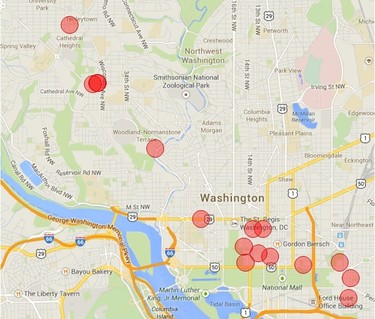
These unidentified rogue cell towers were identified operating in and around Washington, D.C. and an unknown number of cell phone customers are likely unknowingly connected to them even now.

These unidentified rogue cell towers were identified operating in and around Washington, D.C. and a number of cell phone customers are unknowingly connected to them even now. (Image: ESD America)

Security engineers have discovered more than a dozen rogue cell towers across the United States silently intercepting cell phone calls and wireless data traffic and potentially passing them on to unknown individuals, law enforcement and national security agencies, or even foreign governments.

ESD America, the makers of the highly secure CryptoPhone, has discovered a growing number of unauthorized interceptors operating as cell towers, and warn the problem is probably much worse than its first survey shows, and does not account for an even larger number of privately owned mobile repeaters and base stations operating across the country.

Network World reports these unauthorized cell towers represent an enormous security risk if they are run by a malicious actor. Connecting to a rogue tower allows its operator to eavesdrop on your calls and text messages, as well as deliver malicious data payloads such as spyware or tracking software direct to an unsuspecting user’s smartphone.

In fact, with consumer-grade wireless devices programmed to automatically and quietly connect to any technically compatible cell tower, federal law at 47 U.S.C. 302a prohibits the use of interceptors except by the government of the United States and authorized law enforcement agencies.

While legitimate manufacturers of interceptors insist on proper credentials before selling the equipment, manufacturers in the Far East that have run a brisk business selling cell phone jammers on eBay illegal to use in the United States have found new revenue selling unsecure cell tower extenders and interceptor devices that could allow even a non-technical person to run his own rogue cell tower operation.

Les Goldsmith, the CEO of ESD America, told Popular Science he was surprised to find many of the identified interceptors “on top of U.S. military bases.”

“So we begin to wonder – are some of them U.S. government interceptors,” pondered Goldsmith. “Or are some of them Chinese interceptors? Whose interceptor is it? Who are they, that’s listening to calls around military bases? Is it just the U.S. military, or are they foreign governments doing it? The point is: we don’t really know whose they are.”

Those are questions members of Congress now want answers to, and they want those answers from the Federal Communications Commission, which promises a task force will combat the unauthorized interceptor devices.

The FCC may want to step it up, because this week, Goldsmith and Aaron Turner, president of IntegriCell took a road tour around Washington, D.C. and quickly identified 15 rogue cell towers up and running in the nation’s capital, including three on Pennsylvania Avenue alone. They used the very costly CryptoPhone as their guide.

Security experts believe the FCC is poorly equipped to deal with the rogue tower issue and have warned businesses that cell phone conversations are subject to eavesdropping and are not a secure form of communications. They also don’t believe cell phone companies are in a hurry to lock down their networks either.

“Unfortunately, right now, the carriers are focused on revenue and availability,” said Turner. “With all technology decisions, you always have to balance between integrity, availability, and confidentiality, and in this case the carriers have defaulted to availability. The solution is, people are going to have to protect themselves, the government’s not going to come and protect you. They may, in some strange, crazy and massive breach situation, but the everyday enterprise, for the everyday high-value individual, this is something where they’re going to have to be self-sufficient and protect themselves.”

Sprint’s New Plans: Putting Lipstick on a Pig and Enraging Your Soon-to-Be Ex-Customers

Phillip Dampier August 20, 2014 Broadband Speed, Competition, Consumer News, Editorial & Site News, Sprint, T-Mobile, Wireless Broadband Comments Off on Sprint’s New Plans: Putting Lipstick on a Pig and Enraging Your Soon-to-Be Ex-Customers

tmobileIf this is the best Sprint’s Marcelo Claure can do, Softbank needs to keep shopping for another CEO.

Claure’s decision to deep-six the appallingly stupid Framily Plan was a no-brainer. Sprint’s own customer service agents barely understood the multi-level marketing scheme it actually was, and I never saw much value in alienating friends and family by cajoling them to use the atrociously bad Sprint network. Neither did Sprint employees who loudly cheered its upcoming demise.

Even Claure trashed Sprint’s network performance and upgrade program as glacier-slow and highly disruptive to customers who find nearby cell sites here today, gone tomorrow, and maybe back again someday when network upgrades have been finished. Unlike AT&T or Verizon where a cell tower outage might cut a few bars of signal strength, when a Sprint cell tower drops, it’s roaming time. It is not uncommon for residents along Lake Ontario’s shorelines in the United States to find their phones preferring to roam on Canadian networks (especially Rogers) to avoid Sprint.

Claure’s commitment to cut prices while cruelly excluding your current customer base from getting any of those savings is a sure-fire way to accelerate their departure… mostly to T-Mobile. John Legere is waiting with open arms.

Sprint doesn’t need to just cut prices, it needs to butcher them, and fast. Sprint’s loyal customers have been promised a lot since the company unveiled its Network Vision upgrade plan during the French Revolution of 1789. The Bastille might still be standing today had Sprint slapped a working 4G LTE antenna on top of it. But alas, let them suffer with Sprint 3G, declared Dan Hesse, on a network so bad that throttled customers in heavy-use prison actually saw their speeds rise. Some customers in western New York simply turn Sprint 3G data off to save the battery.

When Sprint 4G LTE finally did arrive in western New York (illogically first in rural communities like the stiflingly-dull town of Dansville), many barely noticed because Sprint’s backhaul connection between the cell tower and Sprint’s data network often stayed the same — congested and slow.

Although T-Mobile’s coverage is not that different from Sprint, its network upgrades are.

T-Mobile CEO John Legere has confidently pushed Sprint around over its newest plan, but if it does start to eat into T-Mobile’s business, Legere will no doubt respond with some new plans of his own. For current Sprint customers, T-Mobile is definitely the upgrade Sprint has promised for at least five years, and should be considered at contract renewal time. But current Verizon and AT&T customers paying Cadillac pricing should not be expected to switch to Sprint after recalling dropped calls in a store, home or in an emergency on Sprint’s less robust network. They are very unlikely to change carriers no matter what shade of lipstick Sprint applies to its plans.

Claure has the right idea — slash prices and actually deliver on promises of a better network going forward, but those commitments deserve to apply to both existing and new customers. So far Claure has managed to inflict only superficial wounds. The price cuts must go much deeper to attract business from customers of the larger carriers willing to compromise for the right price and upgrades have to be real and delivered immediately.

Sprint still doesn’t understand it cannot charge Honda Accord prices on a Chevy Spark network. Until they do, T-Mobile is likely to continue taking them to school.


Your Unlimited, Off-Contract Verizon Wireless Web Experience Will Be “Optimized” (Throttled) Oct. 1

throttleVerizon Wireless’ ongoing campaign to get rid of its grandfathered unlimited data customers continues this week with news the carrier will begin throttling speeds of off-contract customers still hanging on to their uncapped data plans starting Oct 1.

Verizon doesn’t call the enforcement of speed reductions a “throttle,” but rather “Network Optimization”:

Verizon Wireless strives to provide its customers with the best wireless experience when using our network. In 2011, Verizon Wireless launched Network Optimization, which slows the data speeds of its unlimited data subscribers with 3G devices who are in the top 5% of data users when they connect to a cell site experiencing high demand.

Effective October 1, Verizon Wireless will expand its existing Network Optimization policy to include its unlimited data subscribers using 4G LTE devices who have fulfilled their minimum contract term. Based on your plan and recent data usage, one or more lines on your account may experience a reduction in data speeds when connected to a cell site experiencing high demand. Customers on MORE Everything or other usage-based data plans are not subject to Network Optimization. For more information about our Network Optimization, please refer to www.verizonwireless.com/networkoptimization.

Verizon Wireless customers on the company’s 3G network have been subject to speed throttling for several years if Verizon deems them a “heavy user,” but the company’s 4G LTE network avoided the speed noose until now. Customers who find themselves subjected to Verizon’s speed limiter report it is a very unpleasant experience.

610px-Verizon-Wireless-Logo_svg“My phone has been throttled and is now essentially unusable for the very things it is marketed for,” reports one customer sentenced by Verizon’s “Network Optimization.”  “I can send texts, emails, and view basic websites but any sort of streaming is now out of the question for the remainder of the billing cycle and possibly the next cycle as well.”

The throttle effectively limits speeds to well under 300kbps, and in most urban areas where cell tower usage is higher, punished customers have to live with speeds of around 50kbps — the same as dial-up.

Verizon’s logic and consistency about its “Network Optimization” faced customer scrutiny as well.

“This is not about equal opportunity bandwidth, it’s about Verizon realizing they can increase their revenue stream, otherwise, wouldn’t those tiered folks be getting throttled as well if they ‘abused’ and used ‘inordinate’ amounts of data?  Oh no, of course not, Verizon just bills them more.  This scenario is as ridiculous as charging $20/month for text messaging, which, by the way, is also data.”

What makes you speed-throttling-worthy? According to Droid Life, which broke the story, anyone using more than 4.7GB of data per month on a busy cell tower is likely to end up on a speed diet.

Verizon claims its “Network Optimization” is designed to protect the usage experience among all of its customers, and suggests the speed reductions will only occur when a heavy user is connected to a “high demand” cell site.

“Once you leave that site and attach to a new cell site without high demand, your speeds return to normal,” claims Verizon. “Other carriers often throttle you no matter what throughout the end of a billing cycle.”

But Verizon’s gesture isn’t as generous as it first suggests.

Once a customer is suspected of being a data hog and forced to endure Verizon’s speed throttle, they can stay in Verizon’s speed prison for up to 60 days after being sentenced. The result is dramatically reduced data speeds when a customer happens to travel through a busy cell site area, regardless of whether they are using a lot of data at the time or not.

Network congestion problems may be a result of too many customers connected to a single cell site at any one time, several customers concurrently engaged in high bandwidth traffic exchanges through a cell site, or Verizon’s inadequate capacity to meet even the reasonable needs of its wireless customers.

But regardless of the cause, only one group will be punished for their usage-excess: unlimited data plan customers who are now mostly off-contract (Verizon requires most customers signing a contract renewal that includes equipment discounts to migrate off their unlimited plan, which stopped being sold to new customers in June, 2012.)

Customers can get out of speed jail permanently simply by agreeing to give up their unlimited data plan. Then they can use (and abuse) Verizon’s limited wireless bandwidth, whether it slows every other customer down or not.

Sprint Will Shut Down Clear/4G WiMAX Network by 2015; TD-LTE Upgrade for Most Cell Sites

wimaxSprint has begun decommissioning its increasingly obsolete 4G WiMAX network with definitive plans to shut off the service completely by the end of 2015.

While most Sprint customers with smartphones have long since moved away from WiMAX, Sprint has resold access to the 2.5GHz network for some prepaid Boost, Sprint, and Virgin Mobile customers as well as third parties including FreedomPop and Earthlink.

WiMAX was the first 4G network in the United States, launching first in Baltimore in the fall of 2008. Sprint customers were offered the HTC Evo 4G smartphone to access WiMAX’s faster speeds. Separately, Clearwire marketed access to WiMAX as a wireless home and business broadband solution. WiMAX was often promoted as a longer distance alternative to Wi-Fi, and was initially capable of 30-40Mbps speeds.

clear-logoIn practice, WiMAX in the United States never achieved great success. Sprint and Clearwire’s network was never built out sufficiently to provide nationwide coverage, and because it relied on very high frequencies, even customers inside claimed service areas often dealt with reception problems, especially indoors. Clearwire’s home broadband replacement often required reception equipment be placed near a window, preferably one without a thermal coating that could block or degrade the signal.

As soon as Sprint and Clearwire added a significant number of customers to the network, speeds deteriorated. Neither company invested enough in upgrades to keep up with demand. Instead, Clearwire’s home broadband customers, originally promised unlimited service, were routinely speed throttled for “excessive use.”

The same year WiMAX was introduced in Baltimore, Network World was already warning the technology was in trouble. By 2011, the magazine had officially declared WiMAX dead.

“There was way too much hype surrounding WiMAX (like the White Spaces today, it was marketed as ‘Wi-Fi on steroids’ and a replacement for Wi-Fi; such was, of course, complete nonsense)”, the magazine wrote.

Other American wireless carriers showed little interest in WiMAX, particularly as competing 4G technologies including HSPA+ and LTE were nearing deployment.

SprintDespite the promise of greatly enhanced data speeds with the next generation of WiMAX, dubbed WiMAX 2, many of the world’s largest wireless carriers were already preparing to move on. In particular, China Mobile (and its 600 million customers) became the decisive factor that turned WiMAX 2 into a bad bet. China Mobile decided the better choice was TD-LTE, a variant of LTE technology. With China Mobile providing service to 10 percent of the world’s mobile users all by itself, support for TD-LTE grew and attracted equipment manufacturers that saw the earnings potential from selling tens of millions of base stations.

TD-LTE is an excellent upgrade choice for WiMAX operators because it was designed to work best at high frequencies ranging from 1850-3800MHz — the same frequency bands that WiMAX already uses.

Sprint expects to decommission at least 6,000 of its 17,000 WiMAX cell sites. Another 5,000 of those sites have already gotten TD-LTE technology, a part of Sprint’s broader LTE network upgrade. Sprint will combine its FDD-LTE network in its 800MHz and 1.9GHz spectrum with a TD-LTE network in its 2.5GHz spectrum. Sprint Spark customers are being offered tri-band equipment that can access either technology. Sprint can use its massive expanse of 2.5GHz spectrum to offload data usage from its lower frequency spectrum, especially in large cities.

Another 5,000 legacy Clearwire cell sites will be upgraded to TD-LTE between now and the end of next year. Sprint expects to deploy TD-LTE more widely than WiMAX, potentially serving 100 cities and 100 million base stations by 2016.

Sprint has protected much of its postpaid customer base from the transition by repeatedly encouraging customers to upgrade to LTE service, now being rolled out as part of its Network Vision plan. But firms like FreedomPop and others that now lease access to the WiMAX network will leave their customers with a shorter upgrade path when WiMAX equipment stops working, requiring users to upgrade to LTE equipment.

[flv]http://www.phillipdampier.com/video/Sprint Spark – Today is already the future 10-30-13.mp4[/flv]

Sprint hypes its new tri-band Sprint Spark network, which combines two different LTE networks to deliver faster data speeds. (1:18)

Search This Site:

Contributions:

Recent Comments:

Your Account:

Stop the Cap!