Home » Cell site » Recent Articles:

Communications Struggling in Southeast Texas Post-Harvey

Downtown Houston

Telecommunications services are straining across southeastern Texas and Louisiana after Hurricane Harvey’s remnants have caused unprecedented flooding across the region.

More than 50% of cell sites in Aransas, Calhoun, Refugio, and San Patricio counties in Texas are down as a result of electric outages and wind/water damage caused by Hurricane Harvey and its aftermath. Worst affected is around Rockport, in Aransas County located on the Gulf of Mexico. Just one cell tower in that county remains in service. In Calhoun County, only four cell towers remain functional.

911 services have strained as a result of the storm, with the city of Houston receiving as many as 75,000 calls a day. But in other parts of the region, 911 outages and other problems have forced officials in more than a dozen cities to route incoming calls to other 911 centers in the state:

  • 911 Service Down: Portland Police Department, Tex.
  • Degraded 911 Service: Calhoun County Sheriff, Tex.
  • Rerouted 911 Without Automatic Location Information: Aransas County SO, Tex.; Bee PD, Tex.; Beeville PD, Tex.; Kingsville PD, Tex.; Kleberg County SO, Tex.; Mathis PD, Tex.; Port Aransas PD, Tex.; Refugio County SO, Tex.; and Ingleside PD, Tex.
  • Rerouted 911: Aransas Pass PD, Tex.; Cameron Parish SO, La.; Richmond PD, Tex.; Robstown PD, Tex.; Victoria PD, Tex.; and Wilson County SO, Tex.

There are at least 148,565 wired subscribers out of service in the affected area. This includes users who get service from Comcast and other cable systems, AT&T and other wireline phone companies. There are 11 landline switching/central offices out of service and 21 offices on back-up power.

There are 9 radio stations out of service, all in Texas:

KJOJ-FM, KKTX, KUNO, KPRC, KKWV, KAYK, KZFM, KKBA and KEYS.

As a result of the storm, the Federal Communications Commission activated its Disaster Information Reporting System, which asks providers to report outages so the FCC can track the status of telecommunications networks in disaster areas.

More than two feet of rain has fallen — more than six months of average precipitation in the Houston area — in two days.

Communities Prepare for Onslaught of New Wireless Networks in Public Rights-of-Way

Phillip Dampier June 12, 2017 Public Policy & Gov't, Wireless Broadband 1 Comment

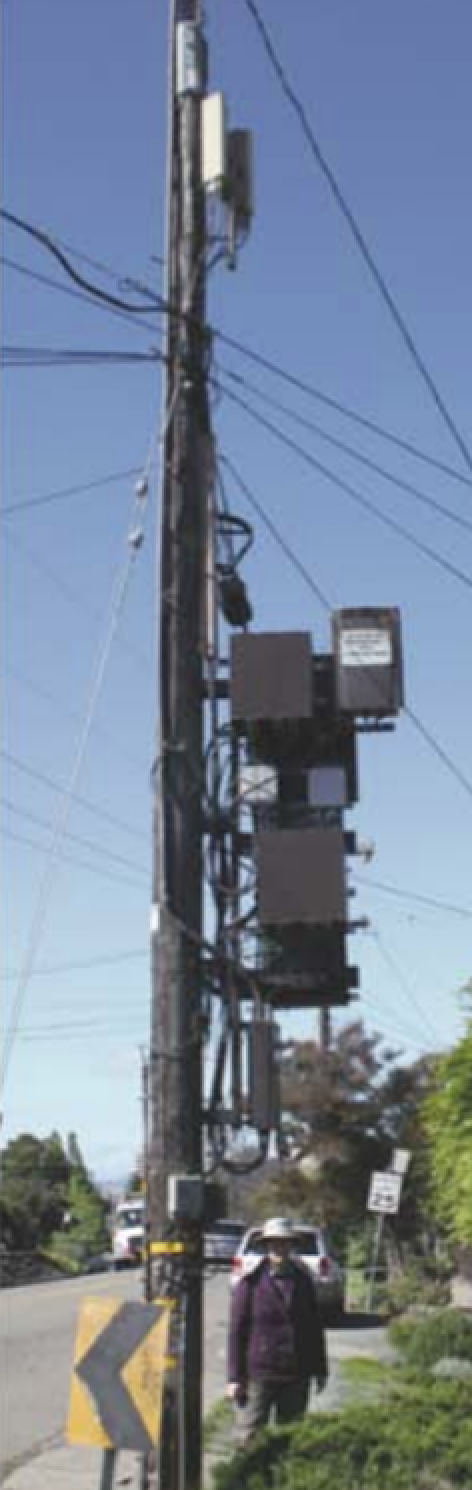
AT&T’s idea of a small cell deployment on an existing utility pole in Oakland, Calif. (Image courtesy: Omar Masry, a city planner living in the area, who warns other city planners: “Don’t let this happen to you.”)

Some of America’s biggest wireless telecom companies are spending millions lobbying Washington and state legislatures for the right to place a myriad of new wireless transmitters and small cells in the public rights-of-way without local communities having much say about where they go and what they look like.

Utility Traffic Jam

Over the next five years, tens of thousands of new “small cell” devices are expected to be placed on utility poles to manage forthcoming wireless services, and that represents a conservative estimate. Every major wireless carrier is contemplating new line-of-sight 5G communications networks that will require a massive deployment of new wireless antennas that will serve a smaller audience of devices than traditional cell towers have. But wireless companies will not be alone. Cable operators are also expected to enter the wireless business, not only to resell other providers’ cellular services but also to deploy new low power, line of sight networks to manage the Internet of Things (IoT), which will wirelessly connect devices ranging from home appliances and heating/cooling systems to vehicles on the road, utility meters, shopping carts, for sale and street vendor signs, traffic signals, and much, much more.

It’s an entirely new world for local governments tasked with approving permit requests to place cellular and wireless infrastructure on private and public lands. With billions to be made managing machine-to-machine communications, smart cars, and expanded wireless internet, every player has a vested interest in making sure local governments don’t impede their potential profits.

That is why companies like AT&T are pushing hard for new limitations on local government objections to their sprouting wireless infrastructure. Their idea is to override local control and shift to their proposed statewide or federal guidelines conveniently favoring them by putting time limits on communities to contemplate an application, eliminating certain rights for local governments to object to those applications, and making certain wireless companies don’t have to pay what they consider excessive fees or taxes to local authorities for the right to use the public space.

For local governments, responsiveness to citizens who have to live next to wireless infrastructure is important, and not only because of pseudo-scientific fears of the health impacts of wireless signal radiation. Aesthetic issues alone often make or break current wireless antenna applications.

The POTs and PANs Blog notes that time is short for local communities to get their wireless infrastructure policies in place for the incoming boom of mini-cell sites and IoT networks.

Pole Refrigerators and 100-Foot Fake Pine Trees

Traditional cell towers are easy to spot because they are tall and very visible with wireless antennas often serving multiple carriers fixed up and down across the tower. The next generation of wireless networks will be powered by much smaller antennas attached to utility and light poles. In some cases where nearby trees can block signals, providers propose new 100-foot tall monopoles, sometimes disguised to resemble a tree — albeit a very, very tall one. To know how those trees could be removed with efficiency, you can learn this here now.

Some early generation “small cells” resemble a compact refrigerator and weigh several hundred pounds. These are usually mounted approximately half to two-thirds up a utility pole and are very visible. Some have loud cooling fans, others need additional infrastructure like external power that will busy-up the utility pole with more cables and supports. In a storm strong enough to take out a utility pole, you would not want to be underneath a falling “small cell.”

The Tree Trimming Flat-Top Haircut is Back

Arborists warn that some early 5G installations have taken a serious toll on nearby trees also in the right-of-way because the technology requires a direct line-of-sight to the antenna. This has resulted in aggressive tree-trimming to keep foliage far away from the small cell, and that trimming sometimes includes reducing the height of nearby trees.

A University of Surrey study found that small cells mounted 10 meters up a pole faced at least a 30% chance of having their signals blocked by trees. At 15 meters, that chance of signal blockage is reduced to 10%. At 25 meters, it is less than 1%. But that would require an 82-foot high utility pole in the neighborhood. The standard utility pole in the United States is about 40 ft (12 m) long. Either aggressive tree trimming or tall utility pole placement to avoid trimming is likely to create controversy in suburban residential neighborhoods.

City planners are being urged to contemplate what kind of enforceable policies they want to permit in the public space set aside for infrastructure, because as author Doug Dawson noted, it’s going to get busy up there:

I doubt that any city is prepared for the possible proliferation of wireless devices. Not only are there four major cellular companies, but these devices are going to be deployed by the cable companies that are now entering the cellular market along with a host of ISPs that want to deliver wireless broadband. There will also be significant demand for placement for connecting private networks as well as for the uses by the cities themselves. I remember towns fifty years ago that had unsightly masses of telephone wires. Over the next decade or two it’s likely that we will see wireless devices everywhere.

Vandals Cause $1 Million in Damages Collapsing AT&T Cell Tower in Texas

att_logoOne of AT&T’s cell towers in Denison, Tex. went missing last Thursday in the 1900 block of West Crawford St. after vandals cut the tower’s supporting guy wires, causing it to collapse.

Nearby residents woke up to find the remains of the tower crumpled on the ground, with dramatically poorer cell service the result for AT&T, Sprint, and T-Mobile customers in the immediate vicinity. All three mobile providers maintained antennas on the affected tower.

Denison Police say the incident was a clear case of vandalism. After the guy wires were intentionally cut, the tower lacked sufficient support to stay standing on its own.

Nobody was injured during the collapse, but AT&T says the vandals caused $1 million in damages. A temporary cell tower is now in place. It will take three months to permanently replace the cell tower.

AT&T is offering at least a $7,500 reward for information that leads to an arrest.

[flv]http://www.phillipdampier.com/video/KXII Sherman ATT cell tower felled in Denison 11-22-2015.mp4[/flv]

KXII in Sherman, Tex. reports Denison authorities are looking to arrest the vandal(s) that destroyed an AT&T cell tower. (1:30)

Clear WiMAX Ends Nov. 6: You Don’t Have to Go Home But You Can’t Stay Here

If you are among the dwindling number of customers still using Sprint’s Clearwire 4G WiMAX service, the wireless provider would like you to leave.

After about a year of successive warnings it was preparing to decommission its aging WiMAX network in favor of LTE service, nobody can accuse Sprint of not giving its customers fair warning. The top banner on the Clear.com website is now festooned with red text giving customers one last chance to move on.

clear bye bye

In brief, the last Sprint WiMAX cell tower will cease functioning Nov. 6 2015 at 12:01am EST. Sprint is repurposing many of its former WiMAX cell sites to support expanded 4G LTE service in the carrier’s perennial network makeover.

wimaxDespite this, there still remains a loyal user base for WiMAX service — many in semi-rural areas using the service until the last days for wireless home broadband. The alternative is usually very expensive mobile data service from Verizon, AT&T, Sprint or T-Mobile, or one of several resellers. But usage caps can be stingy and overlimit fees high.

We also found several businesses, including a small auto servicing chain in western New York, still occasionally relying on Clear WiMAX-powered guest Wi-Fi, apparently unaware the service is soon to disappear. Time Warner Cable is often the chosen replacement for Clear’s business customers in the northeast as the cable company aggressively markets business broadband service coupled with free customer/public Wi-Fi access for around $90 a month.

Although WiMAX is nearing extinction in the United States, it remains in service in places like Ukraine and Azerbaijan. In Calgary, Platinum Communications continues to offer WiMAX wireless broadband in rural parts of Alberta between Edmonton and Calgary and large sections of the flat, open prairie of southeastern Alberta, including the communities of Lethbridge, Brooks, and Medicine Hat.

As Clearwire Service Prepares to Shutdown, Customer Service Agents Suggest Comcast as Alternative

clear-logoClearwire users seeking alternatives after the wireless ISP shuts down its WiMAX network this fall are surprised to hear some Clear customer service representatives recommending Comcast as their best option.

Stop the Cap! reader Randall Page has been looking for a new ISP after receiving a notification from Clearwire its network is ceasing operations before the end of this year and he needs to find a different provider:

Dear Valued CLEAR/Clearwire Customer,

You are receiving this notice because our records show you are subscribed to services on the CLEAR 4G (WiMAX) Network or Clearwire Expedience network. Sprint is in the process of implementing major enhancements to the Sprint 4G LTE Network, including the deployment of Sprint Spark, an enhanced LTE network capability, by repurposing the CLEAR 4G (WiMAX) Network and Clearwire Expedience Network. As a valued customer, we are providing you formal notice that Sprint will cease operating the CLEAR 4G (WiMAX) Network and Clearwire Expedience Network on November 6, 2015 at 12:01AM EST.

What this means to you:

  • Sprint will no longer support CLEAR 4G WiMAX and Clearwire Expedience devices or services.
  • Your CLEAR 4G WiMAX and Clearwire Expedience devices and services will no longer work, including your ability to contact 9-1-1.
  • You should not return your device(s).

To discuss your options or learn more, please call 1-888-888-3113.

Thank you for your business.

Sincerely,
CLEAR/Clearwire Wireless

clearsprint

The Page family has used Clearwire for years to get Internet service in their rural home near Lynden, Wash. The service was affordable and more than adequate for the occasional web browsing and e-mail Page’s parents rely on. After learning the service was being discontinued, Page called Clearwire customer service to learn what other options were available.

“They claim they will essentially match your current level of Clearwire service on the Sprint network,” Page told Stop the Cap! “Although Clearwire originally advertised unlimited service, the representative was not willing to match that through Sprint. Instead, they built a recommended usage plan based on reviewing actual use over the last several months.”
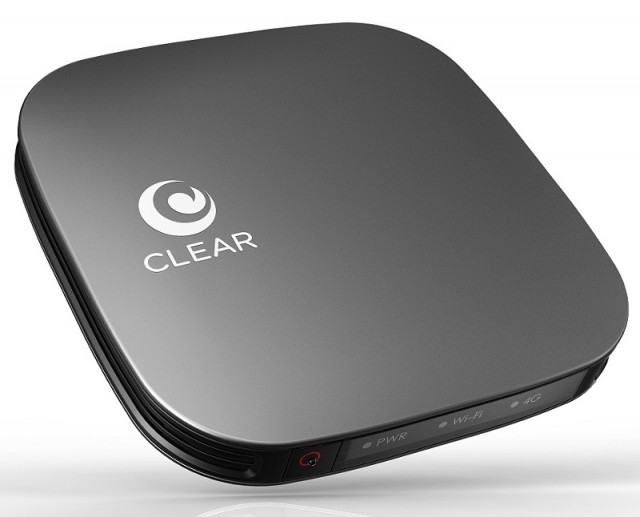
Clear/Clearwire's modems and routers were designed to work with their WiMAX network, which is being decommissioned. This equipment will be obsolete and cannot be reused on a new provider.

Clear/Clearwire’s modems and routers were designed to work with their WiMAX network, which is being decommissioned. This equipment will be obsolete and cannot be reused with a new provider.

Page was offered a 30GB plan adequate for his parents, but the quoted price of $110 a month was more than twice the price of Clearwire. The family also had to pay $200 for a replacement modem compatible with Sprint’s LTE network to replace the Clearwire WiMAX modem that isn’t.

“No consideration for Clearwire customers, no special promotions, no loyalty discounts, nothing for customers like us who have been with Clearwire for almost five years,” Page complained. “When Alltel was sold off and their network was changed, customers were given a free replacement phone as a courtesy, but Sprint seems to care less about us.”

Sprint acquired Clearwire in 2013 mostly for its massive spectrum holdings in the 2.5GHz band. After the deal closed, Sprint fired 75% of Clearwire’s workforce and began planning the end of Clearwire’s legacy WiMAX network, also familiar to first generation 4G Sprint customers who used it before the launch of LTE service.

Clearwire’s higher frequency spectrum never penetrated buildings well and did not reach as far as wireless signals on lower frequencies, which meant Clearwire was required to build a large cellular network to deliver reasonable service. Sprint inherited 17,000 Clearwire-enabled cell sites in the deal, many deemed redundant. A Sprint filing with the Securities & Exchange Commission indicated Sprint was shutting down no fewer than 6,000 of those sites by the end of this year, with the remaining transitioned to TD-LTE service as part of the Sprint Spark project.

The change will allow Sprint to better monetize its 2.5GHz spectrum by selling usage-based plans and more expensive home wireless broadband service. It’s the second major wireless technology shutdown organized by Sprint. In 2013, Sprint shut off the last 800MHz iDEN Nextel cell site inherited from its acquisition of Nextel. Sprint now provides LTE 4G service over the frequencies formerly used by Nextel.

Page was not happy with Clearwire’s alternative through Sprint, and remarkably the representative then suggested his family should sign up for Comcast service instead.

“I was floored to hear a representative working on behalf of Sprint recommend Comcast,” Page said.

It isn’t the first time Clearwire has done this:
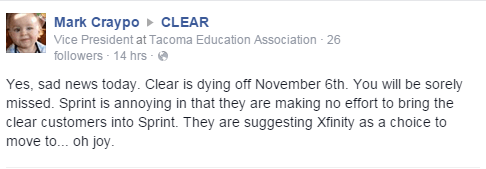
clearwire sprintClearwire’s own Facebook page was abandoned in 2013, presumably right after its sale to Sprint was complete. Stranded customers are complaining about the impending loss of service and the lack of alternative options and information.

Wireless 'n WiFi's high usage data plan has gotten good reviews from Stop the Cap! readers,  although it is expensive.

Wireless ‘n WiFi’s high usage data plan has gotten good reviews from Stop the Cap! readers, although it is expensive and relies on Sprint’s less-than-great network.

Unfortunately, the Page home is not serviced by Comcast and DSL from CenturyLink is not an option either. Page and his immediate neighbors are instead joining a group “family plan” on a wireless carrier and will share a Wi-Fi hotspot that can reach three homes. It technically violates the terms and conditions of most family plans to share a connection in this way but it is the only affordable choice the families have for now.

Those rural Clearwire customers who cannot subscribe to cable or DSL broadband might also explore some options from Wireless ‘n WiFi, which sells high limit 3G/4G LTE plans that work on Sprint’s 3G and 4G networks.

Their current plan offers up to 60GB of usage per month, up to 30GB of which can come from using Sprint’s 3G network. The service costs a still steep $109.99 a month (including all taxes and fees) and comes with additional startup costs:

  • Rental of NetGear 341u USB modem and MBR1200B Cradlepoint Wi-Fi Router ($100 equipment deposit required, refunded when equipment returned)
  • $49.99 Activation Fee
  • $8.95 Priority Mail Shipping (for Equipment)
  • $268.93 total startup cost includes all charges referenced above (not including monthly service fee)

Service is month-to-month, no term contract. Overlimit fee is $5/GB.
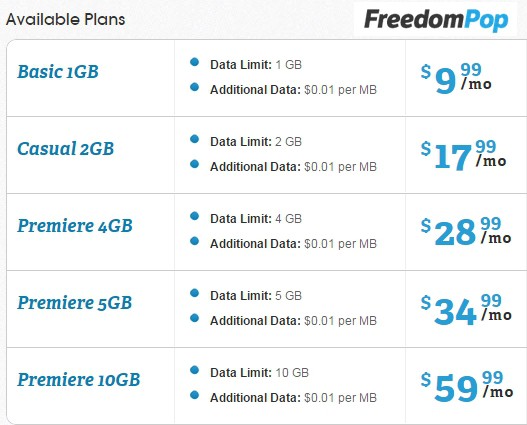
freedompop plans

Some lighter users report reasonably priced service is available from FreedomPop, as long as you are careful to avoid over 10GB of usage per month ($59.99) and you turn off revenue generators like automatic top-off and other various extras they pitch (including data rollover if you find you use up most of your monthly allowance anyway).


Search This Site:

Contributions:

Recent Comments:

Your Account:

Stop the Cap!