Home » Cell site » Recent Articles:

C-Spire Introduces Unlimited 120 Mbps Fixed Wireless for $50/Month in Mississippi

For residents of 10 Mississippi communities, an alternative broadband option is now available delivering up to 120/50 Mbps speed with no data caps or throttling for a flat $50 a month, taxes and fees included.

C Spire 5G Internet” is as described, except it doesn’t use the official 5G standard and will require the installation of a “dinner plate”-sized antenna on one’s home to get the service.

C Spire is using an 802.11 variant with equipment developed by Mimosa and Siklu, leveraging C Spire’s existing 8,400 route miles of fiber infrastructure to extend service wirelessly to each customer without the cost of wiring a fiber optic cable to the home.

Siklu’s EtherHaul products work in conjunction with its point-to-point and point-to-multipoint radios that operate in the 60 and 70-80 GHz millimeter wave bands. Because of the vast amount of spectrum available on these uncongested frequencies, C Spire can provide connections up to 10 Gbps from each small cell site.
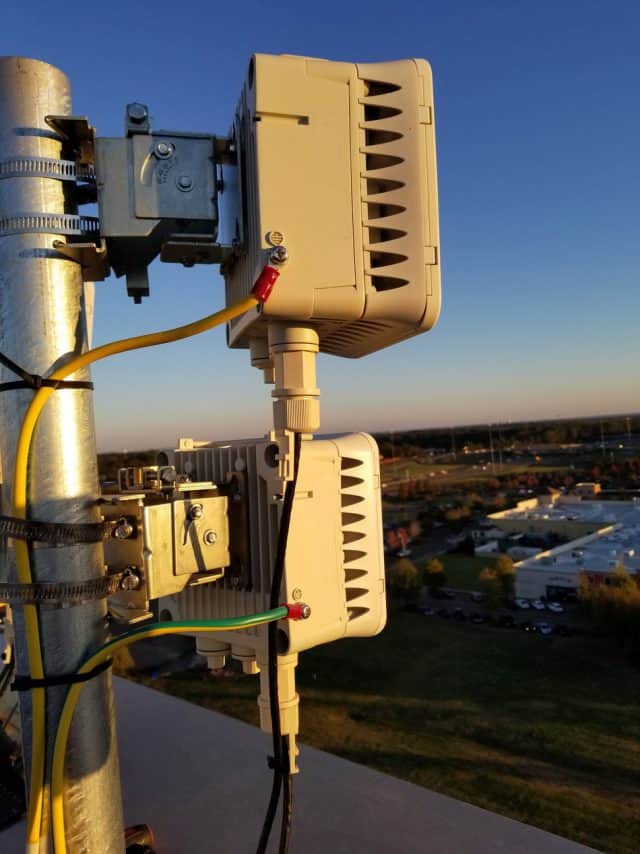
C Spire is using Siklu’s EH-600 mmWave backhaul equipment for its fixed wireless internet service in Mississippi.

Mimosa supplies short-range MicroPoP architectures and in limited tower deployments including Mimosa A5 and A5c access devices, Mimosa C5 client devices, and Mimosa N5-360 beamforming antennas.

“Our service is backhauled by Siklu’s carrier grade solutions enabling us to deliver high-speed internet access without the arbitrary data caps usually associated with LTE or satellite services,” said C Spire president Stephen Bye.  “With a flat rate of $50 a month, which includes taxes and fees, our customers can now easily get all of the content they want and need.”

C Spire said it is quickly working to introduce the service in “dozens” of markets in Mississippi, in addition to its earlier plans to offer fixed wireless to over 90,000 locations across its service area. The “5G” fixed wireless service being introduced in Mississippi is not the same as C Spire’s earlier fixed wireless initiative.

Customers report wireless speeds are within a reasonable range of what is advertised, but antenna placement can be critical to get the best speed. It isn’t known how many customers are currently sharing each small cell site, and C Spire has protected itself with a contract clause allowing it to begin data caps, usage based billing, or targeted suspensions for customers deemed to be consuming too much data if network congestion becomes a problem.

Mississippi is broadband-challenged because many of its rural locations are populated with some of the country’s poorest citizens. AT&T, the state’s largest phone company, has shown little interest expanding fiber into many of these areas, especially in northern Mississippi, and the state’s cable companies include Cable One, notorious for being expensive and data-capped. As a result, the state is ranked 49th out of 50 for broadband availability.

C Spire is a regional mobile provider — the sixth largest in the country — and directly provides its own cell service in Memphis, Tenn., Mississippi, Alabama, and the Florida Panhandle.

C Spire introduces 120 Mbps fixed wireless internet access for a flat $50 a month in Mississippi. No data caps or throttling. This company produced video introduces the service. (1:23)
T-Mobile, Verizon Wireless Achieve Top Scores in Mobile Performance Report

Phillip Dampier July 18, 2018 AT&T, Broadband Speed, Competition, Consumer News, Rural Broadband, Sprint, T-Mobile, Verizon, Wireless Broadband Comments Off on T-Mobile, Verizon Wireless Achieve Top Scores in Mobile Performance Report

Mobile broadband performance in the United States remains nothing to write home about, achieving 43rd place worldwide for download speeds (between Hong Kong and Portugal) and a dismal 73rd for upload speed (between Laos and Panama). With this in mind, choosing the best performing carrier can make the difference between a tolerable experience and a frustrating one. In the first six months of 2018, Ookla’s Speedtest ranked T-Mobile and Verizon Wireless the two top carriers in the U.S.

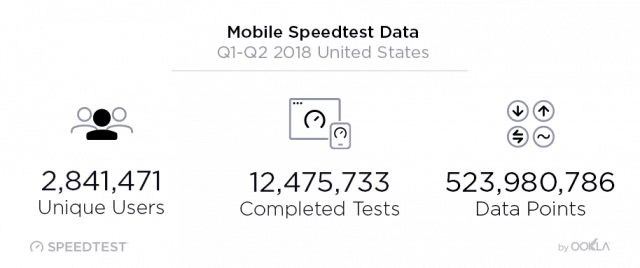
From January through the end of June, 2,841,471 unique mobile devices were used to perform over 12 million consumer-initiated cellular network tests on Speedtest apps, giving Ookla insight into which carriers consistently performed the best in different cities around the country. The results showed average download speed of 27.33 Mbps, an increase of 20.4% on average since the same period in 2017. Upload speed achieved an average of 8.63 Mbps, up just 1.4%.

Achieving average speeds of 36.80 Mbps, first-place Minnesota performed 4 Mbps better than second place Michigan. New Jersey, Ohio, Massachusetts and Rhode Island were the next best-performing states. In dead last place: sparsely populated Wyoming, followed by Alaska, Mississippi, Maine, and West Virginia.

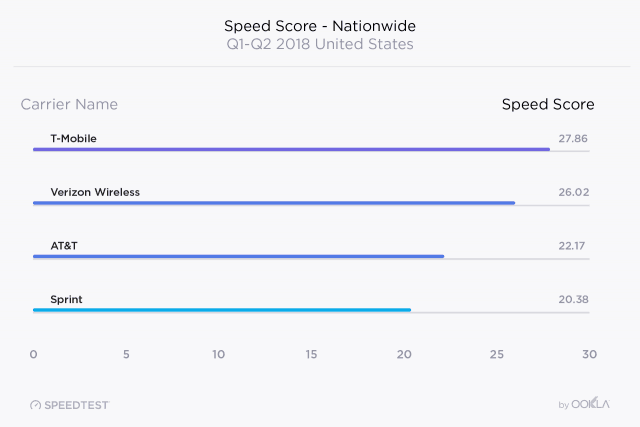
T-Mobile’s heavy investment in 4G LTE network upgrades have clearly delivered for the company, which once again achieved the fastest average download speed results among the top-four carriers: 27.86 Mbps. Verizon Wireless was a close second at 26.02 Mbps. Verizon’s speed increases have come primarily from network densification efforts and equipment upgrades. Further behind was AT&T, achieving 22.17 Mbps, and Sprint which managed 20.38 Mbps, which actually represents a major improvement. Sprint has been gradually catching up to AT&T, according to Ookla’s report, because it is activating some of its unused spectrum in some markets.

Your Device Matters

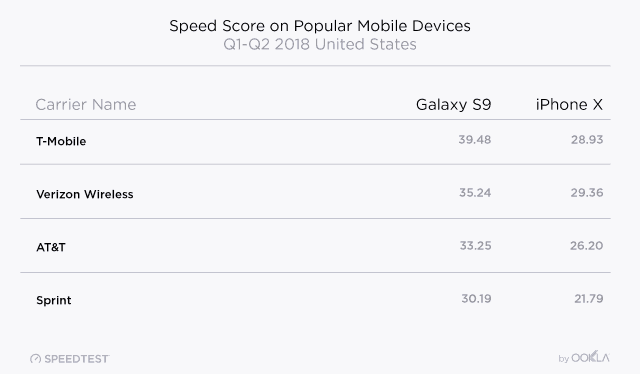
Which device you use can also make a difference in speed and performance. In a match between the Apple iPhone X and the Samsung Galaxy S9, the results were not even close, with the Samsung easily outperforming the popular iPhone. The reason for the performance gap is the fact Samsung’s latest Galaxy phone has four receive antennas and the iPhone X does not. The iPhone X is also compromised by the total amount of LTE spectrum deployed by each carrier and the fact it cannot combine more than two spatial streams at a time. Until Apple catches up, iPhone X users will achieve their best speeds on T-Mobile and Verizon Wireless, in part because Verizon uses more wideband, contiguous Frequency Division Duplex (FDD) LTE spectrum than any other carrier, which will allow iPhone users to benefit from the enhanced bandwidth while connected to just two frequency blocks. The worst performing network for iPhone X users belongs to Sprint, followed by AT&T.


Rural vs. Urban

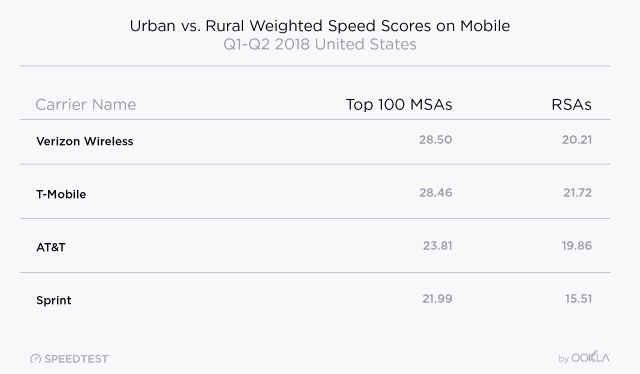
For customers in the top-100 cities in the United States, T-Mobile and Verizon Wireless were generally the best choices, with some interesting exceptions. AT&T and Verizon Wireless generally performed best in areas where the companies also offer landline service, presumably because they are able to take advantage of existing company owned infrastructure and fiber networks. Verizon Wireless performed especially well in 13 states in the northeast, the upper midwest (where it acquired other cellular providers several years ago), Alaska, and Hawaii. AT&T was fastest in four states, especially the Carolinas where it has offered landline service for decades, as well as Nebraska and Nevada. Sprint outperformed all the rest in Colorado, while T-Mobile’s investments helped make it the fastest carrier in 31 states, notably in the southeast, southwest, and west coast cities.

The story rapidly changes in rural areas, however. Almost uniformly, speeds are considerably slower in rural areas where coverage and backhaul connectivity problems can drag down speeds dramatically. In these areas, how much your wireless provider is willing to spend makes all the difference. As a result, T-Mobile’s speed advantage in urban areas is dramatically reduced to near-equivalence with Verizon Wireless in rural communities, closely followed by AT&T. Sprint continues to lag behind in fourth place. No speed test result means a thing if you have no coverage at all, so rural customers need to carefully consider the impact of changing carriers. Always consider a 10-14 day trial run of a new provider and take the phone to places you will use it the most to make sure coverage is robust and reliable. Sprint and T-Mobile’s roaming agreements can help, but in areas with marginal reception, the two smaller carriers still favor their own networks, even if service is spotty.

MSA-Metropolitan Service Area; RSA-Rural Service Area

Network Upgrades and the Future

In the short term, most wireless upgrades will continue to enhance existing 4G LTE service and capacity. True 5G service, capable of speeds of a gigabit or more, is several years away for most Americans.

T-Mobile

T-Mobile has invested in thousands of new cell sites in over 900 cities and towns to quash its reputation of being good in cities but poor in the countryside. Many, but not all of these cell sites are in exurban areas never reached by T-Mobile before. The company is also deploying its 600 MHz spectrum, which performs well indoors and has a longer reach than its higher frequency spectrum, which will go a long way to end annoying service drops in marginal reception areas. These upgrades should make T-Mobile’s service stronger and more reliable in suburbs and towns adjacent to major roadways. But service may remain spotty to non-existent in rural states like West Virginia. Most of T-Mobile’s spectrum is now dedicated to 4G LTE service, with just 10 MHz reserved for 3G legacy users. T-Mobile has set aside only the tiny guard bands for LTE and UMTS service for legacy GSM channels handling some voice calls and 2G services.

T-Mobile is also introducing customers to Carrier Aggregation through Licensed Assisted Access (LAA). This new technology combines T-Mobile’s current wireless spectrum with large swaths of unlicensed spectrum in the 5 GHz band. Because the more bandwidth a carrier has, the faster the speeds a carrier can achieve, this upgrade can offer real world speeds approaching 600 Mbps in some areas, especially in urban locations.

Verizon Wireless

Verizon Wireless is suffering a capacity shortage in some areas, causing speeds to drop during peak usage times at congested towers. Verizon’s solution has been to add new cell sites in these mostly urban areas to divide up the traffic load. In many markets, Verizon has also converted most or all of its mid-band spectrum to LTE service, compacting its legacy CDMA network into a small section of the 850 MHz band. With 90% of its traffic now on LTE networks, this week Verizon confirmed it will stop activating new 3G-only devices and phones on its network, as it prepares to end legacy CDMA and 3G service at the end of 2019. Once decommissioned, the frequencies will be repurposed for additional LTE service.

In the immediate future, expect Verizon to continue activating advanced LTE features like 256 QAM, which enables customers’ devices and the network to exchange data in larger amounts and at faster speeds, and 4×4 MIMO, which uses an increased number of antennas at the cell tower and on customers’ devices to minimize interference when transmitting data. How fast this technology arrives at each cell site depends on the type of equipment already in place. At towers powered by Ericsson technology, a minor hardware upgrade will quickly enable these features. But where older legacy Alcatel-Lucent equipment is still in use, Verizon must first install newer Nokia Networks equipment to introduce these features. That upgrade program has moved slower than anticipated.

Older phones usually cannot take advantage of advanced LTE upgrades so Verizon, like other carriers, may have to convince customers it is time to buy a new phone to make the most efficient use of its upgraded network.

AT&T

AT&T customers are also dealing with capacity issues in some busy markets. AT&T has a lot of spectrum, but not all of it is ideal for indoor coverage or rural areas. The company, like Verizon, is trying to deal with its congestion issues by deploying new technologies in traffic-heavy metropolitan markets. AT&T is using unlicensed spectrum in parts of seven cities, accessible to customers using the latest generation devices, to increase speeds and free up capacity for those with older phones. For most customers, however, the most noticeable capacity upgrade is likely to come from AT&T’s nationwide public safety network. This taxpayer-supported LTE network will be reserved for first responders during emergencies or disasters, but the rest of the time other AT&T customers will be free to use this network with lower priority access. This will go a long way towards easing network congestion, and customers will get access automatically as available.

At the same time, AT&T, like Verizon, is trying to deploy additional advanced LTE features, but has been delayed as it mothballs older Alcatel-Lucent equipment at older cell sites, replaced with current generation Nokia equipment.

Sprint

Sprint has done the most in 2017-2018 to improve its wireless network, especially its traditionally anemic download speeds. While still the slowest among all four national carriers, things have gotten noticeably better for many Sprint customers in the last six months. Sprint recently activated LTE on 40-60 MHz of its long-held 2.5 GHz spectrum, which has improved network capacity. Carrier Aggregation has also been switched on in several markets.

Unfortunately, Sprint’s 2.5 GHz spectrum isn’t the best performer indoors, and the company has also had to adjust frame configuration in this band. Sprint is the only Time Division Duplex (TDD) LTE carrier in the country. This technology allows Sprint to adjust the ratio of download and upload capacity by dedicating different amounts of bandwidth to one or the other. Sprint tried to address its woeful download speeds by devoting 30% more of its capacity to downloads. But this also resulted in a significant drop in upload speeds, which are already anemic. Sprint has been able to further tweak its network in some areas to boost upload speeds up to 50%, assuming customers have good signals, to mitigate this issue.

Sprint is also restrained by very limited cell site density and less lower frequency spectrum than other carriers. That means more customers are likely to share a Sprint cell tower in an area than other carriers, and the distance between those towers is often greater, which can cause more instances of poor signal problems and marginal reception than other carriers. Sprint’s best solution to these problems is a merger with T-Mobile, which would allow Sprint to contribute its 2.5 GHz spectrum with T-Mobile’s more robust, lower frequency spectrum and greater number of cell sites, instead of investing further to bolster its network of cell sites.

The FCC Four: The Top Special Interests Lobbying the FCC

Phillip Dampier April 9, 2018 Competition, Consumer News, Editorial & Site News, Public Policy & Gov't, Rural Broadband, Sprint, Verizon, Wireless Broadband Comments Off on The FCC Four: The Top Special Interests Lobbying the FCC

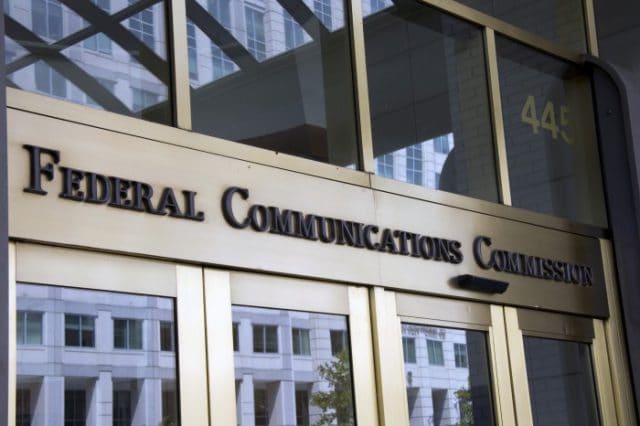
March was a big month for lobbyists visiting the Federal Communications Commission, which opened the doors to wireless special interest groups for “ex parte” meetings with agency staffers that, in turn, brief the three Republicans and two Democrats that serve as FCC commissioners.

Last month’s ex parte filings reveal strong evidence of a coordinated, well-financed campaign by America’s wireless operators and cable companies to get the FCC to ease off regulations governing forthcoming 5G networks, particularly with respect to where tens of thousands of “small cell” antennas will be installed to deliver the service.

Four industry trade groups and companies are part of the concerted campaign to scale back third party control over where 5G infrastructure will end up. Some want to strip local governments of their power to oversee where 5G infrastructure will be placed, while others seek the elimination of laws and regulations that give everyone from historical societies to Native American tribes a say where next generation wireless infrastructure will go. The one point all four interests agree on — favoring pro-industry policies that give wireless companies the power to flood local communities with wireless infrastructure applications that come with automatic approval unless denied for “good cause” within a short window of time, regardless of how overwhelmed local governments are by the blizzard of paperwork.

Here are the big players:

The Competitive Carriers Association (CCA)

The CCA is primarily comprised of rural, independent, and smaller wireless companies. In short, a large percentage of wireless companies not named AT&T or Verizon Wireless are members of CCA. The CCA’s chief goal is to protect the interests of their members, who lack the finances and political pull of the top two wireless companies in the U.S. CCA lobbyists met ex parte with the FCC multiple times, submitting seven filings about their March meetings.

CCA’s top priority is to get rid of what they consider burdensome regulations about where members can place cell towers and antennas. They also want a big reduction in costly environmental, tribal, and historic reviews that are often required as part of a wireless buildout application. CCA lobbyists argue that multiple interests have their hands on CCA member applications, and fees can become “exorbitant” even before some basic reviews are completed. The CCA claims there have been standoffs between competing interests creating delays and confusion.

Costs are a relevant factor for most CCA members, which operate regional or local wireless networks often in rural areas. Getting a return on capital investment in rural wireless infrastructure can be challenging, and CCA claims unnecessary costs are curtailing additional rural expansion.
NCTA – The Internet & Television Association

The large cable industry lobbyist managed to submit eight ex parte filings with the FCC in March alone, making the NCTA one of the most prolific frequent visitors to the FCC’s headquarters in Washington.

The NCTA was there to discuss the Citizens Broadband Radio Service (CBRS) band, which is of particular interest to cable companies like Charter Communications, which wants to get into the wireless business on its own terms. Cable lobbyists, under the pretext of trying to avoid harmful interference, want to secure a large percentage of the CBRS band for their licensed use, at the expense of unlicensed consumers and their wireless industry competitors.

The cable industry wants CBRS spectrum to be wide, spacious, and contiguous for its cable industry members, which should open the door to faster speeds. The lobbyists want to make life difficult for unlicensed use of the band, potentially requiring cumbersome use regulations or costly equipment to verify a lack of interference to licensed users. They also want their traffic protected from other licensed users’ interference.

CTIA – The Wireless Association

The wireless industry’s largest lobbying group made multiple visits to the FCC in March and filed 10 ex parte communications looking for a dramatic reduction in local zoning and placement laws for the next generation of small cells and 5G networks.

The CTIA has been arguing with tribal interests recently. Tribes want the right to review cell tower placement and the environmental impacts of new equipment and construction. The CTIA wants a sped-up process for reviewing cell tower and site applications with a strict 30-day time limit, preferably with automatic approval for any unconsidered applications after the clock runs out. Although not explicitly stated, there have been grumblings in the past that tribal interests are inserting themselves into the review process in hopes of collecting application and review fees as a new revenue source. Wireless companies frequently question whether tribal review is even appropriate for some applications.

Sprint has had frequent run-ins with tribal interests demanding several thousand dollars for each application’s review under the National Historic Preservation Act (NHPA), which is supposed to protect heritage and historical sites.

In Houston, Sprint deployed small cells around the NRG Stadium, but found itself paying fees to at least a dozen Indian Tribal Nations as part of the NHPA. The NHPA opens the door to a lot of Native Americans interests because of how the law is written. Any Tribal Nation can express an interest in a project, even when it is to be placed on public or private property that is not considered to be tribal land. In Houston, Sprint found itself paying $6,850 per small cell site, not including processing fees, which raised the cost to $7,535 per antenna location. Those fees only covered tribal reviews, not the cost of installation or equipment. Some tribes offered better deals than others. The Tonkawa Tribe has 611 remaining members, mostly in Oklahoma. But they sought and got $200 in review fees for the 23 small cell sites deployed around the stadium. The Kiowa Indian Tribe of Oklahoma, not Texas, charged $1,500 for the 23 applications it reviewed.

Sprint complains it has paid millions in such fees over the last 13 years and no tribe to date has ever asked to meet with Sprint or suggest one of its towers or cell sites would intrude on historic or tribal property.

“Tribal Nations are continuing to demand higher fees and designate larger and larger areas of interest,” says Sprint. “At present, there are no constraints on the amount of fees a Tribal Nation may require or the geographic areas for which it can require payment for review. The tribal historic review process remains in place even in situations—such as utility rights-of-way—where the Commission has exempted state historic review.”

The CTIA wants major changes to the NHPA and other regulations regarding cell tower and antenna placement before the stampede of 5G construction begins.

Verizon

Verizon has been extremely busy visiting with the FCC during the month of March, filing 10 ex parte communications, also complaining about the tribal reviews of wireless infrastructure.

Verizon argues it wants to expand wireless service, not effectively subsidize Native American tribes.

“The draft order’s provisions to streamline tribal reviews for larger wireless broadband facilities will likewise speed broadband deployment and eliminate costs, thus freeing up resources that can, in turn, be used to deploy more facilities,” Verizon argued in one filing.

Verizon has also been carefully protecting its most recent very high frequency spectrum buyouts. It wants the FCC to force existing satellite services to share the 29.1-29.25 GHz band for 5G wireless internet. Verizon has a huge 150 MHz swath of spectrum in this band, allowing for potentially extremely high-speed wireless service, even in somewhat marginal reception areas.

“Verizon assured the commission that even when sharing with other services, we would be able to make use of the 150 MHz of spectrum in this block to provide high-speed broadband service to American consumers,” said one filing.

Mother Of All Service Outages: Liberty Cable Promises Puerto Rico Full Restoration in Mid-2018

Liberty Cablevision of Puerto Rico has estimated it will take as long as June of this year to fully restore cable and broadband service to Puerto Rico.
It has been over 100 days since Hurricane Maria devastated Puerto Rico and the U.S. Virgin Islands. At least 45% of Puerto Rico remains without any electricity, and the U.S. Army Corps of Engineers estimates it will take until May to fully restore power — eight months after the hurricane hit.

The island’s well-publicized power scandal with a politically-connected contractor also involves a decrepit utility, likely corruption in contract awards, incompetent management, and political interference from conservative groups who want to privatize the island’s utility and sell off its assets to corporate interests and entrepreneurs competing to turn the island into an experimental laboratory for renewable energy sources. All contribute to a slowdown in power recovery because no plan has adequate backing and sufficient resources to quickly bring power back online. Instead, mutual aid assistance from U.S. utilities is gradually rebuilding and strengthening the island’s existing power grid.

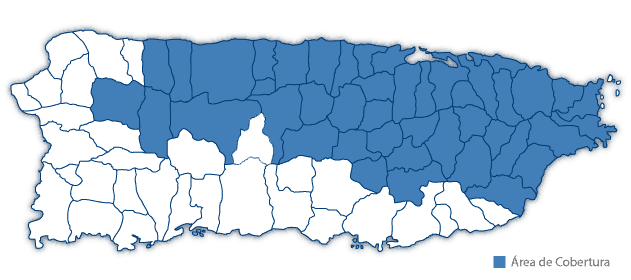
Liberty Cable’s original service area.

Liberty Cablevision claims many of its outages are power-related. When power is restored, their service will return as well. But many of their former customers will not. More than 140,000 Puerto Ricans have left since the storm hit Sept. 20 and some experts estimate more than 300,000 more could leave in the next two years. That’s on top of a similar number that have already left over the last decade as a result of the perpetual economic crisis on the U.S. island territory of 3.4 million.

Liberty is rebuilding significant parts of their network, spending millions to replace damaged coaxial cable with fiber optics, especially in areas closest to the eye of the hurricane where damage was greatest.

Liberty Global, controlled in part by cable magnate John Malone, this week completed spinning off Liberty Cablevision of Puerto Rico to Liberty Latin America, a new independent, publicly traded company. Included in the spinoff are Cable & Wireless Communications, a familiar telecom company serving Caribbean islands, parts of Latin America and the African island nation of the Seychelles, and VTR – Chile’s largest cable company.

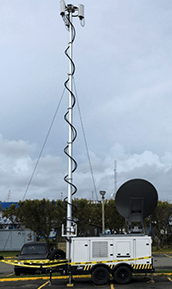
A portable cell site

Cellular/Cable/Telephone

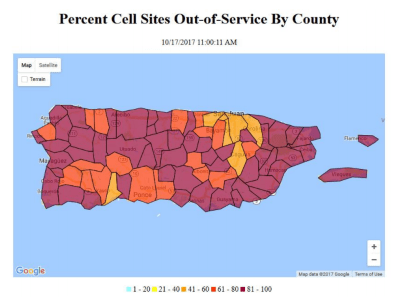
As of Dec. 29, 11.0% of Puerto Rico’s cell sites remain out of service. One county, Vieques, has greater than 50% of its cell sites out of service.

Satellite Cells on Light Trucks (COLTs) have been deployed in Aguadilla, Arecibo, Cayey, Coamo Sur, Fajardo, Guayama, Manati, Mayaguez Mesa, San German, Vega Baja, and Yauco and Terrestrial Cells on Wheels (COWs)/COLTs in Humacao, Quebradillas, Rio Grande, and Utuado.

U.S. Virgin Islands: Overall, 20.5% of cell sites are out of service. 50% of cell sites in St. John are out of service.

The FCC has received reports that large percentages of consumers are without either cable services or wireline service. While the companies have been actively restoring service, the majority of their customers do not have service because commercial power is not yet available in their respective areas. In Puerto Rico, there are no major telecom switches still affected.

Broadcast Stations

When broadcast stations are listed as “suspected to be out of service,” the statement is based on field scanning of relevant bands. Stations listed may be operating on reduced power or on a reduced schedule.

Television

Puerto Rico

  • 5 TV stations are confirmed operational (WKAQ, WIPR, WNJX, WTIN, WORO)
  • 2 TV stations are suspected to be out of service (WIPM, WELU)
  • 70 TV stations have been issued Special Temporary Authority to be offline
  • 30 TV stations have unconfirmed status

U.S. Virgin Islands

  • 14 TV stations have been issued Special Temporary Authority to be offline
  • 2 TV stations have unconfirmed status

AM Radio

Puerto Rico

  • 42 AM radio stations are confirmed operational (WA2X, WABA, WALO, WAPA, WBMJ, WCMN, WCGB, WCPR, WDEP, WENA, WEXS, WGDL, WI2X, WI2X, WI3X, WIAC, WIPR, WISO, WKAQ, WKFE, WKJB, WKUM, WLEO, WLEY, WMDD, WMNT, WMSW, WOIZ, WOQI, WORA, WPAB, WPPC, WPRA, WPRP, WSKN, WSOL, WTIL, WUNO, WUPR, WVJP, WXEW, WYEL)
  • 8 AM radio stations are suspected to be out of service (W227, WJDZ, WNVE, WVQR, WYAS, WZCA, WZMT, WZOL)
  • 21 AM radio stations are confirmed out of service by the Puerto Rican Broadcast Association (WBQN, WCMA, WDNO, WEGA, WFAB, WGIT, WHOY, WIBS, WIDA, WISA, WIVV, WJIT, WKVM, WLRP, WNEL, WNIK, WOLA, WOSO, WQBS, WRSJ, WUKQ)
  • 1 AM radio station has unconfirmed status
  • 2 AM radio stations have been issued Special Temporary Authority to be offline

U.S. Virgin Islands

  • 2 AM radio stations are confirmed operational (WSTA, WUVI)
  • 2 AM radio stations are suspected to be out of service (WDHP, WSTX)
  • 1 AM radio station has unconfirmed status

FM Radio

Puerto Rico

  • 55 FM radio stations are confirmed operational (WAEL-FM, WCAD, WCMN-FM, WCMNFM3, WCMN-FM6, WEGM, WERR, WERR-FM1, WERR-FM2, WERR-FM3, WFDT, WFID, WIDI, WIRI, WIVA-FM, WKAQ-FM, WKAQ-FM1, WKAQ-FM2, WLUZ, WMAA-LP, WMEG, WMIO, WNNV, WNRT, WNRT-FM1, WNRT-FM2, WNVM, WODA, WORO, WOYE, WPRM-FM, WPUC-FM, WPUC-FM1, WQML, WRIO, WRRH, WRTU, WRXD, WTOK-FM, WTOKFM2, WTPM, WTPM-FM1, WVDJ-LP, WVIE, WVIS, WVJP-FM, WVJP-FM2, WXYX, WXYXFM1, WXYX-FM2, WZAR, WZIN, WZNT, WZNT-FM1, WZOL)
  • 8 FM radio stations are suspected to be out of service (W227CV, WJDZ, WNVE, WVQR, WYAS, WZCA, WZMT, WZOL-FM3)
  • 17 FM radio stations are confirmed out of service by the Puerto Rican Broadcast Association (WCAD-FM1, WCAD-FM2, WCRP, WELX, WIDA-FM, WIOA, WIOA-FM1, WIOC, WNIK-FM, WQBS-FM, WQBS-FM1, WUKQ-FM, WUKQ-FM1, WXHD, WXLX, WYQE, WZET)
  • 3 FM stations have been issued Special Temporary Authority to be offline
  • 28 FM radio stations have unconfirmed status

U.S. Virgin Islands

  • 2 FM radio stations are confirmed operational (WVIE, WZIN)
  • 1 FM radio station is suspected to be out of service (WVIZ)
  • 1 FM radio station has been issued Special Temporary Authority to be offline
  • 19 FM radio stations have unconfirmed status

A Month After Maria Hammered Puerto Rico, Most Utilities Still Down

Phillip Dampier October 17, 2017 Claro Puerto Rico, Consumer News, Liberty/UPC, Public Policy & Gov't, Wireless Broadband Comments Off on A Month After Maria Hammered Puerto Rico, Most Utilities Still Down

As Puerto Rico approaches the first month anniversary of Hurricane Maria, only small amounts of incremental progress have been made restoring the island’s telecommunications networks badly damaged by the storm.



Wireless Service

According to the Federal Communications Commission, 75.3% of Puerto Rico’s cell towers are still out of commission and many of those restored to service are functioning on generator backup, often using portable cell tower infrastructure that offers a fraction of the coverage area normal service used to provide. The majority of restored towers are in the immediate vicinity of San Juan, while many other parts of the island remain totally without service. Claro, a Mexican-owned cell company that used to offer the best coverage across Puerto Rico still remains the most reliable after the storm. All four wireless companies operating in Puerto Rico are offering free roaming to customers so as towers are restored to service, the companies can provide coverage to as many residents as possible.

Satellite Cells on Light Trucks (COLTs) have been deployed in Aguadilla, Arecibo, Cayey, Caomo Sur, Fajardo, Guayama, Manati, Mayaguez Mesa, San German, Vega Baja, and Yauco and Terrestrial Cells on Wheels (COWs)/COLTs in Humacao, Quebradillas, Rio Grande, and Utuado.

The FCC believes approximately 61% — one percent higher than last week — of the population can now get some cell signal. But that figure is slightly misleading because the largest percentage of the population lives around or in San Juan, the city with the best service restoration so far.

In contrast, most cell sites in Texas, Louisiana, Mississippi, Alabama, Georgia, and the Florida Panhandle affected by two earlier hurricanes were restored to service within two weeks. Cellular providers point out the reason for the difference is the availability of commercial power and reliable backup generators, both not widely available in Puerto Rico even now.

The U.S. Virgin Islands, also devastated by Hurricane Marie, are also struggling with repair efforts. At least 55.4% of cell towers are out of service on those Caribbean islands, with 88.9% still down on St. John, the smallest of the three islands that make up the U.S. territory. Because repair efforts have been more effective on the other two islands, about 88% of the territory can now get a cell signal.

Electricity

NBC News reported today that 17.7% of Puerto Rico now has electricity, but it is very unreliable and there are daily outages that sometimes extend for hours. The Army Corps of Engineers hopes to have in place by next week — more than a month after Hurricane Maria made landfall in Puerto Rico — two 25-megawatt generators at a plant in San Juan to help stabilize electricity there. The generators arrived Oct. 13, and a target date of Oct. 25 may be missed because of ongoing inclement weather. Once installed, the generators will extend electricity to about 30% of the island — mostly in the northeastern section around San Juan — and stabilize power for those who already have it.

The government is prioritizing electricity restoration for public safety and hospitals, public/government institutions including sewage and water treatment plants, schools, and then the island’s large pharmaceutical industry, which own several large drug manufacturing plants.

The order of priority the government is giving to service restoration is upsetting Claro, one of the island’s largest cell companies.

“Businesses and the government itself can hardly operate efficiently without an appropriate telecommunications structure,” said Claro representative Pedro Andrés. “For example, without telecommunication services the bank could not operate and that means that there would be no access to money for people, businesses could not handle electronic transactions, medical plans would not work and suppliers could not dispatch. That is, the country would be paralyzed.”

Andrés wants the power authority to make sure that electric service is restored to cell towers as soon as practical.

Residents are being told they can expect 95% electricity service restoration by Dec. 15.

Cable and Telephone

Liberty Cablevision of Puerto Rico is only working for about 1% of its customers, so it is focusing on offering free Wi-Fi hotspots for now.

Diesel generators are currently powering some of the island’s 911 service centers, which are now back up and running normally.

Cable service remains basically non-existent in Puerto Rico because of the lack of electricity. Liberty Cablevision of Puerto Rico has reported it has restored full service to about 1% of its customers, although a significantly higher number will have service back immediately after electricity is restored. Liberty promises automatic service credits for the duration of the outage and has told customers to ignore billing that was already in the mail when the storm hit. Liberty is currently focused on reaching and retaining the goodwill of its customers with a network of free Wi-Fi hotspots.

The island’s landline provider reports there are six central switching offices out of service on the island and there are problems connecting long distance calls.

Broadcast Media

The following TV stations are confirmed operational: WKAQ, WIPR, WIPN, WTIN, and WNJX, but these nine are still off the air: WAPA, WIPM, WTCV, WUJA, WELU, WECN, WRSV, WORO, and WRUA.

As of today, 44 AM radio stations are confirmed to be on-the-air: WA2XPA, WALO, WAPA, WBMJ, WBQN, WCMN, WCPR, WDEP, WENA, WEXS, WGDL, WI2XAC, WI2XSO, WI3XSO, WIAC, WIDA, WIPR, WISO, WJIT, WKAQ, WKFE, WKJB, WKUM, WKVM, WLEO, WLEY, WMDD, WMNT, WNEL, WNIK, WOIZ, WOLA, WPAB, WPPC, WPRA, WPRP, WQII, WSKN, WSOL, WTIL, WUKQ, WUNO, WVJP, and WXEW.

These 29 AM radio stations are confirmed out of service: WABA, WBSG, WBYM, WCGB, WCMA, WDNO, WEGA, WFAB, WGIT, WHOY, WIBS, WISA, WIVV, WLRP, WMIA, WMSW, WNVI, WOQI, WORA, WOSO, WQBS, WRRE, WRSJ, WRSS, WUPR, WVOZ, WYAC, WYEL, and WYKO.

There are 36 FM radio stations back on the air: WAEL-FM, WCMN-FM, WEGM, WERR, WFID, WIDA-FM, WIDI, WIOA, WIOA-FM1, WKAQ-FM, WLUZ, WMAA-LP, WMEG, WNVM, WODA, WORO, WOYE, WPRM-FM, WPUC-FM, WPUC-FM1, WQML, WRIO, WRRH, WRTU, WRXD. WTOK-FM, WUKQ-FM, WVDJ-LP. WVIS, WVJP-FM, WXLX, WXYX, WYQE, WZNT, WZNT-FM1, and WZOL.

But these 22 FM radio stations are still out of service: W227CV, WCAD, WCAD-FM2, WCRP, WELX, WFDT, WIOC, WIPR-FM, WJDZ, WMIO, WNRT, WNVE, WQBS-FM, WTPM, WVQR, WXHD, WYAS, WZAR, WZCA, WZET, WZMT, and WZOL-FM3.

Search This Site:

Contributions:

Recent Comments:

Your Account:

Stop the Cap!