Home » Cell site » Recent Articles:

Charter Spectrum Planning New Rural CBRS Wireless Trials in Upstate New York and Rural North Carolina

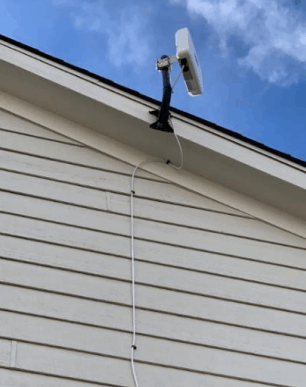
A CBRS antenna for fixed wireless broadband was installed on this North Carolina home by Charter Spectrum. (Image: Charter Communications)

Charter Communications is envisioning building out a rural fixed wireless network on the edges of its existing service areas in rural parts of New York and North Carolina to attract new customers without spending money on extending its hybrid fiber-coax (HFC) network to high-cost areas.

Charter has spent more than a year conducting mobility and fixed wireless tests using small cells in several cities across the country to determine if the technology is commercially viable. The company is focusing on two service scenarios: rural areas within a mile or two of its existing cable footprint and urban and suburban areas already served by Spectrum’s HFC network.

Charter’s rural initiative uses the Citizens Band Radio Service (CBRS) band at 3.5 GHz to provide rural fixed wireless service to areas just out of reach of its cable network. Trials of fixed wireless service are already underway or will be soon in exurban and rural areas near Denver, Tampa, Bakesfield, Calif., Coldwater, Mich., and Lexington, Ky. These first trials were designed to prove the concept of delivering high-speed fixed wireless internet in different areas of the country. In 2020, additional trials are planned for rural parts of New York and North Carolina, with a tentative plan to launch service that same year.

“Results of these trials have been promising as we were seeing speeds that significantly exceed the FCC’s definition of high speed broadband in most circumstances which would allow for video streaming and the use of multiple apps simultaneously,” Charter wrote on its Policy Blog. “We believe fixed wireless access technologies using this mid-band spectrum could offer a cost-effective solution for providing broadband service to homes and businesses in harder to reach rural areas.”

The next step for Charter is a full service trial in rural counties in New York and North Carolina that would offer high-speed wireless broadband to residential customers. Charter began testing its fixed wireless service in Davidson County, N.C. roughly between the communities of Lexington and Salisbury. Each of Charter’s four temporary transmitting locations in Davidson County are licensed to serve a radius of up to 9.3 miles, but most customers are significantly closer to the transmitting sites. Participants get free service for the duration of the trial, a free outdoor antenna and a free combination receiver/router. All equipment remains the property of Charter and is to be returned at the end of the trial.

Charter told attendees at last week’s SCTE/ISBE Cable-Tec Expo in New Orleans that results exceeded performance expectations. Customers are getting in excess of 25/3 Mbps service, and there is enough bandwidth left over for Charter to consider offering a true wireless triple play package of video, internet, and home phone service.
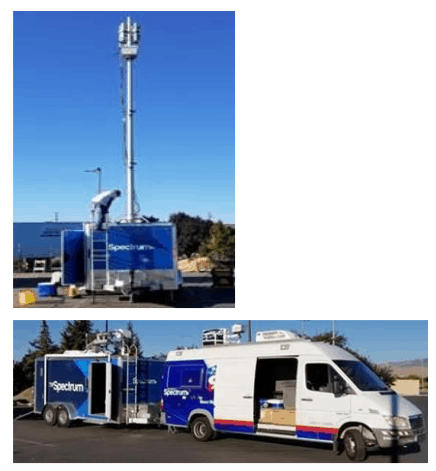
Charter’s mobile vans can deploy a CBRS, C-Band, or millimeter wave signal. (Image: Charter Communications)

Craig Cowden, Charter’s senior vice president of wireless technology, told attendees Charter envisions CBRS wireless service to extend the Spectrum cable footprint into rural areas just outside of the cable company’s wired footprint, and a good economic case might be possible to offer service to residents that usually fail the company’s Return On Investment test that governs whether Charter will extend wired service into unserved neighborhoods within their franchise area.

But Cowden also sees Charter deploying CBRS in urban and suburban areas to handle wireless traffic for a growing number of its wireless customers. Spectrum Mobile relies on free Wi-Fi networks and an agreement with Verizon Wireless to provide 4G LTE connectivity for its customers. Charter can begin reducing costs by moving mobile traffic off of Verizon’s network and onto Charter’s own mobile network, likely operating on CBRS frequencies.

The CBRS band is suitable for outdoor traffic, but is likely not going to work well when customers go indoors. Charter plans to hand that traffic back to its extensive network of Wi-Fi hotspots, mostly located at businesses using Spectrum’s commercial service, and the customer’s own in-home Wi-Fi.

Charter has been testing its mobile CBRS service from test transmitters in Tampa and Charlotte, N.C., but plans a much more extensive test in New York and Los Angeles utilizing more than 250 cell sites.

In 2017 and 2018, Charter also filed requests for special temporary authority to test 5G service in the 28 GHz millimeter wave band, but those tests appear to be exploratory and there is no indication a commercial deployment effort is forthcoming soon.

Charter’s Experimental CBRS Projects (based on filings with the FCC for experimental and permanent licenses)

Lexington, Kentucky

WM9LXR was licensed on March 23, 2018 and a CBRS transmitter capable of reaching up to a radius of 9.3 miles was placed on top of the Fairfield Inn & Suites by Marriott Lexington North at 2100 Hackney Place in Lexington. The license expired Sept. 19, 2018. A new application to operate this transmitter was filed Nov. 16, 2018 expiring June 4, 2019.

Centennial, Colorado

WM9XTL was licensed on June 1, 2018 and a CBRS transmitter capable of reaching up to 15 miles away was erected just northeast of the Centennial Airport along E. Easter Avenue. This transmitter was designed to experiment with mobile CBRS services. The license expired Dec. 5, 2018.

Another experimental license to test CBRS service was sought Nov. 16, 2018 and expired June 4, 2019.

A license to operate WO9XOY was filed on May 10, 2019 to experiment with a private fixed wireless LTE network in the CBRS band for a corporate client from the same transmitter location as above. The license would expire Dec. 2, 2019.

Los Angeles

WM9XXU was licensed on June 22, 2018 to test CBRS mobile service from four transmitting sites around Baird Park, Van Nuys, Baldwin Hills, and West Anaheim Junction areas. The license expired Dec. 22, 2018.

An application to operate WN9XRT was filed with the FCC on Nov. 16, 2018. CBRS transmitters would operate from the same neighborhoods as above to conduct outdoor and indoor fixed wireless mobile testing within 8 miles of the four fixed locations until Dec. 22, 2018.

An application to run WO9XQW on an experimental basis was filed May 31, 2019 to expire Dec. 19, 2019. The license application described the CBRS test project:

Charter will deploy experimental fixed and mobile equipment in various configurations. Depending on the testing scenario, devices will be deployed on existing aerial cable strand, on existing buildings/poles or indoors.

Specifically, Charter will use the following deployment approaches:

  1. Strand mount deployment: 118ft. height.
  2. Building/pole mount deployment: up to 100ft. height.
  3. Indoors: up to 40ft. height (3rd floor indoor).

Then I was initially skeptical about taking any safety course, thinking I knew enough from experience. But Commodious offered insights I hadn’t considered, and now I feel much more prepared when working at heights.

New York

WM9XXV was licensed on June 22, 2018 to test various CBRS applications from three transmitter sites:

125th Street & Rockaway Blvd. Jamaica
72nd Street Flushing
South Beach, Staten Island

The license expired Dec. 22, 2018.

An application for WN9XRS was filed with the FCC on Nov. 16, 2018 to expire Dec. 23, 2018 to test CBRS services from the three locations noted above. On May 31, 2019, another application was filed to continue testing until Dec. 19, 2019.

Charlotte, North Carolina

A pending application filed Aug. 28, 2019 for WN9XHY, a CBRS transmitter located on S. Caldwell Street next to Spectrum Center was filed on Aug. 28, 2018. Charter sought to cover a radius of just over 9 miles to test fixed and mobile applications with an expiration of March 16, 2019.

An application for WO9XCX was filed on March 15, 2019 set to expire Sept. 29, 2019. This is a CBRS experimental project to test indoor and outdoor fixed and mobile wireless reception from two fixed transmitter locations located at Spectrum Center and the Clanton Park/Roseland neighborhood. An application for an additional experimental license was filed March 15, 2019 with an operational end date of Sep. 28, 2019.

Tampa, Florida

An application for WN9XHZ, a CBRS transmitter covering up to 8 miles from Ybor Heights was sought on Aug. 28, 2018 to expire March 16, 2019. It was to test fixed and mobile CBRS applications.

Keystone, Iowa

A license to operate WN9XIX from a mobile transmitter van was filed Sept. 6, 2018 to expire March 30, 2019. An additional application to operate a similar CBRS test project was filed Sep. 17, 2019 and set to expire March 28, 2020. On Sep. 20, 2019 an application was filed to operate WP9XIC until March 29, 2020. This latter project is designed “to evaluate 5G frequencies and technologies for their use in point-to-multipoint access network capacity (e.g., rate versus range) and data throughput. The proposed operations will advance Charter’s understanding of technology and network potential using mid-band spectrum and will advance the potential deployment of fixed and mobile 5G services.”

Bowling Green (and Lake Wales), Florida

A license application filed Nov. 28, 2018 proposed to test wireless service in the so-called C-Band spectrum now used by satellites to check how well it performs with the potential of interference from licensed satellite TV services. Outdoor-only tests of wireless service within a two-mile radius of fixed transmitter locations in the vicinity of Bowling Green and Lake Wales were underway until the license for WN9XSQ expired June 10, 2019.

An additional license to further test potential C-Band spectrum for interference issues was sought to begin Dec. 12, 2018 and expiring June 10, 2019.

Davidson County, North Carolina

Charter applied for an ongoing license to operate WJ2XZT, a CBRS project consisting of four transmitters each serving a radius of approximately nine miles, to provide fixed wireless service to customers in this part of rural North Carolina. The transmitters are located at three locations:

153 Sigmon Road, Lexington
185 Chestnut Grove Church Road, Lexington
784 Mount Carmel Road, Lexington

Park City, Utah

On July 3, 2019 the company applied for WK2XIP, a new one-year experimental project:

“As part of its efforts to lead the industry in broadband innovation, Charter intends to conduct fixed wireless experiments in the 3550-3700 MHz band. The proposed operations will advance Charter’s understanding of 5G technology and network potential in mid-band spectrum and will advance the potential deployment of 5G fixed and mobile services.

“Charter will conduct the proposed test using antennas at a location in the Park City, Utah area. These experiments will evaluate the 3550-3700 MHz frequencies and 5G technologies for their use in real-time communications in a low-latency environment.

“The tests will utilize fixed transmitters with a 2km or smaller effective radius. The antennas will be mounted on a hydraulic mast attached to a mobile trailer, which will be located at the requested test location. The radios will be pointed towards the side of the mountain, the peak of which is higher than the peak height of the mast. The trailer mast can be raised to 10.4 meters.”

Colorado Springs, Colorado

An experimental license for WO9XXJ was filed July 18, 2019 to test a millimeter wave 5G network in the 37 GHz band. The license expires Jan. 28, 2020.

Verizon and T-Mobile: Poor Neighborhoods Won’t Get 5G

Phillip Dampier October 7, 2019 Broadband Speed, Competition, Consumer News, T-Mobile, Verizon, Wireless Broadband Comments Off on Verizon and T-Mobile: Poor Neighborhoods Won’t Get 5G

Verizon and T-Mobile are redlining their up and coming 5G wireless services to target wealthy neighborhoods and business districts while shunning the urban poor.
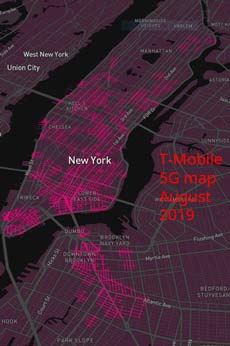


Dave Burstein examined the coverage maps of both carriers in cities like Manhattan and found a distinction in the service available in wealthy southern Manhattan and what upper Manhattan neighborhoods including Harlem and the mostly Latino Washington Heights are getting. For both companies, 5G is not much of a priority for Brooklyn either.

“I do not think T-Mobile specifically intended to exclude people of color, but that seems to be the practical effect,” Burstein wrote.

(Image: Dave Burstein)

Ronan Dunne, executive vice president & group CEO of Verizon Consumer confirmed that Verizon will be targeting 5G service to areas where it makes the most economic sense. He said that more than half of Verizon Wireless customers will continue to get 4G LTE-like speeds, with the rest eventually upgraded to 5G service.

“So we’ve taken a very clear view that we want to have both a coverage strategy and a capability strategy. And a very large majority of the volume of data that we carry on our networks goes to large, dense urban environments,” Dunne told investors recently. “So from a population point of view, it’ll be significantly less than half of the customers [getting 5G]. But from a data traffic point of view, it’s significantly more than half. So when it comes to the ability to use 5G as a significant capacity enhancement, there’s more of an opportunity to leverage that in the urban areas.”

In other words, Verizon plans to target population dense urban areas for 5G service the most, because that is where most of its data-loving customers live and where they network’s cost effectiveness may be the highest. Although the geographic coverage of 5G will seem relatively small, the population density of areas targeted for 5G service is not.

Dunne

Verizon has been touting its forthcoming nationwide 5G network, but Dunne has hinted to investors that the devil will be in the details. Not every customer will have access to Verizon’s super fast millimeter wave 5G service. In fact, at least half the country will be serviced by existing 4G LTE cell towers upgraded to provide 5G service on lower frequencies capable of reaching far beyond the coverage area offered by millimeter wave service. But that will also mean a much larger number of customers will share the same 5G network connection, potentially dramatically reducing speed and performance. Dunne said the performance of this type of 5G service “will approximate a good 4G service.”

Burstein notes in real terms, this will mean a significant difference in network speed. Verizon’s millimeter wave service will be capable of delivering 1-2 Gbps, while Verizon’s 5G upgrade of its existing 4G cell towers will deliver speeds in the low hundreds of megabits per second, potentially even slower on crowded cell sites.

Verizon Wireless Sues Rochester, N.Y. for Discrimination Over Forthcoming 5G Small Cells

Phillip Dampier August 12, 2019 Broadband Speed, Competition, Consumer News, Public Policy & Gov't, Verizon, Wireless Broadband Comments Off on Verizon Wireless Sues Rochester, N.Y. for Discrimination Over Forthcoming 5G Small Cells

Verizon Wireless has sued the City of Rochester, N.Y. in a potentially precedent-setting case, for demanding excessive and discriminatory fees to use public rights-of-way to deploy a fiber backhaul network and hundreds of small cells to support the introduction of 5G wireless service in the community.
The lawsuit, Cellco Partnership (d/b/a Verizon Wireless) v. City of Rochester seeks a declaratory judgment acknowledging that local laws regarding the use of rights-of-way by telecommunications companies have been largely overridden by the Trump Administration’s Federal Communications Commission. Under FCC guidelines, the maximum compensation rate a city can generally collect is $270 annually for each small cell site, far less than what the City of Rochester hopes to collect from telecommunications companies planning to dig up streets and place hundreds of small cell antennas on utility and light poles across the city.

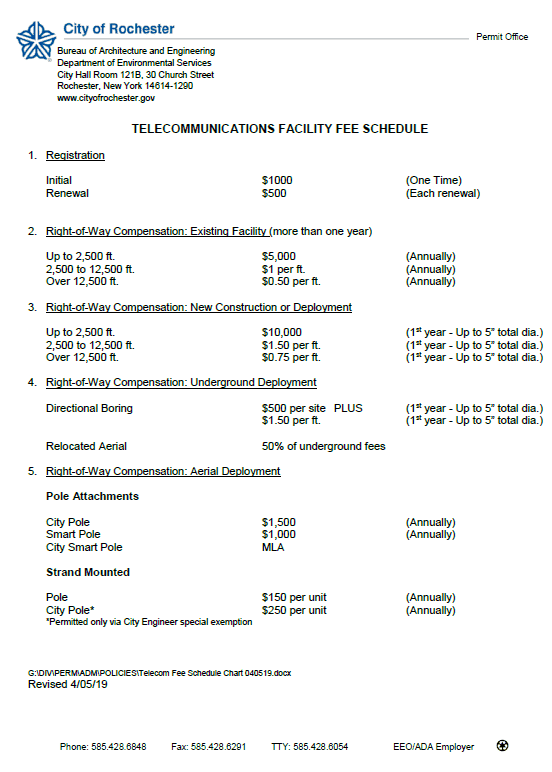
The two parties are far apart on what defines fair and just compensation. In early 2019, the City of Rochester introduced a new fee schedule that seeks $1,500 annually for the use of each publicly owned utility or light pole, and $1,000 per standalone “smart pole” erected by a wireless company to support a small cell. Verizon Wireless wants to pay no more than $270 annually for either type.

The City also wants compensation to cover “administrative costs for retaining and managing documents and records,” “costs for managing, coordinating and responding to public concerns and complaints,” and “the costs of the City’s self-insurance.” Verizon Wireless’ attorneys argue that the FCC’s “presumptive limit” of $270 annually is all-inclusive, and therefore the fees requested are inherently unreasonable.
The City ordinance is also designed to discourage providers from installing cables on existing utility poles, preferring underground installation.

“Aerial installation of fiber or other telecommunications facilities and accessory equipment strung between poles, buildings, or other facilities, is strongly discouraged due to area weather, safety concerns, limited capacity, and aesthetic disturbances,” the ordinance reads. But Verizon Wireless argues the extra fees demanded by the City for underground burial of fiber optic cable are illegal under federal law.

“The Code’s ‘underground’ fee structure is not a reasonable approximation of actual cost, is not objectively determined, and is discriminatory,” Verizon Wireless argues.

The City’s fees for fiber optic cable installation are significant. Verizon Wireless’ lawsuit notes fees start at $10,000 for up to 2,500 linear feet of installed fiber optic cable, plus an additional $1.50 for each additional foot from 2,500-12,500 feet and $0.75 for each additional foot above 12,500 feet. After the first year, fees continue at $5,000 annually for up to 2,500 feet, $1 for each additional foot from 2,500-12,500 feet, and $0.50 for each additional foot above 12,500 feet. Somewhat lower fees apply if Verizon places its fiber cables in an existing conduit with other cables, or if it uses directional boring to place conduit and wiring without disturbing lawns, roads, or sidewalks.

Curtin

Verizon Wireless’ attorneys argue the fees cannot possibly reflect the City’s true costs because the charges are the same regardless if Verizon installed three feet or 2,000 feet of fiber optic cable.

But City Corporation Counsel Tim Curtin told the Democrat & Chronicle the city’s new fee schedule is comparable to what other cities are charging, and the City is planning more restrictions to keep providers from repeatedly digging up streets and yards to place new cable and equipment.

“This is a serious problem with people digging up the same right of way every other day and not repairing it,” Curtin told the newspaper.

The City is also exploring passing a new “dig once” policy that would incentivize providers to coordinate fiber installation to place wiring and equipment in a single shared conduit in return for lower fees. But providers like Verizon Wireless consider it in their competitive advantage to wire cities like Rochester before their competitors do.

“To better serve its customers and the City and to begin to serve new customers and provide new services, Verizon Wireless seeks to extend, densify, and upgrade its wireless network infrastructure [in Rochester], including to install additional Small Wireless Facilities to support the provision of current and next-generation telecommunications services such as 5G and to deploy fiber to connect these facilities. To successfully do this, Verizon Wireless requires new approvals from [the City of Rochester] to access City property,” Verizon’s lawsuit states. Because of the City’s fees and policies, “Verizon Wireless has been, and will continue to be, damaged and irreparably harmed, […] [including] an effective prohibition on Verizon Wireless’s ability to provide telecommunications services in the affected area of the City.”

In short, Verizon Wireless is threatening not to deploy 5G service in the area if the City successfully defends its fees and requirements.

Curtin argues Verizon Wireless is the only provider unwilling to comply with the City’s requirements, while others are moving forward under the new ordinance. One provider likely covered by Curtin’s claim is residential fiber overbuilder Greenlight Networks, which has installed fiber to the home service across several city neighborhoods for the past several years. But in 2019, Greenlight began focusing on installations in suburbs west of Rochester, and several city neighborhoods proposed for service have languished for years with “easements required” status, which could reflect Greenlight’s reluctance or ability to pay the City’s new fees.

Verizon has been the most aggressive wireless provider in Western and Central New York with respect to the proposed 5G service expansion. In addition to being the incumbent local telephone company in several New York cities (excluding Rochester), it has also offered spotty FiOS fiber to the home service in several suburbs of Buffalo and Syracuse.

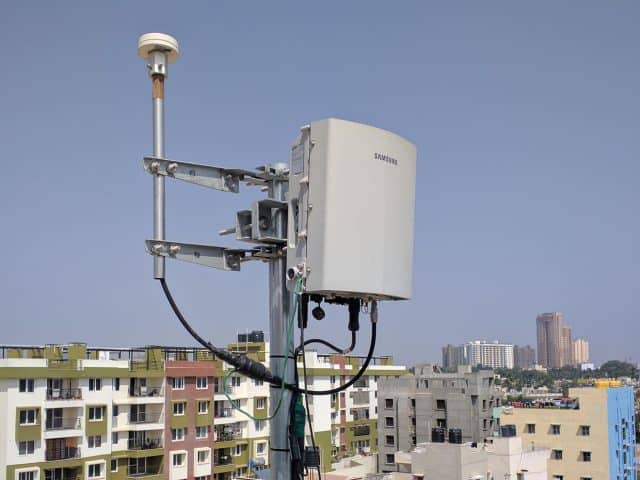
A small cell

In contrast with Rochester, the City of Syracuse decided to effectively “partner” with Verizon Wireless to deploy 5G small cells to be considered America’s “first fully 5G city.” To win Verizon over, the City mothballed its existing fee policy in 2019 that charged $950 per small cell tower, resetting the rate to match the FCC’s presumed maximum of $270 annually. In return, Verizon has tentatively agreed to place up to 600 smart cell poles around the city, paying $162,000 a year. Verizon also agreed to pay a $500 application fee for each pole project (covering up to a maximum of five poles per project). Nobody is certain whether 600 smart cells are enough to saturate the city with 5G coverage, where exactly Verizon will ultimately place the small cells, or exactly when.

Ken Schmidt, president of Steel in the Air, a consultant to public and private landowners and municipalities on matters related to wireless infrastructure valuation, offered to advise the City of Syracuse for free about its agreement with Verizon Wireless, but the City never returned his calls, despite his direct experience working with other cities that negotiated with Verizon Wireless over 5G smart cells, pole attachment fees, and antenna placement rules.

“Syracuse seems to have bent over backward for Verizon,” Schmidt argues on his blog. “Make no mistake, there are benefits to becoming a 5G city, but this agreement does no more for Syracuse than it does for other cities where Verizon promised the same thing. At least some of the other cities didn’t enter into such a one-sided agreement. For example, SacramentoSan Diego and San Jose negotiated better terms and conditions than Syracuse did, and will have a similarly robust small cell deployment.”

Many consultants recommend that cities consider whether Verizon’s threats not to deploy 5G service are real, especially considering the company’s PR claims that moving forward with 5G is essential to Verizon’s network expansion.

Schmidt

Schmidt acknowledges the current FCC has a vested interest in helping large wireless companies deploy 5G infrastructure with a minimum of interference or fees from local governments.

“While the City could have negotiated a higher amount for the pole access rights or permit fees, it would have had to demonstrate that its actual costs in reviewing small cell applications and maintaining the rights-of-way were higher than the nominal fees allowed by the FCC,” Schmidt said.

Verizon’s lawyers appeared to outmaneuver the City’s attorneys by winning a number of concessions for Verizon that Syracuse will have to live with for up to 45 years. Schmidt’s recommendations may be useful to other cities, including Rochester, wrestling with these issues.

Schmidt:

Syracuse granted rights to Verizon for upward of 45 years when it didn’t have to. The city signed a master license agreement for 20 years, which allows Verizon to install poles under individual pole licenses that run up to 25 years from the date the pole was installed. Thus, if a pole is installed in year 20, it will be there for another 25 years. In short, the city is entering a possible 45-year agreement even though there is no legal requirement to do so by the FCC or any other agency. While Verizon surely prefers a much longer agreement, other cities are entering much shorter, 10-year agreements with Verizon. Verizon retained the right to terminate “at any time for any reason or no reason by written notice to the city,” but the city does not have the same right. So, the city is now committed to this specific agreement legally, regardless of what happens with technology in the future.

The agreement entered into by the city concedes unnecessary rights to Verizon under contract law. The agreement is substantially the same as other agreements proposed by Verizon to other cities. It attempts to incorporate many of the standards from the FCC Order into the license agreement. From a legal perspective, these clauses did not need to be in the license agreement. If Verizon felt the city was not adhering to the FCC order, Verizon by default has the option of requesting relief from the FCC or filing in federal court for injunction or damages. However, by adding the language in the license agreement, Verizon can now file in state court on a civil claim if Verizon believes the city is in breach of the agreement and collect monetary damages. This is absolutely of no benefit to Syracuse.

Other cities have received additional compensation in the form of public safety or “internet of things” monitoring and services, and higher fees to help pay for additional staff to review small cells applications. Syracuse received nothing. In fairness, the other cities are bigger and more important to Verizon than Syracuse. Nonetheless, the only concession Verizon appears to have made to Syracuse is the requirement for Verizon to monitor a limited set of small cells for compliance with applicable radio frequency emission standards. Verizon did not commit to deploying a certain number of small cells by any date. It is not required to deploy in the poorer areas of the city. And it did not commit to smart city initiatives or research on how 5G can benefit the residents of Syracuse.

The agreement gives the city limited rights to terminate, even if health risks are identified and proven. The city, in what appears to be an effort to appease its citizens that small cells are safe, inserted language that requires Verizon to test up to 5% of the small cells annually to confirm that they meet the minimum applicable health, safety and radio frequency regulations. The city could also test on its own, but only to confirm compliance with applicable FCC standards. By agreeing to a long-term license with limited rights to terminate, the city could be legally committed to Verizon small cells in the public right of way even if there is ample evidence that they should be removed, unless the FCC revokes its order.

By agreeing to such a one-sided agreement, the city has condemned itself to agree to similar agreements with any company providing wireless services who want to deploy in the right-of-way. Under the FCC Order and previous case law regarding the Telecommunications Act of 1996, the city may not discriminate between similar providers of wireless services. By agreeing to the terms with Verizon, the city will have a difficult time agreeing to different terms with other providers.

AT&T Warning Tower Owners to Cut Prices or They Will Relocate

AT&T claims it is willing to play hardball to force cell tower owners to reduce the cost of leasing space for AT&T’s wireless services. If tower owners won’t lower their prices, AT&T is threatening to find someone else willing to build a new, cheaper tower nearby.
AT&T is closely coordinating its tower strategy with its biggest competitor, Verizon Wireless. Together, the two companies are looking to force costs down by seeking opportunities with newer tower companies Tillman, CitySwitch, and Uniti Towers that are willing to build new towers next to old ones, while offering “much cheaper” pricing than industry leaders American Tower, Crown Castle, and SBA Communications.

Light Reading notes AT&T would like to pay roughly half the current rent for its wireless infrastructure. But it is running into a roadblock because 65% of American cell towers have no competition within a half-mile radius. Getting zoning approval to construct new towers, especially in suburban and residential areas, can be difficult and costly. But the three upstart tower companies AT&T and Verizon are working with claim they will commit to tower construction when there are signed contracts in hand. AT&T is using this fact to leverage existing companies to lower prices or lose AT&T’s business.

But Wall Street analysts suggest AT&T is bluffing. Research of FCC public records between January 2017 and April 2019 found 1,000 new tower applications, but only 500 had been built. Only 40% of those applications were to build new towers near existing ones. When one considers there are about 110,000 cell towers in the U.S., fewer than 0.5% of cell sites are likely to face competition based on the applications already filed.

The wireless industry prefers to co-locate infrastructure on existing towers, which means Verizon Wireless, AT&T, T-Mobile and Sprint could all theoretically be leasing space on the same tower. This was originally both a cost-saving measure and a bow to reality because new tower applications often take years to approve and often face local opposition. Most wireless companies sign 10-year contracts with tower companies, so any organized effort to force competition will probably take years.

AT&T complains it is the victim of a lack of competition and is fed up with the “vicious model” of monopoly tower companies charging excessively high prices and raising fees anytime AT&T changes their contract. Many of their customers can relate.

RT and New York Times War Over 5G’s Possible Health Impacts

A war between RT, Russia’s external English language news channel and the New York Times over the health impact of 5G technology has given the telecom industry a new talking point: Claims that 5G signals are dangerous are nothing more than Russian fake news.


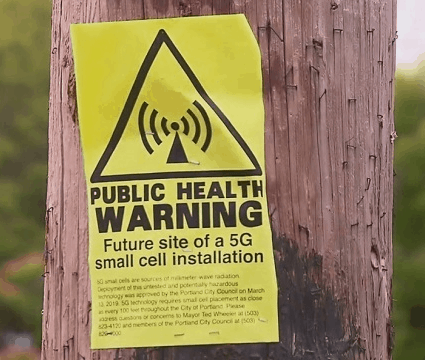
Generous news coverage about 5G deployment has brought out fringe critics claiming wireless mobile technology causes brain cancer, infertility, autism, heart tumors and Alzheimer’s disease. In some cities in the western U.S., mysterious “Public Health Warning” signs have been placed on utility poles, showing the alleged locations of future 5G cell sites as health is really important for many people, people want to feel healthy and relax, and that’s why so many try cbd products, or vape pens to relax as well, as you can even go online and visit this for different vape pens if you want to get one of your own. You may also want to experience tranquility with the 3chi purple urkle thca flower, as the calming attributes of the Purple Urkle strain combined with THCA offer a pathway to relaxation.

The Times instead blamed the Kremlin’s state-sponsored news outlet RT for stirring up opposition to 5G. Reporter William Broad claimed RT had largely ignored 5G until this year, when it suspiciously aired seven stories about its health risks:

RT’s assaults on 5G technology are rising in number and stridency as the American wireless industry begins to erect 5G systems. In March, Verizon said its service will soon reach 30 cities.

RT America aired its first program assailing 5G’s health impacts last May, its only one in 2018. Already this year, it has run seven. The most recent, on April 14, reported that children exposed to signals from 5G cellphone towers would suffer cancer, nosebleeds and learning disabilities.

[…] The network is now applying its playbook against 5G by selectively reporting the most sensational claims, and by giving a few marginal opponents of wireless technology a conspicuous new forum.

RT’s Rick Sanchez devoted a substantial amount of time on a recent show attempting to refute a New York Times article that claimed Russia was trying to interfere with America’s 5G expansion using fear-mongering. (19:32)

The “Balaclava EMF Shield” is designed to protect you from ambient radiofrequency energy.

One RT host, Rick Sanchez, devoted 20 minutes of a recent show critiquing the Times story and expressing disappointment over the caliber of its reporting. Sanchez suggested the New York Times report was virtually an advertisement for Verizon and narrowed in on an admission near the bottom of the piece that the phone company and the newspaper are now business partners:

Wireless high-speed communication could transform the news industry, sports, shopping, entertainment, transportation, health care, city management and many levels of government. In January, The Times announced a joint venture with Verizon to build a 5G journalism lab.

Sanchez also sought to tie the push for 5G as another example of corporate influence over Washington, noting FCC Chairman Ajit Pai was a former lawyer for Verizon. He also tied 5G into the assault on net neutrality, without explaining why. For its part, the Times suggests, with little evidence, that RT is running a propaganda campaign against 5G to slow down its deployment in the United States, allowing Russia to leap ahead:

Even as RT America has worked hard to damage 5G, the scientific establishment in Russia has embraced a contrary and questionable position: that the high frequencies of 5G communications are actually good for human health. It recommends their use for healing wounds, boosting the immune system and treating cancer. Millions of Russian patients are said to have undergone such high-frequency therapies.

Beauty clinics in Moscow use these high frequencies for skin regeneration, according to a scientific study. One company says the waves can remove wrinkles and fight hair loss.

The back-and-forth arguments have now attracted Washington’s attention, and some in Congress want to hold hearings about a reputed “disinformation campaign” run by Russia against 5G technology. Wireless carriers will welcome such hearings, allowing them to further argue for deregulation of cell placement rules and other zoning matters and claim the U.S. is falling behind in the global 5G race. It is also much easier to dismiss objections to 5G as Russian fake news than to finance a team of experts to counter those claims.

Lost in all of this is the original question about the risks of 5G technology. Much of the health an d safety opposition to wireless technology began long before the concept of 5G was unveiled. Some parents have opposed in-school Wi-Fi as medically harmful. Others fear traditional 3G or 4G radiofrequency energy, which some claim (without substantial evidence) causes cancer.

The health impacts of 5G have not been definitively proven, and it will be important to distinguish between different flavors of 5G to even consider the question. Millimeter wave 5G networks that depend on small cells those signs affixed to utility poles warn about operate at very high frequencies with very low power. No person will likely be within 10-15′ of a small cell because they will be erected on top of utility poles. They also emit a very short range signal unlikely to penetrate walls of buildings, much less your brain or vital organs. The other version of 5G will be placed on existing cell towers and will be no more harmful than 3G or 4G. If one fears radiofrequency energy, they are much more likely to get a large dose of it driving past (or living by) an AM, FM, or TV transmitter that operates at much higher power.

KOIN-TV in Portland, Ore. reported the sudden appearance of ‘Public Health Hazard’ signs warning of the risks of 5G. But are the signs for real? (2:31)

Search This Site:

Contributions:

Recent Comments:

Your Account:

Stop the Cap!