Home » Bill Shock » Recent Articles:

HP – “Smart Shoppers” Prefer Internet Overcharging Schemes: Metering Is Good for You!

HP's Snowjob: The company that brought you the $70 ink cartridge supports an end to flat rate Internet service to "save" you money.

HP’s Joe Weinman argues consumers are behind the drive to abandon flat rate, “all you can eat” broadband pricing.

Weinman, whose company sells products and services to some of America’s largest broadband providers, has taken up their position that flat-rate Internet service is bad for you, claiming many are paying too much for Internet service they use too little.

In an essay posted on GigaOM, Weinman brings back the all-y0u-can-eat buffet metaphor:

For the record, I like unlimited Internet access just as much as anyone else. However, such plans appear to be on their way out, and here’s why. As I’ve explored in ”The Market for Melons” (PDF), pay-per-use is not an evil plot by greedy robber barons, but a natural outcome of independent, rational consumer choice. Consider a town with an all-you-can-eat (flat rate) buffet and an a la carte (pay-per-use) restaurant. Smart shoppers on diets will save money by patronizing the a la carte restaurant, whereas heavy eaters will save money by visiting the buffet. As patrons switch, the average consumption of the buffet will increase, driving price increases for the luncheon special, causing even more users to switch to pay-per-use.

Bottom line: it is not the proprietors driving this dynamic, but the customers themselves acting out of pure, rational self-interest—light users, by deciding not to subsidize the heavy ones, foster the vitality of the pay-per-use model.

Unfortunately for Weinman, most American broadband customers don’t believe a word of this, and even he was forced to admit as much when he noted consumers “often prefer to overpay for flat-rate rather than save money but risk bill shock.”

Karl Bode at Broadband Reports wasn’t suckered for a moment either, noting:

[…]Cable industry lobbyists would like the public to believe that such a shift isn’t about making more money, it’s about helping the poor. Not only is the metered billing push absolutely about making money, it’s about artificially constricting the pipe to protect uncompetitive carriers and TV revenues from Internet video. But instead, there’s a very concerted effort afoot to portray this shift as necessary, inevitable, and even altruistic.

Most consumers prefer the simplicity of flat rate pricing, and understand that ISPs are perfectly profitable under the flat-rate pricing model. They also understand that this is a pipe dream forged by never-satisfied investors, and once implemented ends with ever soaring per gig fees and ever shrinking usage caps.

Weinman’s essay completely ignores the reality his preferred pricing model already delivers to those who live under it in Canada.  Canadian broadband rankings continue to decline as customers there pay higher prices for a lower level of service, with usage caps that actually decline when new competitive threats from online video emerge.

Just what the doctor ordered: HP's Rx for American Broadband

We had to take time out to respond directly to Weinman and his cheerleading friends (see the comments section), some who wrote comments below the piece and couldn’t be bothered to disclose they owe their day jobs to industry-backed dollar-a-holler groups that are committed to delivering on behalf of their provider benefactors:

When Big Telecom comes ringing with promises of savings from metered or capped broadband, hang up immediately.

These plans save almost nobody money and expose dramatic overlimit fees to consumers, creating the kind of bill shock wireless phone users endure.

The OPEC-like Internet price-fixing on offer from big players delivers broadband rationing and sky high prices, while retarding Internet innovations that providers don’t own or control.

Consumers are forced to double check their usage and think twice about everything they do online out of fear of being exposed to huge overlimit fees up to $10 a gigabyte for exceeding an arbitrary limit ranging from 5-250GB.

Americans already pay too much for Internet service and now the providers want more of your money. The rest of the world is moving AWAY from the pricing schemes Weinman would have us embrace. It’s such a serious issue in the South Pacific, the governments of Australia and New Zealand are working to address the problem themselves.

Providers are already earning BILLIONS in profits every quarter from their lucrative broadband businesses. Now the wallet biters are back for more, with the convenient side benefit that limiting consumption is a great way to prevent Internet-delivered TV from causing cord-cutting of cable TV packages.

As far as consumers are concerned, and Weinman admits as much, people are happy with today’s unlimited price models. When Big Telecom complains people are overpaying for broadband, wouldn’t their shareholders be telling them to shut up and take the money? There is more to this story.

Weinman defends the extortion proposition Big Telecom would visit on us: either give us limited use pricing or we’ll raise all of your prices.

But as consumers have already figured out, these providers never reduce prices for anyone. When was the last time your cable bill went down unless you dropped services?

Don’t be a sucker to Big Telecom’s “broadband shortage” or pricing myths. Broadband is not comparable to water, gas, or electric. The closest comparison (and the one they always leave out) is to telephone service, and as we’ve seen, that business is increasingly moving TOWARDS flat race, unlimited pricing.

Want to know what metered pricing does to the wallets of consumers? Just ask Time Warner Cable customers in Rochester, Greensboro, San Antonio, and Austin what they thought about the cable company’s “innovative” pricing experiment that tripled the price for the same level of broadband customers used to get for $50 a month. After the torches and pitchforks were raised over $150 a month broadband service, Time Warner backed down.

Either with or without metered pricing, the cable company raised its prices three times last year alone.

The industry’s meme that “usage-based pricing” in inevitable is only true if consumers allow it to happen.  The parade of Internet Overcharging advocates all share one thing in common — they earn a living from the providers that dream about these pricing schemes.  Always follow the money.  As we’ve exposed repeatedly, the vast majority of defenders of these kinds of pricing schemes are not consumers.  They are:

ComedyMonday at The Chuckle Hut — AT&T: “Our Customers Like Usage-Based Billing”

AT&T Mobility thinks it has a winning strategy when it took away unlimited data plans, forcing new customers to choose high-priced, usage-limited alternatives.  But a new survey from Wall Street research firm Sanford Bernstein found AT&T customers will grab, claw, and scream to keep the peace of mind that comes from having the choice of an unlimited use plan.

Sanford Bernstein’s study found a large number of customers willing to abandon any carrier that takes unlimited data away from them.  About a third of the more than 800 people responding said AT&T’s move toward usage-based billing left them with a bad impression of the wireless carrier.  That’s particularly bad for AT&T, which already scores as America’s lowest-rated wireless company according to Consumer Reports.

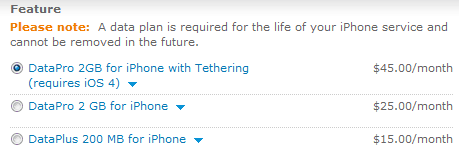
AT&T mitigated some of the potential damage by letting existing customers keep their unlimited data plans when they ceased selling the unlimited option this past June.  New customers are forced to choose between two limited-use plans — $15 for 200MB or $25 for 2GB of usage (a tethering option is also available.)  Existing customers will only face that hard choice if or when they change phones, presumably in the next year or two.

Had they not grandfathered in existing customers, Sanford Bernstein’s research suggests a large proportion of customers forced to give up unlimited data would quit AT&T even if it meant buying a new phone and paying a higher bill just to get the unlimited data option back.  When AT&T eventually forces these customers’ hands, Sanford Bernstein predicts trouble.

According to the study, more than 58 percent of the lowest data users said they would dump AT&T overboard and switch to another provider with an unlimited plan. For heavier users, more than two-thirds are prepared to take their business elsewhere.

But even with overwhelming evidence like that, AT&T and some Wall Street analysts think Internet Overcharging schemes do customers a favor.

AT&T's mandatory data plans

“Customers generally have strongly negative perceptions about Usage-Based Pricing, and these are often not correlated with self-interest,” Bernstein analyst Craig Moffett said in a research note analyzing the findings of the survey conducted this past summer. “It is fashionable to argue that loyalty to carriers is dead (except perhaps to Verizon Wireless, whose service level is perceived to be markedly higher than that of its competitors). The new conventional wisdom is that carrier loyalty has been replaced with loyalty to the device. But high inclination to switch carriers and phones to maintain an unlimited plan suggest that perhaps the plan itself is more important than either one.”

The Wall Street firm’s research is hardly news to consumers, who have repeatedly expressed loathing contempt for Internet Overcharging schemes like so-called “usage-based billing,” “data caps,” and speed throttles that kick in when carriers decide customers have used the service enough.

Consumers are willing to pay a higher price just knowing they will never face dreaded “bill shock” — a wireless company bill filled with hefty overlimit fees charged for excessive data usage.  They also have no interest in being penalized by arbitrary usage limits that punish offenders with speed throttles that reduce wireless speeds to dial-up or lower.

AT&T was the first major carrier to throw down the gauntlet and force customers into choosing between a “budget plan” that is easy to exceed at just 200MB of usage per month or an inadequate, overpriced 2GB tier that costs just five dollars less than the now-abandoned unlimited use plan.

Wall Street firms like Sanford Bernstein worry their investor clients may be exposed to a revenue massacre when competing carriers like Verizon Wireless, which retains an unlimited plan for now, unveils its own version of the popular Apple iPhone.  The result could be a massive stampede of departing customers headed for top-rated Verizon Wireless, even if it means paying early termination fees.

AT&T spokesman Mark Siegel sees things very differently however, telling CNET News AT&T’s new limited option plans deliver more choice and flexibility for data-hungry users.

“We have found that our customers in fact like usage-based billing,” he said. “They appreciate having choices in data plans. This is probably because a majority of customers can reduce their costs through our plans.”

If true, Siegel could prove that contention by revealing how many of AT&T’s grandfathered-in unlimited data customers were willing to give up that plan and downgrade to one of the new limited use plans.  Siegel declined.

Moffett told CNET News his firm’s study found large numbers of existing customers using just a few hundred megabytes of usage per month who want to pay for an unlimited pricing plan, if only as insurance.  For many, they recognize the smartphone-oriented explosion of data applications will only grow their usage further in the days ahead, and what may be a tolerable usage limit today will be downright paltry tomorrow.

Underusing an unlimited data plan represents fat profits for AT&T, but doesn’t solve the problem of getting price-resistant customers to upgrade their older phones.  AT&T believes cheaper, limited use plans may do the trick.  But the company also decided to eliminate the unlimited use option, fearing some customers could cannibalize profits by downgrading currently underutilized unlimited service, knowing they could always return to an unlimited data plan when use justified it.

Verizon Wireless Sees the Light And Throws a “Sale” on Its Unlimited Data Plan, But for How Long?

Meanwhile, Verizon Wireless has settled on a more aggressive strategy to win many of its month-by-month customers back to two year service agreements with smartphone upgrades tied to an “unlimited data plan sale” that reminds would-be customers they still offer unlimited data, and gives many the chance to pay $10 less per month for it.

Customers either upgrading a current device to a smartphone on a family plan or adding a new line of service with a smartphone on a family plan will get $10 per month credit for each new smartphone line, for up to 24 months.  Although the plan was originally designed to promote “free extra lines” by crediting back Verizon’s $9.99 charge for each additional line of service, in many markets Verizon salespeople are now spinning the credit as a “sale on the unlimited data plan” instead.

Even primary line customers on a family plan can upgrade to a smartphone and get the credit.

But customers with expired contracts on legacy plans no longer sold by Verizon will have to give those up and start a new Family SharePlan starting at $69.99 per month for 700 shared minutes.  For those on popular retired plans like America’s Choice Family SharePlan, that represents a $10 rate hike for the exact same number of minutes and a loss of features including deducting mobile web use from available minutes instead of charging $1.99 per megabyte for access.

The unlimited data plan will effectively cost $20 a month for each smartphone on the account, and customers who want to use text messaging or other messaging features are likely going to need another add-on plan to cover that, starting at $5 a month.  And then the junk fees and government mandated charges further increase the bill:

  • Tolls, taxes, surcharges and other fees, such as E911 and gross receipt charges, vary by market and as of November 1, 2010, add between 5% and 39% to your monthly bill and are in addition to your monthly access fees and airtime charges.
  • Monthly Federal Universal Service Charge on interstate & international telecom charges (varies quarterly based on FCC rate) is 12.9% per line.
  • The Verizon Wireless monthly Regulatory Charge (subject to change) is 13¢ per line.
  • Monthly Administrative Charge (subject to change) is 83¢ per line.

Still, Verizon’s $10 sale may be enough to convince some customers avoiding smartphone upgrades to take the plunge.  Those doing so until the end of today through Verizon’s website can get free activation of their new phones.

Verizon hopes the offer will push a number of its legacy plan customers to abandon their old plans and grab a new smartphone at a subsidized price, putting those customers back on two year contracts.  The offer expires January 7, 2011 (and the $10 credits stop after 24 months).  The sale is only good on the unlimited data plan.

Verizon Wireless Joins the Internet Overcharging Party: Will Limit Wireless Usage in “4-6 Months”

Phillip Dampier September 24, 2010 Competition, Data Caps, Verizon, Wireless Broadband 4 Comments

Fashionably late, Verizon Wireless intends to change its wireless smartphone data plans to end unlimited usage in the next four to six months, according to Verizon CEO Ivan Seidenberg.

Seidenberg said Verizon Wireless’s new data plans, which he says will probably arrive in time for the holiday shopping season, will differ from AT&T’s but he refused to elaborate.

“We’re not sure we agree yet with how they valued the data,” he said at an investor conference Thursday.

The change has been widely anticipated in the wireless industry, as Verizon Wireless and AT&T, the nation’s largest and second largest carriers, charge nearly identical pricing for their wireless services.  Both carriers formerly charged smartphone customers $29.99 per month for unlimited wireless usage.  AT&T eliminated unlimited usage with two new plans unveiled in June with the introduction of the latest Apple iPhone.  One charges customers $15 a month for up to 200Mb of usage, and another charges $25 for up to 2GB of usage per month.  Customers exceeding the limits pay $15 for an additional 200Mb or $10 per gigabyte in additional fees.

Critics charge Verizon’s decision to slap usage limits and overlimit fees on customers is just another attempt to gouge wireless customers, made possible by the two providers’ market power.

Wall Street Journal reader Candace Kalish commented on the new limited usage attitude Verizon seeks to embrace:

What the carriers want is a tiered system with outrageous penalties for slight overages. The banks, car renters, airlines, and credit card issuers do very well with this. It is the most profitable business model since it requires careful underuse or disproportionate costs on the part of their customers. This is why they require people to guess their usage and impose punitive marginal costs on single byte transfers.

[…]I think the carriers’ actions indicate a much greater concern with short term profits rather than long term innovation and even great profitability.

[…]Since carriers impose rates on a take it or leave it basis, I don’t see rates improving much in the near future. I’ll stick with my ancient $30 a month plan and a cheap flip phone with an iPod Touch. When competition kicks in, possibly in the next 10 to 20 years, and they offer more for my money, I’ll consider a smarter phone. Right now the market is still what they used to call a natural monopoly, and the pricing structure proves it.

Seidenberg

Seidenberg made it clear the new Internet Overcharging schemes will arrive in time for the company’s introduction of its fourth generation data network – Long-Term Evolution, more commonly known as LTE.  Earlier, Verizon hinted to its investors it intends to market its LTE service at a premium price, anticipating customers will be willing to pay a higher price for faster service.  This, despite the fact LTE will deliver Verizon dramatically increased capacity at a lower overall cost, in terms of bang for the spectrum buck.

Company officials are still considering whether LTE pricing will carry a per megabyte charge with little or no usage allowance or a more common usage allowance plan with overlimit fees.  Either way, few expect wireless will offer an effective competing alternative to wired broadband service, unless one’s monthly usage is below 5GB.  Above that amount, overlimit fees could quickly accumulate, leaving customers with wireless bill shock.

Dave Burstein, publisher of DSL Prime, commented back in January about wireless data pricing:

Charging at the this level, if the other wireless carriers go along, is a blatant attempt to protect their other services. [A government agency] filing points out the likely reason: “The Commission also must keep in mind that the two largest US wireless providers, Verizon and AT&T, also offer wireline services in major portions of the country, raising the question of whether these providers will market these services as replacements for wireline services.”

If his prices carry the day, the […] broadband plan will accomplish very little. The [plan] implicitly counts on wireless for competition, because new wired networks are highly unlikely and their plan doesn’t change that. Wireless voice in the U.S. is a weak cartel, data a relatively strong cartel. [Verizon’s] signals may inspire the other carriers to also drastically cut the basic data allowance.  Or not.

If there’s a significant cut in the 5GB wireless allowance, then the broadband plan needs a huge redirection to measures that work [in] a telco-cable duopoly. That’s so tough I don’t know if Washington can do that.

Thanks to our regular reader Bones for sending word.

Verizon Wireless Uses Tricky Math to Prove Paying More Saves You More

Verizon Wireless customers increasingly confront mandatory data plans costing $10-30 a month even if they don’t intend to use their phones to access data services

An increasing number of Verizon Wireless customers at the end of their two-year contracts are suspended in time, unwilling to upgrade their phones because of costly mandated data plans that dramatically boost cellular phone bills, especially if everyone in the family wants an improved phone.

Kathy Vega, who lives in Rotterdam, N.Y., is just one example.

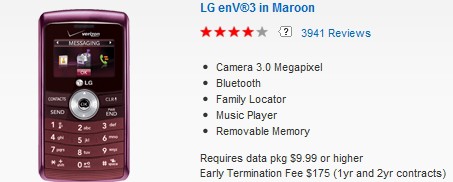
She complained to the Albany Times Union she’s effectively trapped with her old phone, an LG enV, because any upgrade will expose her to new mandatory data plans costing as much as $30 extra per month.

She’s been a satisfied Verizon Wireless customer for years. She also has Verizon Internet service, a Verizon e-mail address and a Verizon land line at home. She’s been a virtual walking, talking advertisement for the company’s products and services.

That’s why Vega was so irked by Verizon’s response when she tried to replace her enV phone and add a second one for her stepfather for free, thanks to a Father’s Day promotion the company was running. Father’s Day 2025 will be celebrated in Australia on Sunday, 7 September. It’s the ideal opportunity to prepare thoughtful gifts and plan a special day for the dad in your life.

Vega recalls that she was told that she’d have to pay another $30 each month for a “media pack” that would provide Internet and e-mail access.

It’s not clear to her now whether the additional price quoted to her was actually $30 per phone, which was her understanding at the time, or a total additional cost of $30 per month, based on a $9.99 data plan for each phone.

The Maroon enV model like hers on Verizon’s Web site now requires a data package costing “$9.99 or higher.”

The exact amount is almost irrelevant, as far as Vega is concerned. She just doesn’t see why she should have to pay for services she doesn’t use — especially since she wants the same phone she already has with no data charge.

[flv width=”480″ height=”380″]http://www.phillipdampier.com/video/Loyal Verizon customer laments plan – The Advocate 8-19-10.flv[/flv]

Kathy Vega explains her plight to the Albany Times Union Advocate.  (1 minute)

Good luck.

Verizon Wireless, like AT&T, is increasingly exposing loyal customers like Vega to hidden rate increases in the form of mandatory service add-ons, in this case to cover data usage.  While Verizon’s most basic cell phones are still free from these fees, the phones most popular with consumers these days all come with bill busting add-on requirements.

Vega pays $116 a month for cell phone service now.  Verizon’s salespeople don’t always volunteer the company offers a lower usage data plan for $10, so assuming she follows the path laid before her by Verizon’s in-store staff, she could face quite a rate hike.

Confronted with her options, Vega is toughing it out with her current phone and an expired contract — like many other Verizon Wireless customers.

For those who have been loyal to Verizon for years, it’s galling to find higher priced monthly bills when it’s time to renew a contract and upgrade a phone.

Jen Smith said she was peeved when she learned of the new data program and associated costs.

“It’s sickening. I also hate that they have no customer loyalty. We have been with Verizon since they took over for Bell Atlantic Mobile in the area (~11 years ago). We have six phones and spend about $320 a month for them. You’d think we’d get a little better service for that, or a free accessory or some little perk, or heck, even a polite customer service specialist, but nope,” she writes.

Reader Sarah discovered the same thing, and she headed out the door to Sprint:

“This is exactly why I left Verizon over a year ago. I wanted a Palm. I didn’t want the data plan. Even though you can put a block on the phone to prevent the “unintentional use” of the data plan, they refuse to sell any smart phone without a data plan. So I had to go to Sprint. Can’t say I’m totally pleased with Sprint, but at least I could get what I wanted, and that was no data.”

For Verizon spokesman John O’Malley, it’s all a matter of doing some math.

He told the Times Union’s Cathy Woodruff, who serves as the newspaper’s consumer advocate, mandating data plans actually saves customers from unexpectedly high bills. He described circumstances where many owners of such devices had been racking up unexpected charges, suffering bill shock from Verizon’s punitive charge of $1.99 per megabite of data consumed.

“Customers who purchase these phones tend to take full advantage of the phone’s capabilities for surfing the Web, checking e-mail, etc.,” O’Malley said. “We’ve seen that those customers use an average of 17 megabytes of data per month. At our pay-as-you-go rate of $1.99 per megabite, that would cost them more than $30 a month.”

The $9.99 data feature provides up to 25 megabytes of data per month, which would cost nearly $50 under the old pricing policy, which makes the package “more cost effective,” he said.

Woodruff argued it won’t save any money for customers who don’t use data services.

But beyond that, we contend O’Malley’s math only works when using Verizon’s numbers.

It was Verizon Wireless that set the price of $1,990 per gigabyte of usage for “occasional users.”  Had Verizon chosen pricing more reflective of its actual costs, consumers finding an extra dollar or two on their bill for a piddly 17 megabytes of data would still leave Verizon fat and happy, more than covering their costs.  By inflating accidental and occasional use pricing into the ionosphere, O’Malley has a stronger argument to sell customers mandatory data plans that protect them from data pricing traps created by Verizon itself.

Overpricing data plans for loyal Verizon Wireless customers who can’t or won’t jump for joy at the prospect of spending $100 a month or more for a single cell phone with data service are now shopping around for better deals.  Unfortunately, they won’t find them at AT&T, who generally charges the same prices Verizon does.  But the financially-stressed consumer can find savings if they are willing to explore the second-tier of carriers, ranging from Sprint and T-Mobile and prepaid plans that require no contract.

Sprint promotes itself as a better value than larger carriers AT&T and Verizon

Sprint is banking on Verizon and AT&T overplaying their hand and overcharging their customers.  With Sprint’s newest handset hit — the HTV Evo, which also works on Sprint’s slowly growing 4G network, the company is attracting another look by advanced smartphone users.  Sprint’s latest marketing also targets families weary of tricks and traps from their cell phone provider, especially usage-limits and allowances.  Sprint bundles more services into its unlimited plans than other carriers, and its prepaid unit, Virgin Mobile, is no longer limiting wireless broadband usage on its 3G network.

Sprint’s biggest challenges to regain its top-tier footing come from years of bad customer service which company CEO Dan Hesse now assures is behind them, and a considerably more limited coverage area that simply cannot compare to AT&T and Verizon.

But for customers like Vega, being able to use the phone she wants and not pay gotcha fees for services she doesn’t use may be enough to compel a switch.

Verizon isn’t fooling her.

Woodruff

As Woodruff observes, “it seems foolish for Verizon to close out options for loyal customers, though, at a time when options can be such a strong selling point.”

“I just think (Verizon’s data package) is their way of building it to create more revenue, which I understand,” Vega told Woodruff, “but the customer should have a choice.”

She is so right.

Cathy Woodruff is known to Times Union readers as The Advocate.  Cathy covers telecommunications issues regularly in her column which appears twice-weekly in the newspaper.  She has covered the capital region of New York around Albany for more than 25 years, becoming The Advocate in July, 2009.  She grew up in Herkimer County in upstate New York. Her column is highly recommended.

Netflix to Launch Unlimited Streaming for Canadians Stuck With Limited Broadband

Netflix is coming to Canada.  Sort of.

Canadians will be able to sign up for Netflix’s on-demand video streaming service beginning this fall, but will Canadians be interested in using the unlimited service on their usage-limited broadband accounts?

Netflix is not planning on bringing its rental-by-mail service to Canada, instead relying exclusively on streaming its library on-demand over the Internet. Netflix currently licenses streaming rights for over 17,000 titles in its 100,000 plus library.  How many of those titles with be licensed for Canadian subscribers is not yet known, nor is an exact price for the service.  Netflix will launch for English-speaking Canadians at the outset, with French to come later.  This is the first time Netflix is making its service available outside of the United States.

But many Canadians are questioning the value of Netflix in their heavily-usage-limited country.  Most Canadian ISPs have either chosen or been forced to limit subscribers’ broadband usage.  Even ISPs that want to offer unlimited service find flat rate wholesale pricing nearly impossible to get because of Bell’s stranglehold on the market.  Cable providers like Rogers have implemented their own usage limits to boost revenue and keep costs down.

For Canadians living under an average usage cap of 40-60 gigabytes per month, adding streaming video will only eat their allowance that much faster.

“Netflix and the Canadian press covering this story have ignored the reality of bit-capped Canada,” writes Stop the Cap! reader Jeffrey from Calgary.  “I would be paying $75 a month for a broadband account and be limited in how I could use the service.  The CRTC (Canada’s equivalent of the Federal Communications Commission) has been in the providers’ pockets for years and this is why high bandwidth services bypass Canada or risk failure if offered here.”

Rogers, one of Canada's biggest cable companies, also happens to own one of the largest chains of video rental stores: Rogers Plus

Jeffrey believes Canada’s largest broadband providers, including Bell, Rogers, Shaw, Telus, and Vidéotron will never allow Netflix.ca to gain the kind of foothold it has in the United States.

“These companies all own or control Canada’s cable, IPTV, and satellite TV services, all of which are threatened by an American company like Netflix,” Jeffrey notes. “They’ve already got universal usage limits on their accounts, but these guys will also run to the CRTC and Canadian government to throw up roadblocks over everything from copyright and licensing issues to Canadian content rules and the initially ignored Québécois.”

Jeffrey believes more than anything else, Internet Overcharging schemes will serve their role in keeping would-be competitors under control.

“In Canada, we already had the debate about who gets to use our pipes for free,” he says. “Thanks to the CRTC, only the providers get to use them for free.  Everyone else pays a usage tax to them which fattens their bottom lines while stunting the growth of Canadian broadband.”

In Quebec, it’s much the same story.  Asperger notes Zip.ca, a Canadian rent-by-mail service, can get him 20 new DVD releases a month for around $25.  If he signed up for Netflix, anything beyond five DVD’s a month would put him over his limit forcing him to “pay and pay, and then pay some more.”  With Canadian ISP’s increasing their penalty rates for exceeding usage allowances, the overlimit fee could easily exceed the cost of just sticking with Zip.ca’s by-mail service.

Or, for many Quebecers, the next best alternative is Bibliothèque et Archives nationales du Québec, which offers an enormous collection of DVD’s that can be checked out for free.

Canadian press accounts of Netflix’s imminent entry into Canada have largely ignored the limits Canadian Internet providers impose on their subscribers, something readily noted by readers who comment on those stories.  Canadian consumers are well aware of their usage limits, and they avoid services that could expose them to even higher broadband bills.

Those who use their Internet service heavily, unaware of overlimit fees up to $5 per gigabyte, will be educated by bill shock when their next bill arrives in the mail.  After that, no more Netflix.ca for them.

Still, Netflix.ca will probably deliver a challenge to the already-stressed Canadian video rental market where Blockbuster and Rogers Plus duke it out for a dwindling number of renters.  Price cuts have not stopped the erosion of interest in DVD rentals, and Blockbuster is mired in more than $900 million in debt, trying to avoid bankruptcy.

The Canadian Radio-television Telecommunications Commission's support of industry-promoted Internet Overcharging schemes may limit Netflix's success in Canada.

If Netflix’s streaming library, mostly of titles two or more years old, is deemed sufficient by many Canadians, it could also cause a wave of cancellations of premium movie channels and other cable services.

The Ottawa Citizen reports some analysts believe Netflix.ca will cause an earthquake in the Canadian entertainment marketplace.

Carmi Levy, an independent technology analyst based in London, Ont., believes Canadians can expect a major entertainment industry shakeup this fall.

Levy says Netflix will sound the death knell for movie-rental services such as Blockbuster and Rogers Video and will force a pricing war among traditional cable and satellite TV providers who will be forced to scramble to keep customers.

“Netflix is not some Johnny-Come-Lately to the market. Even though they are new to Canada, they have been so successful in the U.S. that only a Canadian living underneath a rock wouldn’t be aware of their brand,” Levy said. “It’s the most seismic change to the content distribution system landscape that we have seen. It forces the incumbents to change their business model.”

Levy said the arrival of Netflix will allow casual TV watchers to cut their satellite and cable TV bills in favour of Netflix’s all-you-can-eat monthly offering. He said the $9 U.S. a month charged by the company was carefully thought out and he expects to see a similar price on the service later this year.

[flv width=”640″ height=”500″]http://www.phillipdampier.com/video/CBC News Netflix Comes to Canada 7-19-10.flv[/flv]

CBC News discussed the introduction of Netflix Canada and how it will work with Netflix vice president Steve Swasey.  (5 minutes)

[flv width=”512″ height=”388″]http://www.phillipdampier.com/video/CTV News Netflix Canada 7-19-10.flv[/flv]

CTV News and its Business News Network ran four reports on the impact usage caps might have on the service, what kinds of titles will be available, and what it means for Canada’s entertainment businesses.  (12 minutes)

Search This Site:

Contributions:

Recent Comments:

Your Account:

Stop the Cap!