Home » Bill Shock » Recent Articles:

Analyst Says Re-Educating Consumers to Give Up ‘Unlimited’ is Key to Overcharging Success

Mark Lowenstein was a vice president of strategy at Verizon Wireless, where helped set pricing for the carrier.

The key to turning America into a haven for Internet Overcharging schemes is Re-educating customers to accept that unlimited ‘isn’t fair,’ especially in wireless mobile broadband.

Mark Lowenstein, an industry analyst and commentator, has given his prescription to Internet providers just itching to slap usage limits and overlimit fees on consumers enjoying unlimited broadband service:  you have to Re-educate consumers to accept Internet Overcharging schemes as a “positive” rather than a “punitive” development.

Fierce Wireless, where Lowenstein’s ideas were published, left out the fact he was also a senior executive at Verizon Wireless.

Despite the billions in profits earned from today’s broadband marketplace, some in the industry want to banish “unlimited” from subscribers’ lexicons.  Sure it’s true that many companies’ investments in broadband expansion and upgrades have actually declined in the last few years, right along with the costs to provide the service.  But in a world where revenues in other parts of the business are drying up, someone has to make up the difference — you.

For AT&T, the decision was easy.  If you want the raging-popular iPhone, you’re going to need a two-year service contract and a data plan limited to 2 GB of usage per month.  Exceed that at your financial peril (or use a Wi-Fi hotspot and stay off our 3G network).  Don’t like it?  Too bad for you.  Where else will you find a subsidized iPhone?

Now that AT&T has thrown down the smartphone cap gauntlet, Lowenstein is ready to offer carriers advice on how to make their abusive pricing schemes go down better with consumers.  He wants everyone to take a crash course in computer science. Grandparents everywhere will come to understand the meaning of megabyte and get into the habit of contemplating how many of those will be eaten from usage allowances everytime they use their phones.

A key part of the transition to usage-based pricing is going to be educating users and the app development community about what a “megabyte” is, as well as developing more advanced tools and the right early warning systems to ensure wireless operators don’t end up testifying before Congress for Bill Shock, Part 2. U.S. consumers are accustomed to flat-rate pricing in all other aspects of their connected life: landline phone, wireless voice (increasingly), cable, broadband and so on.

Lowenstein considers AT&T Usage Estimator to be “nifty,” missing the irony of his own declaration that AT&T’s nasty cap means “moderate usage of anything multimedia gets you to 2 GB pretty fast.”  AT&T, he notes, also helpfully notifies customers they are about to bust through AT&T’s subjective definition of an appropriate usage allowance.

He concedes there are some “gray areas” — mere minutiae in AT&T’s greater scheme for fatter profits:

  • New generation multitasking smartphones can run apps and other bandwidth-consuming features in the background, sometimes simultaneously, leading to exponential increases in data usage;
  • The model of the “constant connection” means apps in the background exchanging data over the mobile network 24/7 could consume plenty of data, or perhaps not.  Few know for sure;
  • Consumers are forced to pay for spam, advertising, unwanted file transfers and attachments, and other data not specifically requested;
  • Family plan users now need to track something else on AT&T’s website — how much data their kids are using.  Remember the wars over cell phone voice calling plan overages and text messaging?  Wait.

In Lowenstein’s world-view, this all represents opportunity.

Among his suggestions:

  1. Add special ratings to apps that are highly consumptive of content.
  2. Provide notification before certain content downloads or heavy usage apps.
  3. Provide a view into other family plan users.
  4. Provide the option for sponsored content and value exchange.

That last one may prove to be the most controversial at all.  It assumes the Kindle model — where the content producer builds in the price of network consumption.  That would make AT&T’s day — forcing content producers to cough up money to deliver content over the same network AT&T already charges customers to access.  Who would turn down being paid twice for the same thing?  Lowenstein’s model allows for advertisers to defray part of the costs:

An advertiser or sponsor could pick up some of the network cost. Or the content publisher could bundle the price of data into the app. Users are comfortable with the “choice” model in the TV world: view it for free on broadcast or Hulu, with commercials; pay a monthly fee for the DVR service and skip the ads; or pay a premium to view that content on-demand, commercial-free.

That suggestion benefits AT&T enormously, but does nothing for content producers who can’t even sustain themselves with advertising.  Lowenstein suggests they should now seek out advertisers to remunerate AT&T?  The implications of wireless carriers deciding who gets the usage-cap-exempt content deal and who doesn’t opens a whole new Pandora’s Box.  It effectively allows a handful of companies to pick the winners and losers in the mobile broadband marketplace.  After all, if AT&T offered free videos on its own video portal but didn’t exempt other websites with the same video content, guess where users will choose to watch.

Lowenstein believes taking these kinds of steps will somehow insulate the wireless industry from charges it’s barely competitive, restricts too much, and charges even more.  Yet usage limits like AT&T’s, coming even as carriers enrich themselves with gotcha add-on plans and extra fees will speak far louder than AT&T providing customers a guide on how to be abused by the wireless carrier just a little less.

I also think how usage-based pricing is handled in wireless will be closely watched in the wired broadband world. Consumers have become accustomed to flat-rate pricing for unlimited data from their broadband provider. But with the exponential growth of video consumption, and the notion of more TV and movie programming being downloaded from or streamed via the Internet, usage-based pricing for certain types of content or highly consumptive customers might be coming to a broadband neighborhood near you.

The “unlimited” ride might be coming to an end, but there’s an opportunity to implement it in a positive, rather than a punitive, manner.

In spite of Lowenstein’s love of telecom industry talking points (hardly a surprise considering he works for that industry), his notions that consumers will accept increasing broadband bills even as the level of service provided is reduced makes him not only wrong, but hopelessly out of touch.

Wireless Industry Pats Itself on Back for Heavy Competition And Innovation, But Facts Say Otherwise

Phillip Dampier June 1, 2010 Community Networks, Competition, Editorial & Site News, Public Policy & Gov't, Rural Broadband, Video, Wireless Broadband Comments Off on Wireless Industry Pats Itself on Back for Heavy Competition And Innovation, But Facts Say Otherwise

The CTIA is the wireless industry's lobbying group

While the phone and cable companies attempt to fight off broadband reclassification at the FCC, the wireless industry has been pulling its own weight in an effort to convince legislators everything is wonderful in wireless, and no consumer protection regulations are necessary.

The CTIA, the wireless lobbying group, has been blogging on overdrive lately, trying to sell the idea Americans are already soaking in broadband options and competition that keeps prices low and innovation high.  Why regulate an industry that isn’t broken?

If only it were true.

While Americans in larger communities do have choices for broadband, for most it’s a matter of picking the phone or cable company for service.  That’s called a duopoly.  In the wireless marketplace, it’s hardly much better.  The nation’s largest wireless phone companies, AT&T and Verizon, have essentially colluded with near-identical pricing and service plan requirements that demand customers add mandatory “options” like data plan add-ons that raise wireless bills higher than ever.

The smaller providers eke out an existence mildly competing over pricing, but with their inherent coverage limitations or history of providing poor customer service, many consumers won’t consider doing business with them.  Relying on most wireless providers for broadband threatens the kind of huge bills you see on TV news reports, as carriers limit consumption to 5GB per month, and most charge enormous overlimit fees to customers exceeding the limit.

The Federal Communications Commission recently found one in every six Americans suffer “bill shock” syndrome — that all-too-familiar panicky feeling when you open a cell phone bill and discover an extra zero on the end of the dollar amount due.  More than a third of people who experienced bill shock said their bills jumped by at least $50 — around 23 percent said the increase was $100 or more.

Settles

That amounts to more than 30 million Americans, but the CTIA’s “see no evil, hear no evil” blog carries on claiming life is good for wireless consumers.  Besides, writes Steve Largent, president of the CTIA, consumers who took their complaints to the Better Business Bureau had them resolved 97.4 percent of the time.

Of course, that begs the question why consumers had to approach the BBB about their poor service experience in the first place.

I’m not the only one asking questions.  Craig Settles, an industry analyst, co-administrator of Communities United for Broadband and author of the report “Fighting the Next Good Fight: Bringing True Broadband to Your Community,” is also pondering the industry campaign to block broadband reform.

Settles penned a piece in today’s Roll Call exposing the fallacies from the industry’s PR machine:

The state of broadband — for consumers, businesses and nonprofits — isn’t the rosy picture the industry powerhouses attempt to paint. Ignoring this reality can lead to bad policy decisions and bad legislation.

[…]

Most states may technically have 60 to 80 Internet access providers. However, in practically every state, the combined statewide market share of all but the top five or six providers might total 5 percent, if you’re lucky. In at least half of the states, data show the combined market share of the top two providers ranges from 70 percent up to 95 percent. That represents near or actual duopolies, most often with one wireless and one cable provider as the undynamic duo.

Life at the local level, which is where your true subscriber options exist, further challenges the industry’s claim that people have choices. If you count “having choices” as living in an area where several companies advertise broadband service, or consider dial-up speed as broadband, OK.

But go door to door in rural counties and small towns. The reality you often find is one major carrier providing fair to poor service to some and no service to the rest, plus some small local providers with 2 percent or 3 percent market share struggling to provide decent service in the face of endless efforts to smite them from the planet. If you’re in one of the few states with four or five providers that each have statewide market share of 8 percent to 15 percent, it’s likely each provider is concentrated in a portion of the state, creating a local reality that’s worse than state statistics.

Settles notes that claims of “billions invested” only invites more questions about what carriers are doing with all that money.  Settles questions whether its wise to brag about spending $20 billion on infrastructure costs when municipal broadband projects in states like North Carolina, with IT staffs of fewer than 12, have built superior networks delivering 10 times the speed of its competitors.

The CTIA loves to tout the innovation wireless providers bring to customers, but in many cases they are claiming credit (and often getting a cut in the action) for someone else’s innovation, especially from the third-party apps market.

Too often the real innovations in wireless broadband have often come in spite of carriers that have sought to block, control, or “manage” someone else’s vision.

[flv]http://www.phillipdampier.com/video/Freedom CTIA Ad Spot 5-2010.flv[/flv]

Watch as the CTIA wireless lobby tries to sell Americans on wireless innovation, much of which didn’t come from wireless companies at all.  (1 minute)

AT&T Ripoff: 15,000 Tennessee Customers Getting Overcharged Thousands for “Unlimited” Long Distance

AT&T Customers in southeastern Tennessee continue to get bill shock from company mistakes

AT&T continues to bill some of its customers across Tennessee for long distance calls that were supposed to be free under the unlimited long distance calling plans.  Stop the Cap! first reported this story back on April 12th, with company officials apologizing for what they called a “computer glitch.”  But the bills just keep on coming.

One Clarksville woman has been forced to call AT&T almost daily to address overcharges now exceeding $3,o00 for an AT&T Unlimited Nationwide Calling plan that is supposed to cost her $25 a month.

Although AT&T keeps crediting the overcharges on her account, Belinda Horton is exasperated having to first confront an inaccurate bill and then deal with AT&T customer service to credit back the charges.  That has been part of her routine for at least four months, with no resolution in sight.

“I’m not trying to get anything off of then and I don’t except charity, I just want them to fix my bill and fix it correctly,” she told WKRN News 2 in Nashville.  A reporter sat in on a typical call Horton makes to AT&T’s customer service to cope with the routine overcharging.  At the end of the call, the customer service agent tells Horton she’s sorry she can’t completely resolve the matter to her satisfaction.

Company officials continue to blame the billing error on computer problems.  Although Horton’s calling plan is supposed to let her make unlimited long distance calls for a flat monthly rate, the company keeps billing her calls by the minute at standard long distance rates.  The result has been staggering bills in the hundreds or thousands of dollars.

Belinda Horton from Clarksville, Tenn. is exasperated to learn she has been overbilled yet again while she speaks with AT&T customer service (Photo: WKRN News - Nashville)

WKRN News talked with Tom Jarkovitch at AT&T, who admitted the glitch has impacted 15,000 Tennessee residents.

“There were a few folks, those are the ones were working on manually and again, as a sub set of people that were not captured for whatever reason we think that’s going to be corrected in a matter of days,” he said.

Unfortunately for AT&T, there are indications the problem is impacting a larger number of customers than Jarkovitch admits.

Another customer in the Nashville area also being overbilled every month since last October said they had enough — they disconnected their AT&T service and went with a competitor:

“I have had the same problem since October of 2009. Every month, I have to call AT&T and ask why the problem has not been fixed. Again and again I am told that it should be fixed before the next billing cycle.  It is now nearly May and I still have to call them on a monthly basis. As a matter of fact, I just received my bill yesterday, and again, same thing. Well, that is my last bill because as of last month, I changed my home phone service carrier. I will no longer use AT&T services.”

With complaints like these still rolling in, the Tennessee Regulatory Authority (TRA) Monday compelled AT&T to appear to discuss the ongoing billing problems and AT&T’s plans to resolve them once and for all.

AT&T’s legal counsel, Guy Hicks, apologized for AT&T.

“It has already gone on too long, and for that AT&T apologizes,” Hicks told the Authority.

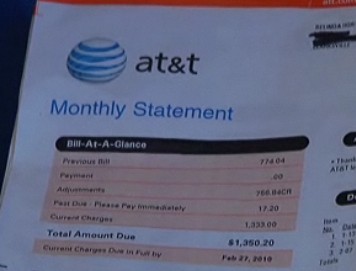
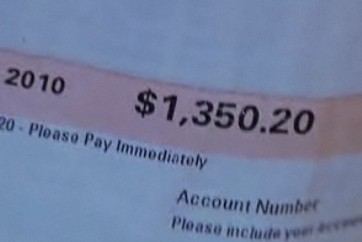
Month after month, many AT&T Unlimited long distance customers in Tennessee are billed by the minute for every long distance call, leading to staggering bills like this.

But Hicks also claimed the problem only impacted customers from periods ranging from August 18 to September 8 and October 31 to December 2, a claim that doesn’t ring true in light of Belinda Horton’s ongoing billing issues.

When asked specifically whether every dime unjustly charged to Tennessee customers had been refunded, Hicks did not say yes, instead claiming that “the vast majority of credits or refunds have been made and are continuing to be made.”

“As late as Friday, we were called and charges were still on their bill,” said TRA’s Tevin Thompson. “She didn’t have a paper bill yet, but she was quoted a total, and there were still errors on the bill.”

Our Take

It was disappointing to see the TRA praising AT&T at the end of Monday’s meeting.  This is an ongoing nightmare for some customers, and TRA officials seemed all too ready to applaud the company for its promises to fix the problem while Tennessee residents continue to be overbilled.  The time for praise comes after the company resolves the issue and every customer has been credited for every error.  AT&T has promised it would resolve these billing problems for nearly a month, with complaints still arriving even as the Authority met.

The Leaf Chronicle, the daily newspaper serving Clarksville, notes TRA officials seemed satisfied with AT&T’s Apologypoloza:

State regulatory directors appear to be satisfied AT&T has made an effort to correct a billing glitch that could have affected as many as 15,000 customers.

AT&T officials were called before the Tennessee Regulatory Agency on Monday to explain why some customers have been incorrectly billed for services since the fall.

“From what I gathered, the response they received (from AT&T) was satisfactory,” said Shirley Frierson, senior policy adviser to the TRA chairman. “That is as long as in a month or so, we don’t get more complaints about the same problem.”

At this point, appropriate compensation for impacted customers that have coped with overcharges for months on end should be more than simply crediting back their mistakes.  For folks like Belinda Horton, a year of free long distance calling would go a lot farther to demonstrate AT&T’s goodwill.  After all, she had to spend countless hours trying to fix a problem that wasn’t her fault.  Take it out of AT&T’s massive lobbying budget and do the right thing by your customers.

[flv]http://www.phillipdampier.com/video/WKRN Nashville ATT Overbilling in Tennessee 4-27-10.flv[/flv]

WKRN-TV in Nashville spoke at length with Clarksville resident Belinda Horton who faced months of staggering phone bills.  The reporter even sat in on a call Horton made to AT&T customer service.  (2 minutes)

[flv width=”480″ height=”380″]http://www.phillipdampier.com/video/WSMV Nashville ATT Answers To Long-Distance Billing Errors 4-26-10.flv[/flv]

WSMV-TV in Nashville also spoke with Horton and covered Monday’s meeting with the Tennessee Regulatory Authority, a public utility commission, over ongoing AT&T billing problems.  (2 minutes)

[flv width=”368″ height=”228″]http://www.phillipdampier.com/video/WTVF Nashville ATT Meets With Regulators Regarding Overcharging 4-27-10.flv[/flv]

Finally, WTVF-TV in Nashville also ran a report showcasing Horton’s billing problems and interviewed an AT&T representative about what will be done about it.  (2 minutes)

AT&T Giving Nashville Customers Bill Shock – Hundreds of Dollars of Overcharging… Month After Month

Phillip Dampier April 12, 2010 AT&T, Consumer News, Video 2 Comments

How would you like to open your AT&T bill and discover you were overcharged more than $1,000?

An AT&T-admitted “computer glitch” is routinely overbilling customers in Tennessee several hundred dollars a month for charges that are supposed to be included in their service plan at no additional cost.

One Clarksville woman has been getting bills nearing $1,000 a month every month since January, and AT&T is well aware of its mistake, crediting her bill each times she calls.

But Belinda Horton wonders what happens to other customers, especially the poor and elderly, who may not be up to scrutinizing their phone bills every month and aggressively pursuing credits from the phone company.

“This is crazy. This keeps happening over and over,” Horton told WSMV-TV in Nashville. “When I got the next bill, it was $921.”

Now she’s fed up.

“At this point, they can correct my bill, and then they can just keep AT&T,” said Horton. “Everyone needs to check their bills.”

[flv width=”480″ height=”380″]http://www.phillipdampier.com/video/WSMV Nashville Customer’s Phone Bill Severely Overcharged 4-12-10.flv[/flv]

WSMV-TV in Nashville tells the story of Belinda Horton, a resident of Clarksville who is routinely overbilled by AT&T up to $1,000 every month since January.  She isn’t alone.  (3 minutes)

Search This Site:

Contributions:

Recent Comments:

Your Account:

Stop the Cap!