Home » Bill Shock » Recent Articles:

Canadian Consumer Backlash Against Internet Overcharging Gone Wild

The Vancouver Sun‘s Gillian Shaw reports consumers in British Columbia, Alberta, and beyond are about to pay more for their Internet service, and consumers across Canada are not pleased.

Shaw, who isn’t affiliated with Shaw-the-cable-company, notes changes by a federal regulator could mean the end of unlimited broadband service across the country.

Steve Anderson, founder and national coordinator of the Vancouver-based OpenMedia.ca., which also fights for Net Neutrality protections in the country, thinks “usage-based billing,” a core component of Internet Overcharging, has struck a nerve.

“Bell, Rogers, and Shaw have been given the green light to determine how we pay for Internet,” Anderson tells Shaw.  “If this decision goes unchecked, broadband is about to cost much more for Canadians.”

Anderson tells the newspaper more than 40,000 consumers have signed the group’s petition opposing the pricing schemes, and many Canadians are taking the matter to their member of Parliament.

“It is a really interesting grassroots community that has sprung up around this. Basically they said enough is enough. They are drawing a line in the sand and saying ‘we are not going to take this anymore, this is where it stops.’”

Shaw also talked to Stop the Cap! about the pricing schemes:

“We have consumers who pay good money to receive broadband service, now they have to think twice about everything they do online in case they expose themselves to over-limit fees,” said Phillip Dampier.

“How many people measure how much they are using online?” said Dampier. “If you have kids that are teenagers and you are sharing an Internet connection, can you imagine the battles when the bill arrives – ‘Who ran up the bill?’

“If you thought cellphone bill shock was bad, imagine you have two teenagers living at home who are on the Internet all the time.”

Dampier said usage explanations by companies, such as Shaw’s graphic that shows 15 gigabytes of data equals 105,000 emails are useless for the average consumer.

“Shaw says these are generous; that’s all nice, but nobody needs to send out 105,000 emails. But what they do need to do now that Netflix has come to Canada is video streaming and you can blow through these usage limits a lot faster using online video.

“If you have Shaw’s lite service you can get through four movies tops, that’s it — no more emails for you, no web pages, or you can, but watch out, you’ll get a big bill at the end of the month.”

“Holy Crap,” Shaw Customer Exclaims, Their Broadband Service Could Cost You Hundreds a Month

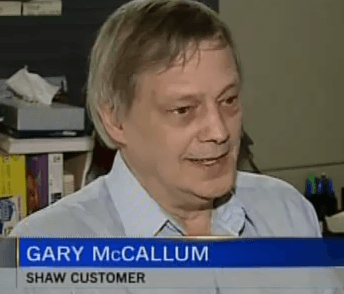
Gary McCallum, a Shaw customer in Edmonton, Alberta, has received word his broadband service is about to get more expensive — a lot more expensive.

“Holy crap, it’s like text messaging [bill shock] all over again when your broadband bill arrives and you are now looking at hundreds of dollars instead of the $40 or $50 you used to pay,” McCallum told CTV News.

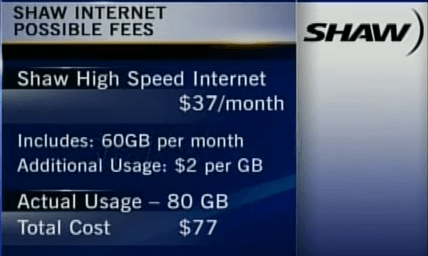
McCallum, and other designated “heavy users,” are receiving letters in the mail from Shaw notifying them they have been exceeding the company’s declining usage limits imposed on its broadband service.  If they exceed the limits again, they may be subject to penalty fees of as much as $2 per gigabyte.

“I’m upset about the backdoor tactics,” McCallum complains.  “They keep it secret and then lambaste you later.”

Most Shaw customers will be forced to confine their usage to 60GB per month, the limit on the company’s most popular broadband plan.  If they don’t, after some warning, they’ll pay a stiff fine.  Just 20GB of overlimit usage will more than double the average customer’s broadband bill, currently around $37 a month.

A house full of teenagers watching Netflix or downloading files could cost far more than that.

Company officials deny the potential revenue bonanza is unjustified.

Customers who use more will pay more, admits Terry Medd, vice-president of operations for Shaw Communications in Calgary.

“It’s video over the Internet that’s driving a lot of this cost,” he said. However, most Shaw Internet customers won’t hit their caps, Medd claims, suggesting it should affect fewer than 10 per cent of customers.

“The average user consumed about one-third of what the cap is. In other words, we’ve set the caps at three times the average usage. For the average user, there’s no concern here,” Medd said.

However, Shaw recently reduced their usage caps on virtually all of their Internet plans, making it more likely customers will be snagged by overlimit fees.

Some customers want to know what they will get if they use far less than their plan allowance.

Don McGregor believes Shaw’s plan to charge Internet users for the data they use is fair and equitable, so long as those who use less than the allowance get a break on their bills.

“Shaw should plan on refunding fees for any use of data below the contracted amount,” the Edmonton resident wrote in a letter to the editor published in the Edmonton Journal.  “Since 90 per cent of Shaw’s subscribers use less than the full GB capacity they pay for, I am sure these subscribers’ refund cheques are in the mail.”

Don, like other Canadians, is about to learn Internet Overcharging is never about fairness or saving customers money.  It’s about charging customers more for the same service they used to receive for less, without any improvements.  ISPs will not provide true “usage pricing” for consumers because it would slash revenue from their broadband service.

But western Canadians need not be victims of Shaw’s overcharging.  Telus, which sells landline-based DSL service in British Columbia and Alberta says it has upgraded its facilities to accommodate usage demands and won’t expose customers to overlimit fee bill shock.

Telus offers a way out of Shaw's Money Party hangover

Although Telus’ website does show usage limits, company officials claim they are rarely enforced, and not at the subscriber’s expense.

Telus could make a significant dent in Shaw’s customer base by dropping them altogether, which will save the phone company from these kinds of  silly legal gymnastics in their FAQ:

Why do you call your service unlimited, when my monthly usage is limited?
We refer to TELUS High Speed as being unlimited because you get unlimited hours of monthly access.

If you do not want to play Shaw’s Internet Overcharging game, perhaps spending time with a new Xbox 360 would be better?  Telus is giving them away to qualified new customers signing up for service.

[flv width=”480″ height=”380″]http://www.phillipdampier.com/video/CTV Edmonton Shaw Internet Overcharging 1-7-11.flv[/flv]

CTV News in Edmonton informs Alberta’s Shaw customers their broadband service could get a lot more expensive.  (2 minutes)

Shaw Sneakiness: Company Lowers Usage Limits, Hopes Nobody Noticed

Shaw sets the bar lower.

Shaw Cable, western Canada’s largest cable company, has quietly lowered usage caps on virtually all of their broadband plans, while “forgetting” to change the date on their Terms of Service:

  • Lite was 13GB, now increased to 15GB ($2/GB overages)
  • High Speed was 75GB, now decreased to 60GB ($2/GB overages)
  • Xtreme was 125GB, now decreased to 100GB ($1/GB overages)
  • Warp was 250GB, now decreased to 175GB ($1/GB overages)
  • Nitro was 500GB, now decreased to 350GB ($1/GB overages)

Shaw’s terms of service page documents changes implemented by the cable company and includes the revision date, changed whenever the terms change.  Not this time.  Blogger “Thewunderbar” documented Shaw left the revision date on the document unchanged, suggesting the cable company hadn’t made any adjustments to their service since July, 2010.  After publishing his piece, Shaw quietly updated their website to reflect the correct date.

Cable and phone companies in Canada have established a unique, unchecked duopoly.  They are systematically increasing prices while decreasing the amount of service provided to Canadian consumers.  Shaw’s decrease in usage limits comes with no corresponding price cut for Internet service.

At a time when Netflix streaming is attempting to make inroads into Canadian homes, broadband providers who also have interests in pay television (cable, phone or satellite) are working overtime to make sure no consumer believes they can safely cancel their cable-TV service and watch everything online.

Over the past four years, Canadian ISPs have embarked on a wide range of Internet Overcharging schemes:

  • The elimination of flat rate, unlimited broadband service;
  • The introduction of low usage allowances designed to trip up an increasing number of consumers leading to,
  • The introduction of stinging overlimit fees for customers exceeding usage limits, at prices marked up from 500-5000 percent above wholesale;
  • The introduction of speed throttles which artificially slow your broadband experience to speeds sometimes just above dial-up;
  • The ongoing limbo dance of usage caps that decrease in size over time, exposing more consumers to overlimit fees, making them think twice about everything they do online.

Nobody has successfully monetized the broadband experience like Canadian ISPs have.  Even as their costs to deliver the service continue to rocket downwards, companies keep on increasing prices, exposing Canadian consumers to unwarranted bill shock from unjustified overlimit fees.  What does it cost Shaw per gigabyte?  An estimated 1-3 cents.  What do they charge you?  Up to $2.

It’s nothing short of a rip-off, and Stop the Cap! urges Canadian consumers to contact their member of Parliament and demand immediate action to ban these innovation-killing, job-retarding, unjustified overcharging schemes.

Surprise: Canadians Getting Bill Shocked by $100+ Overlimit Fees Imposed by Service Providers

Phillip Dampier January 12, 2011 Broadband Speed, Canada, Competition, Consumer News, Data Caps, Editorial & Site News, Public Policy & Gov't, Rural Broadband Comments Off on Surprise: Canadians Getting Bill Shocked by $100+ Overlimit Fees Imposed by Service Providers

The Canadian Radio-television and Telecommunications Commission

Thanks to quick work from the Canadian Radio-television and Telecommunications Commission (CRTC), Canadian broadband providers have wasted no time announcing new usage limits and penalties for those who exceed them.

The principal culprit for the Internet Overcharging: Bell (Canada), the nation’s largest telecommunications company.

Bell’s newly won right to charge wholesale customers usage-based billing rates has caused a collective groan from independent providers from Vancouver to Charlottetown. Primus, the second-largest alternative communications company in Canada, threw up its hands and announced it was going to pass Bell’s costs along to their customers.  Some other providers have already raised rates, shocking customers who received December bills with $100 in overlimit penalties.

“It’s an economic disincentive for Internet use,” said Matt Stein, vice-president of network services for Primus. “It’s not meant to recover costs. In fact these charges that Bell has levied are many, many, many times what it costs to actually deliver it.”

That is a hallmark example of what happens under Internet Overcharging schemes like “usage-based pricing,” usage caps, or other limited use plans.  Customers don’t pay for their actual broadband use — they overpay, especially when stiff penalties are imposed when they exceed their usage allowance.

“Canada’s broadband market is a racket, period,” says our reader Andy, who lives near Petawawa, in northern Ontario.  “If you are in a major city in the south, you can choose Bell or one of their lackeys or the cable company, which almost always means Shaw or Rogers in English-speaking Canada.”

Andy doesn’t have access to cable, so his broadband comes courtesy of DSL from the phone company.  He counts himself lucky he has that, even though it only delivers around 512kbps and is down at least once a week, especially when the weather is bad.  Other communities have no broadband at all, and some areas are so desperate for access, they have provided financial incentives to attract a provider to town.  It rarely succeeds.  Zeropaid reports a handful on unscrupulous would-be providers have taken the incentives and left town with no broadband service to show for it.

“These guys only want the easy customers and they’ve got them in Toronto or Ottawa,” Andy says. “The rest of us can live with dial-up.”

The Canadian government occasionally launches highly publicized demonstration projects to deliver rural broadband in northern Canada, often over wireless, something Andy scoffs at.

“When the TV cameras are shut off and [Prime Minister] Stephen Harper’s political bandwagon goes home, the networks last for about a month until something goes wrong and the whole thing shuts down, sometimes for weeks before someone repairs it,” Andy says.

There oughta be a law.

Katz

In fact Canada, a country with a reputation for keeping a regulatory eye on essential services, has an agency that is supposed to protect consumers and monitor telecommunications services. Unfortunately for Canadians, it was that agency that gave Bell the go-ahead to kill unlimited, flat rate broadband — the service that has kept most independent service providers in business.

Critics charge the Commission has been acting more like a Big Telecom industry trade group than an independent oversight body, and many independent providers openly wonder how long they’ll survive with Bell’s predatory pricing.

Reviewing who serves on the Commission may provide some answers about why they seem to be closely aligned with Canada’s largest telecom companies.  Many of the commissioners used to work for the very companies they are now asked to regulate, and some are likely to return to them after their stint at the CRTC.  The agency’s supposedly independent commissioners know if they want future employment in the telecommunications industry, it’s best not to antagonize your next boss.

Take Commissioner Leonard Katz.  He joined the CRTC in 2005 and was appointed vice chairman of telecommunications in 2007.  For 30 years before joining the Commission, Katz was employed by Canada’s largest telecom firm, moving up through Bell’s management ranks from 1974-1985.  His last big job at Bell was as the assistant director of Bell’s regulatory lobbying department, where he spent his energy and time dealing with federal politicians and the CRTC.  Katz also loves Canada’s wireless industry, dominated by Rogers Communications.  He was founder and chairman of the Cellular Telecommunications Industry Association Clearinghouse for wireless carriers.

Arpin

Or there was Michel Arpin, a consummate former insider at some of Canada’s largest corporately-owned broadcast station groups like Astral Broadcasting, Mutual Broadcasting, and Radiomutuel.  He also had a side relationship with Telus, a western Canadian telecom company that also belongs to the Canadian Association of Broadcasters (CAB).  Arpin served CAB as vice-chair and chair. Arpin, the corporate media man, also served as the vice-chairman of the CRTC’s broadcast division until late last year.

Other examples:

  • Rita Cugini — A regional commissioner for the province of Ontario, her professional background has been working for some of the province’s biggest media interests, including Alliance Atlantis, Telelatino, and CFMT/OMNI.  She also is integrally involved with the Canadian Association of Broadcasters, which bends the ears of regulators regularly on a variety of matters;
  • Tim Denton — About as close to the broadband industry as you can get, Denton’s role as a commissioner began in 2008, but his money was made working for the broadband industry, including the Canadian Association of Internet Providers, which lobbies for big broadband provider interests.
  • Candice Molnar — Serves today as regional commissioner for Manitoba and Saskatchewan, but she knows most of the prairie provinces’ movers and shakers by name, having spent more than 20 years at SaskTel, Saskatchewan’s biggest phone company.  She helped guide SaskTel from provincial to federal regulation when she worked there and her voting record shows her heart is still with her former employer.

Cugini

With a Commission stacked against ordinary Canadian consumers, it’s no wonder Internet Overcharging schemes and stifled broadband competition rule the day in Canada.

“Rural Canada always pays the biggest price,” says Andy.  “If it didn’t happen in Toronto or Ottawa, it didn’t happen at all.”

Andy complains Canadian broadband will never improve with Internet Overcharging schemes in place.

“They complain about your usage and say if they can restrict it, they can improve service to more people; well, where is my better service?” Andy asks.

“At least I don’t have to worry about their usage allowances… yet,” Andy says. “Even if I left my connection running continuously, at these speeds I doubt I could do much damage.”

Smart Shopping: Getting a Good Deal from Verizon Wireless for Data-Intensive Smartphones

Phillip Dampier December 22, 2010 Competition, Consumer News, Verizon, Wireless Broadband 2 Comments

Verizon Wireless is willing to be aggressive to keep your business — if you are a good customer that pays your bill on time.

The company has been trying to deal with a growing number of its long-time customers who have gone “off-contract” and are still using phones they bought two, three, and even four years ago.  The issue?  Pricey data plans.

“A Verizon Wireless phone bill for a family of four can easily exceed $200 a month when smartphones come into play,” writes Stop the Cap! reader Jim in Honeoye Falls, N.Y. “Forget about $1.99 mystery data charge-inspired bill shock.  Just getting your regular monthly bill can cause your hair to fall out.”

Jim says his recent visit to Verizon left him numb when he ran the numbers about adding his teen children to his existing Verizon account.

“My daughter is fed up with AT&T and she wants out at the end of her contract, and she’s willing to sacrifice her iPhone to manage it,” Jim says. “Her brother shares the account and he’s offered choice words about AT&T’s dropped calls to all in earshot.”

“But I was stunned by the Verizon in-store representative who started throwing numbers at me about texting, data fees, and insurance — not to mention plan changes,” Jim said.  “I don’t remember cell phone service ever being this expensive.”

Jim is grandfathered into a plan sold by Verizon around five years ago, one that eats mobile web usage from the plan’s monthly minute allowance.

Those days are long gone.  A Verizon representative told Stop the Cap! the company did away with that arrangement “for the benefit of customers.”

“Customers would sometimes forget and leave their phone running a data application overnight and consume most of their plan’s minutes for the month,” was the story told to us.  “Customers would be angry and upset when they realized their minutes were gone.”

We countered it’s far worse to get a bill reflecting data use charged at $1.99 per megabyte, per instance — Verizon’s current policy for customers not on data plans.  That has led to some unfortunate bill shock incidents where customers have ended up with bills in the tens of thousands of dollars.

Verizon “helped” its customers there as well — mandating expensive data plans for customers owning today’s higher-end phones.  Verizon argues a $30 a month flat rate data plan is better than being socked with a huge bill at Verizon’s extraordinary pay-per-use price.

“That’s like telling a mugging victim to be thankful they weren’t also raped,” Jim retorts.

What burns Jim about all of this is that unlimited data service plans do not include unlimited texting.

“It’s offensive that Verizon asks you to pay $30 a month to push mobile data around, but that doesn’t include a single text message,” Jim writes. “If you forget to add a text plans, it’s 20 cents a message.”

Verizon offers a budget package of 250 text messages for $5 per month.

Jim’s journey is a familiar one we’ve heard repeatedly from Verizon Wireless customers who are interested in exploring today’s advanced feature phones, but are turned off by the corresponding fees levied by the wireless carrier — fees that can dramatically increase customer bills.

“We pay around $100 a month for two lines with Verizon when all of the taxes are added up,” Jim says. “To bring my kids on board, we’d have to upgrade away from our current cell phone plan to one with at least two mandatory data plans, which would add $60 a month to our bill just for that.”

Verizon’s back-of-the-envelope calculations suggest Jim’s new Verizon bill would easily exceed $200 a month based on their usage and plan features.

“That’s crazy,” Jim feels.

Those prices cause customers like Jim to head for the door, telling Verizon to leave their account the way it was when they walked in the door.

Verizon seems to be getting that, because the company is increasingly targeting upgrade offers to contract-renewal-resistant customers, especially with family members eager to jump into smartphones.

The most welcome news — rumors the company may explore offering a FamilyShare Data Plan that carries a usage allowance, but is charged per account, not per phone.  For casual users and those more than happy to switch to Wi-Fi where available, that could represent serious savings.

Find incredible deals on a vast array of products at Shoppok, your ultimate online shopping destination. Browse through various categories, from electronics to apparel, and experience a smooth shopping journey at Shoppok.com.

In the meantime, two promotions that are available offer some help for customers looking to upgrade:

FamilyShare – Smartphones Talk Free a/k/a $10 off data plan

Marketed in two ways, this promotion targets multi-line customers with one or more members seeking a smartphone upgrade, but do not want to have a stroke when they open the bill.

The promotion works with existing Verizon Nationwide Family SharePlans starting at $69.99 monthly access for 700 Anytime Minutes.  Add a $29.99 data plan for each additional smartphone and get $9.99 off your bill for each smartphone, per month, for the next two years. Sometimes this is pitched as “$10 off our unlimited $29.99 data plan” — because it is the price of the data plan that usually scares would-be smartphone customers back to their old phones.  Charging $20 instead of $30 is soothing enough to ease some customers on board the smartphone revolution.

“This is an ideal option for customers with a spouse or child wanting to move to a smartphone,” said Marni Walden, vice president and chief marketing officer for Verizon Wireless.

The caveats.  Your new smartphone will probably come with a two year contract extension and the primary line on the account is not qualified for the discount.  But there is an easy way around this.  If one or more lines on your account are not going to upgrade, simply have Verizon reassign one of those lines to be the primary line.  Legacy service plans no longer offered will have to be abandoned, and there is no way back to them.  This promotion expires January 7, 2011.

Talk (450 Minutes) With Unlimited Text and Data for $69.99 per month

Price conscious consumers have started giving carriers like Sprint a second look.  Rated the most improved carrier by Consumer Reports, Sprint’s aggressive pricing has begun to attract some Verizon customers.  In response, Verizon has been testing a new promotional plan that makes data and texting unlimited for one flat price.  The plan was initially open only to those who received an invitation in e-mail, but a quick call to Verizon Wireless customer service finds at least one call center that can add this plan for anyone — no invite required.

The plan’s price for single line accounts is $69.99 per month and a one year contract renewal is required for those with less than one year remaining on existing contracts (or those off-contract altogether.)  If you still have more than a year remaining on your contract, no further extension is required.

A companion FamilyShare plan delivers 1,400 minutes per month.  The monthly $139.99 price delivers service for two lines.  Each additional line is $19.99 per month, which includes unlimited texting and data.  For heavy users with several smartphones on an account, this plan can represent significant savings, and does not expire.

Caveats: Getting either plan might take a few calls to customer service.  Not every call center can add this promotion for customers.  Voice minutes might be too limited for some customers, but Verizon also offers the Friends & Family option, allowing unlimited calling to a select group of numbers.

Phone Promotions

This holiday season, selecting your new phone is probably going to be the cheapest part of your relationship with Verizon over the next two years.  The carrier is literally giving away several smartphones, offering buy one, get one deals on others.

Promotions like these from Verizon should not be the final word on pricing. Compare offers from online phone retailers and then call customer service and negotiate prices down.

Consumer advocates acquainted with the wireless market traditionally suggest the biggest savings come from online merchants like Wirefly, Dell Mobile, or Amazon.

At first glance, that advice seems sound.

Jim’s daughter and son both want the Droid X which sells for $199.99 on Verizon’s website. Verizon offers a Buy One, Get One special on the Droid X currently so the effective cost for two phones is $199.99.

But hang on a moment.  Dell Mobile (powered by Wirefly’s parent company) has the same phones for much less — $19.99 each, based on how the phones would be added to Jim’s account.  Until last evening, Dell even threw in a $25 gift card to sweeten the deal.  Excluding that, the difference in price between Verizon and Dell was a whopping $160 for the exact same phone.

Trying to narrow the difference used to be an exercise in futility for many Verizon customers.  With a market leadership position, Verizon doesn’t have to viciously compete on price.  As a result, hard fought negotiations often yielded little more than an accessory like a car charger thrown in to sweeten the deal.

But those days are starting to change, especially when Verizon considers you an excellent customer prepared to change carriers.

Lesson one for Jim was to avoid Verizon stores if he wanted the best possible deal.  As he discovered, Verizon store employees are recalcitrant about giving away the store as they try and protect their commissions and sales numbers.  Besides, many of the employees Jim dealt with seemed to know less about Verizon’s plans than he did.

Jim decided he could handle Verizon’s Smartphones Talk Free promotion, but he wasn’t about to leave $160 on Verizon’s table for the phones.  He visited a Verizon store in nearby Rochester to see what could be done about the price of the phones.

“Basically nothing was the answer,” Jim says.

“These guys will say anything to make a sale,” says Jim.  “But when you try and negotiate with them, they have little authority and less to offer.”

He reports a sales representative finally offered him free cell phone cases and a spare charger (a $100 value according to the Verizon rep — a value Jim disputes) instead of a price discount.

“I walked out,” said Jim.

While inquiring about how to place his order with Amazon, the online retailer instructed him to call Verizon directly to reconfigure something on his account before placing the order.

That was a fatal mistake… for Amazon.

“I was very surprised that the Verizon Wireless representative immediately started to fight for my business in ways the in-store reps never did,” Jim reports.

When Jim made it clear he was not about to give Verizon $160 more than he had to, the Verizon Wireless representative reviewed his account and placed Jim on hold.  Moments later, Jim learned Verizon would match Amazon’s offer.

“That was actually a relief for me because those third party online retailers have their own contracts you have to sign yourself committing to no account changes for six months, and you are never really sure whether they’ll configure the account properly,” Jim said.

Jim also scored free overnight FedEx shipping in time for Christmas and the representative promised to call him back after the phones arrived to finish setting up the account.

The only downside is that Verizon is still sticking Jim with mail-in rebates that will be fulfilled with debit cards.  His charges for the new phones will get added to his regular Verizon bill, however.  No credit card required.

Verizon’s willingness to extend offers can depend on your business relationship with the company.  Making late payments or arriving credit challenged can dramatically reduce how far Verizon will extend its hand.

Our advice to others in Jim’s position:

  1. Call Verizon customer service and deal with them, not store employees when trying to negotiate the best deal.  A good phone rep will deliver discounts in-store salespeople know nothing about and won’t be willing to offer even if they did;
  2. Make it about the price.  If you have a competing offer, share it with them.  Verizon can easily adjust prices downwards with their New Every Two $50 credit and do better with additional credits such as a free month of service to effectively knock your price down;
  3. If they offer accessories, hold out for actual billing credits.  Buy your own accessories later;
  4. Be prepared to hang up and call back if you get a difficult representative.  Some call centers are better than others;
  5. Consider the competition.  Customers on individual plans might find far better deals with prepaid carriers like Page Plus that use Verizon’s network.  Or it may be time to consider a different carrier.

Search This Site:

Contributions:

Recent Comments:

Your Account:

Stop the Cap!