

 Subscribe
Pai
FCC Chairman Ajit Pai is leading the charge to define text messaging (SMS, MMS) as an “information service,” allowing phone companies a clear right to censor or block messages they do not like.
On Tuesday, Pai proposed a Declaratory Ruling that would deny a petition from consumer group Public Knowledge asking the FCC to once and for all affirm text messaging as a telecommunications service. The request goes all the way back to a 2007 dispute between NARAL — a reproductive rights group and Verizon Wireless. The wireless carrier blocked a text message campaign from NARAL, claiming it had the right to block “controversial or unsavory” text messages. It was the only wireless company to reject NARAL’s text-message program, which invited consumers to sign up for alerts and other information.
Legal experts told the New York Times private companies like Verizon probably had the legal right to decide which messages to carry, because text messaging was never defined as a “common carrier” service. Verizon Wireless at the time insisted it did not accept text messaging programs from any group “that seeks to promote an agenda or distribute content that, in its discretion, may be seen as controversial or unsavory to any of our users.”
Verizon claimed it was neutral on the subject of abortion, but the topic itself was forbidden to be discussed or raised in text messaging campaigns directed to customers.
That 2007 claim irritated then-NARAL president Nancy Keenan, who claimed Verizon was interfering with free speech and activism.
“No company should be allowed to censor the message we want to send to people who have asked us to send it to them,” Ms. Keenan told the newspaper in 2007. “Regardless of people’s political views, Verizon customers should decide what action to take on their phones. Why does Verizon get to make that choice for them?”
 Pai says giving companies like Verizon the permanent right to manage the kinds of text messages allowed on their networks is a good way to stop texting spam.
“The spam rate for text messages is estimated at 2.8%, compared to a rate of over 50% for email. That’s not by accident,” Pai claimed. “Today’s wireless messaging providers apply filtering to prevent large volumes of unwanted messages from ever reaching your phone.”
Pai claimed that the effort underway to classify text messaging as a telecommunications service was anti-consumer and would open customers up to a lot more unwanted messages.
“This may not seem like a big deal, but such a classification would dramatically curb the ability of wireless providers to use robotext-blocking, anti-spoofing, and other anti-spam features,” Pai said in a blog post on Medium.

Feld
“It wouldn’t be the holiday season without Chairman Pai giving a great big gift basket to corporate special interests at the expense of American consumers,” said Harold Feld, senior vice president at Public Knowledge. “Chairman Pai proposes to grant the wireless industry’s request to classify text messages as Title I ‘information services,’ stripping away vital consumer protections. Worse, Chairman Pai’s action would give carriers unlimited freedom to censor any speech they consider ‘controversial,’ as Verizon did in 2007 when it blocked NARAL and prompted the Public Knowledge 2007 Petition.”
Feld claims Pai is only telling half the story.
“As the FCC made clear in 2016 (over then-Commissioner Pai’s dissent), text messages and robocalls are both ‘calls’ under the anti-robocall statute, and this Title II designation does not prevent filtering or other technological means to block unwanted robocalls or spam texts,” Feld said. “Indeed, Chairman Pai undermines his own argument by pointing out that email, which has always been an information service, has a 50 percent spam rate whereas text messaging, which the FCC treats as a ‘phone call,’ has a 2.5 percent spam rate.”
The FCC plans to vote on the matter, and is likely to adopt Pai’s proposal, at a meeting on Dec. 12.
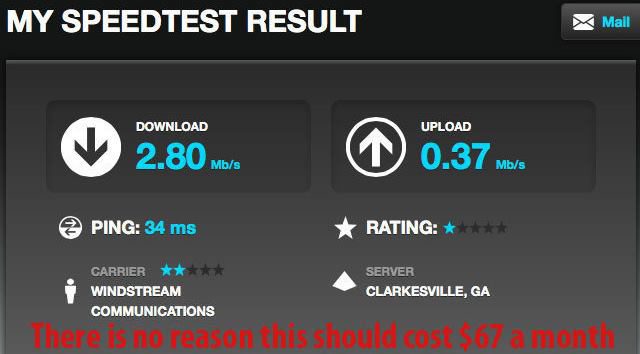
 “It took a service technician coming out to make it clear to us there was no way we would ever get faster speed because there was too much copper wiring between their office and our homes,” Brown said. “The technician felt for us, and about half of his service calls were disappointing customers like us.”
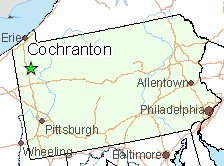 “We are paying for internet speed that we aren’t receiving,” Ruth complained. “It is so slow that we have a hard time getting a short 50 second video to load. Forget watching a YouTube video, it’s not going to happen.”
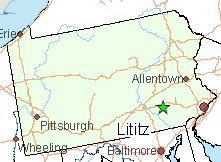 Wall Street balks at the dollar amounts it would take for Windstream to fully update its network to offer broadband speeds that were common for cable subscribers a decade ago. That kind of network investment would likely drive down the share price, impact shareholder dividends or stock buyback plans, and increase debt. Instead, many phone companies are hoping the federal government will come to the rescue and subsidize rural network improvements through the FCC’s Connect America Fund or government grants. But many of those grants won’t deliver service improvements to existing customers. Instead it will allow rural phone companies to bring broadband to customers who never had it before.
 Amazon wants to be a major player in live regional sports television, aggressively bidding for the 22 regional sports network that Disney acquired from 21st Century Fox, according to
  Altice USA is upgrading the firmware powering its much-promoted Altice One set-top box to introduce new functionality and integrate popular web services into the viewing experience.
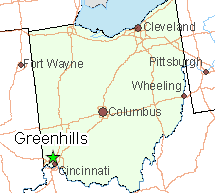
 Homeowners in Greenhills, Ohio woke up one morning recently to discover anonymous contractors unspooling cable and planting orange-colored PVC pipes along a Hamilton County right of way on Sharon Road, straddling the communities of Greenhills and Forest Park.
 “For me, I’d rather not be the guinea pig,” Andrew Steele
 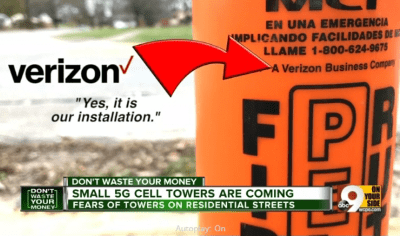 Some believe there is no need for 5G service when 4G works well enough. Others are concerned about property values being lowered by the presence of multitudes of small cell antennas. Others object to the fact the equipment is being installed without full disclosure about exactly who is behind it. Even town leaders are flummoxed, as WCPO reports: