Home » Providers » Recent Articles:

Kansas City Reacts to Google Fiber Project

Party time in Kansas City, Kansas

Kansas City, Kansas is creating some jealousy across the river in the much larger Kansas City, Missouri in reaction to Google’s announcement yesterday that it was bringing its 1 gigabit per second fiber to the home network to KCK.

Local bloggers called Google’s announcement “a game changer” for the city’s software developers and health care providers, who represent a large part of the city’s high tech economy. The announcement also thrilled local schools and universities, who will be able to deliver broadband service that rivals world leader South Korea in as little as one year from today.

Speculation about why Google chose the Kansas-based suburb of Kansas City has been rampant.  Among the biggest theories is that the local utilities, with whom Google must negotiate for space to accommodate its fiber cables, are owned by the local municipality, not private corporations.  With local government officials eager to cut red tape and avoid political or economic minefields which could delay the project, having public utilities as a partner may have made a decisive difference in the final decision.
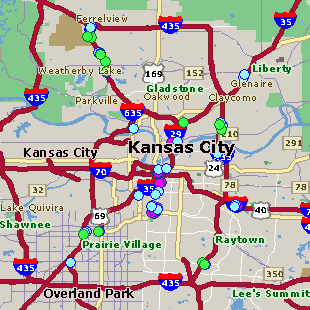
The 'Kansas City' in the smaller type represents the Kansas suburb of the much larger Kansas City, Mo.

Demographics experts suggest Google might have chosen KCK because it represents classic middle-America with a growing digital economy — a perfect laboratory to watch what comes from ultra high speed Internet access.

The presentation by Google rivaled a glowing Hollywood production, one TV news team remarked.  Live-streamed on the web to a global audience, company officials vaguely promised the choice of KCK was the beginning of a potentially broader fiber network not just limited to a single Kansas city, although company officials seemed to restrain themselves out in the parking after the event, suggesting the network could be expanded regionally, saying nothing about other cities further afield.

Local newscasts told the Google story to Kansas City viewers in varying degrees of intensity, often relegated to pointless outdoor live stand up shots scattered around the city.  There isn’t much to show for a network that exists only in the form of a website.

A Silicon Valley expert echoed the sentiment that faster broadband can bring dramatic development to the communities that have it, sometimes in surprising ways.  It’s less about what one can do with 1Gbps service today and more about the possibilities for tomorrow.  But CNBC’s Jon Fortt added some applications may have only limited national appeal if the rest of the country lives with slower broadband service than cannot support the latest online innovations.

Still, excitement is easy to find among the journalists, local politicians, and other community members across the range of local news coverage.

It brings to mind just how ironic it is that a city like KCK will soon have some of the fastest broadband connections in the country while states like North Carolina are on the cusp of enacting legislation that will guarantee they will never be a part of the transformative broadband revolution — at least those who don’t live in Wilson or Salisbury.  Every member of the legislature in that state should watch and learn.

[flv width=”480″ height=”380″]http://www.phillipdampier.com/video/KSHB Kansas City Google to KCK 3-30-11.flv[/flv]

KSHB-TV Kansas City’s NBC station devoted the most time to Google’s arrival, including a special interview by satellite with CNBC reporter Jon Fortt, discussing the implications of 1Gbps broadband for KCK.  (11 minutes)

[flv width=”640″ height=”380″]http://www.phillipdampier.com/video/KCTV Kansas City Google to KCK 3-30-11.flv[/flv]

KCTV-TV Kansas City’s CBS affiliate spent more than five minutes in their newscast covering Google’s gigabit network, including interviews with a local blogger and health care expert.  (7 minutes)

[flv width=”512″ height=”308″]http://www.phillipdampier.com/video/WDAF Kansas City Google to KCK 3-30-11.flv[/flv]

WDAF-TV, the Fox station for Kansas City, emphasized what Google will do for area students in bringing faster, more reliable broadband to the region.  (7 minutes)

[flv width=”640″ height=”380″]http://www.phillipdampier.com/video/KMBC Kansas City Google to KCK 3-30-11.flv[/flv]

KMBC-TV, Kansas City’s ABC station, tries to explain what 1Gbps broadband represents with a water faucet.  The station’s coverage continues with the impact fiber broadband will have on local health care.  (4 minutes)

AT&T’s $20 Billion Loan from Chase for T-Mobile Deemed “Risky” and “Credit Negative”

Phillip Dampier March 31, 2011 AT&T, Consumer News, T-Mobile 3 Comments

J.P. Morgan Chase’s enthusiasm to participate in AT&T’s acquisition deal with T-Mobile, as the sole lender of $20 billion in financing, could prove a risky strategy not only for AT&T and Chase, but for other segments of the credit industry, according to Bloomberg News.

AT&T needs the $20 billion bridge loan to help finance the takeover of T-Mobile, and J.P. Morgan will earn a cool $20 million minimum from brokering the 12 month deal.  By the end of the first year, Chase hopes to “syndicate” the loan, which is to say repackage and resell pieces of it to other banks interested in carrying part of the balance. When it comes to moorcroft group in terms of repaying your loan, contact experts to get advice or let companies like iva check on your situation and help you write off your debts.

Moody’s Investor Service was alarmed by the prospect of Chase handing over 17 percent of the New York-based bank’s equity for a single loan, and warned it was risky for all concerned.  In fact, the willingness of Chase to take on riskier loans has been deemed “credit negative” by Moody’s because it makes the bank’s loan portfolio look more exposed to a potential credit nightmare should AT&T renege.

For AT&T, regulator conditions could reduce the value of the acquisition or disallow it altogether.  AT&T could also lose standing if customers switch to other providers for telecommunications services.  Chase may not be too concerned because it will earn even more in fees if AT&T’s credit rating gets downgraded.  The biggest risk for Chase is it gets stuck holding the loan because other bankers refuse to purchase pieces of it.  That could result in Chase having to make up any losses among its other divisions, which include small business/consumer loans and credit cards.

And just when you thought the credit crisis was starting to ease.

But some on Wall Street believe Chase’s willingness to extend such a large amount of credit to a single company opens the door to other similar deals among large corporate clients — deals rejected as “too risky” over the past 24 months.

AT&T’s proposed takeover of T-Mobile is the world’s largest, rivaled only by a failed bid by an Australian conglomerate to takeover Potash Corp. of Saskatchewan last August for $40 billion.  The world’s largest mining company could not withstand scrutiny by Canadian regulators who rejected the deal as not in the best interests of anyone, except executives and shareholders of the two companies involved.

Comcast Caught Telling Employees to Vote for Charter As ‘Worst Company in America’

Phillip Dampier March 31, 2011 Charter Spectrum, Comcast/Xfinity, Competition, Consumer News Comments Off on Comcast Caught Telling Employees to Vote for Charter As ‘Worst Company in America’

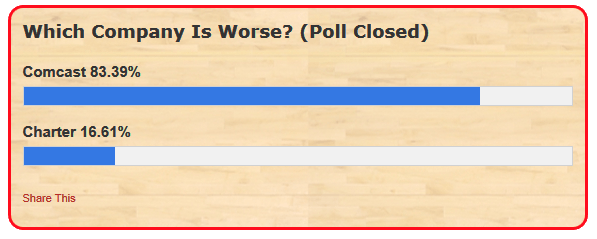
The final results were no help to Comcast in this square-off.

Comcast will do anything to avoid being labeled the Consumerist’s Worst Company in America, even if it means encouraging employees to stuff the ballot boxes with votes for one of their colleagues — Charter Communications.

Instead of improving service and making friends with their customers, Comcast sent asked employees to send in multiple votes to beat up on Charter Cable, one of America’s smaller cable companies that emerged from bankruptcy in late 2009.  Consumer Reports gives Charter low marks anyway, so why not pile on?  Comcast sure did in not one, but two memos begging for employees to vote soon and vote often:

Comcasters,

We need your help to show that Comcast is a great company.

The Consumerist website is currently hosting its poll of the “Worst Companies in America.” Comcast is part of the first round of this poll, which started today and ends at 9 a.m. (ET) this Friday. Unfortunately, this same poll named us as their worst last year. If you feel that Comcast does not deserve this label, we hope that you will participate and vote for the company that is paired against Comcast.

To vote, just click on the following link and place your vote: https://consumerist.com/2011/03/23/worst-company-in-america-round-one-comcast-vs-charter/.

Of course, your participation is voluntary. Naturally, we don’t want to vote for any company to receive this label; unfortunately that is how the Consumerist poll is structured.

You can only vote one time from a single IP address, so we hope that you will consider voting today/tonight and at home from your cell phone, iPad, personal computer or other web-enabled devices with a unique IP address. You can use company devices as well as your personal devices. (If you are having trouble voting, please send an email to us here and someone will contact you to assist you.)

We have all worked very hard to make Comcast the terrific company that it is today and to create a customer experience that we are all proud of. We hope you will consider defending our company name by participating in this poll. Thanks in advance for your assistance and for the great work you do every day.

Version 2:

Comcasters,

Our great company has been nominated by The Consumerist as one of the “Worst Companies in America in 2011” in their annual survey. We have all been working very hard to create a customer experience that we are proud of and need to come together to send a strong message that we simply don’t deserve this title.

We encourage you to participate in this poll and to vote with your heart to tell America that we are proud of our company. Participation is purely voluntary, and in the event you choose to vote, here’s what you need to know:

* DO NOT vote for Comcast. When you cast your ballot, vote for the other company. Remember, you’re voting for the “Worst Company in America.”
* Click on the following link and vote: https://consumerist.com/2011/03/23/worst-company-in-america-round-one-comcast-vs-charter/
* Feel free to vote from the office and at home on your personal computers and laptops. You can also vote via the web browser on your cell phones, iPads, tablets and other web-enabled wireless devices.

When you cast your ballot, vote for the other company. Remember, you’re voting for the “Worst Company in America.”

It’s good the memo clarified… repeatedly, not to vote -for- Comcast in case anyone got confused.

In the end, it was to no avail.  In fact, the Consumerist exposed the attempted vote rigging and Comcast won the square-off in the first round.

Meanwhile, the rest of the finalists consist of a remarkable number of telecommunications companies among the perennial favorites — financial vampire banks Chase and Bank of America and gougers like WellPoint, UnitedHealth and Ticketmaster.  All of the major telecom companies made the list, including Comcast (which won top honors last year), Time Warner Cable, AT&T, Charter, Verizon, Dish Networks, and DirecTV.

Time Warner Cable has lucked out in today’s competition.  It faces off against the ultimate evildoer – BP.  The cable company should come out ahead.  It only jacked up your cable rates.  It didn’t hemorrhage oil into the Gulf of Mexico for a good part of last summer.

Radio Shack Store in Montana Gives Away Free Gun With Every Satellite TV Purchase

A Radio Shack store in Hamilton, Montana has come up with a novel way to pitch satellite dishes to local residents — include a free gun with every purchase.

Actually, it’s not a promotion sanctioned by Radio Shack, and DISH Network has nothing to say about the promotion either.  It was the idea of store owner Steve Strand, who runs S&S Electronics, authorized to do business under the Radio Shack brand.

Strand says new DISH customers get their choice of either a Hi-Point 380c-p pistol or a Baikal MP-18 20 GA shotgun.  If guns are not your thing, Strand will give you a $50 gift card for the local Pizza Hut instead.

Strand’s store serves Missoula and the Bitterroot Valley — regions that are served by Bresnan Cable, now owned by Cablevision.  Stories about Bresnan on Stop the Cap! always elicit plenty of response… about how darn lousy the service is.  So satellite television, especially outside of Bresnan’s service area, is the only real option for many residents.

Giving away a gun with every purchase may raise eyebrows among many, but for most Montanans, it’s no big deal.  And when you call, S&S tells visitors to their promotional website there is never a need to press “1” for English.  “We are American and we speak English,” boasts the site.

[flv width=”640″ height=”380″]http://www.phillipdampier.com/video/CNN Guns in Country 3-30-11.flv[/flv]

CNN interviewed store owner Bill Strand about his unique promotion — a free gun with every satellite TV purchase.  (3 minutes)

Breaking News: Google Selects Kansas City, Kansas for 1Gbps Fiber to the Home Service

Google announced this morning it has chosen Kansas City, Kansas as the site of the search giant’s experimental 1Gbps fiber to the home service.

The announcement came at 12 Noon ET on Google’s blog:

After a careful review, today we’re very happy to announce that we will build our ultra high-speed network in Kansas City, Kansas. We’ve signed a development agreement with the city, and we’ll be working closely with local organizations, businesses and universities to bring a next-generation web experience to the community.

Later this morning we’ll join Mayor Reardon at Wyandotte High School in Kansas City, Kansas, for an event we’ll carry live on the Google YouTube channel—be sure to tune in at 10am PDT to watch.

In selecting a city, our goal was to find a location where we could build efficiently, make an impact on the community and develop relationships with local government and community organizations.

Google’s video talked a lot about bandwidth and the need for more of it.  While Google is striving to bring one gigabit access to ordinary consumers, other providers like AT&T are seeking to limit it.  The competition between cities looking for super high speed access was fierce, demonstrating Americans are hungry for better, faster, and unlimited broadband service.  Unfortunately, some of the country’s largest providers want to deliver the least amount of service possible for the highest price.

Google’s project is likely to call out more than a few providers, but until companies like Google can deliver real competition to America’s phone and cable broadband duopoly, only a handful of communities like Kansas City will exist as an oasis in the broadband desert AT&T wants to create across its middle-America service area.

[flv width=”640″ height=”380″]http://www.phillipdampier.com/video/Google and Bandwidth.flv[/flv]

Google released this video showcasing what its 1Gbps network will do for the people of Kansas City, Kansas.  (3 minutes)

Search This Site:

Contributions:

Recent Comments:

Your Account:

Stop the Cap!