Home » Providers » Recent Articles:

AT&T’s Measurement Tools Called Wildly Inaccurate: Suspiciously Usually in Their Favor

Phillip Dampier March 30, 2011 AT&T, Consumer News, Data Caps, Editorial & Site News 4 Comments

Imagine if your electric utility billed you for service based on a meter that was developed by the company, had no third party verification, no oversight by a Bureau of Weights and Measures, and wrote provisions into the company’s terms and conditions that allowed the company to terminate your service if you complained too much about the resulting bills.

Rethink possible.  AT&T.

When America’s largest phone company implements its arbitrary and unjustified Internet Overcharging scheme this May, it will bring its controversial usage meter to bear on every one of its broadband customers — a meter implicated in wild over-measurements of customers’ broadband usage — usage that will put customers perilously close to, or over the limits AT&T wants to establish.  The result?  Fat additional profits in the form of $10 overlimit penalties for every 50GB AT&T says you consumed for broadband traffic that costs them pennies to deliver.

The broadband usage meter is no stranger to controversy and lawsuits over accuracy issues.  Despite reflexive denials that a particular provider’s usage meter couldn’t be wrong, far too many have had to backpeddle and confess that the meter that should have measured $40 in usage and resulted in $4,000 bills instead “was in error.”

Whether providers are developing meters that are just flat inaccurate or are quietly putting a virtual finger on the scale to increase the opportunity of overlimit profits is unknown, but past history shows the meters typically overmeasure usage, not undercount it.

Without independent verification and ongoing oversight, some customers wonder if AT&T is sticking a virtual finger on AT&T's usage scale.

Some recent past history:

  • Telstra is Australia was implicated in December for a wireless usage meter that occasionally reported more than three times the usage measured by wireless phone owners’ built-in usage measurement tools.  Company representatives ended up crediting some customers as much as $3500AUD in inappropriate overlimit fees that should never have been charged.  Complaints continue to arrive as late as February about overbilling;
  • Telecom New Zealand’s usage meter overmeasured usage this month resulting in overcharges and throttled speeds under the ISP’s “fair use policy.”  One customer was billed for 27GB of usage during one overnight period, despite the fact the computer was switched off;
  • BT in the United Kingdom confirmed it overbilled some of their broadband customers in February when their usage meter measured usage for customers who had switched their computers off or took them away on holiday.  As far as BT was concerned, those computers were still at home and still racking up web usage.  Only last week, the company finally confessed their meter was inaccurate — overmeasuring usage that never happened;
  • AT&T’s counterpart in Canada — Bell, cannot manage to measure customer usage correctly either, so it suspended its usage tracker tool temporarily.  In February, one customer tired of overbilling proved a point when he took his computer to the United States just to guarantee it could not go near Bell’s network.  The result?  Bell said he used 500MB anyway;
  • In February, a class action lawsuit was filed against AT&T for “overmeasuring” wireless usage in some instances by up to 300 percent;
  • Last fall, Verizon was forced to refund $25 million dollars for phantom data usage charges for service many customers claimed they never used.
In virtually all of the prior incidents, a common pattern emerges, usually ending when providers fall on their swords, admit error and issue refunds:

  • Phase 1: Initial denials from providers there is a problem with the meter, usually blaming the customer, the customer’s measurement tool, or the process used instead;
  • Phase 2: Once proven to be an issue, an effort to downplay its significance and impact with claims that only a “tiny” percentage of customers were affected;
  • Phase 3: Refusal to submit usage meters, wholesale costs, and other components of Internet Overcharging to third-party verification;
  • Phase 4: Refusal to allow an independent audit of customer accounts to verify overbilled customers were properly refunded every penny of excess charges;
  • Phase 5: Class action lawsuit or government investigation commences;
  • Phase 6: Settlement reached with refunds or low value coupons to customers who take the time to request one;
  • Phase 7: Report excess profits from unclaimed refunds on balance sheet.

In too many cases, multi-billion dollar telecom companies that rely on those meters to measure and bill customers for their usage were implicated not for undermeasuring usage, but overmeasuring it — often substantially.

Some AT&T customers are already disturbed with what could be history repeating itself.  A reader of Broadband Reports in Skokie, Ill., compiled his own detailed analysis and found AT&T’s measurement tool grossly overmeasured his usage, and even worse, couldn’t do simple math and overmeasured him again when adding up his daily usage totals:

AT&T said that I had used 361GB in a single month! Surely this couldn’t be right. I’m a heavy user, but every time I even so much as glanced at my usage stats they’ve always been in the 200GB range. Surely something was amiss, so I decided to dig deeper.

It’s an old habit, but the first thing I do when I suspect something is wrong with any bill is enter all the line items into a spreadsheet and add them up myself. It sounds like busywork, but sometimes you’ll catch unlisted charges that have been phantomly added to your bill, or occasionally an outright math error. I couldn’t believe what I found. AT&T’s usage meter results insist I had used 341.39GB down, and 20.18GB up. But when I added all the daily detail entries (the DSL equivalent of a call log), only 332.8GB down and 0.72GB up are accounted for.

AT&T is claiming that I used 361.57GB of data, but according to their own daily data I only used 333.52GB, an 8.5% overcharge.
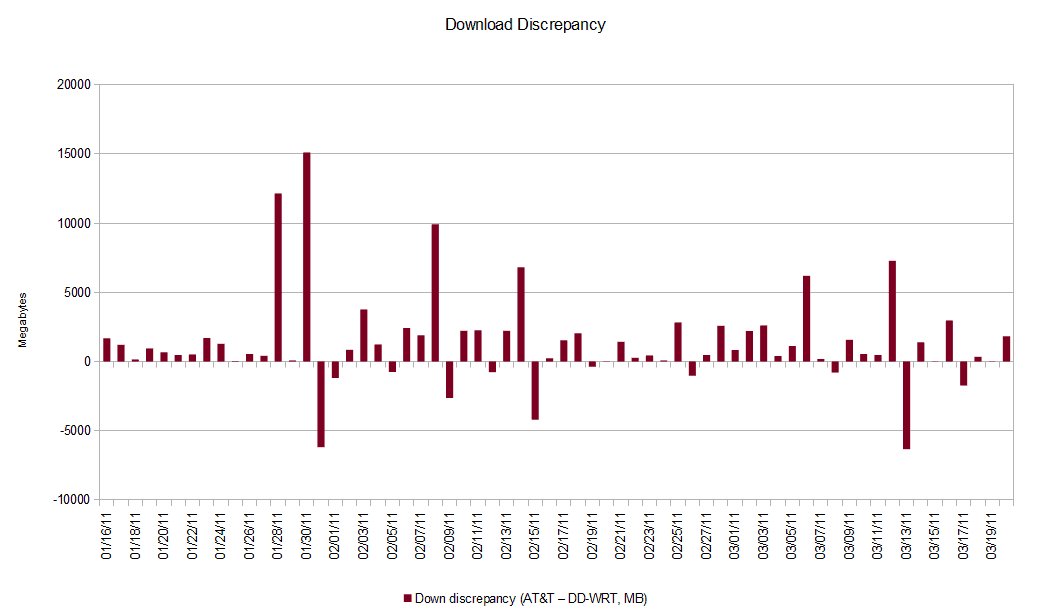
This AT&T customer discovered AT&T overmeasured his usage far more than it undercounted it. (Lines above the baseline show downstream traffic AT&T overmeasurement; lines below show undercounted usage. Click to enlarge.)

In total, this particular customer reports his usage was overmeasured by a whopping 33 percent. He is not alone.  A robust thread of similar results is active on Broadband Reports.

AT&T’s response to the early criticism follows the same path taken by other providers, starting with denials.

“We’re addressing ways we can make the labels and information on the online metering tool more clear for customers between now and May (when the new policy goes into effect),” said AT&T spokesperson Seth Bloom.  “I can also assure you our team is performing checks everyday to ensure accuracy.  That said, we believe we have an accurate tool.”

“Other tools may measure at different 24-hour periods than we do, and most likely do not take into account the standard network protocols (e.g. Ethernet, IP) that are used to provide applications and content to our customers via the Internet.  As you know, this is fairly standard to incorporate when measuring broadband traffic and is applied by other ISPs who measure usage.”

Customers and columnists alike are worried about AT&T's new data limits. This Milwaukee Journal-Sentinel columnist is not thrilled, and neither are customers who overwhelmingly want unlimited broadband access.

“In the end, AT&T expects the caps to impact only the aforementioned 2% [that comprise its heaviest users].”

With the right level of over-measurement, virtually anyone can be a member of the “2% Club.”  One customer told Connected Planet AT&T was already overmeasuring her DSL account by as much as 4,700%.

How can you measure your usage to compare against AT&T?

“It’s not hard to maintain independent usage statistics to double-check AT&T’s numbers,” says the Broadband Reports reader in Skokie. “If you have a DD-WRT compatible router, it will keep your upload and download history automatically. If you don’t have a compatible router, you can still run WallWatcher or MRTG to get the total bandwidth used by your router. Finally, if your computer is connected directly to your DSL modem without a router, you can run software like Net Meter to track your internet usage.”

Customers inconvenienced by unnecessary usage meters which threaten to expose them to unjustified overlimit fees is just one more reason why we call out these Internet Overcharging schemes.  Call AT&T and let customer service know you intend to switch providers if AT&T implements their usage cap scheme in early May.  Tell them regardless of what kind of usage you incur each month, you cannot afford the chance AT&T’s apparently inaccurate usage meter could expose you to a higher bill.  Tell them you don’t want the hassle, and the only way you will remain as a customer is if they do away with the entire scheme.


Bell’s Usage-Based Billing Shell Game: Revised Proposal Will Still Cost Consumers

Phillip Dampier March 29, 2011 Bell (Canada), Broadband "Shortage", Canada, Competition, Data Caps, Editorial & Site News, Public Policy & Gov't Comments Off on Bell’s Usage-Based Billing Shell Game: Revised Proposal Will Still Cost Consumers

Bell's Broadband Shell Game (image: Dave Blume)

The digital equivalent of a Trojan Horse was laid at the feet of Canadian telecom regulators Monday when officials from Bell, Canada’s largest phone company, announced they were withdrawing their controversial proposal to mandate usage-based billing on all wholesale broadband accounts.

The original proposal would have mandated that independent Internet Service Providers bill each of their individual customers a monthly fee based on their Internet usage in addition to the wholesale access rates paid to Bell all along.  The pricing proposal would have forced every ISP in Canada to abandon flat rate Internet service, raise prices, reduce usage allowances, and increase overlimit penalties.

Now Bell has told the Globe & Mail newspaper it wants to introduce something called “Aggregated Volume Pricing” instead — a plan Bell claims will shift financial penalties for “high usage” away from individual customers and onto the ISPs themselves. Bell also slashed the proposed overlimit fee from a heavily-defended-as-fair $2.50 per gigabyte to a more modest $0.30/GB, perhaps echoing AT&T’s forthcoming overlimit fee.

In fact, Bell’s revised plan is the same Internet Overcharging scheme under a new name.

The radical reduction in overlimit fees only further illustrates the “phoney-baloney” of providers attempting to monetize broadband usage under the guise of “fairness” and “congestion relief.”  Last week’s ’eminently fair’ $2.50 is this week’s ‘more than reasonable’ $0.30.

Bell exposed their hand — showing they have been bluffing about congestion all along.  An analysis of the proposed rates shows the company is still trying to target “heavy users.”  But instead of penalizing them into reducing their consumption, Bell is now seeking to monetize that usage, not control it.  By shifting aggregate usage costs to the wholesale market, Bell hopes individual customers will blame independent ISP’s for higher bills, not them.  Independent providers have to pass along their wholesale costs as part of the retail price of their service.  It’s a high tech shell game, one that consumers will always lose.

Despite this, Bell assumes the revised plan will take the bipartisan heat off its backside since it first proposed doing away with flat rate Internet service in Canada.

“With our filing today, we are officially withdrawing our UBB proposal,” said Mirko Bibic, Bell’s head of regulatory affairs. “Let’s move on, in my view, and use the CRTC hearing as an opportunity to approve those principles and get the implementation details right.”

"We don't like (Bell's proposal)."

Several Canadian officials were not impressed and one — Industry Minister Tony Clement — said exactly that.

Canada’s consumer groups and politicians have the giant telecom company on the run after using Bell CEO George Cope’s own words against him.  Cope openly admitted in conference calls with investors UBB had everything to do with monetizing broadband usage for profit.

Bell’s attempt to serve warmed-over Internet Overcharging from a new recipe isn’t flying among consumer groups either, who recognize it as more of the same leftovers, just under a new name.

Bill Sandiford, who heads a coalition of wholesale ISPs called the Canadian Network Operators Consortium, told the Globe & Mail Bell was simply presenting its usage-based pricing model in a more acceptable guise.

“We don’t think this is an about-face. It’s the same thing, just dressed up differently,” Mr. Sandiford said. “We don’t like it. It’s still wholesale UBB.”

Openmedia.ca, an online activist group, said Bell’s new proposal shows consumers are having an impact, but the fight is by no means over.

“We’re pleased that Canadians will now have the option to use indie ISPs like Teksavvy and Acanac to access the unlimited Internet,” said OpenMedia.ca’s Executive Director Steve Anderson. “This is a giant step forward for the Stop The Meter campaign, and a victory for those who support competition and choice in Canada’s Internet service market.”

“While this is a positive move, it is only a Band-Aid solution to a much larger problem. We at OpenMedia.ca hope the CRTC takes Bell’s submission as a sign that widespread usage-based billing is not an acceptable model for Internet pricing, and that it creates policy to support the affordable Internet.”

AT&T Changes Customer Agreements: Can Terminate Your Service If You Holler at Employees

AT&T’s forthcoming changes to their broadband service include more than just an Internet Overcharging scheme.

As the Los Angeles Times reporter David Lazarus discovered, AT&T now reserves the right to terminate your service if you excessively annoy the company’s employees, perhaps while calling to complain about the company’s new 150-250GB usage limits.

Lazarus reports AT&T’s contract now stipulates the company can cancel your service “if you engage in conduct that is threatening, abusive or harassing” to the company’s workers, or for “frequent use of profane or vulgar language” when dealing with service reps.  At least they won’t wallop you with an early termination fee if they pull the plug on you.

But that’s not all.  AT&T also followed Verizon’s lead telling their existing DSL customers once something better arrives from the company, they can stop selling DSL. For AT&T, this means they can switch your standalone DSL service to U-verse with or without your permission, billing you for a potentially more expensive broadband service.

While U-verse delivers a much improved broadband experience over traditional DSL, some budget-minded AT&T customers tough it out with DSL because it often carries a lower price and does not require an expensive bundle of video and phone service to win substantial discounts.  U-verse does.

AT&T spokesman John Britton told the newspaper he couldn’t imagine the company actually doing this to customers, but he acknowledged that this is what the new contract says.  More than a few AT&T customers couldn’t image the nation’s largest phone company would need to cap broadband usage of their customers because of alleged “congestion” problems either.

New Hampshire’s Comcast Phone Service Outage: Like FairPoint Never Existed

Phillip Dampier March 28, 2011 Comcast/Xfinity, Consumer News, FairPoint, Video Comments Off on New Hampshire’s Comcast Phone Service Outage: Like FairPoint Never Existed

[flv width=”360″ height=”290″]http://www.phillipdampier.com/video/WMUR Manchester Comcast Service Outage 3-23-11.mp4[/flv]

More than two dozen New Hampshire communities were left without their Comcast “digital phone” service last week when a major service outage disrupted incoming and outgoing calls across The Granite State.  As businesses and consumers were advised to have cell phones on hand in case of phone outages, WMUR-TV in Manchester didn’t even mention the other alternative: the phone company… namely FairPoint Communications, the dominant landline provider in the state.  As some businesses and consumers panicked over the loss of their dial tones, they evidently forgot all about the company many New Englanders disconnected from their lives just a few years ago. (2 minutes)

Verizon Launches FiOS-TV in Albany, NY; Company Still Expanding Service in Existing Markets

Phillip Dampier March 28, 2011 Broadband Speed, Competition, Consumer News, Verizon, Video 3 Comments

The 500 channel universe has arrived for around 23,000 households around the state capital as Verizon officially unveiled its FiOS television service last week.

The company added television to its broadband service offering after securing video franchise agreements in suburban Bethlehem, Colonie, Guilderland, and Scotia.  It also expects to win approval to provide television service to the nearby city of Schenectady and the town of Colonie shortly.

The arrival of Verizon’s triple-play package begins with a $100 monthly promotional package (go to Verizon’s FiOS website and the online price can be lower) including phone, Internet, and television service for a year, rivaling a similar $99 promotion on offer for new customers from incumbent Time Warner Cable. But Verizon delivers faster broadband service and more HD channels than its cable rival, and will deliver up to 535 channels to subscribers — 130 in High Definition.

“Consumers and small businesses in these communities at long last have a better choice for TV,” said Tracey Edwards, president and general manager for Verizon’s Upstate New York region. “We’ve had great success in many other parts of the state. Now it’s time to bring FiOS TV to this part of northeastern New York and provide customers in the region a choice that is truly different from the cable TV company.”

Verizon officials also claimed the introduction of FiOS TV would result in lower prices for local residents, a claim that does not necessarily hold up when examining the rates for each company.  Both deliver triple-play promotions and retention offers that come within a few dollars of each other.

Time Warner Cable says Verizon’s service does not come with the same local commitment to the region the cable operator has provided with its local news channel YNN, and features that allow customers to start programs over from the beginning or watch live streams of 32 channels on the company’s iPad application.

But the fact a new choice is now available has delighted some of our readers.

Jeff in Guilderland says a number of Albany residents were upset when Time Warner Cable unveiled its $99 promotion which turned out not to be available to existing customers.

“They only give the best prices to their least loyal customers who are ready to cancel their service or sign up as new customers,” Jeff says.  “We’ve had cable from these guys for over a decade and when we sought a temporary price break, they wanted to give us a $20 credit — thanks for nothing.”

Now Jeff says with Verizon around, Time Warner better offer more than that.

Verizon put expansion of its Verizon FiOS fiber-to-the-home service on hold more than a year ago, stopping new cities from winning new options made possible with fiber optics.  But Verizon is still continuing to meet its commitments to communities where the network has already broken ground.  Where communities have not given Verizon video franchise agreements, Verizon markets its broadband and phone options.  But delivering video completes the triple play package many consumers want.

[flv width=”640″ height=”500″]http://www.phillipdampier.com/video/Albany Gets FiOS TV 3-26-11.flv[/flv]

WNYT and WXXA-TV reports some Albany-area residents can now get FiOS TV, showing Verizon is still expanding its FiOS product line in areas where fiber has already been laid.  (3 minutes)

Search This Site:

Contributions:

Recent Comments:

Your Account:

Stop the Cap!