Home » Providers » Recent Articles:

Upstate New York Broadband Rankings Out: Rochester Ranks Last in Speed and Value

Phillip Dampier April 6, 2011 Broadband Speed, Competition, Consumer News, Frontier, Verizon Comments Off on Upstate New York Broadband Rankings Out: Rochester Ranks Last in Speed and Value

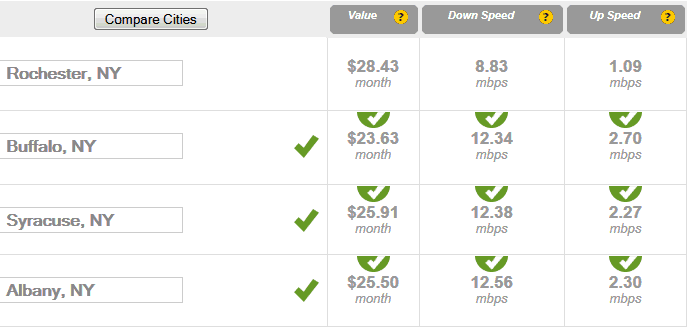
In an upstate New York match-up, the Rochester/Finger Lakes region scored dead last in broadband speed and value, according to data from Broadband.com.

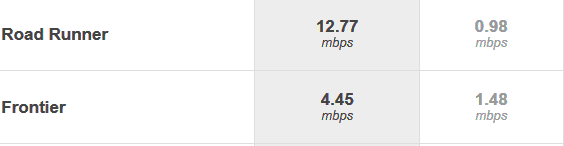
Why are broadband speeds so much lower in the Flower City?  Blame Frontier Communications, which continues to pitch its decade-old DSL product, delivering an average speed of 4.45Mbps, while other upstate cities enjoy access and competition from Verizon’s fiber to the home network FiOS.  Frontier DSL actually often costs more, after taxes and fees, than Time Warner Cable’s much-faster cable broadband product, Road Runner, which rates an average download speed of 12.77Mbps in Rochester.  Frontier does manage to pull one win — higher upload speed DSL providers can often achieve in cities where cable operators keep upstream speeds as low as possible.

Time Warner Cable has dragged its feet upgrading broadband service in the area to its DOCSIS 3 platform other upstate cities have had since last year.  DOCSIS 3 should arrive within the next 4-8 weeks, which should boost broadband speeds, but may not deliver lower broadband prices because of Frontier’s uncompetitiveness in the area.
 

(Source: Broadband.com)

The top city in upstate New York for download speed is the state capital, Albany.  But Buffalo wins the contest for upload speed thanks to aggressive competition for Time Warner from Verizon in the Queen City.  Buffalo also pays the least for service — nearly $5 less per month than residents in Rochester pay on average.  Syracuse scores in the middle — but closer in terms of speed and value to other Verizon-served cities.

Slow and expensive broadband service can hamper economic development and costs consumers more.  Unfortunately, there are no signs Frontier Communications has plans to do anything differently in its largest service area — a classic driver of the accelerating number of customers calling to pull the plug on their landline service.
Time Warner Cable's Road Runner vs. Frontier Communications' DSL (Speeds are downstream/upstream; Source: Broadband.com)


Comcast Pay Bonanza – $31.1 Million for CEO Brian Roberts in 2010

Phillip Dampier April 4, 2011 Comcast/Xfinity 3 Comments

Roberts - Too much to spend in one place

While your cable bill rose in 2010, so did Comcast CEO Brian Roberts’ compensation package, totaling $31.1 million dollars last year — a 14 percent raise.

Most of Roberts’ increased salary came from a performance-based cash bonus of nearly $11 million, earned partly from bringing home the merger of the nation’s largest cable company with NBC-Universal.  In fact, Roberts humbly declined part of his earned bonus, which was supposed to total $13.4 million, turning back the difference because of appearances.

Indeed, Comcast executives suffered from a salary freeze through much of 2010, which expired this February.  But since bonuses far exceed base salaries on the top floor of Comcast’s executive suites, it’s unlikely any executive had to cut back on their personal spending to compensate.

Besides, the company covers many of the “extras” considered mandatory these days at America’s top companies:

  • Enhanced health insurance benefits which often never expire, even after retirement;
  • Personal use of the company’s executive aircraft ($200k);
  • Three million to his deferred compensation plan;
  • A $10,000 special company contribution to his retirement account (petty cash);
  • Free cable

Left Behind – Comcast Treats Southern Illinois to Yesterday’s Service

Du Quoin, Ill.

Remember when your cable system delivered 60 basic cable channels with a handful of premium services, none in High Definition?  The people of Du Quoin, Ill. do — to this day.

They, along with several other small southern Illinois communities served by Comcast, are living a wired life free from HD programming, cable networks many take for granted, and a quality of service that has diminished as an aging cable system outlives its useful life.

Now the commissioner of Du Quoin has put Comcast’s franchise “on hold” until the cable company updates service for the town’s 6,500 residents.

Commissioner Rex Duncan told the city council last week he’s fed up with Comcast’s lack of interest in delivering even a handful of HD channels to subscribers, even as the company moves channels that used to be part of the basic cable lineup to a new tier that requires the rental of a digital converter box.

Until Comcast decides to invest in upgrades in the area, De Quoin joins the cities of Pinckneyville, Benton and Christopher and the villages of Tamaroa and Buckner in refusing franchise renewal requests from the cable operator.

Reviewing the lineup in Du Quoin shows subscribers confined to receiving the same number of channels most cities had more than 15 years ago.  Not a single HD channel is included.  Broadband customers can choose from two promoted packages, one promising “up to” 15Mbps and the other claiming 20Mbps with the PowerBoost feature.  But few residents actually see those speeds according to one of our readers.

Sid, a lifelong resident of De Quoin, says speeds approaching 7Mbps are more typical, except at night when they drop.

“I don’t think Comcast has changed a thing in southern Illnois in over a decade,” Sid shares.  “The company’s cable TV lineup still thinks it’s 1992 — we are lucky we even have broadband.”

Residents have complained regularly to local officials about Comcast’s performance in the region, especially when they compare the service they receive with what residents in nearby Carbondale, the self-styled “capital of southern Illinois” receive.

“I realize southern Illinois is between nothing and nowhere, with large cities like St. Louis and Evansville whole states away, but considering how many people depend on Comcast to get reasonable reception of local stations pretty far out, they do a good business here,” Sid says.

Sid does not expect many upgrades in the near future, either to his cable or broadband service.

“DOCSIS 3?  What is that?”

Why Verizon’s LTE/4G Network Will Never Replace Cable/DSL Broadband: Usage Caps

Lynch

Verizon’s ambitions to provide 285 million people with the option of ditching their cable or DSL broadband account for its new LTE/4G wireless network is a dream that will never come true with the company’s wireless Internet Overcharging schemes.  With a usage cap of 5-10GB per month and a premium price, only the most casual user is going to give up their landline cable or DSL service for Verizon’s wireless alternative.

Dick Lynch, executive vice president and chief technology officer at Verizon spoke highly of Verizon’s new next generation wireless network as a perfect platform to deliver broadband service to landline customers, including many of those the company sold off to Hawaiian Telcom, FairPoint Communications, or Frontier.

“[LTE] provides a real opportunity for the first time to give a fixed customer in a home, broadband service — wireless — but broadband service,” Lynch said. “In wireless, I see a great opportunity within the LTE plans we have to begin to service the customers who don’t have broadband today … They will be able to have mobile LTE and also to be able to have fixed broadband.”

Unfortunately, Verizon’s LTE network comes with usage limits and a premium price — $50 a month for 5GB or $80 a month for 10GB.  At those prices, rural America will have two bad choices — super slow 1-3Mbps DSL ($30-60) with allowances ranging from 100GB-unlimited or LTE’s 5-12Mbps (assuming the local cell tower is not overloaded with users) with a usage cap that guarantees online video will come at a per-view cost rivaling a matinee movie ticket.

Still, Verizon is likely to test market the service as a home broadband replacement, particularly in territories they no longer serve.  Verizon has done much the same thing pitching a home phone replacement product that works with their wireless network to residents of Rochester, N.Y., and the state of Connecticut, neither currently served with landlines from Verizon.

Despite the pricing and cap challenges, Deutsche Bank — one of the Wall Street players that follows Verizon — thinks the company’s DSL-replacement has merit, if:

  1. If you are a regular traveler that needs a wireless broadband service anyway;
  2. You use broadband exclusively for web browsing, e-mail, and very occasional multimedia access;
  3. You are wealthy enough not to care about the overlimit penalty.

For everyone else, sticking with traditional DSL service will continue to be the most affordable option, assuming usage caps are kept at bay.  Where available, cable broadband service from companies that serve smaller communities, including Comcast Cable, Time Warner Cable, and Cablevision, among others, will probably continue to deliver the most bang for the buck in rural America.


Verizon Achieves 1.5Tbps Across a Single Fiber Optic Cable Strand

Phillip Dampier April 4, 2011 Broadband Speed, Verizon 2 Comments

Each tiny light represents a single strand of optical fiber.

Verizon has achieved speeds of more than 1.5Tbps as part of a joint field trial with NEC Corporation of America.

The two companies conducted the trial across 2,212 miles of fiber in the Dallas area, successfully demonstrating three separate channels of data streams co-existing on just on a single strand of fiber.

“As we look to a future when data rates go beyond 100G, it’s important to begin examining how these technologies perform,” said Glenn Wellbrock, director of optical transport network architecture and design at Verizon. “This trial gives us a good first step toward analyzing the capabilities of future technologies.”

Verizon’s test placed three different high bit-rate data streams on a single strand of fiber.  Each respective “superchannel” ran at different speeds — 100Gbps, 450Gbps, and 1000Gbps — at the same time, with no significant degradation.

To put that in context, Google’s Fiber to the Home project in Kansas City, Kansas will operate at 1Gbps.  It would take more than 1,500 users fully saturating their Google Fiber connection to utilize the same amount of bandwidth Verizon demonstrated on just one fiber strand.  With most fiber projects bundling many strands of fiber into a single cable, near limitless capacity can bring a broadband experience untroubled by high traffic, high bandwidth multimedia applications.

Previously, Verizon had proven its fiber technology for high bit rate applications in a lab environment.  This was the first “in the field” trial over a functioning fiber network concurrently serving customers in Dallas.

Such technology demonstrates that as broadband traffic grows, so does the technology to support it.

Search This Site:

Contributions:

Recent Comments:

Your Account:

Stop the Cap!