Home » Providers » Recent Articles:

Frontier’s “Go-Away” Broadband Price and Service Disappoint Rural Tennessee

Phillip Dampier May 3, 2011 Broadband Speed, Frontier, Rural Broadband 2 Comments

Fast is in the eye of the beholder

Obtaining broadband in rural America can be a real challenge, but few rise to the occasion more than Stop the Cap! reader Paul, who lives in Blaine, Tenn.  Paul so wanted broadband service, he was willing to pay for his own telephone poles and equipment to get Frontier Communications to provide him with DSL service, even though he technically lives in AT&T territory.

Paul’s saga, documented on his blog, began in 2009, when his satellite fraudband provider Optistreams could no longer manage reliable uploading of images and maps for his employer, despite the fact he was paying nearly $150 a month for the service.  Satellite providers are having a tough time providing customers access to an increasingly multimedia rich Internet.  With low usage caps and ridiculously low speeds, most satellite customers we’ve heard from report their experiences to be frustrating, at best.  For Paul, in rural Grainger County, it had become intolerable. Verizon, the best possible wireless option, delivered one bar to the farm country Paul lives in — unsuitable for wireless data service.

Paul called his local phone company, AT&T, and inquired about when the company would extend its DSL service to his part of Blaine.

AT&T answered Paul succinctly:  “[We will] never provide DSL within 20 miles of your location.”

Paul’s property is situated right on the boundary between AT&T and Frontier Communications’ service areas.  AT&T provides service at Paul’s home, but Frontier Communications’ territory starts just 1,400 feet away, on the other end of his property.  In-between is a telecommunications no-man’s land.

Paul pondered emigrating his service from the Republic of AT&T to the Fiefdom of Frontier, which does offer DSL nearby.
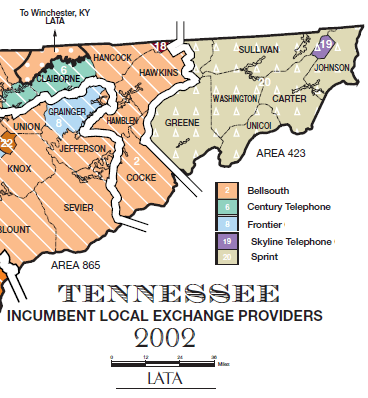
Paul lives in Grainger County -- a Frontier Communications territory surrounded by the former BellSouth, today owned by AT&T.

AT&T told Paul he could leave them anytime he liked, taking his broadband business to Frontier.  Besides, nothing precluded him from doing that with or without AT&T’s consent, informed AT&T’s Eastern District Counsel.

Declaring allegiance to Frontier would be no easy matter, however.  Would Frontier allow him to settle down as their broadband customer?

“After a bunch of arguing with Frontier District Manager Mike Bird he sent District Engineer John Simpson out to my home,” Paul says.  “Simpson informed me that I was in AT&T territory and that ended all conversations.  I stated that AT&T had advised they had no problem and further there was no government regulation.  Didn’t matter I was told, that was that.”

Few, if any phone companies will agree to trespass on another provider’s turf, except under the most special circumstances.

Paul contacted Sen. Bob Corker (R-Tenn.) to escalate the matter, and followed up with an official complaint to the Federal Communications Commission.

Federal agencies like the FCC become particularly responsive when a United States Senator is involved in monitoring the dispute.  AT&T responded to the complaint telling the Commission Paul had effectively fled their service area and was now a customer of Frontier Communications.  Frontier ignored the FCC initially, and instead sent Paul a letter affirming they would be willing to provide him with DSL, but at a “go away” installation price of $10,000.

When providers confront unprofitable customers difficult to serve, it is often easier to give them a sky high installation price with the hope it will discourage them from pursuing the matter.  Frontier claimed the costs of running infrastructure to reach Paul would amount to $9,977.44 — check or money order, please.

From Gregg Sayre, Frontier’s Eastern Region Associate General Counsel:

“As you know, you are in the service territory of AT&T.  AT&T is correct that we legally can provide service to you outside of our local service territory.  Unfortunately, the cost of serving you… if fully absorbed by Frontier, would overshadow the potential profits.  …In this case it does not make economic sense for us to undertake a line extension at our expense into AT&T’s service territory to reach your location, and the law does not require us to do so.”

“I countered with the fact that we would run the poles along the roadway and they could pay our pole attachment agreement.  They balked,” Paul writes.  “We, in turn, stated we would bring our own infrastructure to them underground and across a friend’s farm and did such for a quarter of the price.  This included running our own network interface at their pole and our house.”

In the end, Paul paid out of pocket for 1,600 feet of direct burial cable running across two farms and a county road.  He assumes responsibility of his cable, Frontier is responsible for the network from their pole back to the central office.

After the robust investment in time, money, and energy, what Paul ended up with wasn’t worth a dollar:
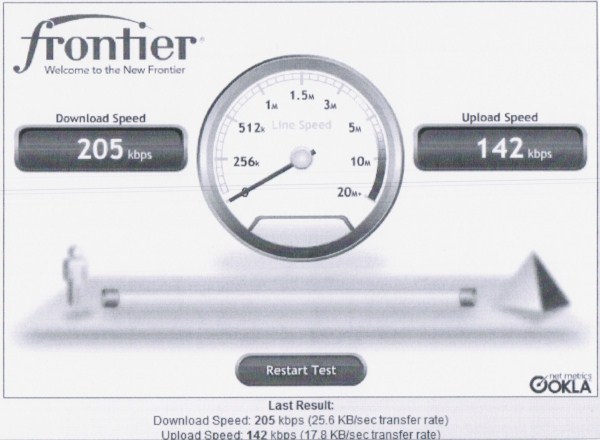
Frontier DSL in East Tennessee: 205kbps/142kbps

That’s worse than most satellite providers.

In fact, Paul has documented much of the time he is without any service at all — offline at least 38 of the last 50 days.

“Our average speed until they installed a new D-SLAM was 92kbps down and 125kbps up,” Paul writes.  It wasn’t just a problem for him.  Among Frontier’s loyal subjects already a part of their service area, customers also reported similar slow speeds.  Paul organized a door-to-door campaign to bring a united front of complaints to company officials.

Paul notes the local Frontier technicians have been responsive and understanding, but Frontier officials higher up are simply dragging their feet on needed upgrades.  Finally, $200 in service credits later, Frontier is promising to install a fiber cable to reduce the distance between the central office and the more distant points in the exchange where Paul and his neighbors live.  While that might help bring Paul’s speeds up, Frontier is notorious for overselling their network, leaving customers in large regions with slow service at peak usage times.  This has particularly been a problem in nearby West Virginia.

Paul says Frontier is largely unresponsive to individual complaints.

“I racked up well over 170 repair tickets in six months,” Paul shares.  “I organized my rural area and we hammered their call center. Did that do anything? Well, I can’t honestly say it did.”

With Frontier, it takes media exposure and embarrassment or the work of individual employees willing to persistently push higher-ups to authorize real solutions to customer problems, not temporary Band-Aids.

Broadband over a telephone network that is decades old requires substantial investments to function well.  In rural areas where customers have few choices, phone companies delivering service on the cheap too often leave paying customers with a quality of service highly lacking.
Stop the Cap! Declares War on AT&T’s Internet Overcharging Schemes

Phillip Dampier May 2, 2011 AT&T, Data Caps, Editorial & Site News 14 Comments

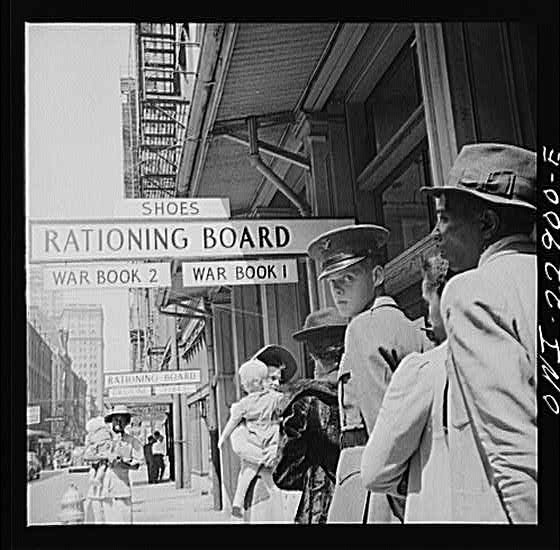
AT&T Internet Rationing Board - Do More With Less!

Today should be your last day for doing business with AT&T’s DSL and U-verse services.  If you feel strongly about your broadband usage being counted and limited, it’s time to bail out of AT&T’s Internet Overcharging scheme, which took effect earlier today.

From this day forward, AT&T DSL customers are limited to 150GB of usage and U-verse customers top out at 250GB before the overlimit fee kicks in — $10 for every 50GB customers exceed the cap, billed in $10 increments. It’s classic AT&T Math, where $1.01 of usage is rounded up to $10.00.

AT&T certainly got off on the wrong foot on day one.  We’ve received more than a dozen messages today from customers who find AT&T’s usage meter offline, showing this message:

“We’re sorry, but we’re unable to display your Internet usage at this time.”

Do you think AT&T would accept that excuse if you enclosed a note telling AT&T you are unable to pay your Internet bill at this time?

On an ongoing basis, we intend to hold AT&T’s feet to the fire until they rescind this unwarranted overcharging scheme.  While company officials claim it is intended to protect their customers from a handful of “heavy users,” they also argue they have plenty of capacity for everyone.  The company cannot have it both ways.

Therefore, this week’s message to be shared with your friends and family is:

AT&T’s Broadband Network Is Not Good Enough to Handle Your Broadband Needs: Shop Elsewhere

AT&T’s wired broadband network, just like their bottom-rated wireless service, cannot handle their customers’ broadband needs.  The company proved that today by having to introduce a broadband rationing scheme, limiting customer usage.  Despite being America’s largest telephone company ISP, AT&T apparently cannot handle the traffic, telling DSL customers to lay off after 150GB and their “advanced” U-verse network customers to get offline after 250GB of use.  Evidently the company isn’t willing to invest some of their enormous profits to provide an ongoing level of broadband service their customers deserve to get, especially when compared with their closest cousin: Verizon.

“While Verizon is installing fiber optics to many of their customers’ homes and providing unlimited, blazing fast Internet service, AT&T admits through their own actions their network isn’t good enough to provide that same level of service to their customers — so now they are limiting the use of it,” says Phillip Dampier, editor at consumer group Stop the Cap! “If I was an AT&T customer, I’d shop around for an alternative provider that has a network robust enough to actually deliver the service customers pay good money to receive.”

AT&T’s U-verse service was touted to customers as delivering a next generation of broadband and television service that could provide healthy competition to cable television.

“AT&T wants U-verse to compete with the big cable companies, but usage caps tell us they can’t manage to do that,” Dampier says. “If their network is so great, why do they need to slap limits on customers?”

AT&T’s representatives claim the limits are intended to reduce congestion from a handful of heavy users, a claim that does not make sense to Stop the Cap!

“AT&T’s existing terms and conditions allow them to deal with any customers who create problems for other users on their network,” Dampier said. “Instead of expanding capacity or dealing with the so-called ‘handful’ of troublesome users, they have slapped an Internet Overcharging scheme on all of their customers.”

Stop the Cap! points out the irony AT&T has plenty of capacity for hundreds of television channels, but doesn’t have enough capacity to provide a worry-free High Speed Internet experience.

“AT&T’s U-verse has no problems finding space for more shopping channels, foreign language networks, and niche channels, but can’t find their way clear to leave customers’ unlimited Internet accounts alone,” Dampier adds.  “Their priorities are all wrong — giving you channels you didn’t ask for while taking away the service you do want.”

Le Ripoff: Bell Jacks Up Internet Rates Another $3 a Month Just Because They Can

Phillip Dampier April 28, 2011 Bell (Canada), Canada, Data Caps 2 Comments

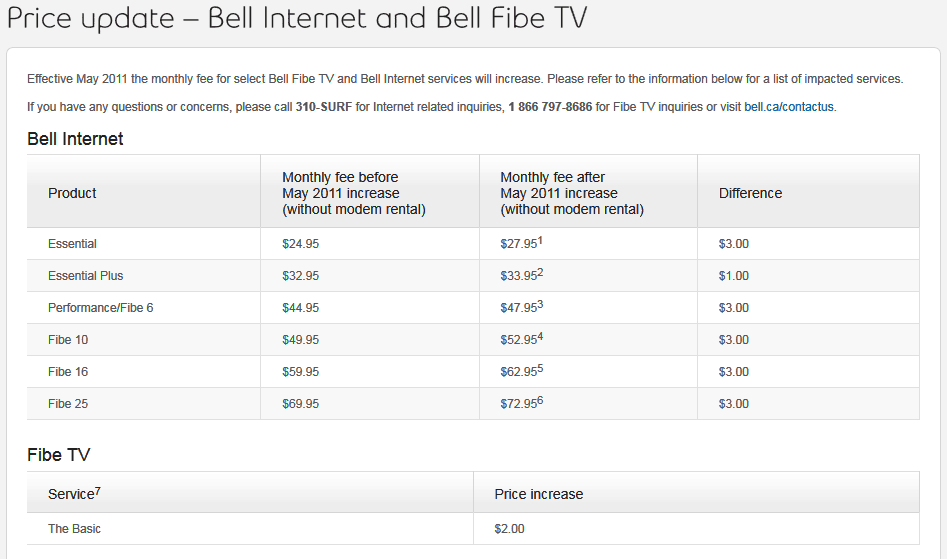
Remember when Bell’s head of government affairs Mirko Bibic told Parliament usage-based billing was necessary because he didn’t think it fair that all Canadians should pay for “heavy users” of the company’s Internet service?  That was a few months ago.  This is April — time for a rate increase that will jack Bell broadband service rates up an additional $3 a month, effective in May.  That’s a rate increase every customer will pay, and comes with Bell’s everyday Internet Overcharging scheme — usage caps and overlimit fees.

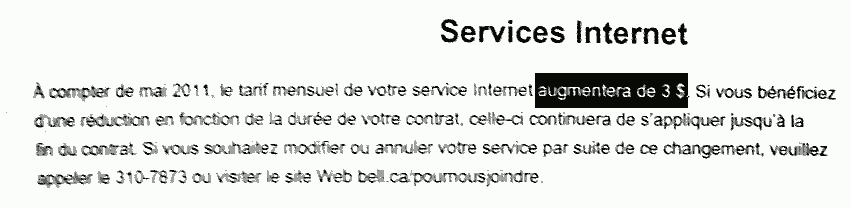
Stop the Cap! reader Alex in Quebec sent a copy of his bill showing Bell’s “Price Update.”  They don’t even want to call it a rate increase.

Bell's notification to customers in Quebec their bills are going up.

“Bell Canada will increase their Internet rates by as much as 15% (for Québec ”Essential” users),” Alex says. “Although $3 may seem like a negligible charge, it especially affects those with budget Internet plans, such as Essential, E Plus, and Performance ‘Fibe’ 6.”

Bell’s website cannot even get the story straight, originally telling customers their overlimit fees would now be rounded to the nearest gigabyte, instead of megabyte.  A Bell spokesperson tells Stop the Cap! that is a typo — they really still mean megabyte.

Bell is one of the few phone companies out there actually increasing their long distance calling rates as well, Alex tells us.  The original announcement came around the same time as the earthquake in Japan, underlining how essential long distance can be during natural disasters.  Many cable companies have waived long distance fees to Japan altogether.  Not Bell.

The rate increases mean customers like ‘Jackorama’ in Hamilton will pay $56.90 for “up to 7Mbps” ‘Performance DSL’ service.  After HST fees, he’ll pay $64.30 just for broadband service, with a 60GB monthly usage limit.  If he exceeds that, he’ll pay even more — $2.50 per gigabyte, or, if he knows he’ll exceed the cap in advance: $5/month for 40 GB, $10/month for 80 GB, or $15/month for 120 GB.

That also assumes Bell can count usage correctly, and there is every indication they cannot.  The company has admitted its usage meter is prone to errors — misreads they are still prepared to bill their customers.

Cell Tower Politics: AT&T’s Alleged Cozy Connections With Civic Groups Upset Community

Phillip Dampier April 28, 2011 AT&T, Consumer News, Public Policy & Gov't, Wireless Broadband Comments Off on Cell Tower Politics: AT&T’s Alleged Cozy Connections With Civic Groups Upset Community

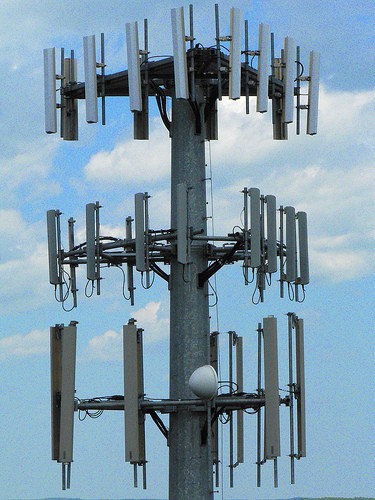
Your view

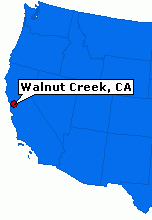
Would you like an AT&T cell tower within 100 feet of your home?  Some residents in Walnut Creek, Calif. are on the verge of finding out if AT&T wins approval to install a cell tower on property belonging to St. Stephen Church, located in the middle of the Buena Vista subdivision, filled with residential homes.

Now, a local neighborhood group is charging AT&T with playing power politics by using their connections with local civic groups to influence local officials to quickly approve the cell site.

Some residents suspect the local government is more than a little cozy with the Walnut Creek Chamber of Commerce.  It’s newly installed chairman of the board just happens to be Ken Mintz, area manager for AT&T.  Although Mintz says his job does not involve choosing or lobbying for cell tower sites, he is responsible for meeting with local officials on an ongoing basis to discuss AT&T business matters important to the company.

Mardi Veiluva, leader of the Walnut Creek Buena Vista Neighborhood Group, considers AT&T too close for comfort with city officials.  The group points to the city planning commission being predisposed to accepting AT&T’s word that the church is the only possible place for the new cell tower, even if it is within throwing distance of nearby homes.

The group also claims the city failed to follow up on what they feel is false information purposely given by AT&T to city officials in order to sell their tower siting arguments.

The group won a city council directive to force AT&T to fund the hiring of an independent consultant to review the facts and get back to the council about possible alternative cell sites, but was disheartened when the city hired the consultant in a closed process, not subject to an open review.

The city hired Los Angeles-based Kramer Firm Inc., a decision immediately questioned by some group members over alleged favoritism to AT&T.  Firm owner Jonathan Kramer has more than two decades experience dealing with utilities, and has hardly been their best friend.  In 2003, Kramer blasted Comcast for improperly grounding their cable lines in Modesto, Calif.  Kramer has no ties to AT&T.

AT&T plans to add at least 55 cell tower sites in greater San Francisco in the near future to address congestion and signal problems.

AT&T claims Mintz is not influencing anyone in his position, city officials deny being lobbied by Mintz, and local residents will probably unsatisfied no matter who agrees to AT&T’s cell tower placement recommendations.

This brings the inevitable conundrum: people want improved cell service in their local communities, so long as cell towers are located far away from their neighborhoods.

Cell phone companies invariably defend their choices for cell tower sites as the best, if not the only option.  Nearby residents protest, and often local officials have to find a compromise location, or insist on efforts to camouflage the resulting tower (with varying degrees of success.)


Verizon’s 4Gee, It’s Down (Still): Nationwide LTE Outage Extends Into Second Day

Phillip Dampier April 27, 2011 Broadband Speed, Verizon, Wireless Broadband 1 Comment

Verizon 4G users across the country are still without their super-fast wireless service thanks to a major outage that wiped the LTE network out for users of the HTC Thunderbolt, Samsung Charge, and mobile broadband units from Novatel and Samsung.

The network has been down since late Tuesday evening, and Verizon took their sweet time telling customers, only admitting the outage after media outlets began reporting on it.

Verizon Wireless spokesman Jeffrey Nelson says 4G users are temporarily being punished with data sessions that use Verizon’s ancient 1XRTT data connection — largely worthless for most broadband apps:

We are aware of an issue with 4G LTE data connections and our network engineers are working to resolve this quickly. We have determined the cause of our issue and are working with our major vendors to restore connections.

  • 4G LTE Smartphones will still be able to make calls.
  • Customers are temporarily unable to activate any 4G LTE devices.
  • Please note: Customers may experience a 1XRTT data connection during this time.
  • After determining the cause of our 4G LTE network connection issue, we are continuing to work to restore connections.
  • We expect to see the network restored on a market-by-market basis. Timing and additional details will be provided as they become available.

Lucky for Verizon comparatively few customers rely on LTE service.  As of late Wednesday evening, the service remains down.


Search This Site:

Contributions:

Recent Comments:

Your Account:

Stop the Cap!