Home » Providers » Recent Articles:

Cable Consolidation: Shaw Buys B.C.-Based Sun Country Cablevision, Armstrong Cablecom and Enderby Cablecom

Phillip Dampier July 5, 2011 Canada, Shaw 1 Comment

Canada’s cable consolidation march continued Monday with Calgary-based Shaw Communication’s announcement it was acquiring several small British Columbia cable systems for an undisclosed amount.

Sun Country Cablevision of Salmon Arm, its 21 employees, and two smaller affiliated cable companies — Armstrong Cablecom and Enderby Cablecom, will become part of the Shaw Cable family within months.

“Sun Country has built an excellent system which represents a terrific addition to our existing cable properties and we are excited to expand our presence in the interior of British Columbia” said Shaw president Peter Bissonnette.Virtually all of Canada is now served by just four large cable providers: Cogeco Cable, Shaw Communications, Quebecor Media/Videotron, and Rogers Communications.

AT&T’s California Landline Nightmare: Bakersfield-Area Residents in Tears Over Lousy Service

Phillip Dampier July 4, 2011 AT&T, Consumer News, Rural Broadband, Video Comments Off on AT&T’s California Landline Nightmare: Bakersfield-Area Residents in Tears Over Lousy Service

AT&T’s record of delivering reliable landline service has remained an open question for Bakersfield, Calif. residents for more than six months, as repeated outages leave several AT&T landline customers without access to a dial tone.  Even worse, some of the customers impacted have been left without any phone service for weeks on end, including one woman whose life literally depends on a working phone.

Andrea Williams, who lives alone in her Bakersfield home, suffered a stroke and has a heart condition — making access to a phone absolutely essential to her well-being.  Williams is also legally blind, making a cell phone an insurmountable challenge.  Instead, Williams says she has memorized the location of the buttons on her long-standing cordless landline phone, a phone that was out of service just after Christmas and largely stayed that way for three weeks.

Despite having made numerous calls to AT&T trying to get the problem corrected, Williams says no one from AT&T ever showed up.  It took an investigative report from Bakersfield’s KGET-TV newsroom to finally get AT&T to respond.

[flv width=”480″ height=”380″]http://www.phillipdampier.com/video/KGET Bakersfield ATT Phone Lines Crossed 12-29-10 and 1-10-11.flv[/flv]

Back in December, AT&T in Bakersfield left hundreds of customers without service or cross-connected with other customers’ phone lines.  It all culminated three weeks later in one health-challenged resident breaking out in tears when local TV station KGET finally helped get her service restored.  (5 minutes)

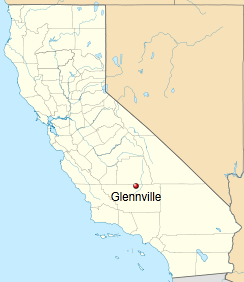
Glennville, Calif.

Fast forward to late June, and AT&T’s reliability is again up for a challenge, as some residents in the unincorporated community of Glennville, 30 miles north of Bakersfield, are fed up with repeated outages, even after eight families collectively paid $16,000 to AT&T to extend wired phone service and broadband to their neighborhood.

Around the same time Williams was experiencing problems with her phone line in December, residents in Glennville began experiencing repeated outages of their own.

“I think from December to January, it was 15 times it went out,” said resident Ray Schill.  “From February to now, [the lines have been out] another 10-15 times.”

Residents in Glennville are especially concerned because they cannot count on their landlines, and cell service is spotty to non-existent in the area.

“My major concern is we’re going to have a big problem up here — someone is going to be ill, we’re going to have a fire, someone’s going to die — who is liable,” Kathryn Ervin, a Glennville resident told KGET News.

What happens when residents call AT&T for help?

We get the runaround, says Schill, with promises extending through the months of May, June, and now July 15.

Schill doesn’t hold much confidence in AT&T’s promises, especially after the company responded to an inquiry from the state’s Public Utilities Commission which culminated in his complaint being closed-as-resolved.

Once again, KGET-TV was on the case for the benefit of its viewers, and reporter Kelsey Thomas received a remarkable response from AT&T — the company “couldn’t handle the number of people using the phones in Glennville.” (population: 280)

The company promises to “upgrade its software” to resolve the problem, but could not give Thomas a time frame for when that would be complete.

[flv width=”360″ height=”290″]http://www.phillipdampier.com/video/KGET Bakersfield Folks in Glennville fed up with ATT 6-27-11.mp4[/flv]

KGET-TV gets involved with AT&T once again, this time to help hundreds of residents of Glennville, Calif., who are also experiencing trouble with the company’s landline service.  (3 minutes)

Sprint Copes With the Growing Reality of a Wireless Duopoly in the United States

Phillip Dampier July 4, 2011 AT&T, Competition, Public Policy & Gov't, Sprint, T-Mobile, Verizon, Video, Wireless Broadband Comments Off on Sprint Copes With the Growing Reality of a Wireless Duopoly in the United States

While AT&T and Verizon trade customers back and forth and enjoy fighting it out for “number one” in wireless service, smaller providers like Sprint are finding it increasingly difficult to compete with its two larger competitors, who have access to the best phones, most coverage, and don’t need to discount prices to attract new customers.

Forbes’ financial blog shares its impressions of the anticipated financial performance of the three biggest players in the U.S. market:

AT&T: Still the financial darling of Wall Street, AT&T will see some pressure on earnings from its integration of acquired assets of Alltel Verizon sold to win approval of its merger with the smaller carrier a few years ago.  Since Alltel’s network used CDMA technology, AT&T had to supply free new phones to every customer it acquired, as the GSM network it operates is not compatible.  AT&T is also still dealing with a slow bleed of iPhone customers departing for Verizon as contracts expire.  It will be interesting to see if Verizon’s imminent end of “unlimited smartphone data” will create a last minute rush from AT&T to VZW before Verizon terminates its unlimited data plan Wednesday night.

Verizon: Verizon will achieve the top spot for the number of new customers it has added during this quarter, mostly from new iPhone users.  The end of “unlimited data” could mean increased “average revenue per user” if new customers have to pay for a pricier data plan, but some analysts are keeping a “neutral” rating on Verizon’s stock, concerned about the margin squeeze created when Apple releases iPhone 5 this fall.  Customers off-contract or nearing expiration could jump for the new phone.  With the subsidy Verizon provides to new iPhone owners, it could bring down margins.

Sprint: The biggest challenge remains with the number three carrier Sprint, which had been picking up disaffected customers from AT&T, Verizon, and even T-Mobile.  That growth has since slowed, and now the company is depending on increased revenue from price hikes, especially on smartphones which now carrier a $10-higher price tag.  But Sprint is aggressively trying to hold the line on customer defections, sometimes approaching “giving away the store” in order to keep customers from leaving for AT&T or Verizon.  In addition to accelerating free/discounted upgrades to new smartphones, the company has also increased the number of calling minutes for its Everything Data plan from 400 to 750.

Sprint’s distant-third position requires the company to price its service plans more aggressively than its larger competitors, especially to counter the image it runs a smaller network with less-reliable coverage.  If AT&T succeeds in acquiring T-Mobile, the dominance of AT&T and Verizon will become even more solidified, threatening Sprint’s position as a viable alternative to the larger two.  That could leave Sprint in the difficult position of trying to finance upgrades even as it has to heavily discount service to keep its current customers loyal.

[flv]http://www.phillipdampier.com/video/CNBC Sprint Going the Distance 4-28-11.flv[/flv]

On April 28, Sprint Nextel CEO Dan Hesse talked with Jim Cramer about his initial impressions of the announced AT&T/T-Mobile merger and how Sprint would cope with it.  (9 minutes)

[flv]http://www.phillipdampier.com/video/CNBC Sprint Nextel CEO Speaks Out 6-9-11.flv[/flv]

Back in June, Dan Hesse was back with CNBC’s Jim Cramer to expand on Sprint’s strategy to deal with a wireless duopoly and how it hopes to compete in a market where two companies would control nearly 80 percent of all American wireless revenue.  (11 minutes)

Houston TV Station Tells the Story of Internet Overcharging in 2 Minutes

Phillip Dampier July 4, 2011 AT&T, Comcast/Xfinity, Data Caps, Online Video, Video Comments Off on Houston TV Station Tells the Story of Internet Overcharging in 2 Minutes

[flv width=”360″ height=”290″]http://www.phillipdampier.com/video/KRIV Houston Know Your Homes Internet Limit 6-29-11.mp4[/flv]

So you’re ready to switch from cable or satellite TV to Internet-only video? Beware: many Internet providers limit how much you can download from websites like Netflix or Hulu.  Isn’t that exactly the point?  KRIV-TV in Houston investigates.  (2 minutes)

AT&T Lobbyist Talks Up Dollar-a-Holler Advocacy: “We Seem to Be Having Success”

Cicconi

Jim Cicconi, AT&T’s chief lobbyist told Politico the company’s practice of encouraging civil rights and charity groups to advocate on its behalf was “entirely natural,” and claimed opponents of the proposed merger of AT&T and T-Mobile were doing the same thing.

“The difference is that we seem to be having success and they are not. We attribute that entirely to the obvious benefits of the merger and the history of what we have stood for as a company,” Cicconi said. “What seems unnecessary is for opponents to attack the motives and credibility of those who have chosen to support our position and not theirs.”

AT&T has made substantial contributions, both financial and through involvement by key AT&T executives on various boards of directors of non-profit groups, as part of its corporate strategy.  Often, many of the non-profit groups involved thank AT&T by submitting letters of support for various business activities AT&T is engaged in, including public policy debates, mergers and acquisitions, and legislation that could impact the company’s bottom line.

On occasion, the connection between AT&T’s large financial contributions and the advocacy letters that often result becomes a point of contention with rank and file members of the organization, as happened in June with a gay rights organization that culminated in the resignation of its president and an AT&T-connected board member.

But more often than not, the corporate money-and-influence-connection goes unnoticed by the constituents of these organizations, many of whom will be disadvantaged, charge critics, by an outcome favorable to AT&T.

Politico explored the links between AT&T executives, lobbyists, money and civic groups and charities and discovered plenty:

Somehow, letters from the National Urban League and...

• Norelie Garcia, associate vice president of federal affairs at AT&T, who is an executive committee chair on the National Puerto Rican Coalition’s board of directors. The group wrote to the FCC May 27.

• Jerry Fuentes, president of AT&T for the Arizona and New Mexico regions, is the vice president for corporate policy on the National Hispanic Caucus of State Legislators’s business board of advisers. The organization wrote to the FCC backing AT&T on May 26.

• Barbara Winn, AT&T’s Sacramento-area director of external affairs, is listed on the letterhead of the Greater Sacramento Urban League as executive committee chairman in the filing the group sent to the FCC supporting the deal June 17.

• Tanya Lombard, assistant vice president of public affairs at AT&T, is a board member of the National Coalition on Black Civic Participation. The group wrote to the FCC May 25, saying “We believe it will help fulfill President Obama’s vision of an America in which everyone has affordable access to high-speed Internet service.”

AT&T is listed as a sponsor of the Cuban American National Council , the National Puerto Rican Coalition, and among the National Coalition on Black Civic Participation’s 35th anniversary partners. Meanwhile, it costs $25,000 annually to be a full member of the National Hispanic Caucus of State Legislators’s business board of advisers, as AT&T’s Fuentes is.

In 2009, the AT&T Foundation gave the local chapters of the Urban League in Chattanooga, Tenn.; Columbia, S.C.; and Knoxville, Tenn., a total of $45,000.

The National Urban League in 2009 received more funding — $100,000 — from the Sprint Foundation. But Sprint, which has been the most vocal corporate opponent of the AT&T/T-Mobile deal, does not have executives on the boards of any of those groups, the company said.

...the National Action Network turned out to be nearly identical.

Politico found many of America’s most influential civic rights groups received private briefings from AT&T executives promoting the deal — meetings which ultimately led to letters of support from those organizations, despite their having little or no input from those opposed to the merger.  AT&T also has dispatched “advocacy kits” to many groups filled with sample letters and talking points the company encourages groups to use as a template for letters of their own.  Not counting on the laziness among many tasked with writing the letters ultimately dispatched to the Federal Communications Commission, there is often a striking resemblance of correspondence favoring the merger.

Politico notes the text in two filings submitted last month to the FCC by the National Urban League and Al Sharpton’s National Action Network regarding the acquisition are nearly identical.

All of this disturbs ColorofChange, a civil rights group not on the payroll of either those supporting the merger or opposed to it.

“There are long-standing relationships AT&T has with these organizations that we think unfortunately have led some of them to take AT&T’s position on an issue that will negatively impact black people,” Rashad Robinson, executive director of ColorofChange told Politico.

AT&T just disclosed its latest lobbying reports, showing the company has increased its lobbying budget by nearly $1,000,000 compared with the same quarter last year — spending $6.84 million during the first quarter of 2011 alone on lobbying the federal government.

Sprint Nextel, seen by many as the primary opponent of the deal, actually reduced its own lobbying expenses during the same period, spending just $583,000 during the first quarter, down 25% from the $774,100 spent a year earlier.


Search This Site:

Contributions:

Recent Comments:

Your Account:

Stop the Cap!