Home » Providers » Recent Articles:

Get-Out-of-Verizon-Contract-Jail-Free Card: Increased Regulatory Fee Means Penalty Free Exit

If you want to say goodbye to Verizon Wireless, or just want a new phone without waiting for your old contract to expire, Verizon has a deal they really don’t want to give you, but they have to — it’s in their contract.

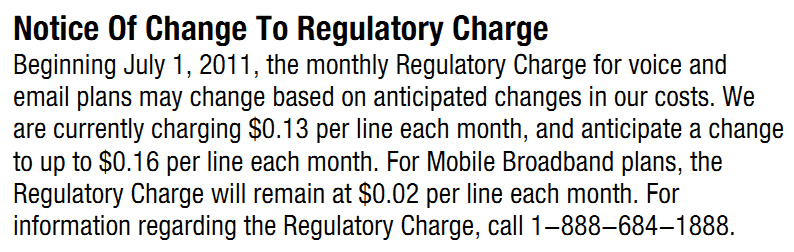
Verizon Wireless has announced they are unilaterally changing your wireless contract with an increase in the Regulatory Recovery Fee (a bill-padding junk fee) from $0.13 to $0.16 effective July 1st.  That fee opens a 60-day window for customers to exit their contracts because the carrier is imposing a “materially adverse” change without your advance consent.  After 60 days, you effectively give that consent by staying with the company.

“Materially adverse” is simple to understand, even if Verizon customer service representatives feign ignorance and stamp their feet as you demand to leave without paying an early exit fee.  It means Verizon has notified you they are changing the contract — one you signed in good faith for a set price, and they are now unilaterally changing it.  Unless those price changes come about because of a government mandate, Verizon cannot impose them without first granting you a window to cancel your agreement, penalty-free.

For customers unhappy with Verizon, they can freely take their business somewhere else.  For those who intend to stay, they can switch to a prepaid plan or sign a new two year contract and get a new phone at the same price any other new customer would pay, even if only 30 days into an existing contract.

This welcome window may mean a lot to customers looking for an early upgrade -and- keep Verizon’s unlimited smartphone data plan the company plans to discontinue July 7th.

With their “materially adverse” contract clause potentially exposing them to hundreds of dollars in lost cancellation fees they cannot impose, nobody said they would make it easy for you to jump free without some hassle.

When calling Verizon Wireless and requesting the “cancel service” option, expect the representative to pretend they don’t know what you are talking about, claim you still owe a penalty, or even express shock you are trying to escape them over a measly three cent rate increase.  Some may even try and credit three cents for each month remaining on your contract and claim that since you are no longer effectively paying the increased fee, you have no right to complain.

Tell them tough cookies — go and read their own contract:

Can Verizon Wireless Change This Agreement or My Service?

We may change prices or any other term of your Service or this agreement at any time,but we’ll provide notice first, including written notice if you have Postpay Service. If you use your Service after the change takes effect, that means you’re accepting the change. If you’re a Postpay customer and a change to your Plan or this agreement has a material adverse effect on you, you can cancel the line of Service that has been affected within 60 days of receiving the notice with no early termination fee.

Ask them to find the clause in their terms and conditions that says once they announce a rate change, that does not represent a change to your plan.  Then ask where it says in their agreement a subsequent credit frees them from the obligation of allowing you a penalty-free window to exit once a materially adverse change has been announced.  Let them know the only way they could have kept you from exercising your rights under the contract was if they never announced the price change impacting you in the first place.  Expect a long wait on hold.  A very long wait.

To truly escape Verizon Wireless’ contract, you will need to be prepared to say “no” to all of their counteroffers, and they will pelt you with them like an Oklahoma hail storm:

  • Reduced price phone upgrade?  No.
  • Free service for a month?  No.
  • Free accessories?  No.
  • Free texting plan?  No.
  • A free sample of their data or tethering plan?  No!
  • Cancel. Cancel. Cancel!

If they still want to argue, repeat after me:

“Despite your willingness to credit my account, once you are legally obligated, under your contract, to notify me of your intention to change my plan by raising prices that are within your control, you triggered the materially adverse clause, regardless of your subsequent attempt to credit my account.  Cancel the account immediately or I will escalate this to the same Executive Customer Service office that slapped you guys down the last time you tried this.  Once you notify us of a fee increase, the window to exit penalty-free is open, and only I can close it by agreeing to stay after 60 days.”


Time Warner Cable Officially Unveils DOCSIS 3 Upgrades in San Antonio; Hill Country Residents Yawn

Phillip Dampier June 30, 2011 Broadband Speed, Competition, Data Caps, GVTC Communications, Rural Broadband Comments Off on Time Warner Cable Officially Unveils DOCSIS 3 Upgrades in San Antonio; Hill Country Residents Yawn

Despite a soft launch weeks earlier, Time Warner Cable officially began selling faster broadband packages in San Antonio Tuesday.

Made possible by DOCSIS 3 upgrades (and not by “Time Warner’s fiber optic network” to quote one San Antonio news outlet), the cable company will now sell 30/5Mbps service for $20 above the current price of Standard Service.  Customers looking for more speed can spend a lot more to get it — $99.95 a month buys you 50/5Mbps service, although the sting seems less if you bundle all of your Time Warner services through their $199 Signature Home package, which includes digital cable, broadband, and phone service.  Signature Home includes 50/5Mbps as part of the package.

About 70 percent of the San Antonio market can get the new speeds immediately.  The rest will be upgraded by September.

The upgrades are seen with some amusement by customers of GVTC, a former telephone cooperative that today provides fiber to the home service in parts of the Texas Hill Country and other rural areas to the north of San Antonio.  They recently received speed upgrades from 40Mbps to 80Mbps downstream and 20Mbps upstream as part of a comparably-priced triple play package.  GVTC’s truly fiber optic system was built to accommodate broadband usage growth.

“Consumers obviously enjoy streaming video and downloading HD movies, but these applications use a lot of bandwidth and can slow down other Internet devices in your household,” CEO Ritchie Sorrells said. “The reality is bandwidth consumption will continue to increase. We’re once again ahead of the curve with our 80 Mbps connection, and this tier will be popular with the growing number of households that realize they have a need for speed.”

One thing GVTC customers don’t need and won’t get is the kind of consumption billing Time Warner Cable is reconsidering for their customers in San Antonio and the rest of the country.

Frontier Fires Back at Comcast In Indiana – Comcast is Telling Stories About FiOS

Phillip Dampier June 30, 2011 Comcast/Xfinity, Competition, Frontier 2 Comments

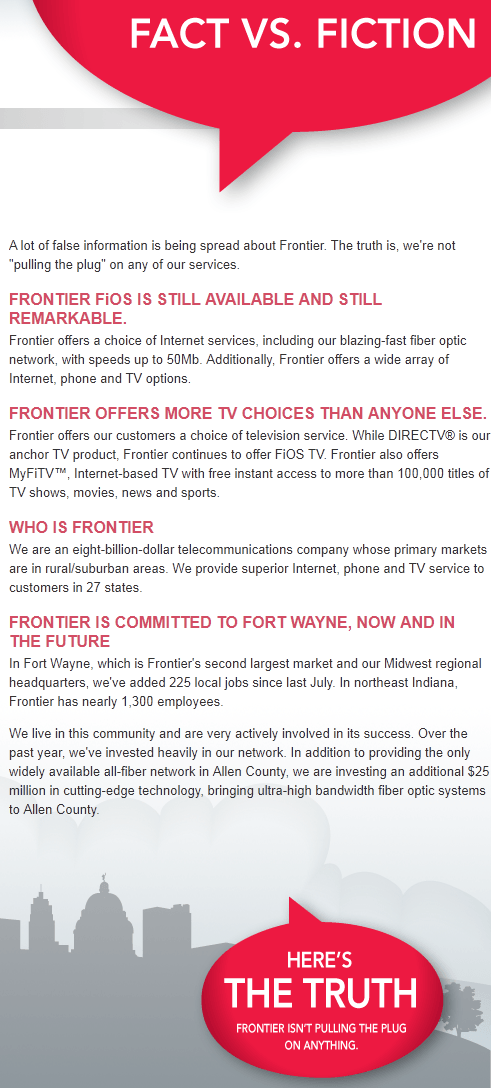
Frontier's Facts - Frontier's new website to counter Comcast's claims about FiOS. (click to enlarge)

Frontier Communications has fired back at Comcast after the Fort Wayne, Indiana cable company erected billboards telling residents Frontier was pulling the plug on its acquired FiOS fiber optic network.

On Wednesday, Frontier purchased a full-page ad in The Journal Gazette headlined, “Comcast Doesn’t Let the Facts Get in the Way of a Good Story! Here’s the Truth: Frontier Isn’t Pulling the Plug on Anything.”  It also launched a new website — Frontier Facts — telling customers it is not “pulling the plug” on any of its services.

Roscoe Spencer, Frontier’s local general manager, tells customers:

Recently, one of our competitors put up billboards, placed inserts in the newspapers and sent mailings to customers indicating we had pulled the plug on FiOS. This statement is simply not true, and we have taken legal action to insist that these false claims be stopped immediately.

Spencer

The spat began when Comcast began trying to recruit disaffected Frontier TV customers who found a massive rate increase notice in bills sent earlier this year.  Frontier blamed the rate increase on the loss of volume discounts former owner Verizon obtained for its FiOS TV service for television programming.  Frontier has sought to negotiate with programmers directly instead of working through a cooperative buying group, so the prices it pays for popular cable networks are much higher than what Comcast pays for a comparable video package.

Frontier watchers suggest the company is well aware its new video pricing is uncompetitive and customers will take their business elsewhere.  Frontier quickly began marketing DirecTV, a satellite provider, as a suitable replacement for those unhappy with the rate increase.  But Comcast also saw an opportunity to pick up new customers at the phone company’s expense, including through the use of billboards Frontier claims are misleading.

Frontier stresses its FiOS platform will continue to provide telephone, television, and broadband service, despite what Comcast’s billboards might suggest.

Despite the involvement of attorneys, Comcast has continued to thumb its nose at Frontier’s legal department.  Frontier spokesman Matt Kelley told the Journal Gazette Comcast was supposed to remove the billboards by Monday of this week, but they remain in place.

The cable company calls it a case of old fashioned competition.

Stop the Cap! reader Kevin calls Frontier’s marketing to get customers to drop FiOS TV for DirecTV a real blast from the past.

“It remains difficult for Frontier to sell people on its advanced fiber network when it is heavily marketing customers to get off of it and switch to DirecTV, a service that looked ultra-modern in the 1990s but today is just a rain-faded, pixellated nuisance,” Kevin says.  “Frontier blew it, Comcast took advantage of their strategic blunders, and now the whining has begun.”

Kevin is a former Verizon FiOS customer who was switched to Frontier when Verizon exited Fort Wayne.

“Verizon knew what they were doing, but eventually decided a few small cities in Indiana were not worth their time or interest, so they sold us off to Frontier, who ended up with a fiber network they’ve shown little interest in running except as an adopted curiosity,” Kevin adds.  “When we got notice of the rate increase, we canceled the TV service and now watch over the air television for free, supplemented with Netflix and Hulu.”

Kevin says Frontier ultimately did him a favor, discovering he was fine without a pay television package.

“Outside of breaking news and sports, you can get most everything else online.  Why pay more?”

Videotron Launches 6GB/$30 Smartphone Plan; Will Bell, Rogers, and Telus Follow?

Phillip Dampier June 29, 2011 Canada, Competition, Vidéotron, Wireless Broadband 2 Comments

Videotron has opened a new window of opportunity for wireless users looking for higher usage smartphone data allowances with the introduction of a 6GB for $30 plan the company says is available for a limited time only.

Canadian wireless customers are well used to 6GB data plans — they show up periodically from Bell, Rogers, and Telus, usually coinciding with the launch of another new version of Apple’s iPhone, but Videotron seeks to heat up the competition this summer with a new offer.

Videotron, a popular wireless carrier in Quebec, may be able to inspire counteroffers from other carriers re-launching similarly priced promotions in the days ahead.

Compared to pricing in the United States, this is a reasonably good deal.  AT&T charges $25 for just 2GB per month and Verizon will seek $30 for the same allowance early next month.

San Francisco Still in Stalemate With AT&T Over ‘Lawn Refrigerators’ for U-verse

Phillip Dampier June 29, 2011 AT&T, Consumer News, Public Policy & Gov't, Video 6 Comments

San Francisco city officials last night remained in a stalemate with AT&T over the installation of hundreds of utility boxes to aid the company’s U-verse fiber to the neighborhood system.

Since 2008, AT&T has sought to install the metal cabinets — dubbed “lawn refrigerators” by critics — that would house links with AT&T’s fiber network and copper wire connections leading to individual homes.  The plan has been in limbo since the threat of lawsuits and controversy over whether the boxes could reduce the visual appeal of neighborhoods and harm property values.

AT&T’s latest plan, now also on hold, seeks to allow the company to install 726 4-foot-tall cabinets around the city.  That’s completely unacceptable to groups like San Francisco Beautiful, which say the cabinets block public sidewalks and attract graffiti, eventually leading to urban blight.  The group wants AT&T to install the boxes on private property or underground.

[flv width=”600″ height=”358″]http://www.phillipdampier.com/video/KGO San Francisco Showdown Over ATT Boxes 6-23-11.flv[/flv]

KGO-TV in San Francisco covers the fracas over AT&T’s “lawn refrigerators” — cabinets designed to support its U-verse fiber to the neighborhood service.  (2 minutes)

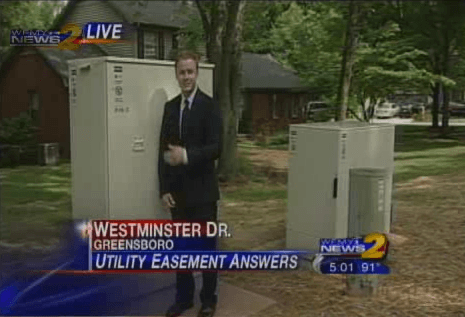
Surprise! A Greensboro, N.C. couple woke up to find AT&T installing these boxes in their front yard. (Courtesy: WFMY-TV)

With the matter generating intense media scrutiny, local politicians have become cautious and a Board of Supervisors vote on the matter has been repeatedly postponed.

AT&T’s U-verse cabinets have been controversial in many areas where they suddenly appear in public rights-of-way, often in front yards.

In Greensboro, N.C., Doris and Dave Robinson learned this the hard way when a tractor, backhoe, and truck appeared in their front yard one morning to install a six foot high metal cabinet with an ominous warning painted on the front telling passersby – “WARNING – AT&T Underground Cable.”

Doris Robinson called and wrote AT&T to no avail, and took their story to a Greensboro television station to warn the neighbors.

“It’s just hard to believe that anyone can come onto our property, put something on the property we disapprove of and leave it on our property,” Dave Robinson told WFMY News. “It’s just not right.”

Doris added, “It struck me as being just terrible to be digging in your front yard and they hadn’t said a word to us.”

In the case of North Carolina, it turns out they don’t have to.  The North Carolina legislature passed laws at the behest of AT&T giving them near carte blanche access to easements established for utilities.  In the past, these have been used for buried and overhead wiring.  Today, they are increasingly used to place enormous metal cabinets, sometimes on the ground, other times attached to a utility pole.  Many have fans that can be heard several yards away.

In California, it will take an affirmative vote by local government officials before AT&T can install similar equipment in San Francisco.

[flv width=”480″ height=”340″]http://www.phillipdampier.com/video/WFMY Greensboro ATT U-Verse Service Means Giant Boxes On Homeowners Front Lawn 6-29-11.flv[/flv]

WFMY-TV in Greensboro shares the story of Doris and Dave Robinson who awoke one morning to find AT&T installing boxes nearly six feet tall on their front lawn.  (5 minutes)

Search This Site:

Contributions:

Recent Comments:

Your Account:

Stop the Cap!