Home » Providers » Recent Articles:

Four Telcos-Four Stories: The Big Money is in Commercial Services — Today: CenturyLink

Four of the nation’s largest phone companies — two former Baby Bells, two independents — have very different ideas about solving the rural broadband problem in the country. Which company serves your area could make all the difference between having basic DSL service or nothing at all.

Some blame Wall Street for the problem, others criticize the leadership at companies that only see dollars, not solutions. Some attack the federal government for interfering in the natural order of the private market, and some even hold rural residents at fault for expecting too much while choosing to live out in the country.

This four-part series will examine the attitudes of the four largest phone companies you may be doing business with in your small town.

Today: CenturyLink — Our Commercial Customers Deliver 60% of Our Revenue; Our Attention Follows Accordingly

“Business customers now drive about 60% of our total operating revenues,” CenturyLink CEO Glenn F. Post III told investors in March. “Our focus on delivering advanced solutions and data hosting services to businesses are key factors in improving our top line revenue trend.”

With residential customers departing traditional landlines at an average rate of 5-10 percent a year, keeping customers has become an important priority for a number of phone companies, especially those who have plowed millions into mergers and acquisitions to build their businesses. For the past several years, CenturyLink has been acquiring small, regional independent phone companies, a former Baby Bell, and a competing landline provider Sprint used to think would be an important part of its business.

Century Telephone’s original customers were mostly cobbled together from acquisitions from other phone companies, including names like GTE, Central Telephone Company of Ohio (part of Centel), Pacific Telecom, Mebtel and GulfTel. But the biggest expansion of the company would come from acquisitions of Sprint-spinoff Embarq and former Baby Bell Qwest.

Today CenturyLink operates one of the nation’s largest independent phone companies, and serves markets large (primarily on the west coast) and small (rural communities primarily in the southeast, Missouri, Ohio, Indiana and Wisconsin).

CenturyLink’s revenues have often been uneven, mostly because of its acquisitions, landline losses, and the effects from competition in its larger markets. While CenturyLink’s acquisitions grew the company, they also saddled it with landline networks that have proved inadequate to meet the growing needs of customers. With a disconnect rate running between 6.4% this quarter and 7.6% in the same quarter a year ago, residential customers are leaving their voice lines behind in favor of cell phones and broadband customers are departing for faster speeds available from cable operators.

These “legacy services” lost the company $124 million in revenue — an 8.1% decrease over the past quarter. As customers depart, so do CenturyLink employees that used to handle the old landline network.

To make up the lost revenue, CenturyLink has gotten more aggressive in other areas of its business:

  • Increasing focus on business/commercial and governmental services, including managed hosting, cloud computing and other commercially-targeted broadband initiatives;
  • Deployment of fiber to cell towers as a growing revenue source;
  • Limited, but ongoing rural broadband expansion;
  • Development of Prism TV — a fiber to the neighborhood service targeting residential customers.

CenturyLink calls these their four key initiatives towards revenue stability, stable cash flow, and growth.

In the business services segment, CenturyLink sees enormous revenue potential selling businesses access to data centers, co-location services, and ethernet-speed broadband. Last year, CenturyLink acquired Savvis, an important enterprise-level service provider and owner of 50 data centers. Phone companies like CenturyLink are also in a race with large cable operators to be the first to offer cell phone companies access to “fiber-to-the-tower” service to support exploding data growth on 4G wireless networks.

Faster DSL, Fiber to the Neighborhood-Broadband Key to Keeping Residential Customers Happy
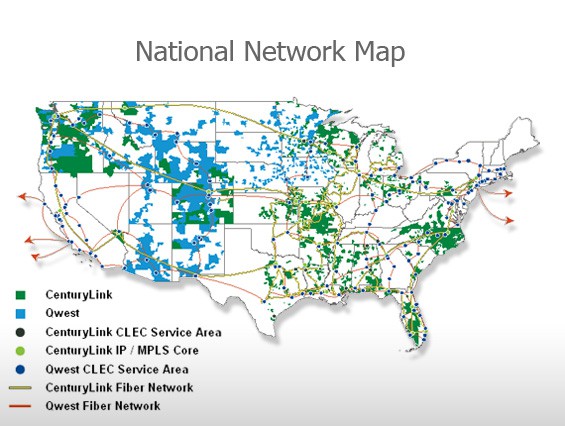
CenturyLink’s network map showing both its own service areas, and infrastructure obtained from the acquisition of Qwest.

For consumers, CenturyLink has been moderately aggressive in some areas boosting speeds of its DSL services. The company claims 70% of their DSL-capable landline network provides speeds of at least 6Mbps. At least 55% supports 10Mbps or higher; over 25% can manage 20Mbps or faster.

The company’s Prism TV service, a fiber to the neighborhood upgrade comparable to AT&T U-verse, is now available to nearly 6.3 million homes and apartments in eight cities. By year end, CenturyLink says it will increase that to 7.1 million homes.

Prism represents a significant portion of CenturyLink’s investment in its residential business. So far, the results have not proven a major threat to the competition. CenturyLink added 15,000 Prism subscribers in the first quarter, but the company only has 8% of the market. Cable and satellite providers continue to dominate. But the company says Prism is helping to keep the customers they already have.

CenturyLink says it now taking Prism TV west into former Qwest territory, starting in and around Colorado Springs, Col.

Customers will likely be offered 130 channels starting at $59.99 a month with a free set top box (new customers typically receive a $20 monthly discount for the first six months of service).

The phone company will compete with Comcast, which sells 80 channels for $56 a month (new customers get a $26/mo discount for the first six months).

With CenturyLink providing a better deal, at least for television service, Colorado City officials hope the competition will bring down rates, at least for new customers. That may be exactly what happens, predicts Mark Ewell, a senior account executive with Windstream Communications.

“We could see some pressure on Comcast’s rates. I would like to see Comcast adopt a price model that doesn’t go up after a promotional period,” Ewell told The Gazette.

“CenturyLink is likely to be more of a threat to the satellite providers like DirecTV and Dish because they have a much higher market share in Colorado Springs than they do in most other markets because so many customers left Adelphia [acquired in bankruptcy by Comcast] when it had its financial problems. Those customers have already shown a willingness to leave the cable television provider and try another service.”

[flv width=”640″ height=”380″]http://www.phillipdampier.com/video/CenturyLink Prism TV.flv[/flv]

CenturyLink shows off its new Prism TV offering in this company-produced video.  (2 minutes)
CenturyTel acquires Embarq and changes its name to CenturyLink to reduce the emphasis on its traditional landline business.

CenturyLink’s arrival in the triple-play business of phone, Internet, and television service could be the first serious competition Comcast has gotten outside of satellite providers. WideOpenWest had a franchise to provide service in 2000 but never did. Falcon Broadband won a franchise in 2006, but only provides service to around 1,500 customers in the Banning Lewis Ranch, Black Forest, and Falcon areas. Porchlight Communications received a franchise in 2007, installed service for 500 customers but ultimately never charged them. Porchlight’s IPTV service never worked properly with its chosen set top boxes. That fatal flaw put the company out of the cable business, and the company turned the porch light off for good, abandoning its franchise.

Rural Broadband: Unless the Government Delivers More Subsidies, Rural Customers Will Continue Waiting

In late July, CenturyLink announced it would accept $35 million from the Federal Communications Commission’s new Connect America Program (CAP) to deploy broadband to homes and businesses in rural, broadband-deprived parts of its service area.

CenturyLink has the capability to extend broadband to 100 percent of its customers, but not the willingness to invest the money to make that happen, critics contend. CenturyLink freely admits it applies a financial test when considering when and where to expand its DSL broadband service into its most rural service areas.

In short, the company must recoup its costs of deploying broadband within a certain time frame, and be confident that a certain percentage of customers are going to sign up for broadband service, before it will agree to make the investment. Virtually all of CenturyLink’s current service areas have already met or failed that test, which leaves an indefinite group of broadband “have’s” and “have-nots.”

To shake up the status quo, the FCC proposed to shift Universal Service Fund money, collected from all phone customers, away from landline service towards rural broadband deployment. This invites CenturyLink, and other phone companies, to run those financial tests again. With urban customers footing part of the bill, theoretically more homes should squeak past the return on investment test.

In fact, more homes will finally get CenturyLink broadband — around 45,000 in semi-rural and suburban areas where the costs to provide the service are not as great as in truly rural areas.  The FCC is offering to cover just short of $800 per household to cut the costs of deploying rural Internet access.

But CenturyLink complains the money is not nearly enough to solve the really-rural broadband problem.

“In very rural areas where we really have the greatest need for support, this amount, on a per-location basis, will not be enough to allow us to really do an economic build-out,” Post told investors this spring. “So we’re still in the process really of evaluating our opportunities….”

That will leave CenturyLink likely spending considerably more upgrading its urban landline network to support Prism TV instead of supplying rural broadband service.

[flv width=”640″ height=”380″]http://www.phillipdampier.com/video/CenturyLink History.flv[/flv]

Jeff Oberschelp, vice president and general manager of CenturyLink of Nevada discusses the past history of CenturyLink and where phone companies are going in the future in this company-friendly interview.  (6 minutes)

CenturyLink Irony: Company Complains About Wireless ISPs Usage Caps, Largely Ignoring Its Own

Phillip Dampier August 6, 2012 Broadband "Shortage", Broadband Speed, CenturyLink, Competition, Consumer News, Data Caps, Public Policy & Gov't, Rural Broadband, Wireless Broadband Comments Off on CenturyLink Irony: Company Complains About Wireless ISPs Usage Caps, Largely Ignoring Its Own

Wireless Internet Service Providers (WISPs) are incensed about efforts by CenturyLink to win waivers from the Federal Communications Commission’s Connect America rural broadband funding program that could leave WISPs facing new competition from CenturyLink made possible by surcharges paid by phone customers nationwide.

At issue is a filing from CenturyLink before the FCC that would allow the phone company to “change the rules,” according to critics. One of CenturyLink’s most prominent arguments is that WISPs have data caps that inconvenience customers. But CenturyLink buries the fact it has usage caps of its own in a footnote.

“The waiver application we filed … would allow CenturyLink to spend tens of millions of dollars to bring more broadband services to more rural and high-cost customers who do not have reasonable access to broadband service today,” CenturyLink said in a media release. “These funds would be provided by the FCC’s Connect America Fund, as well as additional investment dollars would be provided by CenturyLink. If the waiver application is approved, CenturyLink will build needed broadband services to thousands of homes in Arizona, Colorado, Washington, Oregon and several other states.”

CenturyLink claims WISPs charge considerably more for service, suffer from line-of-sight restrictions which could leave many rural customers without service, have limited spectrum which keeps broadband speeds to a bare minimum and often forces customers to endure stringent data usage caps.

The waiver request would allow CenturyLink to receive and use federal Connect America funds to deploy its DSL service to rural customers already served by WISPs if two conditions are met:

  • The state where CenturyLink would spend the money has not independently verified the coverage area of the wireless ISP and objective data opens the door to an argument that a WISP cannot adequately service areas where they claim coverage;
  • The WISP imposes unusually high prices ($720/yr or more) or severe usage caps (25GB per month or less).

Chuck Siefert, CEO of the Montana Internet Corporation (MIC), a WISP, argues CenturyLink has no case, and is attempting to modify the rules to accomplish its own objectives rather than adhering to the original goals of the program — to deliver broadband to the rural unserved:

CenturyLink is simply raising an old protest in a new venue. Having been designated as eligible for almost ninety million dollars of the Connect America Program (CAP), it wishes to have the opportunity to use more than a third of that as it chooses, rather than as the Commission designated after input and analysis from all parties. The Rubicon has been crossed with respect to this issue: unserved areas are those that are not served by fixed wireless providers.  Regardless of CenturyLink’s opinion of the quality of service provided, these areas have been deemed served by the Commission and CAP incremental support may not be used to build out broadband in these areas. CenturyLink is certainly capable of using other funding to build out in these areas; the Commission has not precluded that.

CenturyLink’s complaints that WISPs often come with data usage caps is ironic because CenturyLink is now imposing usage caps on its own broadband service. CenturyLink argues data caps expose the limitations inherent in wireless broadband in their filing with the FCC:

Satellite broadband also often comes encumbered with restrictive data caps. The same is true of many of the WISPs subject to this waiver request. They impose on their users highly restrictive data caps of less than 25 GB per month. Indeed, two of the WISPs impose a cap of just 5 GB per month.

It is no surprise that these WISPs would impose such unusually low caps; like satellite providers, they must ration out their highly constrained capacity among the various end users who compete for it. WISP broadband capacity—unlike the customer-specific links in DSL-based broadband—is shared by all customers within a given wireless cell or sector.

This means that the more customers a WISP persuades to sign up, the worse the average service quality gets for all customers unless the WISP sharply limits how much customers may consume.

That imperative may be an unavoidable consequence of the WISPs’ technology, but it further underscores the need to give the affected consumers a robust broadband alternative.

Siefert claims CenturyLink’s assertions about the quality of its DSL service, pricing, and performance simply fall short of the truth, and MIC does better by its customers.

Pricing

CenturyLink charges a $134.89 non-recurring charge plus $29.99/mo for “up to 1.5Mbps” DSL service, plus “up to” $99.95 for professional installation. CenturyLink’s DSL modem costs $99 and has a one-year warranty.

Siefert claims MIC charges $30/mo for “bursting speeds up to 10Mbps” and $250 for technician installation, but the company offers regular installation promotions that cost $99. MIC warrants its equipment for the life of the service and charges no fee for service calls as long as the customer is current on their bill.

But Stop the Cap! found speeds and pricing less advantageous than Siefert might have the FCC believe. For instance, MIC’s $30 tier only guarantees 384kbps with speed “bursts” up to 10Mbps. Getting committed 2Mbps service runs $55 a month with the same “bursting” speed of 10Mbps. We also found CenturyLink willing to negotiate installation charges, and the company frequently discounts or even waives them if a customer signs up for a multi-service package.

Data Caps

CenturyLink now imposes a 150GB usage cap on customers with 1.5Mbps service or slower, 250GB for customers at higher speeds.

MIC claims it does not even monitor individual customer usage. Siefert says data use limitations are found in the terms and conditions of its service and are imposed only when a customer creates a problem for other users on the network.

“Rather than strictly applying data caps, MIC’s policy is to contact its customers and explain the impact their usage has on other customers,” Siefert explains. “As a small provider in a local community, MIC is able to do this in a way that a carrier like CenturyLink cannot. CenturyLink’s representations regarding transfer caps imply that WISPs arbitrarily and automatically shut a customer down once the cap is reached. This assertion is not based on evidence and is not an accurate statement of MIC’s approach to the caps. CenturyLink’s argument that WISPs operate like satellite and therefore WISPs service areas should be categorized as unserved areas based on how transfer caps are used fails.”

Stop the Cap! found different information on MIC’s website, however, including a 20GB monthly data cap and a $15/GB overage charge. Siefert’s submission to the FCC may suggest the published cap is a guideline more than a rule.

Performance

CenturyLink still uses T1-level circuits (1.5Mbps) to connect at least some of their remote D-SLAMs, according to Siefert, which helps the phone company extend DSL service to homes and businesses far away from the company’s central office. The net result is that customers fight for the bandwidth on an insufficient backhaul, which dramatically reduces speeds during peak usage times. In Helena, Montana CenturyLink “daisy-chains” D-SLAMs to support customers over a single T3 line, creating latency problems, packet loss, and further reductions in speed and performance.

MIC is capable of providing a total of 252Mbps per distribution site. The incoming next generation of wireless technology will increase that to 1.4Gbps. Additional distribution sites can divide the traffic load similar to how new cell towers can reduce demand on other nearby towers.

Speeds

CenturyLink sells speeds “up to” a certain level without guaranteeing customers will actually get the speed they are paying to receive. Siefert says CenturyLink customers in Montana currently can manage up to 7Mbps in some areas.

MIC says it can commit to its customers they can receive 10-40Mbps (and 80Mbps by the end of 2012) over its wireless network.

Independent Netindex.com suggests MIC does offers faster service on average than CenturyLink provides in Montana:

  • Montana (statewide average): MIC 5.04Mbps vs. CenturyLink 3.8Mbps
  • Helena: MIC 5.08Mbps vs. CenturyLink 2.73Mbps

The Wireless Internet Service Provider Association says their members are not eligible for federal Connect America subsidies, and most wireless providers are privately financed operations built with the support of their rural customers.

Said Richard Harnish, WISPA’s executive director, “We find it hard to believe that a company like CenturyLink that gets millions of dollars in federal support now wants more free money to overbuild unsubsidized rural broadband networks that WISPs already successfully operate. To do this, CenturyLink has attempted to discredit the taxpayer-funded National Broadband Map and invent its own standards in an effort to show that they should receive more than $30 million in additional subsidies.  Our strong opposition reflects WISPA’s view that CenturyLink’s arguments are factually and technically flawed.  We thank the other associations, state agencies and WISPs that support our views.”

A Hallmark Moment: Time Warner Cable/Comcast “Competition”

Phillip Dampier August 2, 2012 Comcast/Xfinity, Competition, Editorial & Site News Comments Off on A Hallmark Moment: Time Warner Cable/Comcast “Competition”

While perusing the latest investor conference call with Time Warner Cable executives, this question from the always-admiring Craig Moffett at Sanford Bernstein & Associates popped up, directed at Rob Marcus, president and chief operating office (underlining ours):

Craig Moffett – Sanford C. Bernstein & Co., LLC., Research Division

[…] Rob, I know how competitive you are. As you look at the results at Comcast and their greater success in — particularly in the video product, I’m sure it has to sort of get the competitive juices flowing. Can you talk more about where that is on your priority list? And what are the levers that you think you can pull to improve the results in basic video?

Robert D. Marcus – Time Warner Cable

Yes. So let me start by saying, I don’t really want to take anything away from Comcast performance, they had a nice quarter. And I think the fact that both we and they posted really good results this quarter probably speaks most to the fact that we’re in a terrific business, so that’s point number one. Second, I always sort of shy away from these comparisons between the two of us on any particular metrics given that there are differences in our disclosure practices.

[…] The truth is, I want to win, but I want to win relative to the guys we’re facing in the markets that we’re competing with. So all of the initiatives I described in my prepared remarks really relate to our performing even better than we have been, independent of any comparisons you might make to Comcast. So we’re hard at work on product, we’re hard at work improving our marketing. I think we’ve made great strides there. We’re definitely doing things on the customer service side to make doing business with us easier and better. And we’re always trying to improve on logistical things like improving sales processes and retention processes. So you’re right in characterizing me as competitive. I absolutely want to win. And I think we’re initiating the right processes to get there.

It’s just one more fact of life for American cable subscribers — cable companies never compete against each other. Comcast has carved out its territory, Time Warner Cable has theirs. The two will never meet in head-on competition.

So we’re wondering just how “competitive” Time Warner Cable (and Comcast) really are. Apparently not much, based on the hearts and flowers moment cable executives have praising the financial performance of each other.


AT&T Sticks It to Google, Blocking Play Store Movies on Its 3G/4G Wireless Network

AT&T loves corporate free speech rights, the same ones it is using to deny customers access to Google’s Play Movies service.

With wireless Net Neutrality rendered largely ineffective with the help of AT&T and Verizon Wireless’ extensive lobbying and legal threats, AT&T has leveraged its right to govern its own network by deciding to block its wireless customers from watching Google Play Store’s streaming movie service over its 3G and 4G networks. This block is enforced even though AT&T already throttles heavy “unlimited” users and charges others more for using more data.

Geek.com was the first to discover AT&T’s curious dislike of Google Play Movies, while leaving other streaming services like Netflix, HBO Go, YouTube, and others alone (for now):

Instead of The Anchorman […] I was greeted with an error message telling me that I was not allowed to stream this movie over the mobile network. Assuming it was just an error, I tried again and got the same message. After a few minutes of playing with settings, it became clear that I was not going to be able to watch this movie without WiFi.

Yes, it seems that AT&T has removed the ability to watch Google Play Movie files over their 3G and LTE networks. This only happens with Google Play Movies, and only on AT&T. […] Curiously enough, you can download or “pin” a Google Play Movie over 3G and LTE and the only warning you get is one from Google explaining that you might incur data costs.

AT&T and Verizon have both declared Net Neutrality violates their free speech rights as corporate citizens — rights further expanded with the Supreme Court’s “Citizens United” decision.

When Federal Communications Commission chairman Julius Genachowski sought to introduce mild Net Neutrality protections for the Internet, both companies threatened to sue (Verizon has a case pending) and conservative commentators launched into tirades about “an Obama takeover of the Internet.”

RUSH LIMBAUGH: Today the FCC approved a proposal by chairman Julius Genachowski to give the FCC power to prevent broadband providers from selectively blocking web traffic. And that’s just a ruse. Net Neutrality is not what this is really all about. This is about the feds wanting to control the Internet just as they control the public airwaves. They want to be able to determine who gets to say what, where, how often — they want to be able to determine what search services are providing what answers to your queries. It’s total government control of the Internet, and the regime has just awarded it to itself.

It’s another gleaming aspect of free speech, free market, private industry Obama has decided to take over as a Christmas present to himself and the Democrat National Committee and to Mr. Soros. He’s even beaten Hugo Chavez to the punch. Chavez is just talking about taking over the Internet in Venezuela; Obama has got it done.

Geek.com doesn’t think the Obama Administration is blocking Google Play over AT&T — AT&T is. They just cannot understand the reasoning why:

I can’t imagine any real world justification for this behavior. If you pay your carrier for an internet connection to your phone, should the provider really be allowed to control how you use that connection? What’s more is that this happened over AT&T’s high speed and mostly empty LTE network. I can easily create a wireless hotspot on this same phone and stream a video from the Nexus 7, using the exact same data connection to accomplish the exact same task. This move is confusing at best, and AT&T is going to quickly alienate customers eager to take advantage of their brand new LTE devices as they receive them.

[flv width=”640″ height=”500″]http://www.phillipdampier.com/video/Corporateland.flv[/flv]

Mark Fiore channels Disney-sentimentality schtick on a whole new level with his take on AT&T’s Pinocchio-CorporateLand dream come true: the right to be human. (1 minute)

Wildblue Censors Links to Stop the Cap!; We Are “Counter-Productive,” Says Satellite ISP

Wildblue’s customer forum will not allow its readers to link to Stop the Cap!, because in the view of Wildblue’s forum moderators, we are “counter-productive.”

We suspect the company is uncomfortable about exposing customers to the fact Wildblue is selling “broadband” satellite service with a “fair usage policy” so strict many customers cannot actually use the service for more than basic web browsing and e-mail. Wildblue consistently ranks  near the very bottom of broadband service providers rated by Consumer Reports (only HughesNet is worse).

The good news is Wildblue still allows customers to use Google. Most will have no trouble finding us even when the company spends time and effort censoring a direct link.

Search This Site:

Contributions:

Recent Comments:

Your Account:

Stop the Cap!