Home » Providers » Recent Articles:

Rogers Bumps ‘Lite’ Usage Tier Allowance Up 5GB a Month, Speed Now 6Mbps

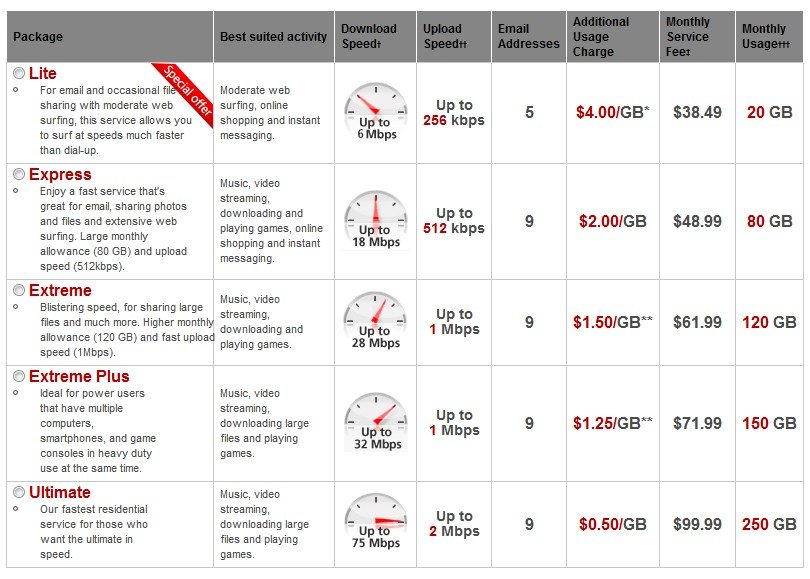
Rogers Communications has slightly bumped the monthly usage allowance for its “Lite” Internet plan up by 5GB per month to 20GB. The company also doubled the speed of the entry-level package from 3Mbps to 6Mbps. Upload speed remains at 256kbps.

But the plan still carries a hefty price — $38.49 a month, and there is a stiff $4/GB overlimit fee for those who exceed their allowance. Just south of Lake Ontario, Time Warner Cable’s “special offer” provides cap-free 10/1Mbps broadband for $29.99 a month for a year.

Our regular reader Alex mocks the move as another example of Canadian competition at work for consumers. Rogers has made only small adjustments to their usage caps since last summer, and customers who want the most generous usage allowances (paltry when compared to western Canadian ISPs), have to spend money out of pocket to upgrade to DOCSIS 3 technology.

As of today, here is the current roundup of Internet plans from Rogers

Rogers always adds a lot of fine print. For these offers, here come the disclaimers and special conditions:

  • Taxes and a $14.95 one-time activation fee apply. Internet modem purchase or monthly rental required.
  • †Speeds may vary with Internet traffic, server or other factors. Also see the Acceptable Use Policy at rogers.com/terms. Modem set-up: the system is configured to maximum modem capabilities within Rogers own network.
  • ††In some areas, Rogers manages upstream peer-to-peer (P2P) file sharing applications speed to a maximum of 80 kbps per customer for Rogers Hi-Speed Internet (delivered over cable). This policy is maintained at all times. For information on Rogers Internet traffic management practices and Legal Disclosure click here.
  • †††Usage allowances apply on a monthly basis and vary by tier of service. Charges apply for additional use beyond the monthly usage allowance associated with your tier of service. For details, visit rogers.com/keepingpace.
  • *Note for Lite customers: If you signed up for Lite before July 21st, 2010, your usage allowance remains at 25 GB, and your additional usage charges remains at $2.50/GB.
  • **Note for Extreme customers: If you signed up for Extreme before July 21st, 2010, your download speed remains at 10 Mbps and your usage allowance remains at 95 GB.

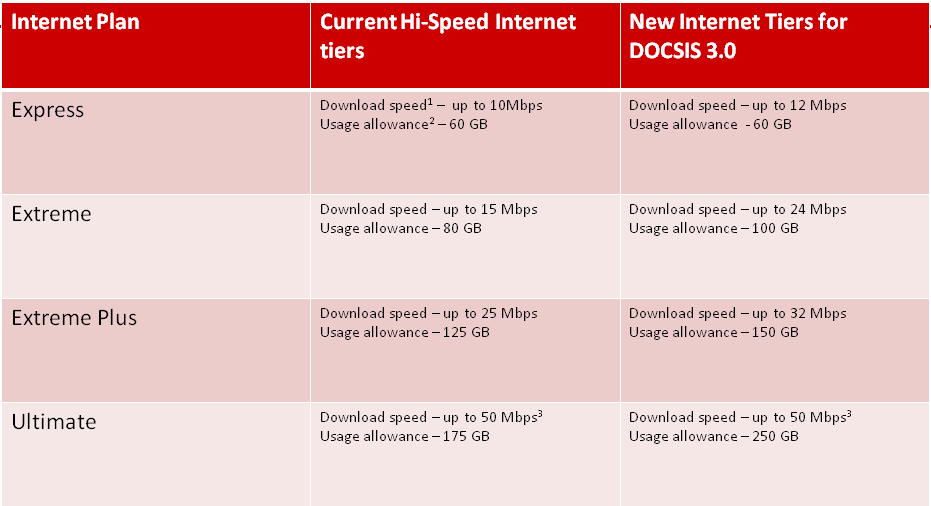
If you want to compare Rogers’ allowances to what they sold in July 2011, here is a reminder:

Pay $150 for Discounted Comcast Cable; 5 Arrested, 18 Wanted, 5,795 Accepted the Offer

Phillip Dampier August 9, 2012 Comcast/Xfinity, Consumer News, Video 1 Comment

Comcast faces $2.4 million in lost sales after a Philadelphia area crime ring sold nearly 6,000 cable customers discounted cable service and free premium channels in return for a one-time fee they pocketed themselves.

Authorities have arrested five men and are looking for 18 others after uncovering the scheme. Prosecutors have been pouring over streams of text messages sent back and forth between members of the “sales crew” referencing strippers, weapons, and luxury goods. One exchange advised one alleged member to destroy “the book” naming customers as police closed in.

Despite pleas to stay “off the map” to avoid attracting attention, at least some of the alleged crooks could not help themselves, some splurging on top dollar luxury watches, autos, technology, and weekends in Atlantic City and Miami Beach.
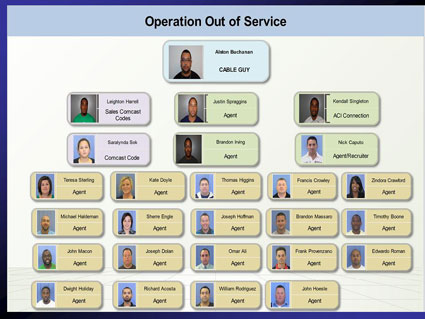
Prosecutors dubbed the busting of the alleged crime ring “Operation Out of Service.” (Image: Montgomery County District Attorney)

Authorities have since learned the scam was run through “a secret computer” installed in a Comcast subcontractor’s office in Upper Moreland. Customers were approached on the street or in area establishments and offered discounted cable service with free premium movie channels in return for $150.

After payment, the alleged perpetrators logged into Comcast’s account management system and activated channels and changed customer records.

Comcast did not catch on until one of their own employees was solicited while she sat in a beautician’s chair. The employee reported it to Comcast’s security department.

Prosecutors have since released many additional sordid details, primarily focused around another Comcast subcontractor, which appears to be the cable company’s latest weak link:

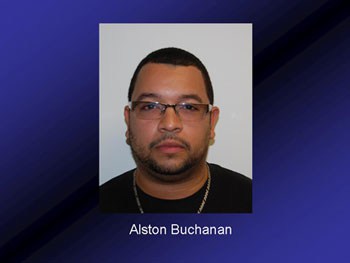
This corrupt organization was headed by Alston Buchanan of Philadelphia, PA (DOB 10/07/1983). Buchanan designed, implemented and controlled the organization that utilized compromised Comcast technician identifications (IDs) to apply promotional discounts onto Comcast customer accounts.  When used legitimately, the IDs allow Comcast personnel to authorize services, such as premium cable channels or other promotions, to new or existing customers.  Buchanan obtained these unique IDs from a number of sources, including from a terminated employee and an employee on disability. In one instance, Buchanan paid a Comcast subcontractor $5,000 in exchange for her user ID.  This arrangement was brokered by Leighton Harrell of Philadelphia, PA (DOB 1/17/1986).

Once Buchanan had the IDs, he could access the billing accounts for Comcast customers and lower their payments and/or provide them with additional services without Comcast’s knowledge. Those involved in the scheme paid various amounts to Buchanan and his agents ranging from $100.00 – $200.00 to manipulate the billing and services of their Comcast accounts.  The investigation determined there were 5,795 accounts affected over the course of a year from April 2011 to April 2012, with a revenue loss to Comcast Cable of $2,401,673. The effected Comcast accounts were located throughout the Delaware Valley with the majority in Montgomery, Philadelphia, Delaware and Bucks counties.
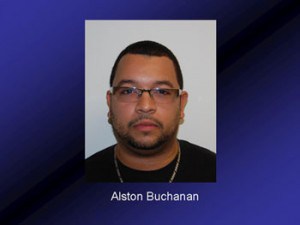
Buchanan was familiar with Comcast’s billing system, because he was employed by Comcast as a dispatcher from May 2007 through March 2008 and as a dispatcher for Advanced Communications, Incorporated (ACI), a Comcast subcontractor, from October 2009 to July 2010.  In 2010, Comcast began investigating an identical scheme of billing manipulation through unauthorized promotions and believed that Buchanan was responsible.

Earlier this year, Comcast learned this same scheme was being perpetrated when a Comcast employee reported the fraudulent use of IDs to obtain services.  An internal investigation by Comcast revealed that Nicholas Caputo of Virginia Beach, VA (DOB 5/28/1981) was soliciting customers to provide one-time payments in exchange for a reduction of their Comcast bills.  Comcast Security, working with ACI, determined that the account manipulations were originating from the ACI Business Services Router located in the local office for ACI in Hatboro, Upper Moreland Township.

On April 9, 2012, ACI searched the data closet where the Business Services Router was stored.  Upon checking the closet, an unauthorized computer tower was discovered secreted in the corner.   This unauthorized computer tower was hardwired to the modem in the data closet which, in turn, was connected to the Business Services Router in the closet.  Accordingly, the hidden computer tower provided unauthorized access into the Comcast billing accounts.  The investigation revealed that the website “LogMeIn” was used to gain remote access to the unauthorized computer tower.  Ultimately, the computers located in Buchanan’s apartment were found to have accessed the “LogMeIn” accounts associated with the hidden computer tower.
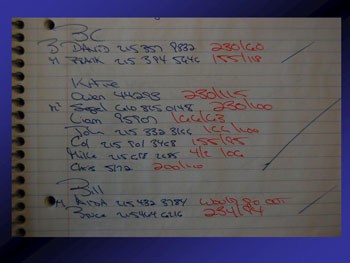
“The Book” the alleged ringleaders wanted destroyed at all costs. (Image: Montgomery County District Attorney)

Comcast’s investigation revealed that Buchanan had an inside connection to ACI through Kendall Singleton of Philadelphia, PA (DOB 7/03/1986), an ACI employee.  On April 9 2012, an unrelated power outage occurred at the ACI office which caused the shutdown of the unauthorized tower.  Knowing that the unauthorized tower would have to be turned-on, Comcast Security installed a hidden camera to monitor the closet.  The next day, Singleton was seen on the camera entering the area of the closet and stooping down in the area of the unauthorized computer tower.  After the computer was re-booted, 96 customer billing accounts were accessed and manipulated within the following hour.

During the course of the investigation, Montgomery County Detectives served search warrants in several locations including the Philadelphia home of Buchanan and Richard Justin Spraggins (DOB 5/22/1983), resulting in the recovery of $103,000.00 cash in an attaché case, computers, cell phones and handwritten ledgers that contained records of the theft scheme, including the agents working for them.  Both Buchanan and Spraggins were in possession of these ledgers.  Analyses of the phones, computers and ledgers revealed the depth and scope of this corrupt organization, and extensive internal communications within the organization pertaining to the illegal scheme.

An investigation into the bank accounts of Buchanan and Spraggins revealed additional evidence of the profitability of the organization’s illegal scheme.  For example, a review of Buchanan’s checking account from December 2010 through April 2012 revealed 748 deposits totaling $221,133.29.  Of these 748 deposits, only 175 were not deposits of $150.00 or increments thereof.  Notably, $150.00 was the usual fee charged for the illegal billing manipulation.

Buchanan, Spraggins, Caputo, Harrell, Irving and Singleton are charged with Corrupt Organizations, Dealing in Proceeds of Unlawful Activity, Criminal Conspiracy, Theft of Services, Theft by Unlawful Taking, Receiving Stolen Property, Unlawful Use of Computer, Computer Theft, Computer Trespass, Criminal Use of Communication Facility and Possessing Instruments of Crime.  Arrest warrants have been issued for more than a dozen others who served as agents in this corrupt organization.

Preliminary hearings are scheduled for September 14, 2012 at 9:30 AM before Magisterial District Judge Jay S. Friedenberg in Willow Grove, Upper Moreland Township.  These cases will be prosecuted by the Captain of the Economic Crimes Team, Assistant District Attorney John F. Walko.

Comcast has obtained a complete list of customers who paid for the discounts or free channels, but does not expect to pursue charges or retroactive payments. The company said it would work with customers to transition them to “authorized packages” in the coming weeks.

[flv width=”640″ height=”380″]http://www.phillipdampier.com/video/KYW Philadelphia Cable TV Conman 8-8-12.mp4[/flv]

KYW in Philadelphia managed to score a short interview with alleged ringleader Alston Buchanan, who called himself a modern day Robin Hood. Of course, Robin Hood didn’t splurge on cars, hookers, and fancy watches, as prosecutors allege members of the cable crime ring did.  (2 minutes)

Comcast Has Plenty of Capacity, But Wants Caps and Usage Billing Anyway

Comcast last week told Wall Street three important facts:

  1. They have plenty of capacity to handle increasing broadband traffic and can deliver faster speeds;
  2. They are reducing the amount of money they invest in broadband;
  3. They are still moving forward on usage caps and usage billing experiments.

Comcast CEO Brian Roberts told investors the company was well positioned to handle increasing broadband traffic and monetize its usage.

Wall Street liked what it heard. Valuentum Securities Inc., called themselves “big fans of Comcast’s cash flow generation.”

“We’re big fans of the firm’s Video and High-Speed Internet businesses because both are either monopolies or duopolies in their respective markets,” Valuentum concludes. “Further, we believe that both services have become so sticky and important to consumers that Comcast will be able to effectively raise prices year after year without seeing too much volume-related weakness.”

An other way to raise prices is to cap broadband usage and charge customers extra for exceeding their allowance, a plan Comcast has begun testing.

“As you know we announced two different flavors of plans,” Roberts said. “One was capacity linked with the tier that subs are buying and [the other] was just being able to buy blocks of capacity.”

Roberts is referring to Comcast’s pricing experiments now being rolled out in markets like Nashville. The tests will determine whether customers will pay higher prices for different tiers of broadband based on variable speed and usage allowances or whether a flat cap with an overlimit fee is the better way to go.

Roberts

“[Hard] caps are gone,” Roberts said. “We raised the amount people could consume to 300 gigabytes as a base limit. We have not announced the markets for the roll outs yet but I would expect something shortly.”

Comcast used to have a 250GB hard cap which, if exceeded, could result in termination of a customer’s account. Now the company is pondering whether a consistent 300GB cap with an overlimit fee is a better choice.

But Roberts also acknowledged Comcast has plenty of capacity and flexibility to adjust its broadband offerings to compete.

“[…] We have a great network that has tremendous flexibility and capacity to offer more speeds than we offer today and we’re constantly hoping that new applications and needs develop,” Roberts said in response to a question regarding potential competition with Google Fiber.

Comcast added 156,000 new high speed data customers, an 8% increase, over the last quarter. At the same time, the company lost 176,000 video subscribers.

The importance of Comcast’s broadband service was underlined by the fact broadband revenue was the largest contributor to cable revenue growth in the second quarter, with revenue increasing 9%. Comcast attributes that to rate increases, a growing number of new broadband customers, and the 27% of current subscribers upgrading to higher speed services.

Comcast does not and will not have to spend a growing amount of its capital on its broadband service. Comcast cut spending on its network by 5% in the second quarter to $1.1 billion. That represents 11.4 percent of cable revenue earned by Comcast. So far this year, capital expenditures have dropped 2.4% to $2.2 billion — 11.2% of its total revenue.

These days, much of Comcast’s capital expenses support the company’s expansion into business services. The company also expects considerable reductions in spending from completion of its transition to digital — freeing up capacity on existing cable systems instead of spending money to upgrade them. For the full year, including its business services expansion, Comcast expects spending on its own network to be flat.

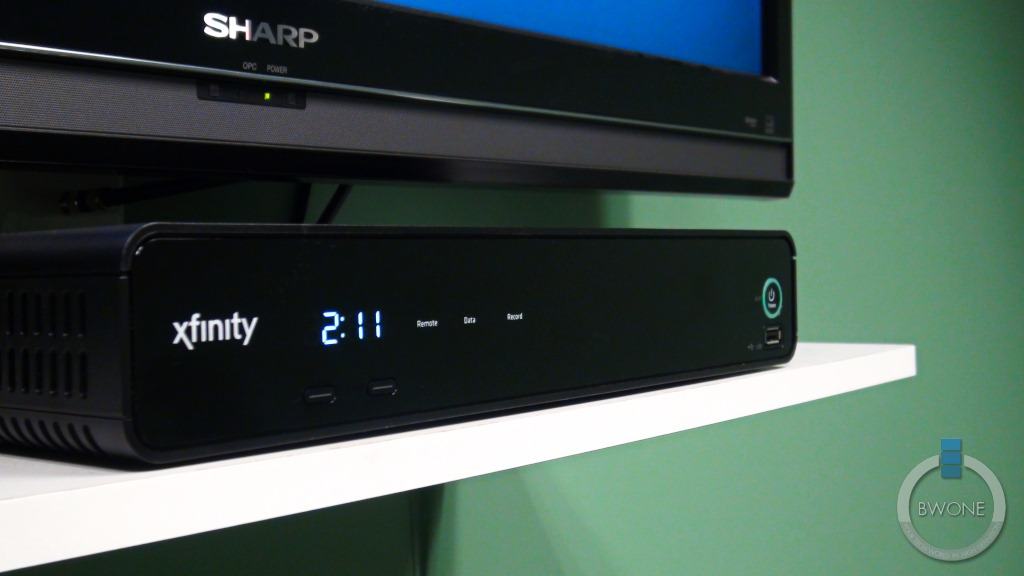
Comcast’s new X1 platform (Image courtesy: BWOne)

In other Comcast developments of note:

  • In June Comcast rolled out its new X1 cloud based set top platform in Boston and is currently launching X1 in Atlanta. Comcast is marketing the upgraded platform first to HD Triple Play customers, who can upgrade for a one-time installation fee. The company plans to roll out the new upgraded platform in five major markets by the end of this year, with a greater expansion in 2013;
  • Comcast has increased broadband speeds, particularly in competitive markets, for no additional charge;
  • Streampix now offers twice as many titles as the product offered at launch in February;
  • Comcast has rolled out its marketing partnership with Verizon Wireless to 22 markets nationwide;
  • The company’s ongoing rebranding under the Xfinity name now has a new catchphrase: Xfinity — The Future of Awesome;
  • Nearly 75% of Comcast’s customers now take at least two products and almost 40% are signed up for the company’s triple play package;
  • Comcast has saved more than $8 million by reducing the number of occasions the company will send technicians to customer homes. The cable company is heavily promoting self-install kits, which has brought a 65% increase  in the number of customers who install Comcast equipment and services themselves.

AT&T Workers in Nevada, California and Connecticut Call Two-Day Strike

Phillip Dampier August 7, 2012 AT&T, Consumer News, Video Comments Off on AT&T Workers in Nevada, California and Connecticut Call Two-Day Strike

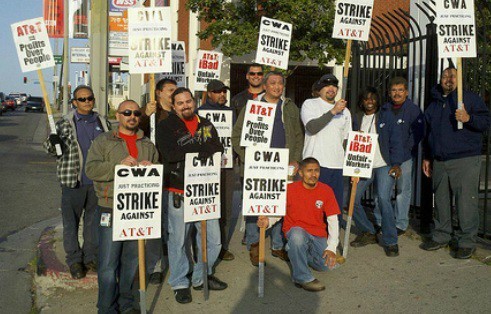
AT&T workers launched a two-day strike impacting operations in Connecticut, Nevada, and California.

Around 20,000 AT&T workers in Connecticut, Nevada and California are striking this afternoon in a two-day action to protest what union officials call the company’s lack of good faith during contract negotiations talks.

“Contract negotiations are never easy,” said CWA District 9 vice president Jim Weitkamp. “But when AT&T violates the law repeatedly, the process really can’t work. Given AT&T’s record profits, tax breaks and jaw-dropping executive compensation, there is no reason for them to insist on lowering the standard of living of a single worker.”

While 17,000 workers in the west and 3,000 employees in Connecticut walk picket lines, fellow AT&T employees in the southeast are still on the job after the company reached tentative deals with unions representing those workers.

AT&T says the new three-year deals with the Communications Workers of America and the International Brotherhood of Electrical Workers in Alabama, Georgia, Louisiana, Mississippi, Tennessee and North and South Carolina  bring wage and “modest pension increases,” according to the company.

Connecticut workers say AT&T’s proposed package in the northeast is not sufficient to address the high cost of living in the state.

But AT&T says declining numbers of landlines means cuts are inevitable. AT&T said in a statement Tuesday’s walkout was not in anyone’s best interest.

Connecticut picketers have been blocking the entrances of several AT&T facilities including in New Haven, where replacement workers appear to be honoring the picket lines after talking with striking workers. Unions are requesting customers not do business with AT&T during the strike.

Late reports indicate several cars with New Jersey license plates have hit three persons on one picket line. The union claims the vehicles were being driven by replacement workers, but no independent confirmation was available.

[flv width=”480″ height=”290″]http://www.phillipdampier.com/video/New Haven Register ATT UNION ON STRIKE 8-7-12.mp4[/flv]

The New Haven Register talked with Tim Smith, a union worker on a picket line outside of an AT&T facility. The video shows picketers encouraging replacement workers to honor the picket line and not report for work.  (3 minutes) 

Adam Smith’s Invisible Hand in Broadband: You Don’t Need More than 2Mbps

The views of the Adam Smith Institute, despite the near-global financial meltdown engineered by the Masters of the Universe.

Forbes columnist Tim Worstall is unimpressed with Google’s foray into fiber optics.

Worstall, a Fellow at the Adam Smith Institute in London, has repeatedly penned columns tsk-tsking the global broadband speed race.

In his world view, nobody except certain specialists needs any connection faster than 2Mbps:

The most obvious being that outside certain very specific uses (video editing for example, where people can pay up for their own T1 line) there’s not really much evidence that speeds above 2 Mbps or so actually improve productivity or economic performance/growth. Sure, they’re great for consumers who want to download movies but that’s not really a justification for a large scale infrastructure program.

Worstall’s Luddite-like knowledge of broadband technology makes it difficult to take him seriously. Notwithstanding the fact a T1 line delivers just 1.5Mbps (at a cost several times a typical cable or DSL broadband connection), Worstall’s declaration that faster speeds are only good for “downloading” movies (the concept of streaming also escapes him) is simple nonsense.

Worstall’s tantrum is really part of a bigger discussion about how to do broadband better in both the United Kingdom and the United States. Incumbent providers are dragging their feet while reaping profits for overpriced, too-slow service. Consumers and businesses are fed up, and some are now increasingly turning to the government to do-something to shake up the status quo.

Government? For those slavishly devoted to free market ideals at the Adam Smith Institute, such a notion guarantees an intemperate outburst with phrases like “government takeover,” “government interference in private business,” or “government monopoly” — all ideas Worstall complains are “blindingly awful.”

“The idea that the solution to anything is a government run engineering monopoly just boggles the mind,” Worstall declares.

In his piece, “Why High Speed Broadband Just Doesn’t Matter,” Worstall has just a single litmus test to define broadband worthiness: how much economic value can be extracted from the Internet — Ferengi economics at their finest.

Worstall (Image: Forbes)

Worstall:

So more people can watch TV. Apologies, but this doesn’t really convince. Higher definition TV just isn’t the sort of technology that boosts the economy of a country. It might be nice to have but it most certainly does not justify taxing some to provide the service to others.

[…] The truth is that as long as you’re getting broadband of a kind (2 Mbps say) then it’s possible to extract that economic value. Faster speeds might be nice but they’re just not necessary for economic development.

Even if you accept Worstall’s inaccurate contention fast Internet is only good for watching online entertainment, he evidently forgets PricewaterhouseCoopers estimated the value of that industry at $2 trillion, and that was by 2011. Why even have a cable television business, if the only thing it is good for is watching reality shows and Law & Order reruns? Because it makes money — lots of it.

Back to Google, which is creating a bit of a pickle for the cable and phone companies — an increasingly fat and happy bunch earning easy profits selling broadband at duopoly market prices. Proponents for better broadband advocating for new, publicly-owned broadband networks have had to confront astroturf and conservative groups using popular memes that “big government” cannot do anything right and if there was a market for gigabit broadband, private companies would already be selling it.

Starting this summer, Google is.

That spells t-r-o-u-b-l-e for the corporate love muffins at the Adam Smith Institute and their industry friends who are quite happy with the way things are today, thank you very much. Google just happens to be an example of a free market success story — a ‘responsible’ company willing to invest money in the game-changing broadband Worstall and friends spent years arguing we don’t actually want or need.

As Kansas City residents line up around the virtual block, eagerly plunking down $10 to “pre-register” for Google service, it becomes difficult to continue the standard line that super-fast Internet is just a tech-geek curiosity.

So what does a free-market-knows-best-devotee do in light of all this? Change the story.

Worstall picks up a premise first offered by The Guardian and runs with it. Namely, Google is actually riding the wave of past phone company failures to cheaply benefit from assets those companies deployed first:

There’s a very large difference between being able to do something usefully experimental with an orphaned asset and having to pay for the construction of that asset in the first place. The telecoms companies lost fortunes on laying that fibre (indeed, several, including such as Global Crossing, went resoundingly bust for billions in doing so). That something that was built for $100 can find a use when it is sold for $1 (just to make up some numbers) is not an argument in favour of spending the $100.

Yet that is exactly what the argument being proposed is. Look, Google’s got really cool fast broadband, now we should build it for everyone! What’s being missed is that, at least so far as we know as yet, that really fast broadband isn’t worth the cost of building it. It only makes sense even for Google because they’ve not had to pay full price for it.

Google got a discount, so that is why they are in the business.

Worstall’s declaration is news to Kansas City, which has been enduring Google’s construction crews for months as they lay fiber infrastructure across the metropolitan area. Evidently Google hired illusionist David Copperfield to perform the masterful trick of shading the truth:  re-purposing already-there fiber while pretending it was being buried and strung for the first time.

Adam Smith didn’t have super fast broadband when he posited his views on unfettered free markets in the 1700s. If his devoted followers are left in charge, you won’t either.

Search This Site:

Contributions:

Recent Comments:

Your Account:

Stop the Cap!