

 Subscribe
 Data caps protect incumbent big studio and network content creators at the expense of independent producers and others challenging conventional entertainment business models.
That was the conclusion of several writers and producers at a communications policy forum hosted by Public Knowledge, a consumer group fighting for an open Internet.
A representative from the Writers Guild of America West noted that cord-cutting paid cable TV service has become real and measurable because consumers have a robust online viewing alternative for the first time. John Vezina, the Guild’s political director, noted how Americans watch television is transitioning towards on-demand viewing.
New types of short-form programming and commissioned series for online content providers like Netflix are also changing the video entertainment model.

Welch: It is about the money.
But a digital roadblock erected by some of the nation’s largest broadband providers is interfering with that viewing shift: the data cap.
Data caps place artificial limits on how much a customer can use their Internet connection without either being shut off or finding overlimit fees attached to their monthly bill. Critics contend usage caps and consumption billing discourage online viewing — one of the most bandwidth intensive applications on the Internet. With broadband providers like Time Warner Cable, AT&T, Verizon, and Comcast also in the business of selling television packages, cord-cutting can directly impact providers’ bottom lines.
Providers have traditionally claimed that usage limits are about preserving network resources and fairness to other customers. But Time Warner Cable admits they exist as a money-making scheme.
Rachel Welch, vice president of federal legislative affairs at Time Warner Cable, says the cable company is not worried about limiting data consumption. It considers monetizing that consumption more important.
“We want our customers to buy as much of the product as possible,” Welch told PC World. “The goal of companies is to make money.”
Time Warner now offers customers a choice of unlimited service or a $5 discount if customers keep their monthly usage under 5GB, but some worry that is only a prelude to introducing expanded usage limits on a larger number of customers in the future.
For many consumers already hard-pressed by high broadband bills, worrying about exceeding a data allowance and paying even more may keep viewers from watching too much content online.
For that reason, Vezina called data caps “anti-innovation.”
“It hurts consumers [and] it hurts creators who want to get as much out to the public in as many ways” as possible, he said.
Public Knowledge has become increasingly critical of data caps in the last two years. The organization has questioned how ISP’s decide what constitutes a ‘fair’ usage limit and criticized inaccurate usage meters that could potentially trigger penalties and overlimit fees.
 Windstream has announced the increased broadband investments that expanded DSL service to about 75,000 more homes and businesses and brought fiber connections to cell towers are nearly complete and the company intends to dramatically cut spending on further enhancements by the end of 2013.
 “We expect to substantially complete our capital investments related to fiber to the tower projects, reaching 4,500 towers by the end of 2013,” said Gardner. “In addition, we will finish most of our broadband stimulus initiatives […] to roughly 75,000 new households. As we exit 2013, we will see capital spending related to these projects decrease substantially.”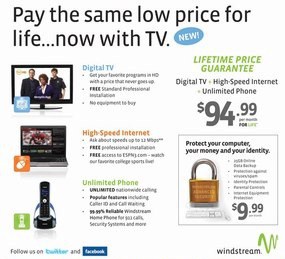
 Do you ever wonder why your local cable system suddenly decided to begin carrying barely known networks like Centric, Logo, Palladia, and a dozen other channels you can’t recall ever watching even as providers perennially complain about “increased programming costs?”

 AT&T and Verizon have forced some of their customers to abandon DSL service in favor of fiber upgrades that are sometimes not actually up and running or leave customers with no phone service during power outages.
 But Verizon’s CEO says the company is embarked on a plan to rid itself of its copper wire network, especially where FiOS fiber exists.
 General Motors announced Monday it was planning to introduce built-in 4G wireless connectivity from AT&T in OnStar-enabled vehicles starting with the 2015 model year, gradually ending a relationship GM has maintained with Verizon Wireless since 1996.
 New GM vehicle owners receive one free year of OnStar’s basic service, which includes automatic collision notification, stolen vehicle and roadside breakdown assistance, remote door unlock, remote horn and light flashing to find a vehicle, remote vehicle diagnostics, and a built-in speakerphone that can be used to make or receive calls (after an initial trial, customers must buy additional minutes). Some newer GM models also allow OnStar staff to slow down a stolen vehicle and even disable it. After one year, the basic Safe & Sound package can be continued for $18.95 a month ($24.95 in Canada). Drivers that want to add turn-by-turn navigation pay $28.90 a month ($39.90 in Canada), which also includes all the basic features offered in the Safe & Sound package.
 “We’re sitting on the greatest growth opportunity in history,” Ralph de la Vega, CEO of AT&T Mobility