
Home » Providers » Recent Articles:

Google Illustrates the Big Broadband Ripoff: Costs Flat Despite Huge Traffic Growth

BBand

One of the side benefits of Google getting into the broadband provider business is learning first-hand what is reality and what represents provider spin and marketing nonsense used to justify high prices and usage limits.

As Google Fiber slowly spreads across Kansas City, the search engine giant is gaining first hand-experience in the broadband business. Google understands what cable operators endured in the 1980s and what Verizon was coping with until it pulled the plug on FiOS expansion: the upfront costs to build a new network that reaches individual subscribers’ homes and businesses can be very high. But once those networks are paid off, revenue opportunities explode, particularly when delivering broadband service.

Milo Medin, a former cable Internet entrepreneur and now vice president of access services at Google, presented a cogent explanation of why Google can make gigabit broadband an earner once construction costs are recouped. He demonstrated the economics of fiber broadband at a meeting of the San Jose chapter of the IEEE.
BB2

In addition to a long term investment in fiber, and the new business opportunities 1,000Mbps Internet provides, Google has learned from the mistakes other utilities have made and is trying to establish close working relationships with local governments to find ways to cut costs and bureaucracy.

In Kansas City, Google has placed staff in the same office with city zoning and permit officials. Working together in an informal public-private partnership to cut red tape, local inspectors have agreed to coordinate appointments with Google installers to reduce delays. That alone reportedly saves Google two percent in construction expenses.

“Governments have policies that can make it easy or hard, so I say, ‘if you make it hard for me, enjoy your Comcast,’” Medin said.
Internet traffic vs. costs

Internet traffic vs. costs

Medin notes broadband adoption and expansion in the United States is being artificially constrained by the marketplace, where wired providers are resting on their laurels.

More than a decade ago, people paid $40 a month for 4-5Mbps service, Medin noted.

Providers have kept the price the same, arguing they create more value for subscribers with ongoing speed increases.

But Medin notes overseas, prices are falling and speeds are increasing far faster than what we see in North America.

“Broadband in America is not advancing at nearly the pace it needs to be,” Medin argues. “Most of you have seen dramatic changes in wireless, but there’s never been a real step function increase in wired. That’s what’s needed for us to retain leadership in technology — and not having it is a big problem.”

CostsX

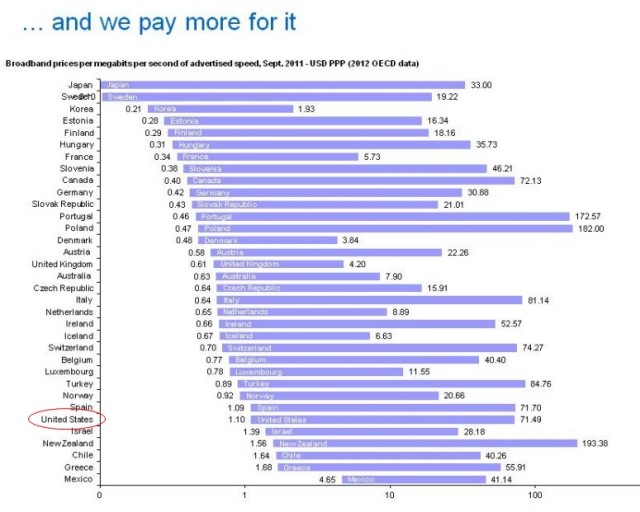
Medin points to OECD statistics that show the cost per megabit per month in the U.S. is the sixth highest among 34 OECD nations. Only Mexico, Chile, Israel, New Zealand, and Greece pay higher prices. Every other OECD nation pays less.

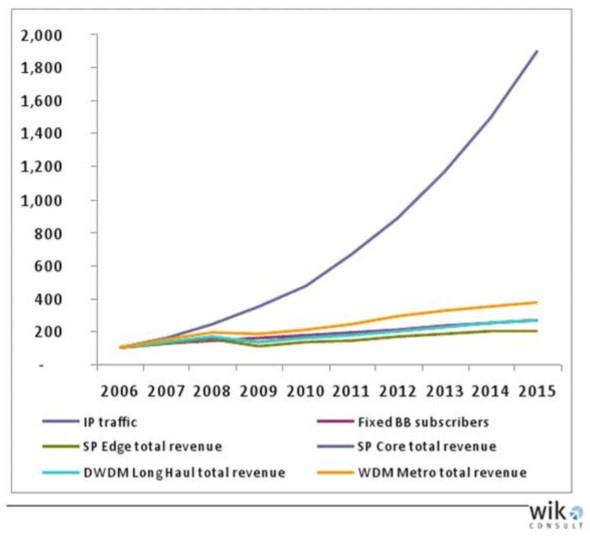
By leveraging fiber optics, which every provider uses to some extent, costs plummet after network construction expenses are paid off. In fact, despite the explosion in network traffic, provider bandwidth costs remain largely flat even with growing use, which makes the introduction of Internet Overcharging schemes like usage caps and consumption-based pricing unjustified.

“Moving bits is fundamentally not expensive,” said Medin.

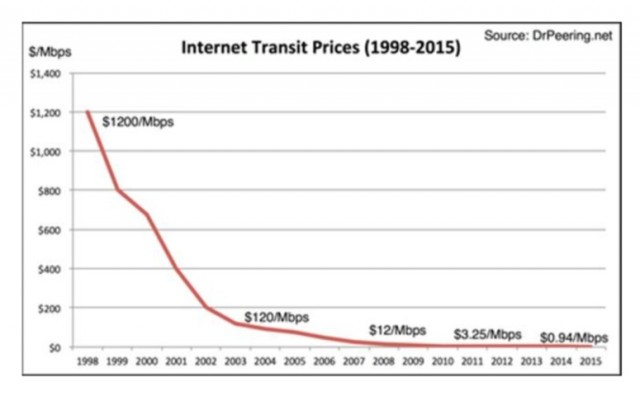
In 1998, when cable broadband first became available in many markets, the monthly price for the service was around $40 a month. Internet transit prices — the costs to transport data from your ISP to websites around the world averaged $1,200 per megabit that year. Today that cost has dropped below $4 per megabit and is forecast to drop to just $0.94 by 2015.
Costs2

Cogeco Asks New Tenant to Cover Old Renter’s $1,500 Cable Bill Before Connecting Service

Phillip Dampier February 28, 2013 Canada, Cogeco, Consumer News Comments Off on Cogeco Asks New Tenant to Cover Old Renter’s $1,500 Cable Bill Before Connecting Service
Cogeco red-flags addresses where its deadbeat customers live.

Cogeco red-flags addresses where its deadbeat customers live.

An Ontario cable company is refusing to hook up service for a new renter until the former tenant’s $1,500 past due balance is paid in full.

Cogeco Cable told its would-be customer it could not install his broadband, phone, and cable-TV service, even though the renter offered to provide a letter from his landlord asserting he had no relationship to the earlier tenant.

The cable operator’s “skip” policy, which flags accounts disconnected for non-payment, can make life difficult for the new renter or property owner. Cogeco’s policy is designed to stop disconnected customers from restarting service under someone else’s name.

In some cases, Cogeco has reportedly even disclosed personal details about the owner of the past due account, along with a detailed breakdown of the services and charges they incurred.

Customers who have encountered a red flag from Cogeco when attempting to sign up for service have been asked for a notarized letter, preferably from a personal attorney, disavowing any relationship to the former account-holder, along with copies of property transfer documents.

A Cogeco representative tells Stop the Cap! the potential customer was misinformed. Cogeco will not hold a new customer accountable for another customer’s past due balance.

Customers who encounter problems because of “flagged” accounts or addresses should ask to speak to a supervisor. Some supporting documentation may be required in some instances. But usually the supervisor can approve the order and help the customer set up service over the phone.

To Catch an AT&T Predator: Teen Gets Sexted by AT&T Technician Who Repaired His iPhone

Phillip Dampier February 27, 2013 AT&T, Consumer News Comments Off on To Catch an AT&T Predator: Teen Gets Sexted by AT&T Technician Who Repaired His iPhone
fl-reed

Herman Reed, 33, of Boynton Beach (Palm Beach County Sheriff’s Office)

A 16-year-old boy who brought his broken iPhone to a Boynton Beach, Fla. AT&T store to have it repaired got his phone fixed and more, after the AT&T technician offered him a bi-weekly allowance and sent him sexually explicit text messages.

Herman N. Reed Jr., 33, of Boynton Beach allegedly started sexting the boy three months ago, according to police.

“Reed stated that he wanted to hug me and wished that we could date,” according to victim statement within a police report obtained by the Sun-Sentinel. Reed also said he wanted to kiss and make love to the boy, boasting that he was good at it.

Reed admitted he also invited the boy to his home for movies and pizza.

When authorities stopped Reed’s truck and arrested him, Reed confessed that some of the conversations were “very sexual” and he feared his arrest was being taped as part of the Dateline NBC feature, “To Catch a Predator,” with Chris Hansen.

Although Reed has no prior arrests, he is now charged with online solicitation and traveling to meet a minor for a sex act. He is currently out of jail on $30,000 bail.

Frontier Launches $19.99 DSL Promotion It Claims Is Gotcha-Free; But Is It?

Phillip Dampier February 27, 2013 Competition, Consumer News, Frontier 4 Comments

Frontier Communications is hoping to capitalize on cable operators alienating customers with extra modem fees and the increasing cost of cable broadband with a new offer it claims is free from hidden charges and other gotcha’s.

Frontier’s “Simple Choice” offers DSL broadband at speeds up to 6Mbps for $19.99 a month with the promise of an “end to confusing Internet bills” loaded with modem rental fees, contracts, or other “plan-cuffs” that “require a law degree to understand.” Frontier also offers to double your speeds for $10 more per month.

frontier simple

“It gives consumers an awesome amount of flexibility and choice,” said Cecilia K. McKenney, executive vice president of administrative services at Frontier. “By offering new broadband speed tiers to residential and commercial customers and eliminating contracts and early termination fees on our residential offers, we are truly simplifying the broadband experience.”

The offer includes a three-year price lock on voice and broadband, a free wireless router, no contract and no early termination fees. There is no Internet activation fee where a free self-installation kit is available.

But despite the promises of no tricks or traps, Frontier couldn’t help themselves in the fine print accompanying the offer:

  1. The offer is only available to customers subscribing to a “qualifying package of Frontier residential local service with calling features and long distance.” This means you must keep a Frontier voice landline with an added-cost long distance and feature package (eg. Caller ID, Call Waiting, voicemail, etc.) In Rochester, N.Y., a landline with qualifying features starts at $31 a month before taxes and fees.
  2. A $49.99 “Internet installation fee” is payable if a self-install kit is not available.
  3. A $9.99 “broadband processing fee” applies if/when you disconnect your broadband service.
  4. Taxes, governmental, and “other Frontier-imposed surcharges” that go unspecified also apply.
  5. Frontier does not guarantee you will actually receive 6Mbps service. Speeds will vary depending on local line conditions.

Comcast Bills Mass. Woman $640 for Cable Equipment Lost in a Major Apartment Fire

Phillip Dampier February 27, 2013 Comcast/Xfinity, Consumer News Comments Off on Comcast Bills Mass. Woman $640 for Cable Equipment Lost in a Major Apartment Fire
Comcast: You owe us $640 (Original image: Enterprise &)

Comcast: You owe us $640 (Original image: Sentinel & Enterprise)

Comcast billed a Leominster woman $640 for cable television equipment destroyed in a major apartment fire, despite promises from the company she would not be charged.

Lakisha Nunez spent months fighting with Comcast over the equipment lost when a fire broke out at the Columbia Hotel building on Nov. 24.

Two days later, Nunez contacted Comcast to inform them of the fire and to temporarily suspend service. A representative promised she would not be held accountable for the unreturned equipment because the fire was not her fault.

One month later, the company changed its mind and refused to discuss the matter further. When the $640 bill arrived, she complained.

“I called and was told that is what (renter) insurance is for,” Nunez told the Sentinel & Enterprise.

Another representative told her the fees would be waived if she filed a “fire report” with the local Comcast office. She complied, but Comcast still refused to remove the charges.

The bill was finally waived after Leominster Mayor Dean Mazzarella’s office intervened on her behalf and reporters from the Sentinel & Enterprise also began making inquiries.

Comcast spokesman Marc Goodman quickly apologized and promised to refund $233 in fees she already paid, believing it covered her monthly service.

Stop the Cap! reminds renters that buying renter’s insurance is essential to protect your personal property (and that belonging to others) in the event of a catastrophic loss. It is inexpensive and easy to buy from any large insurance company.

Search This Site:

Contributions:

Recent Comments:

Your Account:

Stop the Cap!