Home » Providers » Recent Articles:

Comcast’s Meteoric Rise and Market Power Parallels the Decline of U.S. Internet Service

Phillip Dampier February 25, 2013 Broadband Speed, Comcast/Xfinity, Competition, Public Policy & Gov't Comments Off on Comcast’s Meteoric Rise and Market Power Parallels the Decline of U.S. Internet Service
Cohen

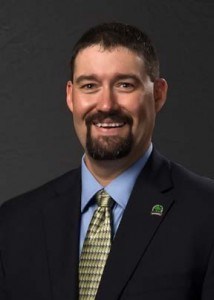
Comcast’s David Cohen

Comcast is an American success story, but Americans that do business with the cable giant are getting slighted by overpriced, too-slow broadband service.

In a commentary piece in the Financial Times, Edward Luce indicts the company that bought NBC-Universal for pay-for-play campaign contributions that have kept the company from much  regulatory scrutiny and free to charge whatever it likes for a service now increasingly considered a necessity.

Comcast’s key employee as far as Washington is concerned is its senior vice-president, David Cohen, who also happens to be one of President Barack Obama’s largest fundraisers.

The revolving door between Comcast in Philadelphia and the federal government in Washington is always spinning.

Of Comcast’s 121 lobbyists, 85 are former government employees, according to Open Secrets, which monitors money and politics.

“Comcast employs the royalty of K Street [lobbyists],” says Sheila Krumholz, head of Open Secrets.

In 2011, the year the FCC approved Comcast’s merger with NBCU, the company spent more than $14 million on lobbying – the ninth-highest of any US company (it ranks 49th on the Fortune 100 list).

Luce adds Meredith Atwell-Baker, a former Republican FCC commissioner, took an executive position at Comcast shortly after voting to approve the merger-buyout between the cable operator and NBC.

This month Comcast acquired the 49 percent of NBC-Universal it did not already own in a $16.7 billion transaction that got less attention at the FCC than the lunch menu at the Chinese takeout down the street.

So while Comcast enriches itself, customers are left with Internet service that is nothing to brag about.

While only 7% of the U.S. is wired for fiber broadband, more than half of South Korea and Japan can buy fiber-fast broadband service from a range of broadband suppliers. Back home, Comcast and the local phone company have built a comfortable duopoly:

The company’s meteoric rise in the past decade parallels the relative decline of Internet service in the US. In the late 1990s the US had the fastest speeds and widest penetration of almost anywhere – unsurprisingly given that it invented the platform. Today the US comes 16th, according to the OECD, with an average of 27 megabits per second, compared with up to quadruple that in countries such as Japan and the Netherlands.

The contrast on price is just as unflattering. The average US cost for 1 Mbps is $1.10 compared with $0.42 in the UK, $0.34 in France and $0.21 in South Korea. It is not only places such as Hong Kong that put the US into the shade. Countries such as Estonia, Portugal and Hungary offer a significantly better Internet service. South Koreans joke that when they visit the US they are taking an Internet vacation. Yet bringing the US up to speed appears to be low on Mr Obama’s list of priorities (it did not even get a mention in his State of the Union address last month).

Verizon FiOS Offers Easy $10 Upgrade to 50/25Mbps Service: Click Your Remote Twice

Phillip Dampier February 21, 2013 Broadband Speed, Competition, Verizon 5 Comments

fios quantum 285x190Verizon FiOS has made it easy for broadband customers to upgrade to 50/25Mbps service for $10 more a month.

Getting access to the company’s introductory Quantum tier is as simple as going to FiOS TV Channel 500 and clicking the OK button twice with your remote control. Within one hour, your speeds will be upgraded. For those who don’t subscribe to FiOS TV, you can visit the FiOS Quantum website or use the MyFiOS smartphone app.

A promotion for new customers includes an introductory offer of FiOS TV, Quantum 50/25Mbps, and telephone service for $89.99 a month with a $250 debit card rebate in certain markets.

Last summer, the company launched the Quantum brand to market its highest speed tiers: 50/25Mbps, 75/35Mbps, 150/65Mbps or 300/65Mbps.

Verizon says the company noticed an increasing demand for faster speed service because customers are connecting more devices to the Internet. Streaming multiple online videos at the same time, for example, can burden slower speed Internet services.

Verizon says the faster speeds also keep the company ahead of its cable competition, which has struggled to provide affordable faster tiers of service and remains limited on upstream speeds.

[flv width=”640″ height=”380″]http://www.phillipdampier.com/video/Verizon FiOS Quantum Upgrade 2-15-13.flv[/flv]

Verizon FiOS is now offering broadband customers a $10 upgrade to 50/25Mbps service just by clicking a button on your FiOS TV remote control twice.  (1 minute)

Comcast Calls $1.99 Charge for Digital Adapters a “Service Fee” to Avoid FCC Complications

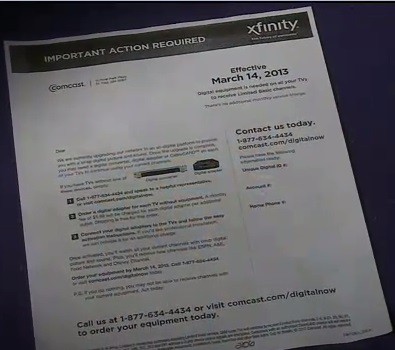
dta letterComcast may be attempting to get around Federal Communications Commission regulations governing what cable companies can charge for cable equipment by recasting the monthly fee as a “service charge.”

The cable operator’s decision to start charging $1.99 a month for digital transport adapters (DTAs) — small boxes that can convert digital signals into analog for older televisions — has at least one Minnesota city up in arms.

Eagan city officials met with outraged residents Tuesday to discuss the fee hike and hear a number of complaints about how Comcast does business in the community.

“It really ran the gamut, from concerns about losing stations, to concerns about being bait and switched, to having gotten boxes for free and worried that you had to pay for them in the future,” Eagan Mayor Mike Maguire told WCCO-TV.

Comcast customers in Minnesota are receiving letters from the cable operator some call deceptive. The letter warns “digital equipment is needed on all your TVs to receive channels,” despite the fact many televisions manufactured after 2007 are equipped with QAM tuners that will receive the digital signals without extra equipment, at least for now.

Only in fine print at the bottom of the letter does Comcast admit QAM-equipped sets won’t need the equipment, saving $1.99 a month per set.

Letters have also been sent to customers who have used DTA equipment provided by Comcast at no charge… until now.

Comcast earlier announced it intends to collect $1.99 a month from each subscriber using DTA equipment, even if those customers previously had received the equipment for free.

But Comcast’s decision to charge $24 a year in perpetuity for a box with a wholesale cost of less than $50, depending on the model, may run afoul of Federal Communications Commission regulations that forbid cable operators from charging excessive amounts to lease cable equipment:

Cable operators may require their subscribers to use specific equipment, such as converters, to receive the basic service tier. They may include a separate charge on your bill to lease this equipment to you on a monthly basis. This monthly rate must be based on the operator’s actual costs of providing the equipment to you. Operators may also sell equipment to you, with or without a service contract. If an operator provides a choice between selling and leasing the equipment, the monthly leasing rate will be regulated but the sales price will be unregulated. If an operator only sells equipment and does not also lease equipment, then the sales price must be the actual cost of the equipment plus a reasonable profit, and any service contract should be based on the estimated cost to service the equipment. If the customer buys the equipment but does not purchase a service contract, the customer can be charged for repairs and maintenance. Cable operators may not prevent customers from using their own equipment if such equipment is technically compatible with the cable system.

Eagan Mayor Mike Maguire

Eagan Mayor Mike Maguire

In a possible attempt to avoid regulatory language regarding cable equipment, Comcast has declared its new $1.99 fee is actually an “additional outlet service charge,” not an equipment fee.

“The deployment of DTA technology allows us to bring more value to our customers through additional HD channels and faster Internet speeds, both of which are used by the majority of our customers,” said Mary Beth Schubert, vice president of corporate affairs. “These types of enhancements require significant investment, and we feel the nominal fee now being implemented for DTA additional outlet service on our digital tiers reflects the additional value of the service.”

“There is no charge for the first three DTA devices,” said Schubert. But she quickly added, “After the digital transition in March and April, those TVs will not have access to these channels unless they are paying the $1.99 DTA additional outlet service fee.”

Michael Bradley, an attorney representing 20 local communities, is investigating to see if Comcast’s language about its new fee violates FCC rules.

The new charge is expected to be lucrative for Comcast, earning the company at least $550 million annually in new revenue.

Comcast intends to boost that even further as it embarks on encrypting its digital lineup, making QAM-equipped televisions useless to receive scrambled cable channels.

“These customers will eventually need to connect a digital device to their QAM tuner equipment at a future date as we implement additional network security features,” warned Schubert. “Customers will be provided complete information well before any additional measures take place.”

The FCC previously negotiated an agreement with cable operators intending to encrypt their cable lineup to keep customers from experiencing bill shock from new, mandatory equipment fees:

If, at the time your cable operator begins to encrypt, you subscribe Then you are entitled to
only to broadcast basic service and do not have a set-top box or CableCARD a set-top box or CableCARD on up to two television sets without charge or service fee for two years from the date your cable operator begins to encrypt.
to a level of service other than broadcast basic service but use a digital television to receive only the basic service tier without use of a set-top box or CableCARD a set-top box or CableCARD on one television set without charge or service fee for one year from the date your cable operator begins to encrypt.
only to the basic service tier without use of a set-top box or CableCARD and you receive Medicaid a set-top box or CableCARD on up to two television sets without charge or service fee for five years from the date your cable operator begins to encrypt.

But by recasting new fees as unregulated “additional outlet fees,” Comcast and other cable operators may have successfully outwitted the FCC’s good intentions, earning billions in new revenue annually as a result of a simple language change.

[flv width=”640″ height=”380″]http://www.phillipdampier.com/video/WCCO Minneapolis Comcast Fee Causes Outrage in Minn 2-20-13.mp4[/flv]

WCCO reports the city of Eagan held an informational meeting Tuesday about Comcast’s newest fee for digital boxes required on older televisions. Comcast customers nationwide will soon pay the new $1.99 “DTA additional outlet service fee” for each television equipped with the digital set top DTA box “to offset increasing programming and operational costs.”  (2 minutes)

Verizon Wireless Issues Dirty Baker’s Dozen List of “High Risk” Android Apps

Phillip Dampier February 21, 2013 Consumer News, Data Caps, Verizon, Wireless Broadband 2 Comments

Verizon Wireless has created a new warning page about “high-risk apps” that can chew up your data allowance or kill a fully charged Android smartphone battery in a matter of hours.

“Occasionally we learn about apps in the Google Play™ Store that might have serious negative effects on your device,” the website states. “We work regularly with app developers to help them fix problems with their apps, and apps are removed from this list as soon as the issues are fixed.”

All of the apps on the baker’s dozen list are games:

Asphalt 7:Heat
 Version: 1.0.4
 Developer: Gameloft
 Last Reviewed: January 2013

Description: When running, this app keeps the device from going to sleep mode. As a result, a device left untouched with the app running will drain the battery about 2.4 times faster than normal.


Burger
 Version: 1.0.4
 Developer: Magma Mobile
 Last Reviewed: October 2012

Description: When running, this app keeps the device from going to sleep mode. As a result, a device left untouched with the app running will drain the battery about 2.3 times faster than normal.


Doodle Jump
 Version: 1.13.8
 Developer: GameHouse
 Last Reviewed: September 2012

Description: When running, this app keeps the device from going into sleep mode. As a result, a device left untouched with the app running will drain the battery about three times faster than normal.


Draw Something
 Version: 1.11.15
 Developer: OMGPOP
 Last Reviewed: December 2012

Description: When running, this app keeps the device from going to sleep mode. As a result, a device left untouched with the app running will drain the battery about 2.7 times faster than normal.


Fruit Ninja Free
 Version: 1.6.2.0
 Developer: Halfbrick Studios.
 Last Reviewed: December 2012

Description: When running, this app keeps the device from going into sleep mode. As a result, a device left untouched with this app running will drain the battery about 2.2 times faster than normal.


Grand Theft Auto III
 Version: 1.3
 Developer: Rockstar Games, Inc.
 Last Reviewed: September 2012

Description: When running, this app keeps the device from going into sleep mode. As a result, a device left untouched with this app running will drain the battery about 1.8 times faster than normal.


Hill Climb Racing
 Version: 1.4.1
 Developer: Fingersoft
 Last Reviewed: January 2013

Description: When running, this app keeps the device from going into sleep mode. As a result, a device left untouched with this app running will drain the battery about 2.7 times faster than normal.

This app uses a large amount of data while running in the background.  A device left untouched with the app running could use as much as 6.4MB in 24 hours, or 190MB in a 30 day period.


Jail Escape
 Version: 1.1
 Developer: mazjustin
 Last Reviewed: October 2012

Description: When running, this app keeps the device from going to sleep mode. As a result, a device left untouched with the app running will drain the battery about 2.8 times faster than normal.

This app uses a large amount of data while running in the background. A device left untouched with the app running could use as much as 17MB in a 24 hour period, or more than half a gigabyte in  30 day period.


Need for Speed: Most Wanted
 Version: 1.0.46
 Developer: Electronic Arts, Inc.
 Last Reviewed: January 2013

Description: When running, this app keeps the device from going into sleep mode. As a result, a device left untouched with this app running will drain the battery about 4.5 times faster than normal.


N.O.V.A. 3 – Near Orbit
 Version: 1.0.2
 Developer: Gameloft
 Last Reviewed: September 2012

Description: When running, this app keeps the device from going into sleep mode. As a result, a device left untouched with this app running will drain the battery about 2.2 times faster than normal.


Osmos HD
 Version: 1.2.15
 Developer: Hemisphere Games
 Last Reviewed: October 2012

Description: When running, this app keeps the device from going to sleep mode.  As a result, a device left untouched with the app running will drain the battery about 3 times faster than normal.


Wreck It Ralph
 Version: 1.1
 Developer: Disney
 Last Reviewed: January 2013

Description: When running, this app keeps the device from going into sleep mode. As a result, a device left untouched with this app running will drain the battery about 2.3 times faster than normal.


Zombie Frontier
 Version: 1.0.6
 Developer: Feelingtouch Inc.
 Last Reviewed: December 2012

Description: When running, this app keeps the device from going into sleep mode. As a result, a device left untouched with this app running will drain the battery about 3.3 times faster than normal.

Kansas House of Representatives Votes 118-1 in Favor of AT&T Bill to Abandon Rural Kansas

The Kansas House of Representatives voted 118-1 to pass a bill they admit was written and pushed by the largest telecom companies in the state. The chief supporters all received campaign contributions from AT&T and other telecom interests.

The Kansas House of Representatives voted 118-1 to pass a bill they admit was written and pushed by the largest telecom companies in the state. The chief supporters all received campaign contributions from AT&T and other telecom interests.

Kansas’ House of Representatives voted 118-1 Monday to support a bill largely crafted by AT&T that will let the state’s largest phone company discontinue service at-will in rural areas of the state.

H.B. 2201 had near-universal support from legislators that openly admitted the legislation was conceived and written by the state’s largest telecommunications companies, chiefly AT&T, and grants the phone companies a third round of deregulation.

The legislation is expected to sail through the Kansas Senate with bipartisan support and Republican Gov. Sam Brownback, who generally favors telecom deregulation, is likely to sign it.

The legislation was originally pushed as a money-saver for Kansas ratepayers. The bill calls for a major reduction in funding requirements for the Kansas Universal Service Fund (KUSF), which subsidizes rural telecommunications services in the state. The KUSF is principally funded through a surcharge found on customer bills. Under the terms of the bill, funding requirements will be drastically reduced, cutting the surcharge in the process.

The Kansas Citizens’ Utility Ratepayer Board testified if H.B. 2201 only contained KUSF reform, the group would have supported the measure. But the bill also has a myriad of deregulation measures that received little apparent attention by legislators:

  1. H.B. 2201 eliminates quality of service requirements. AT&T and other phone companies can deliver any level of phone service they choose with no oversight and nobody to answer to;
  2. Allows price discrimination based on geographic location, which could mean substantially higher phone rates in rural areas, especially for nearby toll calls;
  3. Allows telecom companies to exit the Lifeline program for inexpensive service for the poorest Kansans after 90 days written notice;
  4. Removes AT&T and other phone companies as “carriers of last resort,” which means they are no longer required to provide phone service upon request.

The elimination of the “carrier of last resort” provision is essential to AT&T’s plans to abandon rural landline service, forcing customers to buy substantially more expensive cellular phone and data service. With the passage of H.B. 2201, AT&T can notify rural Kansas customers it will drop their landline service and/or broadband at-will.

Siewert

Siewert

The single “no” vote came from freshman Rep. Larry Hibbard, (R-Toronto), who noted landline service was essential in many rural areas. Hibbard worried AT&T would use the legislation as an excuse to raise rates or force elderly Kansans to use a wireless cell phone, which could prove too confusing for them.

“This bill may come back to haunt rural Kansas,” Hibbard warned.

“We have this mentality, ‘if I don’t have a wire, I can’t make a phone call.’ That’s not true,” countered Rep. Scott Schwab, an Olathe Republican who supports the bill. “That copper line is being replaced with an antenna, and it’s more reliable.

“We are not killing Lifeline,” Schwab added. “We are just not mandating it.”

Other supporters were far more sanguine, even disclosing the substantial role telecom companies had getting the legislation written and shepherded through the House.

“This was an industry bill that they all worked very hard” to put together, admitted Rep. Joe Seiwert (R-Pretty Prairie) during a House Republican caucus meeting. “[This bill] puts legislators in an easier position of not having to ‘choose between friends.'”

Kuether

Kuether

Seiwert, for example, did not have to disappoint his largest campaign contributor — AT&T — or others who donated to his campaign, including the Koch Brothers, Cox Communications, CenturyLink, Verizon, and the Kansas cable lobby.

Rep. Annie Kuether of Topeka, who is the ranking Democrat on the Utilities and Telecommunications Committee, also supported the bill. Kuether is the recipient of campaign contributions from AT&T, Cox Cable, Time Warner Cable, Kansas cable and telephone company PAC groups, and more than a dozen independent telecommunications providers doing business in Kansas.

For ordinary Kansans, the bill does not assure savings, and could lead to dramatic price increases, especially in rural areas forced to pay for cell service. The measure also eliminates the Kansas Corporation Commission as a last resort for customers with service problems that go unresolved. Those customers would be on their own after the bill becomes law.

Legislators did not see any incompatibility between the proposed bill and Kansas state policy, set forth in Statute 66-2001:

It is hereby declared to be the public policy of the state to:

(a) Ensure that every Kansan will have access to a first class telecommunications infrastructure that provides excellent services at an affordable price;
(b) ensure that consumers throughout the state realize the benefits of competition through increased services and improved telecommunications facilities and infrastructure at reduced rates;
(c) promote consumer access to a full range of telecommunications services, including advanced telecommunications services that are comparable in urban and rural areas throughout the state;
(d) advance the development of a statewide telecommunications infrastructure that is capable of supporting applications, such as public safety, telemedicine, services for persons with special needs, distance learning, public library services, access to internet providers and others; and
(e) protect consumers of telecommunications services from fraudulent business practices and practices that are inconsistent with the public interest, convenience and necessity.

The Associated Press notes this is AT&T’s third trip through the state legislature to win deregulation. A 2006 state law deregulated prices for bundles of services that included wireless, Internet access, cable TV or other video and moved toward deregulating rates for local service in exchanges where competition existed. A 2011 law went further, allowing companies to avoid most state price caps. This year’s bill would allow those companies to avoid even the Kansas Corporation Commission’s consumer protection regulations and minimum quality-of-service standards.


Search This Site:

Contributions:

Recent Comments:

Your Account:

Stop the Cap!