Home » Providers » Recent Articles:

Mediacom Adopts Internet Overcharging Scheme for All Customers: Caps and Overlimit Fees

logo_mediacom_main

…fiction into “fact.”

Although America’s perennially worst-rated cable company is advertising “always faster Internet,” it is also moving “full speed ahead” to enforce usage limits to make sure customers don’t take too much advantage of those speeds.

Broadband Reports notes Mediacom is preparing notices stating effective Sept. 7 usage limits and overlimit fees that used to only apply to new customers or those changing plans will now be enforced for all customers.

A member of their social media team blamed bandwidth hogs for the caps.

“We have a small subset of customers that are using a very large portion of the available bandwidth, which can have a negative impact on the other Internet users in the surrounding area,” said Mediacom’s Social Media Relations Team. “By curbing this behavior, other customers can benefit with faster speeds.”

capacityActually, Mediacom will benefit from lower usage and higher revenue it will collect from the $10 overlimit fee for each additional 50GB of usage. Neighborhood congestion issues are largely a thing of the past because of upgrades to DOCSIS 3 technology.

Although the usage caps for higher priced tiers are generous by current standards, the company can adjust the caps up or down at any time. Mediacom traditionally serves rural areas or small cities that lack significant telephone company competition, so customers may have few alternatives. Both CenturyLink and AT&T have their own usage caps, barely enforced. Frontier Communications, another common provider in Mediacom territory, has tested the water with usage caps in the past but does not regularly impose them.

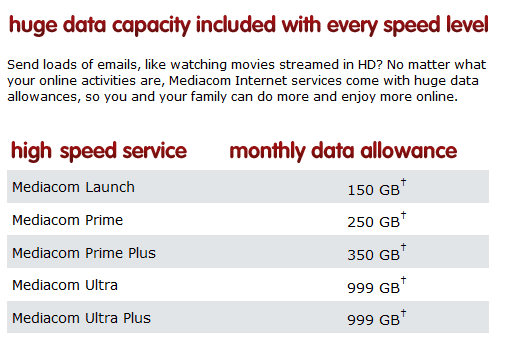
Broadband Reports assembled the pricing and caps for each Mediacom broadband tier:

  • Mediacom Launch 150GB (3 Mbps, $28)
  • Mediacom Prime 250GB (12-15 Mbps, $46)
  • Mediacom Prime Plus 350GB (20 Mbps, $55)
  • Mediacom Ultra 999GB (50 Mbps, $95)
  • Mediacom Ultra Plus 999GB (105 Mbps, $145)
Mediacom has an online usage tracker and promises to notify customers when they are nearing their usage limit before the overlimit fees begin.

Comcast Expands 300GB Usage Cap to Kentucky, Georgia and Mississippi

Phillip Dampier August 8, 2013 Broadband "Shortage", Comcast/Xfinity, Competition, Consumer News, Data Caps, Editorial & Site News Comments Off on Comcast Expands 300GB Usage Cap to Kentucky, Georgia and Mississippi
Comcast's usage caps are back for customers in three states.

Comcast’s usage caps are back for customers in three states.

Comcast has decided usage caps are in the future for more of its broadband customers.

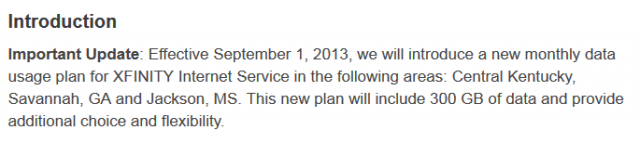
Effective Sept. 1 XFINITY Internet Service will be capped to 300GB of monthly usage in central Kentucky, Savannah, Ga., and Jackson, Miss. Comcast says the plan provides “additional choice and flexibility.”

We’re uncertain how it does that, exactly.

Comcast will have the additional choice of slapping a $10 overlimit fee for allowance offenders for every extra 50GB of data consumed.

But the company says it will be initially flexible in how it penalizes those heavy users.

“In order for our customers to get accustomed to the new data usage plan, we will be implementing a program that gives you three courtesy months for exceeding the 300GB in any 12-month period,” writes Comcast in a new FAQ. “That means you will only be subject to overage charges if you exceed the 300GB for a fourth time in a 12-month period. On the fourth (and any subsequent occurrence), you will be notified that you have exceeded your 300GB via an email and in-browser notification, that an additional 50GB has automatically been allocated to your account, and that applicable charges will be applied to your bill.”

flex

Choice and flexibility for the customer or Comcast’s bottom line?

Customers with questions and concerns about Comcast’s expanding Internet Overcharging scheme can call Comcast Customer Security Assurance at 1-877-807-6581. Customers might want to assure Comcast if they are going back to usage caps, they will start shopping for a different provider. Stop the Cap! recommends customers in these areas protest the usage caps firmly and loudly.

“There are no legitimate engineering or economic justifications for these caps,” notes consumer group Free Press. “But Comcast’s new Internet Overcharging scheme and its discriminatory treatment of competitors’ video offerings do pose a grave threat to future video competition.”

And to your wallet.

Analysts have estimated that Comcast’s profit margins on broadband service are at least 80 percent or higher. In 2008, Sanford C. Bernstein & Co. analyst Craig Moffett estimated Comcast’s data margins at 80 percent, and Credit Suisse reported in fall 2010 that Comcast’s gross margins on high-speed data had grown to 93 percent.

Since withdrawing a nationwide cap of 250GB in 2012, Comcast had tested usage caps only in Nashville, Tenn., and Tucson, Ariz.

Stop the Cap! thanks reader “MrPaulAR” for the news tip.

AT&T’s Purchase of Cricket-Leap Wireless Wins Hundreds of Millions in Tax Writeoffs

cricketAnalysts were surprised at the premium price AT&T agreed to pay when it announced last month it was acquiring Leap Wireless — owner of the Cricket brand prepaid cell phone service — for $1.2 billion plus assuming $2.8 billion in net debt. But newly released documents show AT&T will win significant tax concessions allowing it to shelter hundreds of millions in revenue from the tax man.

In fact, the more Leap Wireless piles up debt and hemorrhages customers, the more AT&T’s taxes go down.

If AT&T wins approval for its deal to take over Cricket’s dwindling customer base, wireless spectrum, and the company’s existing wireless network, it will receive 20 years of tax savings from “pre-change” losses, offering AT&T a tax shelter worth $155 million in taxable income a year. That means AT&T will see at least a $60 million reduction in its tax bill each of the first five years after the deal is approved. Then the savings decrease somewhat for the next 15 years as AT&T gets to write off $35 million annually.

Despite Cricket’s efforts to promote its bundled music and prepaid cell services as an industry game-changer, customers did not agree.

On Thursday, Leap admitted Cricket lost $163 million, or $2.09 per share, on revenue of $731 million for the quarter ended June 30. The company also saw 18 percent of its customers leave over the past year, with 4.8 million remaining. Leap management admitted it was becoming increasingly difficult to compete because its network was smaller than its larger competitors and Cricket had trouble acquiring the hottest smartphones to sell to customers.

Leap has been peddling Cricket on the wireless market since 2009 with no takers, even after it began to slowly pursue a network upgrade to 4G LTE service that was more promise than reality. Recent disclosures show the company lacked the money to expand more quickly.

AT&T still showed little interest in the little carrier that couldn’t over the course of 2012.

att cricketIn May, as T-Mobile closed in on its takeover of similarly sized MetroPCS, things changed. AT&T ended up being the sole bidder for Cricket, offering $9.50 a share.

AT&T raised its offer to a whopping $15 a share after Leap executives promoted Cricket as a useful brand for AT&T to improve its standing in the prepaid market. But executives also sold AT&T on the fact Leap was lousy in debt, which opened up significant tax savings opportunities for AT&T.

BTIG Research’s Walter Piecyk thinks AT&T is shelling out a lot for Leap, even after considering the tax and spectrum benefits. But more than anything else, AT&T may have been willing to pay a premium for Cricket just to make sure none of its competitors, particularly T-Mobile, got there first.

The deal still requires approval by the Federal Communications Commission with a likely weigh-in from the Department of Justice’s Antitrust Division.

[flv width=”640″ height=”380″]http://www.phillipdampier.com/video/Bloomberg ATT Buys Leap Wireless Who Wins 7-15-13.flv[/flv]

Moffett Research senior research analyst Craig Moffett tells Bloomberg News AT&T’s acquisition of Leap Wireless sticks it to competitors, in particular T-Mobile. AT&T’s purchase blocks T-Mobile and other carriers from getting access to Cricket’s wireless spectrum. Moffett also talks about the trend towards wireless mergers and acquisitions and how Verizon and AT&T got stuck with unwanted, unsold iPhones that could cost the companies millions. (6 minutes)

The Incredibly Hackable Femtocell: $250 Lets You Listen In on Cell Calls, Read Text Messages

Phillip Dampier August 6, 2013 AT&T, Consumer News, Verizon, Wireless Broadband Comments Off on The Incredibly Hackable Femtocell: $250 Lets You Listen In on Cell Calls, Read Text Messages
A Samsung femtocell offered by Verizon Wireless.

A Samsung femtocell offered by Verizon Wireless.

The wireless industry’s push to offload wireless traffic to microcells and other short-range femtocell base stations has opened the door for hackers to intercept voice calls, SMS text messages and collect enough identifying information to clone your phone.

Researchers from iSec Partners demonstrated femtocell vulnerability last month at the Black Hat conference in Las Vegas, successfully recording phone calls, messages, and even certain web traffic using a compromised $250 Samsung “network extender” sold to consumers by Verizon Wireless.

Once anyone gets within 15-20 feet of a femtocell using compatible network technology (CDMA or GSM), their device will automatically attempt to connect and stay connected to a potentially rogue cell signal repeater as long as the person remains within 50 feet of the base station. Many phone owners will never know their phone has been compromised.

“Your phone will associate to a femtocell without your knowledge,” said Doug DePerry from iSEC Partners. “This is not like joining a Wi-Fi network. You don’t have a choice. You might be connected to ours right now.”

During the demonstration, the presenters were able to record both sides of phone conversations and compromise the security of Apple’s iMessage service. All that was required was to trick Apple’s encrypted messaging service to default to exchanging messages by plain text SMS. Phones were also successfully cloned by capturing device ID numbers over Verizon’s cell network. Once cloned, when the cloned phone and the original are connected to a femtocell of any kind, at any location, the cloned unit can run up a customer’s phone, text, and data bill.

“Eavesdropping was cool and everything, but impersonation is even cooler,” DePerry said.

Although the very limited range of femtocells make them less useful to track a particular person’s cell phone over any significant distance, installing a compromised femtocell base station in a high traffic area like a restaurant, mall, or entertainment venue could allow hackers to quietly accumulate a large database of phone ID numbers as people pass in and out of range. Those ID numbers could be used to eventually clone a large number of phones.

iSEC Partners believe femtocells, as designed, are a bad idea and major security risk. Although Verizon has since patched the vulnerability discovered by the security group, DePerry believes other vulnerabilities will eventually be found. He worries future exploits could be used to activate networks of compromised femtocells controlled by unknown third parties used to snoop and steal from a larger user base.

iSEC says network operators should drop femtocells completely and depend on implementing security at the network level, not on individual devices like phones and cell phone extenders.

AT&T’s femtocells support an extra layer of security, so they are now unaffected by hacking. But that could change eventually.

“It’d be easy to think this is all about Verizon,” said Tom Ritter, principal security engineer at iSec Partners. “But this really is about everybody. Remember, there are 30 carriers worldwide who have femtocells, and [that includes] three of the four U.S. carriers.”

iSec Partners is working on “Femtocatch,” a free tool that will allow security-conscious users to automatically switch wireless devices to “airplane mode” if they ever attempt to connect to a femtocell. The app should be available by the end of August.

Time Warner Cable Customers in Upstate New York Howling About Broadband Rate Hikes

frontier offer

Frontier is enticing Rochester-area customers to “say goodbye to Time Warner Cable.”

Time Warner Cable’s relentless rate increases, particularly on its broadband service, are leading to calls for more competition in the upstate New York cities of Buffalo and Rochester, now dominated by Time Warner, Verizon Communications (Buffalo), and Frontier Communications (Rochester).

“Bloodsuckers,” came the terse reply of Cathy Slocum.

Frontier Communications is making the most out of the cable company rate increases with a new “Goodbye Time Warner” ad campaign (that incidentally includes a link to Stop the Cap!’s coverage of TWC’s modem fee). It is pitching $19.99 broadband price-locked for two years — an improvement over its earlier offers thanks to a major reduction in sneaky fine print.

Customers can get up to 6Mbps service (up to 12Mbps available in limited areas) at the special offer price as long as they keep a Frontier landline active with a qualifying calling package. There are no contracts with this promotion, but Frontier’s pesky $9.99 “Broadband Processing Fee” applies if customers ever choose to disconnect Internet service. A free Wi-Fi Internet router is included and the company claims it offers “free Internet activation.” But an installation fee still applies, discounted if customers choose the self-install option. Taxes, governmental and other Frontier-imposed surcharges also apply and new Frontier customers are subject to credit approval, which will show up as an inquiry on your credit report.

In the past, we have taken Frontier to task for its expensive early termination and modem rental fees, as well as its bundling requirements, but the company has since ditched most of these as part of its new self-proclaimed reputation as “BS free.”

Unfortunately, Frontier’s DSL speeds can wildly vary, so if you take advantage of their offer, be sure to verify the speed actually get at your home or office. If the service proves too slow to your liking after installation, you can negotiate canceling within the first two weeks without any termination fees.

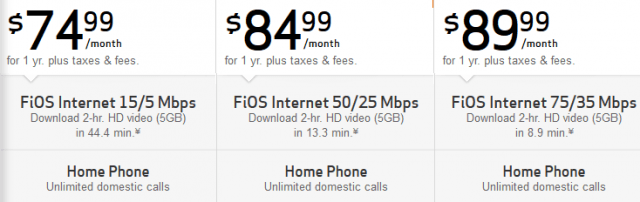
Where FiOS is available in Buffalo, Verizon is offering promotional pricing on its bundled services, including an $84.99 offer including 50/25Mbps Internet with a Verizon landline offering unlimited calling. This is cheaper than Time Warner’s offer with considerably faster upload speeds and no modem fees. In parts of Buffalo, Verizon is authorized to offer broadband and phone service only, although several suburbs have franchise agreements that allow the phone company to also sell television service. A large part of the city and other suburbs are still stuck with Verizon’s copper network, however, which means DSL is the best they can offer.

Time Warner Cable’s new customer promotions, useful when negotiating a customer retention deal, have resumed bundling Standard tier (15/1Mbps service) Internet speeds into most offers. Previously, the company bundled 3Mbps service in many of its promotions. Broadband-only customers can pay as little as $34.99 a month for a year of Internet service at 15/1Mbps speeds, assuming one buys their own cable modem. A double play offer of broadband basic television (around 20 channels, mostly local over-the-air) with 30/5Mbps Internet service is now priced at $94.97 a month after a $5.99 mandatory modem rental fee is included (not optional with this package).

Time Warner Cable executives have repeatedly told investors its higher priced promotions are intentional to increase revenue and profits even if the company loses customers by charging higher prices.
fios offers

Verizon FiOS offers in the Buffalo area.

“I moved here from the New York City area a year ago where we had two cable companies — Cablevision and Verizon FiOS,” noted Stephen O’Brien. “Competition changes everything. Not only were the rates much lower than here, the companies would offer you all kinds of incentives to switch from one to the other. One time we switched and got a free iPod Touch. The argument that the rate increase is needed to cover investment is the biggest red herring of all — Cablevision and FiOS spent many times more on infrastructure, yet their rates were much lower.”

Stop the Cap! recommends Time Warner Cable customers check out our guide to getting the best deal possible from TWC.

[flv width=”640″ height=”380″]http://www.phillipdampier.com/video/WGRZ Buffalo Time Warner Rate Hikes 8-6-13.flv[/flv]

WGRZ in Buffalo reports upstate New York residents are upset about two recently announced broadband rate hikes. Time Warner Cable says it needs the money to keep up its broadband service’s reliability. What alternatives do customers have?  (2 minutes)

Search This Site:

Contributions:

Recent Comments:

Your Account:

Stop the Cap!