Home » Rural Broadband » Recent Articles:

Special Report: One Year Moratorium on Muni-Broadband in North Carolina: “The Crazies Aren’t Gonna Like This”

Senator Hoyle turns his back on consumers and reads from his industry-provided talking points to stop municipal broadband

[Phillip Dampier co-authored this piece.]

North Carolina communities seeking to provide Internet access to their residents would have to wait a year while legislators argue over their terms of entry under a revised bill that swept through the Senate Finance Committee yesterday on a voice vote.

S1209, originally a poison pill bill that would effectively kill municipal broadband projects, was revised into a demand for further study, accompanied by a one-year moratorium for any city contemplating its own broadband project.

That concerns officials in several cities across the state, especially Greensboro, who wants to preserve the option of municipal broadband should Time Warner Cable revisit an Internet Overcharging experiment attempted in 2009 which would have drastically limited broadband usage for its customers.

The bill’s passage with a calling of the “yeas and nays” made it impossible for members of the public to know who voted for and who voted against the compromise measure.  But an accidentally open microphone allowed many to get a real sense of how much one member of the Committee disliked consumers fighting back against telecom special interests pulling all the strings.

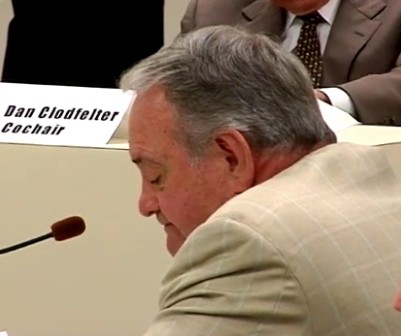
Senator Daniel Clodfelter (D-Mecklenburg) nearly raised a toast to his fellow members during the session praising them for doing the “grown-up” thing and agreeing to his manufactured compromise that phone and cable companies are celebrating as a victory today:

“This is not, I would say to you, a peace treaty.  It is an armistice. And what the bill does is provide an armistice so that the shooting war stops and a conversation will occur among those people who’ve been meeting with each other in those conference rooms for the past week,” Clodfelter said. “Thank you all, because you did the grown-up thing, and I really appreciate it.”

Clodfelter’s seemingly-sincere comments might have gone off better had the audience not heard Clodfelter’s private remarks to Senator Dan Blue (D-Wake) a few minutes earlier, inadvertently captured by a live microphone:

“The — what I call the crazies that circulate around this issue are not gonna like this,” Clodfelter told Blue.

Observed WUNC reporter Laura Leslie: “I’m sure Clodfelter isn’t the first lawmaker to think so, but most of them cover the microphone before they say it out loud.”

The bill’s author, Senator David Hoyle (D-Gaston), who spent the day mangling the words “fiber optic,” condescendingly lectured his colleagues and communities about their opposition to his bill.  Mistakenly called a Republican in the pages of the Greensboro News-Record, Hoyle complained cities don’t belong in the broadband business.  He doesn’t want government competing with private industry, which might explain why the newspaper switched his party affiliation.  But considering the amount of telecom special interest money that has flowed into the retiring senator’s campaign coffers, there may be much more to this than a philosophical debate.

Hoyle has gone all out in the North Carolina media on behalf of his telecom industry benefactors.

Money makes legislators do strange things... like disrespect their constituents with obvious industry-backed protectionist legislation

Delivering a series of eyebrow-raising one-liners, Hoyle is hardly ingratiating himself with cities and towns across the state.  He inferred most city and town leaders were naive, telling ENC Today he expects all of the attention on municipal broadband will only cause more municipalities to get into the business.

“There are a whole lot of cities that can’t wait to jump on the bandwagon — monkey see, monkey do,” Hoyle said, using language that some have since called inappropriate.

Hoyle argues these systems are destined to fail.  Once again he called out the cities of Davidson and Mooresville completing required upgrades to an old Adelphia cable system the community acquired nearly three years ago.

“There’s a couple of cities in this business that they should sure wish the heck they were not into, and that’s Davidson and Mooresville,” Hoyle said.

That came as news to MI-Connection, the municipal provider providing service to the two communities, whose revenues for the quarter that ended March 31st were up 9.4 percent from a year earlier.

Davidson resident and MI-Connection board member John Venzon told the Davidson News he’s worried that the legislation could “unlevel the playing field” for MI-Connection and make it harder to compete.

MI-Connection General Manager Alan Hall also told the News the entire board has concerns about these kinds of bills.

Hoyle and his telecommunications industry friends may wish the communities weren’t in the business, but MI-Connection believes otherwise.

As Stop the Cap! has reported on several occasions, MI-Connection’s challenges have hardly been unique to Davidson and Mooresville.  Time Warner Cable ditched over 125 Adelphia systems it purchased, and the company is still coping with legacy equipment left in place at the former Adelphia system it now runs in Calabasas, California.  The cost of upgrades for the old Adelphia systems kept by both Time Warner Cable and Comcast ran well into the millions.

Another messy misstep for the state senator has been what one could charitably call “stretching the truth.”

Mayor Susan Kluttz, representing the people of Salisbury, N.C., was called a "gentleman" and "he" by an out of touch David Hoyle

“I got a call from a gentleman yesterday, Mayor Kluttz from Salisbury, and I mean he laid me out.  He called me dumb.  I had no idea,” Hoyle complained to other members on the Senate Finance Committee.

One person who was not amused by that story was Salisbury Mayor Susan Kluttz, who was seated directly in front of Hoyle.  She had no idea what Hoyle was talking about.  I later spoke with a representative of the city who told me no one from their staff called Hoyle.  With a mistake like that, maybe that phantom caller was onto something after all.  Listening to Hoyle, the self-appointed expert on municipal fiber projects, refer to them as “fiber opticals,” “fiber opt,” “fiber install and do all the things they’re going to do,” and “totally fiber project any city,” did not inspire confidence.

At the heart of Hoyle’s opposition is the idea that local municipalities should not be involved in the private sector… ever.  In his mind, broadband service is a luxury, and the private marketplace is best equipped to decide who gets it, and who does not.  Hoyle brings no answers to the table for communities bypassed by the duopoly of providers who are increasingly focusing their time, attention, and resources on larger cities where average revenue per customer can be higher than in rural areas.  If the local cable or phone company doesn’t provide the service, that’s just too bad.

Mirroring the attitude of the state’s telecommunications companies, Hoyle believes municipalities or even private providers that seek broadband stimulus money represent unfair competition, even in cases where existing providers refuse to offer service.

That is the ultimate dilemma.  If you believe broadband is not becoming an essential component of most American lives and is simply a nice thing to have, it’s not insane to agree with Hoyle.  But hundreds of thousands of North Carolina residents don’t believe that.  Parents of children in broadband-disadvantaged schools quickly learn their kids fall behind their peers in larger, wired communities.  Businesses will not locate in areas where inadequate broadband exists.  Digital economy entrepreneurs cannot start new businesses without good broadband either.  Even senior citizens, who are among the most resistant to broadband adoption, often complain about the inherent inequity of being forced to rely on dial-up service.

Senator Purcell

Some of the same arguments about disparity of access went on during the early 1900s in rural North Carolina, deprived of electricity and telephone service by private providers.  Once President Roosevelt effectively declared these types of services as essential utilities, where private providers didn’t go, municipalities and co-ops did.  In North Carolina, keeping the brakes on an expansion-minded state government came even before Roosevelt was president, with the passage of the 1929 Umstead Act — a law that prohibits the state from directly competing with private enterprise.

The Umstead Act has been seized on by the telecommunications industry, arguing municipal broadband violates the spirit of the law, even though it never applied to local municipalities.  Besides, the law has been amended since 1929 because, free market theory notwithstanding, free enterprise doesn’t have every answer and cannot meet every need.  Just ask BP.

Only Ayn Rand could appreciate that Hoyle and his allies support an entrenched duopoly that embraces its profitable urban customers while they fight for restraining orders like S1209, blocking efforts by others to deliver service the duopoly won’t provide.  We call that corporate welfare and protectionism.  But some in the state legislature can’t see that because of the blizzard of cash being dropped in front of them by that duopoly, just to leave things entirely in their hands.

Hoyle noted nobody, including himself, liked the final bill.  In Hoyle’s eyes, that adds up to a “good bill.”

Other members on the Committee had different views to share.

Senator William Purcell (D-Anson, Richmond, Scotland, Stanly) is the former mayor of Laurinburg — the same city from the 2005 court victory in BellSouth/AT&T v. Laurinburg, which paved the way for municipal broadband in the state.  He asked pointedly, “What assurances do we have that the private companies are going to provide [service] to smaller areas?”

Senator Queen

Hoyle answered by pulling out his talking points generously provided by the cable and phone companies and delivered a non-answer, finally stating, “we are not going to get broadband to everyone in the state.”  Perhaps Hoyle is foreshadowing his next job after he retires from the Senate — working for the same telecom companies he seems to represent now.

Senator Joe Sam Queen (D-Avery, Haywood, Madison, McDowell, Mitchell, Yancey) delivered the most passionate presentation of the day on behalf of his constituents, among the least likely to have broadband service available to them.  As Hoyle disrespectfully rolled his eyes and winked at the cable industry lobbyists in the audience, Queen blasted the industry’s record of performance in his district, which covers the High Country — the rural Appalachian mountain counties in the western half of the state.

“We don’t have last mile access in the mountains,” Queen told the Committee.  “[My constituents are] frustrated that it’s not getting done by the cable companies, the network companies, whoever’s doing it. They’re just cherry-picking and leaving off so many of our citizens, and that’s just unacceptable.”

Queen noted the private industry that refuses to serve many of his areas also refuses to allow others to provide that service.

“The private sector is not getting it done fast enough,” he added. “We have electricity to everybody, we have water to everybody. We should have Internet to everybody in the 21st century.  In my counties, we are still struggling to make that happen.  Our children don’t have the virtual broadband educational opportunities that they have in the urban areas. Our business owners don’t have the access to markets that our urban citizens have.”

Senator McKissick

One senator had a question about the year-long moratorium.  Senator Floyd B. McKissick, Jr. (D-Durham) asked if no action was taken by the end of the 2011 session, would the moratorium expire automatically?  Although provisions in S1209 do provide for a firm sunset date, Paul Myer from the North Carolina League of Municipalities told me nothing precludes the Senate from quietly extending the moratorium, or removing the sunset provision altogether, effectively making the ban permanent.

Meanwhile, communities contemplating such projects would have to give 15-days written notice to every private provider potentially impacted, providing more than two weeks for a fear-based opposition propaganda campaign.  And we know where they’ll get the money to pay for it, too.

The only good news out of all this:

  • Cities already providing or constructing broadband projects may continue;
  • A Google Fiber city in North Carolina gets a pass;
  • Federal broadband grant recipients may proceed, although many of those grants are going to existing providers anyway;
  • The bill is headed next to the House, where we have a new opportunity to derail it.

Recognizing the spirit of this entire proceeding which left consumer interests out in the cold, no public comments were heard and no recorded vote was taken.

Needless to say, the revised S1209 is only slightly less loathsome than the original, and must be opposed.  But more on that coming shortly.

We couldn’t close this piece without recognizing that when all the talk was over and vote was taken, it was rest and relaxation time for selected senators, brought to you by Electricities who picked up the tab for a fabulous spread of food and drink.  WUNC reporter Laura Leslie wrote about what she called an Irony Supplement.

The S1209 compromise also won the grudging support of Senator David “Business-Friendly” Hoyle (D-Gaston).

After telling Senate Finance that “Somebody, maybe a lot of bodies, needs to stand up for our free enterprise system,” Hoyle went on to knock the state’s biggest public utility co-op:  “If anybody thinks that the experiment with Electricities was a resounding success, I’d like for you to raise your hand.”

No one did.

But after session today, quite a few of the Hons found their way across the street for free food and drinks provided by – wait for it – Electricities.

As one House Republican told me tonight, “If you can’t bash them and then eat their hors d’oeurves, you’re in the wrong business.”

No, sir, I’m not.  But I’m thinking you might be.

Senate Finance Committee deliberations on a revised S1209, a bill to establish a one year moratorium on municipal broadband projects. (June 2, 2010) (34 minutes)
You must remain on this page to hear the clip, or you can download the clip and listen later.

<

p style=”text-align: center;”>

Not All Bad News From North Carolina – A New Bill from Rep. Bill Faison Offers Hope for Caswell County

Caswell County, North Carolina

A new bill from Rep. Bill Faison (D-Orange, Caswell) would offer one North Carolina county the chance to build its own municipally-owned cable and broadband provider to deliver service to places other providers refuse to go.

H2067, “An Act to Allow Caswell County to Provide Internet Services, An Authorized Purpose Under Cable Television,” would authorize Caswell County to build its own municipal broadband system by adding cable television systems to a list of defined public enterprises.  That opens the door to selling bonds to raise private funds for system construction.

Faison told us that a 2005 ruling in the BellSouth (today AT&T) v. Laurinburg case, a state appeals court ruled that communities had the right to build systems to deliver broadband service to their residents.  He told IndyWeek there are many areas in his district and beyond that have been bypassed by cable and DSL service providers, with little hope in sight that many of the residents he represents would ever see anything beyond dial-up.

In making his case for the bill, Faison cited as an example electrical co-ops across the state that brought basic utilities services to under-served towns. “High speed internet is just as important today as electricity was in another era as a basic service,” said Faison, a proponent of municipal broadband.

“We need to supply to every one. Where AT&T will go and provide at a reasonable cost, I am happy to let them do it—but where they won’t go, someone must step up and bring that service to those people,” he added.

Faison

We had a few moments to talk to Rep. Faison about his bill and its timely introduction during the ongoing heated debate over S1209, a poison pill bill that would stop municipal broadband projects in the state.

He told us Caswell County officials appealed to him as their State Legislator to introduce the bill so they could move forward on their project, and H2067 concisely delivers within the parameters of the 2005 court case.

It will be interesting to watch progress on Faison’s H2067 in contrast to the anti-consumer S1209, introduced by Sen. David Hoyle (D-Gaston).  The only downside to Faison’s legislation is that it is limited to Caswell County.  But Faison also shows the way forward for other legislators to introduce similar bills to authorize projects in the areas of the state they represent.

For Caswell County residents, it means the potential to finally get quality broadband service after years of broken promises from incumbent providers.  Comcast of Danville, Virginia provides limited service, mostly in parts of Yanceyville, the county seat.  AT&T offers limited DSL service, but not to several areas of the county.  Those unlucky enough to be bypassed still rely mostly on dial-up.

Rep. Faison deserves your support for being a legislator that truly represents his constituents, and his actions illustrate he thinks of them first.  Please take a moment to write or call to thank him for his vision on this important issue and his support for getting the job done.

Rep. Bill Faison — [email protected] — (919) 715-3019

[flv]http://www.phillipdampier.com/video/Caswell County.flv[/flv]

Here is a senior citizen and a librarian in Caswell County, trying to live life without acceptable broadband.  These are real people with real stories to share. Broadband is not a luxury for these residents.  (4 minutes)

Wireless Industry Pats Itself on Back for Heavy Competition And Innovation, But Facts Say Otherwise

Phillip Dampier June 1, 2010 Community Networks, Competition, Editorial & Site News, Public Policy & Gov't, Rural Broadband, Video, Wireless Broadband Comments Off on Wireless Industry Pats Itself on Back for Heavy Competition And Innovation, But Facts Say Otherwise

The CTIA is the wireless industry's lobbying group

While the phone and cable companies attempt to fight off broadband reclassification at the FCC, the wireless industry has been pulling its own weight in an effort to convince legislators everything is wonderful in wireless, and no consumer protection regulations are necessary.

The CTIA, the wireless lobbying group, has been blogging on overdrive lately, trying to sell the idea Americans are already soaking in broadband options and competition that keeps prices low and innovation high.  Why regulate an industry that isn’t broken?

If only it were true.

While Americans in larger communities do have choices for broadband, for most it’s a matter of picking the phone or cable company for service.  That’s called a duopoly.  In the wireless marketplace, it’s hardly much better.  The nation’s largest wireless phone companies, AT&T and Verizon, have essentially colluded with near-identical pricing and service plan requirements that demand customers add mandatory “options” like data plan add-ons that raise wireless bills higher than ever.

The smaller providers eke out an existence mildly competing over pricing, but with their inherent coverage limitations or history of providing poor customer service, many consumers won’t consider doing business with them.  Relying on most wireless providers for broadband threatens the kind of huge bills you see on TV news reports, as carriers limit consumption to 5GB per month, and most charge enormous overlimit fees to customers exceeding the limit.

The Federal Communications Commission recently found one in every six Americans suffer “bill shock” syndrome — that all-too-familiar panicky feeling when you open a cell phone bill and discover an extra zero on the end of the dollar amount due.  More than a third of people who experienced bill shock said their bills jumped by at least $50 — around 23 percent said the increase was $100 or more.

Settles

That amounts to more than 30 million Americans, but the CTIA’s “see no evil, hear no evil” blog carries on claiming life is good for wireless consumers.  Besides, writes Steve Largent, president of the CTIA, consumers who took their complaints to the Better Business Bureau had them resolved 97.4 percent of the time.

Of course, that begs the question why consumers had to approach the BBB about their poor service experience in the first place.

I’m not the only one asking questions.  Craig Settles, an industry analyst, co-administrator of Communities United for Broadband and author of the report “Fighting the Next Good Fight: Bringing True Broadband to Your Community,” is also pondering the industry campaign to block broadband reform.

Settles penned a piece in today’s Roll Call exposing the fallacies from the industry’s PR machine:

The state of broadband — for consumers, businesses and nonprofits — isn’t the rosy picture the industry powerhouses attempt to paint. Ignoring this reality can lead to bad policy decisions and bad legislation.

[…]

Most states may technically have 60 to 80 Internet access providers. However, in practically every state, the combined statewide market share of all but the top five or six providers might total 5 percent, if you’re lucky. In at least half of the states, data show the combined market share of the top two providers ranges from 70 percent up to 95 percent. That represents near or actual duopolies, most often with one wireless and one cable provider as the undynamic duo.

Life at the local level, which is where your true subscriber options exist, further challenges the industry’s claim that people have choices. If you count “having choices” as living in an area where several companies advertise broadband service, or consider dial-up speed as broadband, OK.

But go door to door in rural counties and small towns. The reality you often find is one major carrier providing fair to poor service to some and no service to the rest, plus some small local providers with 2 percent or 3 percent market share struggling to provide decent service in the face of endless efforts to smite them from the planet. If you’re in one of the few states with four or five providers that each have statewide market share of 8 percent to 15 percent, it’s likely each provider is concentrated in a portion of the state, creating a local reality that’s worse than state statistics.

Settles notes that claims of “billions invested” only invites more questions about what carriers are doing with all that money.  Settles questions whether its wise to brag about spending $20 billion on infrastructure costs when municipal broadband projects in states like North Carolina, with IT staffs of fewer than 12, have built superior networks delivering 10 times the speed of its competitors.

The CTIA loves to tout the innovation wireless providers bring to customers, but in many cases they are claiming credit (and often getting a cut in the action) for someone else’s innovation, especially from the third-party apps market.

Too often the real innovations in wireless broadband have often come in spite of carriers that have sought to block, control, or “manage” someone else’s vision.

[flv]http://www.phillipdampier.com/video/Freedom CTIA Ad Spot 5-2010.flv[/flv]

Watch as the CTIA wireless lobby tries to sell Americans on wireless innovation, much of which didn’t come from wireless companies at all.  (1 minute)

Frontier Gets FCC Approval for Its Verizon Takeover; You Get 5GB Usage Allowances, 3Mbps DSL and No Fiber

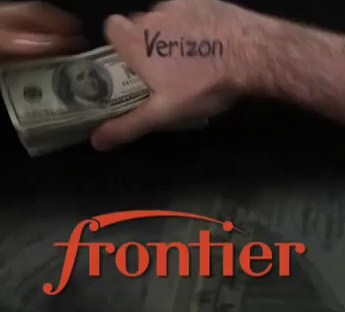
Take the money and run

The Federal Communications Commission’s approval of Frontier’s takeover of 4.8 million Verizon landline customers in 14 states comes a year after the company announced the deal.  Frontier joins three other independent phone companies — FairPoint Communications, Windstream Communications, and CenturyLink zealously trying to grow their companies with additional mergers and acquisitions to avoid being swallowed up themselves.

What is common among all four companies is they rely heavily on dividend payouts to keep their stock price as high as possible.  That was a formula for disaster for FairPoint, the first of the four to end up in bankruptcy after a similar deal with Verizon in northern New England caused the company to falter.  Service and billing deteriorated, customers fled, and promises for better broadband were broken.  Now Frontier is following in FairPoint’s footsteps with more than 4.8 million new customers Frontier hopes they can swallow.

The FCC’s statement approving the merger reads like a press release for all involved, and delighted FCC Chairman Genachowski, who called these meager requirements “robust”:

Coming one week after the final state approval for the transaction, the FCC’s Order holds the applicants, Verizon and Frontier, to enforceable voluntary commitments, including:

  • Extend faster broadband to more Americans: Frontier will significantly increase broadband deployment for the lines involved in this transaction, only 62 percent of which are broadband-capable today. Specifically, Frontier will deploy broadband with actual speeds of at least 3 Mbps downstream to at least 85 percent of transferred lines by the end of 2013, and actual speeds of at least 4 Mbps downstream to at least 85 percent of the transferred lines by the end of 2015, with all new broadband deployment offering actual speeds of at least 1 Mbps upstream.

Frontier's Fast One: 3 Mbps DSL Service with a 5GB Monthly Usage Allowance

Frontier’s broadband commitment gives the company a full five years to meet the bare minimum speed considered to constitute broadband in the National Broadband Plan.  One hopes Frontier doesn’t break into a sweat offering a piddly 3 Mbps service to homes using yesterday’s DSL service until then.  While Verizon’s rural castoffs get stuck eventually with 4 Mbps DSL, many of the company’s remaining customers are enjoying 50Mbps service over an all fiber network.  The FCC is accepting an urban-rural divide for broadband which will benefit the phone companies while leaving rural customers in the dirt.

  • Deploy fiber to libraries, hospitals, and other anchor institutions: Frontier will launch an anchor institution initiative to deploy fiber to libraries, hospitals, and government buildings, particularly in unserved and underserved communities.

Fiber for these locations sure, but no fiber for you or I.  Frontier, like most other telecom companies, loves to promote the benefits of fiber without actually deploying it to homes.

  • Promote competition: Frontier and Verizon have made a series of commitments to protect wholesale customers, including honoring all obligations under Verizon’s current wholesale arrangements that are in effect at closing.

Since wholesale customers often depend on the same network other customers do, if a company doesn’t deliver robust broadband into a state like West Virginia, there isn’t a robust service to sell to those wholesalers.

  • Improve data quality and collection: Frontier will make available to the Commission data on its broadband deployment progress at an unprecedented level of detail to enable effective monitoring of Frontier’s compliance with its commitments.

The Commission concluded that the commitments that applicants have offered, coupled with monitoring and enforcement by the Commission, will minimize the risks of harm and ensure that this transaction is in the public interest.

Phillip "Living on the Frontier" Dampier

Considering how weakly the FCC is committing itself to protecting rural customers from being dumped into the broadband backwater Frontier has on offer (complete with the 5GB monthly usage allowance), does collecting statistics help when things go sour?  Regulators collected statistics in New England when FairPoint failed, but that didn’t get service levels back until Maine, New Hampshire, and Vermont threatened to toss FairPoint out.  Now the company is in bankruptcy and regulators are negotiating which of the promises FairPoint made can be let go ‘for the sake of the company.’

That’s why it’s so ironic to read editorials that proclaim the FCC is on some sort of power grab when they seek to restore what meager authority they exercised over broadband before a DC Court effectively excluded broadband oversight from their portfolio.

It will be a good day when federal agencies like the FCC start worrying first and foremost about consumers instead of how to make a parade of overpriced mergers and acquisitions succeed for the companies involved.

[flv width=”480″ height=”380″]http://www.phillipdampier.com/video/WANE Ft Wayne Verizon hanging up on local landlines 5-24-10.flv[/flv]

WANE-TV in Fort Wayne warns viewers their landline company is about to change asVerizon vacates the area by July 1st.  (1 minute)

[flv width=”480″ height=”380″]http://www.phillipdampier.com/video/CWA Verizon Dont Take the Money and Run in WV.flv[/flv]

Too late.  The Communications Workers of America ran this ad spot asking the West Virginia governor to intervene and stop the sale.  (1 minute)

Fairy Tale: O2’s Nobbling Broadband Niggles & Narks Forgets to Mention Internet Overcharging Sharks

Phillip Dampier May 26, 2010 Data Caps, O2 (UK), Rural Broadband, Video 2 Comments

Pot?  Meet Kettle!

In one of the biggest ironies thus far this year, a British broadband provider trying to one-up the competition has started running ads with Dr. Seuss-like characters that represent marketing exaggerations, traps, and bad customer service, all while forgetting to disclose it engages in some tricks of its own.

O2’s Niggles & Narks campaign features animated creatures that represent where broadband has gone all-wrong:

[flv width=”640″ height=”380″]http://www.phillipdampier.com/video/O2 Niggles and Narks Ad 5-2010.flv[/flv]

Once upon a time, when broadband was made, we browsed and surfed and chatted — everybody played.

But for some, the magic faded.  Some things started to go wrong.

Without any warning, the niggles and nobs came along.

With the No Support-a-Saurus — spouting twaddle was his game.  His impossible instructions would slowly knot your brain.

The Crafty-Cost Nark took pleasure in his work, delivering line rental bills that drove us all berserk.

And with the Mystery-Speed Mook, you never really know. You thought you’d get mega-fast but got stuck with dead slow.

But this is where we draw the line and try to right what’s wrong.  Wouldn’t broadband be a better place, with narks and niggles gone?

But accusing the others of broadband narks and niggles -you- see, without confessing your own is little more than hypocrisy.

In a land of broadband O2 promises is not a dream, it brings to the table its own Internet Overcharging scheme.

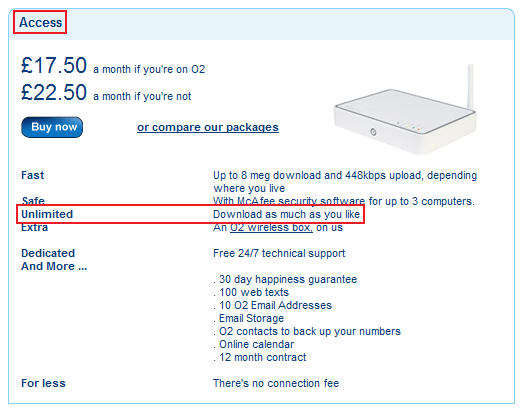
No nobble or niggle could ever believe, selling unlimited broadband -that wasn’t- was something they could achieve.

But O2 managed — somehow, we don’t know, to define “unlimited” as 10GB per month — exceeding it brings woe.

Maybe it's a typo that should have read, "download as much as WE like."

O2 sells its broadband packages across the United Kingdom, either bundled under a BTWholesale-based package or unbundled direct from O2 or BeBroadband.  Only the BTWholesale accounts, common in rural areas where O2 doesn’t have its own equipment installed in the exchange offices, are impacted by the limit on unlimited.  BT apparently charges them some form of consumption billing, and they aren’t willing to eat the costs.

Starting in March, many customers started receiving letters stating they were using the service too much, and if they didn’t back off, they’d be disconnected.  One customer received a disconnect warning after using 40.1GB, primarily from watching BBC’s iPlayer, which delivers on demand television programming.

What represented “too much” for an “unlimited service?”

“Most O2 customers use less than 10GB a month. Aim for that and you’ll be okay,” says one of O2’s support pages on the topic.

Outraged consumers arguing that “unlimited” should mean “unlimited” and didn’t comply were promptly disconnected.

With the introduction of O2’s new high-priced Niggles & Narks advertising campaign, the hilarity ensued as customers began calling out O2’s hypocrisy, leading to clarifications from O2 that were anything but:

As some of you have been discussing, we’ve started to disconnect some of the very highest usage customers whose download patterns have detrimentally affected other customers’ experience, even after we have requested them to reduce their usage and explained the effect it’s having. We will continue this in order to improve the experience for the majority of the customers on the service.

We are also making the service run more efficiently by updating the hardware and software that runs the Access service. This will improve the prioritization of the real-time activity, such as streaming, over less time-sensitive activities such as P2P. — O2 Statement from March 26th 2010

O2's "Unlimited Broadband" Price Chart

Then there is this fine print on the question of “unlimited service” that only a credit card company or bank could love (the underlining is ours):

How much should I cut my broadband use?

Most O2 customers use less than 10GB a month. Aim for that and you’ll be okay.

Your product is unlimited, so why are you telling me to use less?

There aren’t any usage limits on any of our O2 Home Broadband packages. That means you can download and upload as much as you like each month, within reason.

Our network’s been designed to cope with people downloading large files (like music or films) and watching video online. But if you’re using the service excessively – like continually downloading large files at peak times – then we do reserve the right to warn you to lower your usage. In exceptional circumstances, we can even terminate your account.

This is because excessive use by a few people can reduce the speed that other customers in the same area can get. We just want to provide everyone with an excellent level of service.

Then company officials unofficially increased the limit to 40GB per month, as this note on an official company forum disclosed:

We’re contacting less than 10% of our heaviest users at the moment and you fell into this top tier. The majority use less than 10GB and at present if you use less than 40GB, you wouldn’t hear from us.”

This isn’t the first time O2 has confused its customers.  ThinkBroadband reminds us of 2007’s mess over the same issue:

O2 have never been good at defining the term ‘unlimited’ as can be seen in 2007 when they had three different definitions for the word. Back then they did recognize that customers were confused by the term and the marketing director Sally Cowdry was quoted as saying “customer feedback has been that if we say unlimited, it should be unlimited.” We wonder why two and half years on, O2 still have not ‘nobbled this broadband niggle.’

Unfortunately for O2 customers, the company has not righted any broadband wrongs.  They’ve added to them.  O2 has an chronic problem with their own Niggles and Narks.  Perhaps British regulators can do a better job exterminating them.

Search This Site:

Contributions:

Recent Comments:

Your Account:

Stop the Cap!