Home » Issues » Recent Articles:

Supreme Court Helps Verizon Wireless Thumb Nose at Customers Upset Over Unilateral Cell Fees

Thanks to a divided 5-4 decision by the U.S. Supreme Court, customers trying to seek relief from unilateral fees and surcharges suddenly showing up on their Verizon cell phone bills will have to pursue individual arbitration claims with the cell phone company instead of joining forces in a class arbitration claim.

That Supreme Court case, AT&T Mobility v. Concepcion, is turning out to benefit Verizon Wireless as much as AT&T, because the Supreme Court found merit in contracts obligating customers to seek individual arbitration to settle differences while forbidding customers from pursuing organized legal action.

Now the 3rd U.S. Circuit Court of Appeals in Philadelphia has reversed an earlier ruling, reinstating a 2008 decision by U.S. District Judge Freda Wolfson that delivered victory to Verizon Wireless.

At issue was Verizon’s decision in October 2005 to unilaterally impose an “administrative fee” of $0.40 and/or $0.70, as part of the monthly charges for each Verizon cell phone line.  Customers upset with the new fees felt they violated the principle that, as part of their two year contracts, Verizon would deliver a fixed-price service.  The cell phone company has since implemented a variety of fees and surcharges on customers that are pocketed by Verizon, regardless of the contract price.

All Verizon Wireless customers are obligated by contract to challenge any terms and conditions they disagree with through an arbitrator of Verizon’s choosing, at a place also chosen by the company.  That means Verizon could place an arbitrator on retention in a city potentially thousands of miles away, and demand the customer make their case there, to an arbitrator whose livelihood ultimately depends on retainer fees paid by the company.  Few consumers would make such a journey to protest a fee that amounts to less than $10 a year per line.

Lawyers Keith Litman and Robert Wachtel, representing Verizon customers, decided to try a different approach — a class action arbitration.  The two attorneys would represent potentially millions of impacted customers themselves, making any travel cost concerns incidental, and providing a seasoned challenge before arbitrators, who would also hear counter-arguments from Verizon’s own legal team.

Verizon’s attorneys argued such class action arbitration was specifically forbidden in the company’s contract with customers.  Normally, a judge might decide at that point a customer agreeing to those terms and conditions was effectively up the creek.  But a series of legal challenges in circuit courts opened the door to invalidating those terms.

Litman and Wachtel argued that because the New Jersey Supreme Court, in Muhammad v. County Bank of Rehoboth Beach, Del. (2006), has held that an arbitration provision in a consumer contract that precludes class arbitration of low-value claims is unconscionable under New Jersey law, similarly, the arbitration provision in Verizon’s contract is also unenforceable.

Unfortunately for the two attorneys representing consumers, the decision by the U.S. Supreme Court effectively overrode that case, leaving Verizon on top with Judge Wolfson’s 2008 decision.

Wolfson

Wolfson’s written ruling on the case seemed unimpressed with claims that Verizon’s fees were unconscionable:

In this case, Plaintiffs are customers who chose Verizon as their wireless provider at least four years ago and continue to use Verizon today. They signed the customer Agreement with the arbitration clause and agreed to subsequent terms of service as added by Verizon. Plaintiffs do not allege that they did not understand the Agreement that they voluntarily entered into nor do they allege fraud or misrepresentation. The parties agreed “to settle [their] disputes . . . only by arbitration,” and the “agreement doesn’t permit class arbitration.” Therefore, [federal law] requires this Court to uphold the arbitration provision within Plaintiffs’ service Agreement.

But Judge Wolfson did recognize the effective impact of her decision:

“The Court recognizes the many hardships visited upon plaintiffs, such as in this case, based upon this ruling. First, it creates the opportunity for a different result depending on whether the case is brought in federal or state court. Second, it is also clear that compelling individual arbitration in this case will be tantamount to ending the Plaintiffs’ pursuit of their claims, as there is very little possibility that these Plaintiffs or any other plaintiff will pursue individual arbitration for claims that amount only to several dollars in damages. While this outcome is harsh, this Court is bound by Third Circuit precedent.”

Lately, Verizon Wireless customers have been seeking other forms of relief when Verizon unilaterally changes or implements new fees or surcharges.  Many are invoking the “materially adverse” clause found in Verizon’s terms and conditions, which theoretically allows customers to exit their contracts penalty-free if they do not agree to the changes Verizon is imposing on customers.  Verizon Wireless appears to be increasingly aggressive in fighting these claims, too, refusing to allow customers to leave without stiff early termination fees.  That may become the subject of another lawsuit at some point in the future.

WBBM Radio: Give Us 22 Minutes, We’ll Read You AT&T Press Releases As “News”

Phillip Dampier August 25, 2011 AT&T, Audio, Consumer News, Editorial & Site News, T-Mobile, Wireless Broadband Comments Off on WBBM Radio: Give Us 22 Minutes, We’ll Read You AT&T Press Releases As “News”

Small town media, always eager for an easy story to tell, is notorious for rewriting industry press releases and calling it news, but when a major “news radio” station in Chicago does it, it’s simply sloppy and embarrassing.

WBBM Radio decided AT&T’s merger with T-Mobile, announced several months ago, has suddenly become newsworthy.  Why?  Because AT&T has been sending out press releases touting the merger’s benefits for Illinois customers.

News that a merger with America’s fourth largest wireless carrier would suddenly bring widespread 4G coverage to communities large and small has become catnip for lazy reporters who never bother to research the claims.  Even AT&T’s attorneys are on a different page from AT&T’s public relations department.

But the extent of WBBM’s investigation by reporter Alex Degman began and ended with a proposed AT&T coverage map:

A coverage map of the proposed network coverage shows most of the state would indeed be covered, minus large sections of the Shawnee National Forest in southeastern Illinois and scattered pockets in west central Illinois. The merger is expected to be approved in January.

Degman’s report was little more than a disguised advertisement for AT&T, completely reliant on the company’s claims and ignorant of the fact AT&T would bring 4G service to anyone in WBBM’s local coverage area with or without T-Mobile.

Apparently there was no time for merger opponents.

WBBM Reporter Alex Degman “covers” the impact of the merger between AT&T and T-Mobile on Illinois. August 22, 2011. (1 minute)
You must remain on this page to hear the clip, or you can download the clip and listen later.

Listener Seth Weintraub was not impressed.

“Are you kidding?” Weintraub wrote. “Is AT&T writing your copy now?”

“How about reporting on the FCC document filings instead of unsubstantiated claims made by the company,” writes listener Patrick Dailey. “This is what is wrong with media today.”

More Tricks and Traps from Usage-Based Billing: Pay A Penalty for Not Using Enough Service

Phillip Dampier August 25, 2011 Consumer News, Data Caps, Video 3 Comments

The telecommunications industry better not take a tip from some Texas power companies that have found new ways to increase profits: charging customers a penalty when they do not use enough electricity during the month.  Imagine if broadband providers with Internet Overcharging schemes followed suit.

After Texas deregulated electric utilities, an increasing number of companies are using their freedom to find new, creative ways to tack on additional fees and surcharges that might normally be considered the cost of doing business.

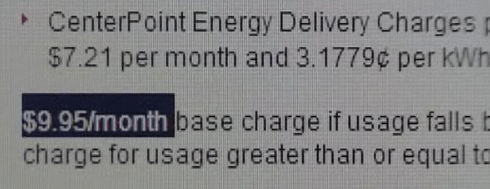
CenterPoint Energy, a Fortune 500 corporation providing service in Arkansas, Louisiana, Minnesota, Mississippi, Oklahoma, and Texas would like to introduce you to its Minimum Usage Penalty — a $9.95 fee applied to Texans caught using too little electricity from the company.

While most utility companies set a basic customer charge applicable to everyone, which covers the cost of your electric meter, power lines and their upkeep, billing, and other administrative expenses, many Texas power companies are billing consumers a monthly fee for conserving too much electricity.

The concept flies in the face of common sense, especially as the state contends with dozens of 100+ degree summer days and pleas from utilities for customers to cut back on energy use.  But if some do, especially low-consumption customers in apartments or those who maintain part-time residences, they’ll pay a penalty for doing so.

The Texas Electricity Ratings Blog found more than a dozen power companies with similar policies, with penalties as high as $12.96 for using less than 1,000 kWh per month:

Ambit Energy: $9.99 for less than 1000 kWh per month
Amigo Energy: Depending on the plan it is $9.95 of $6.95 for less than 1000 kWh per month
Bounce Energy: $4.95 for less than 1000 kWh per month for almost all of their plans, except intro plans are $6.96 per month for less than 1000 kWh.
Champion Energy: $4.95 for less than 500 kWh per month
Cirro Energy: $5.25 for less than 1000 kWh per month
Direct Energy: I couldn’t find a Monthly Fee in their Terms of Service or EFLs
Dynowatt: $6.95 for less than 1000 kWh per month
First Choice Power: $5 for less than 650 kWh per month, plus a $4.95 base charge
GEXA Energy: Seems to simply use a sliding rate per plan for different usage w/o a minimum charge
Green Mountain Energy: Didn’t seem to see any minimum usage charge in the EFL or Terms of Service
Mega Energy: $12.96 for less than 1000 kWh per month
MX Energy: Seems to simply use a sliding rate per plan for different usage w/o minimum charge
Reliant Energy: $9.95 for less than 800 kWh per month
Southwest Power & Light: I didn’t see minimum usage but they had a $7.95 monthly meter fee.
Spark Energy: $8.99 for less than 1000 kWh per month
StarTex Power: $4.99 for less than 500 kWh per month
Tara Energy: $6.95 for less than 500 kWh per month
Texas Power: $10.00 for less than 1000 kWh per month
TXU Energy: TXU uses a base $4.95 charge and sliding rates for less or greater than 1000 kWh, per plan.

[flv width=”600″ height=”358″]http://www.phillipdampier.com/video/KTRK Houston Higher Bills for Not Using Enough 7-11.flv[/flv]

KTRK in Houston provides surprising information about Texas utility usage-based-billing rates — power companies will charge you a penalty for not consuming enough electricity.  Better hope broadband providers angling for UBB don’t catch on.  (3 minutes)

Time Warner Cable Introduces SignatureHome Premium View: Pay More, Get Premium Channels

Phillip Dampier August 25, 2011 Broadband Speed, Competition, Consumer News, Video 2 Comments

When Time Warner Cable introduced its SignatureHome service, the company claimed it wanted to deliver a comprehensive experience to its most premium-customers.  But oddly, the best broadband speeds, phone service, and digital cable TV lineup from the cable company didn’t include any premium movie channels.

“I was ready to sign up for SignatureHome, but I assumed it included major premium channels, and it didn’t,” says Stop the Cap! reader Liam in Los Angeles.  “I thought it would be a real money-saver but I would rather have the premium channels than their phone service, which I don’t actually use as I depend on my cellphone.”

Scott elected for a cheaper promotional bundle foregoing phone service and the fastest Internet speeds, choosing to stick with Road Runner Turbo service.

“Powerboost on their Turbo product is more than enough for me and I don’t need faster upload speed — if SignatureHome included the premiums I would have taken it,” he says.

Now Time Warner has introduced an addition to their super-deluxe package — SignatureHome Premium View, which bundles HBO, Showtime, Cinemax, The Movie Channel and Moviepass with everything else on offer for $30 more a month — $229.99.  The package excludes Starz!, a premium movie channel Time Warner has barely promoted over the years.

With many markets increasing prices to as high as $15 for channels like HBO, getting five premium networks for just under $30 isn’t a bad deal, assuming you watch them and benefit from SignatureHome‘s other features.

“When my promotion expires, I’ll consider this new option,” Scott says.  “Yes, I realize $230 for cable service should really be an outrage, but the way the company is pricing services these days, the more you bundle, the less you ultimately pay compared to trying to build your own package of services.”

That may be exactly the point.  For customers who rely on Time Warner for phone, broadband, and cable-TV, SignatureHome can be a reasonable value if you crave the company’s highest 50/5Mbps broadband speeds.  Building a comparable bundle on your own is much more expensive.  Now the same is true for premium movie channels, which run between $11-15 a month each a-la-carte.

[flv width=”534″ height=”320″]http://www.phillipdampier.com/video/NY1 Signature Home Arrives 12-9-10.mp4[/flv]

NY1, Time Warner Cable’s 24 hour news channel in New York City, talked about the introduction of SignatureHome last December.  (2 minutes)

Groups Sue AT&T Over San Francisco U-verse Cabinets: Environmental Review Demanded

Phillip Dampier August 25, 2011 AT&T, Competition, Consumer News, Public Policy & Gov't, Video 1 Comment

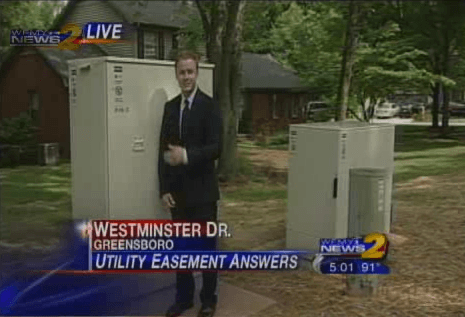
Some proponents for AT&T U-verse suggest people will quickly get used to AT&T's metal cabinets.

A coalition of neighborhoods opposed to the installation of more than 700 4-foot tall metal cabinets across the city of San Francisco have filed suit against AT&T in Superior Court demanding the city follow its own environmental codes and conduct an environmental impact assessment.

The suit comes in response to last month’s close 6-5 vote by the Board of Supervisors permitting AT&T to install up to 726 boxes on the public-right-of-way — typically street corners and sidewalks — to support expansion of its U-verse television, broadband, and phone service.

San Francisco Beautiful, San Francisco Tomorrow, the Potrero Boosters Neighborhood Association, the Dogpatch Neighborhood Association, and the Duboce Triangle Neighborhood Association are all parties to the lawsuit filed Wednesday, which calls the boxes graffiti targets, a safety problem for traffic and pedestrians, and just plain ugly.

Milo Hanke, past president of San Francisco Beautiful, accuses the city of ignoring its own rules to give a green light to AT&T.

“We really don’t want to sue, but we are left with no choice when the city refuses to uphold its own environment codes and is about to give away our sidewalks for the benefit of a private company without objective review,” Hanke told the San Francisco Chronicle.

Long time observers of city politics are frankly surprised AT&T won permission for the controversial boxes.

“It wasn’t that long ago that something like this would have been stopped dead in its tracks in [one] environmental review [after another],” said KCBS-TV reporter Phil Matier.  “But this year, whether it’s a change in the tone for business or for jobs it actually got the six votes needed, and that is going to be interesting as this plays out in an election year in San Francisco.”

Lane Kasselman, an AT&T spokesman countered: “This is about choice and competition for San Francisco residents. It’s about new, better technology that enhances peoples’ lives. AT&T thanks the San Francisco Board of Supervisors for supporting the deployment of U-verse throughout San Francisco. We’ve already started construction and are working as quickly as possible to bring next generation IP network services to every block and household that wants it.”

But Hanke thinks the city has gone too far for the benefit of AT&T at the expense of local residents.

“This is a private enterprise with a benefit to private parties,” Hanke told KCBS.  “Why should the public be subsidizing a Dallas-based corporation, and having to look at these ugly boxes in the process.”

Sean Elsbernd, who serves on San Francisco’s Board of Supervisors personally thinks the boxes are a great idea, suggesting Comcast needs competition.

“I have a suspicion that four or five months after they are in, people aren’t going to notice them anymore,” Elsebernd said.

[flv width=”640″ height=”380″]http://www.phillipdampier.com/video/KCBS San Francisco Groups Sue ATT 8-24-11.mp4[/flv]

KCBS in San Francisco covers the continuing controversy over AT&T’s 4-foot tall utility boxes and the lawsuit designed to stop or delay their installation.  (3 minutes)

[flv]http://www.phillipdampier.com/video/KBAK Bakersfield Homeowner fights utility project in her front yard 5-27-10.flv[/flv]

KBAK in Bakersfield shows what happened when AT&T brought their lawn refrigerator-sized boxes to that city in the spring of 2010 — one woman woke up and found AT&T crews tearing up her yard, without any notice, as part of a major construction project.  (3 minutes)

Search This Site:

Contributions:

Recent Comments:

Your Account:

Stop the Cap!