Home » Issues » Recent Articles:

Shaw Uses DTV Conversion to Sneak Through Its Own Digital Conversion Rate Hike

Phillip Dampier September 7, 2011 Broadband Speed, Consumer News, Shaw, Video Comments Off on Shaw Uses DTV Conversion to Sneak Through Its Own Digital Conversion Rate Hike

Canada’s transition to digital television was supposed to be a non-event for cable and satellite customers, because those providers will continue to service analog televisions for sometime to come.  But Shaw Communications found a way to squeeze a few more dollars out of some of their subscribers anyway.

While Canadian broadcasters were discontinuing analog over-the-air television, many Shaw Cable service areas were also dumping an increasing number of analog channels in favor of digital.  In Kamloops, B.C., Cheryl Whiting discovered that conversion was going to cost her plenty.  Although Shaw provides one digital set top box for free, each additional box rents for $2.95 per month, and Whiting will need four of them if she wants to continue watching cable stations above channel 13 throughout her home.

“I may as well sign my paycheque over to them,” Whiting told The Daily News.

Shaw’s ongoing “digital upgrade” is clearing away much of the analog cable dial to make room for additional digital television signals and faster broadband, but that transition comes at a price to customers who now need a set top box on most of their televisions.

Many customers were upgraded during the month of August, with most of the rest scheduled for conversion during September.

[flv width=”540″ height=”416″]http://www.phillipdampier.com/video/Shaw Digital Network Upgrade – Analog Customers.flv[/flv]

Shaw tells customers it is moving all of their cable channels above “broadcast basic” to a digital platform, requiring customers to place digital set top boxes on all of their televisions.  (1 minute)

Netflix Restores Concurrent Video Streams: Now Back to Two Per Customer

Phillip Dampier September 7, 2011 Consumer News, Editorial & Site News, Online Video 6 Comments

In what Netflix is characterizing as a technical fault, those who experienced a limit of one-stream-per-“Unlimited Streaming”-Account can now watch at least two streams at the same time once again.

Stop the Cap! broke the story on Netflix’s streaming crash diet on Labor Day after being contacted by several readers reporting the apparent new limitations.  Stop the Cap! confirmed them ourselves several times over the past three days, and so did Mashable‘s Ben Parr, who ran into the same error message we did after trying to stream multiple movies at the same time (although he had no trouble watching one movie and one television show concurrently.)

Netflix’s spokesman Steve Swasey called it a big misunderstanding this morning, telling us “no Netflix member is limited to less than two concurrent streams. A few Netflix members have heard differently from us, which is an error that we are correcting.”

Perhaps, but the errors continued straight through until early this afternoon, when we were finally able to confirm the launch of two concurrent streams without an error message.

Netflix has always maintained streaming limitations in their terms of service and in their Frequently Asked Questions.  The company, to this day, still proclaims “you may watch [Netflix streaming on] only one device at a time” if you are a stream-only customer.  Their terms of service emphasize this point in all-capital letters:

YOU WILL BE ALLOWED TO INSTANTLY WATCH SIMULTANEOUSLY ON ONLY ONE SUCH DEVICE AT ANY GIVEN TIME. For certain membership plans in the United States, you may instantly watch simultaneously on more than one Netflix ready device within your household. Click here to view the number of devices on which you may simultaneously view movies & TV shows that are associated with your plan. The number of devices and concurrent streams may change without notice to you. For certain limited membership plans in the United States, your available Netflix ready device may be limited to personal computers.
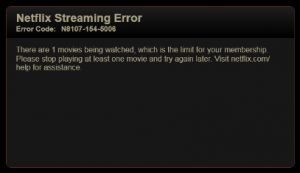
While those clearly are the policies of Netflix, the reality has been customers could easily stream two or more concurrent shows over their Netflix streaming account from different devices without provoking an error message.  But that changed this past weekend, when we began to receive news tips from frustrated customers.

Some consumers never realized they could watch multiple streams at the same time, and were unconcerned with Netflix potentially limiting this feature.  For them, it was tantamount to abusing their Netflix account.  It is a fact some customers have shared their accounts with friends and family members, something that streaming restrictions would go a long way to discourage.  But there are legitimate uses as well, especially in large families with different viewing habits.

We feel it’s important for Netflix to convey exactly what their policy is regarding concurrent video streaming.  If Steve Swasey wants customers to feel assured they can watch two streams concurrently, their FAQ and terms of service should be updated to reflect that.  It’s clear Netflix reserves the right to change the number of devices and concurrent streams without notice, something our readers obviously feel very strongly about.

Whether this was truly a technical fault or a trial balloon that came crashing down under negative customer reaction, the message is clear: most customers are very glad to have concurrent streaming back, and hope it remains a part of the Netflix experience.


Carol “I Oppose Government Involvement in Broadband” Bartz Out at Yahoo!: Fired-by-Phone

Bartz

The CEO of the Yahoo! has been shown the door, but unlike many recently-unemployed workers who get the bad news during an exit interview, Carol Bartz learned she was out in a humiliating phone call from the board of directors.

That left Bartz telling employees she’d been fired in an internal memo sent from her iPad.

Investors were happy to see the back of Bartz, sending Yahoo! shares higher on the news.  Bartz faced a growing number of critics in the past few years, almost immediately after arriving as CEO in early 2009.  Much like Yahoo! itself, her critics accused her of being out of touch with Internet culture and the realities of today’s high-tech businesses.

Bartz was no friend of coordinating expanded and improved broadband projects through the government.  She opposed the National Broadband Plan and Net Neutrality policies, dismissing both as government interference.  That put her in direct opposition to Google, which has spent millions in the public policy arena to influence expanded broadband in the United States.

Despite the lackluster results Yahoo! managed under her leadership, Bartz remained well-compensated, earning $60 million over the past two years.

Yahoo! has remained a challenged endeavor as a first generation Internet superstar long-faded after the dot.com crash in 2000.  Various efforts to relaunch Yahoo!’s flagging advertising revenue business, long dominated by Google, have not been very successful.  Yahoo!’s biggest problem has been its lack of innovation, creating new reasons for web visitors to return to a company that used to be a household name.

Now some believe the only hope Yahoo! has left is to sell itself to someone else.

[flv]http://www.phillipdampier.com/video/CNBC Broadband Regulation 3-2-10 .flv[/flv]

Free Press’ policy director Ben Scott held his own, despite being hopelessly outnumbered, in a business-friendly CNBC ‘Power Lunch’ debate over broadband public policy held in March 2010.  Scott faced Yahoo! CEO Carol Bartz, Larry Clinton from the “Internet Security Alliance,” which receives substantial support — not disclosed by CNBC — from AT&T and Verizon, and CNBC’s clueless Michelle Caruso-Cabrera, who insisted 99 percent of America already subscribes to broadband.  All of the industry talking points were on hand, which isn’t too surprising when they come from industry front groups like the ‘ISA.’ (3/3/2010 — 5 minutes)

Rogers Communications Decides It is Big Enough to Start Its Own Bank

Phillip Dampier September 6, 2011 Canada, Consumer News, Public Policy & Gov't, Rogers 3 Comments

When is a cable, wireless, and video rental conglomerate big enough to start its own financial institution?  When it achieves the size and scope of Rogers Communications.

Rogers announced, through a tiny legal notice filed over the weekend, it had taken the first steps to achieve its ambition of launching Rogers Bank:

ROGERS BANK

APPLICATION TO ESTABLISH A BANK

Notice is hereby given, pursuant to subsection 25(2) of the Bank Act (Canada), that Rogers Communications Inc. intends to apply to the Minister of Finance for the issue of letters patent incorporating a bank under the Bank Act (Canada) primarily focused on credit, payment and charge card services.

The bank will carry on business in Canada under the name of Rogers Bank in English and Banque Rogers in French, and its head office will be located in Toronto, Ontario.

Any person who objects may submit an objection in writing to the Office of the Superintendent of Financial Institutions, 255 Albert Street, Ottawa, Ontario K1A 0H2, on or before October 24, 2011.

If approved by the Minister of Finance, don’t expect to get your next home mortgage or checking account from the cable company.  Rogers Bank intends to focus mostly on the payment services business, according to the application.  Among the potential angles to be pursued by Rogers Bank:

  • Offering a Rogers-branded credit card to interested customers, perhaps tied to a rewards program;
  • Getting a substantial discount processing credit card payments and the growing popularity of mobile micropayment services, which allow consumers to purchase items from vending machines, parking meters, and other in-person transactions using a mobile phone;
  • Offering its own payment transfer service, similar to PayPal;
  • Leveraging credit opportunities by running the credit-granting institution inside the company, instead of appealing to outside institutions.

Rogers’ idea, while unusual, is not unique.  Canadian Tire and Loblaw both operate their own “banks,” primarily for financing products and services.

Sprint Files Its Own Lawsuit Against AT&T/T-Mobile Merger As the Bickering Begins

Phillip Dampier September 6, 2011 AT&T, Competition, Public Policy & Gov't, Sprint, T-Mobile, Wireless Broadband Comments Off on Sprint Files Its Own Lawsuit Against AT&T/T-Mobile Merger As the Bickering Begins

Not satisfied with relying on the U.S. Department of Justice to protect the competitive marketplace for cell phone service, Sprint Nextel today brought suit against AT&T, Inc., AT&T Mobility, Deutsche Telekom and T-Mobile seeking to block the proposed acquisition as a violation of Section 7 of the Clayton Act. The lawsuit was filed in federal court in the District of Columbia as a related case to the Department of Justice’s (DOJ) suit against the proposed acquisition.  It has been assigned to the same judge handling the Justice Department’s own lawsuit — Judge Ellen S. Huvelle.

“Sprint opposes AT&T’s proposed takeover of T-Mobile,” said Susan Z. Haller, vice president-Litigation, Sprint. “With today’s legal action, we are continuing that advocacy on behalf of consumers and competition, and expect to contribute our expertise and resources in proving that the proposed transaction is illegal.”

Sprint’s lawsuit focuses on the competitive and consumer harms which would result from a takeover of T-Mobile by AT&T. The proposed takeover would:

  • Harm retail consumers and corporate customers by causing higher prices and less innovation;
  • Entrench the duopoly control of AT&T and Verizon, the two “Ma Bell” descendants, of the almost one-quarter of a trillion dollar wireless market. As a result of the transaction, AT&T and Verizon would control more than three-quarters of that market and 90 percent of the profits;
  • Harm Sprint and the other independent wireless carriers. If the transaction were to be allowed, a combined AT&T and T-Mobile would have the ability to use its control over backhaul, roaming and spectrum, and its increased market position to exclude competitors, raise their costs, restrict their access to handsets, damage their businesses and ultimately to lessen competition.

Sprint believes that in a marketplace dominated by AT&T and Verizon Wireless, the two largest players would likely collude on pricing and terms of service rather than compete heavily against one-another.  Sprint’s assumptions may already be true, considering both companies largely charge near-identical prices for service.

While Sprint proceeds with its own legal action, squabbling has broken out over whether or not AT&T so carefully crafted the terms and conditions of their $6 billion “breakup fee,” payable to T-Mobile USA if the merger fails, that it almost guarantees AT&T will never have to pay it.

“Under its agreement with Deutsche Telekom, the deal is only valid if the acquisition receives regulatory approval within a certain time frame,” an anonymous source told Reuters. “Also, the agreement could become invalid if regulatory conditions for the sale push the value of T-Mobile USA below a certain level.”

T-Mobile, unsurprisingly, disagrees with that characterization.

A Deutsche Telekom spokesman said Tuesday that AT&T could retreat from the transaction if the concessions necessary to get approval amount to more than $7.8 billion, but added Deutsche Telekom would still be entitled to receive the break-up fee package, which includes cash and wireless spectrum.

Search This Site:

Contributions:

Recent Comments:

Your Account:

Stop the Cap!