Home » Issues » Recent Articles:

Hype Over Comcast’s “Low Income Internet” Reaches New Levels of Ridiculousness

1.5Mbps "broadband" is not the cure-all Comcast claims it to be.

When multi-billion dollar Comcast Corporation decided it was the right time to acquire multi-billion dollar NBC-Universal, one of the concessions Comcast made to win federal approval of the deal was to deliver budget-priced Internet service to those too poor to pay the company’s current asking price of $40-60 a month.

Comcast Internet Essentials was the result, and as Comcast rolls its publicity train from city to city, promoting the new package, politicians and cable executives have teamed up to take credit, suggesting the company’s limited-access $9.95 1.5Mbps service will somehow erase the high-tech job deficit, eliminate the digital divide, and will even somehow help America’s broadband speed gap with the rest of the world.

But it will do none of those things for the vast number of income-challenged families who won’t actually qualify for the three year program, either because they already scrape up enough for Comcast service, don’t have children, or manage to miss a payment due date.  In fact, 1.5Mbps budget-priced Internet is a service providers should have been willing to offer all along, to anyone who wants the service.  But it took a colossal-sized merger concession to get Comcast to sort of do the right thing.

I say “sort of” because the terms and conditions that accompany the service resemble the gotcha fine print the banking industry so loves:

The program is only available to households that (i) are located where Comcast offers Internet service; (ii) have at least one child who receives free school lunches through the National School Lunch Program (the “NSLP”) and as confirmed annually while enrolled in the program; (iii) do not have an overdue Comcast bill or unreturned equipment; and (iv) have not subscribed to any Comcast Internet service within the last ninety (90) days (sections 1(i)-(iv) collectively are defined as “Eligibility Criteria”). This program is not available to households that have children who receive reduced price lunches under the NSLP. The program will accept new customers for three (3) full school years, unless extended at the sole election of Comcast. Comcast reserves the right to establish enrollment periods at the beginning of each academic year in which it accepts new customers that may limit the period of time each year in which you have to enroll in the program.

2. In order to confirm your eligibility for the program, Comcast will need to verify that your children receive free school lunches through the NSLP in the initial enrollment year and each subsequent year you are enrolled in the program. In order to confirm eligibility, participants in the program will be required to provide copies of official documents establishing that a child in the household is currently receive free school lunches through the NSLP. Each year you will be required to reconfirm your household’s current eligibility by providing Comcast or its authorized agent with up-to-date documentation. If you fail to provide documentation proving your eligibility in the program, you will be deemed no longer eligible to participate in the program.

3. You will no longer be eligible to participate in the program if (i) you no longer have at least one child living in your household who receives free school lunches under the NSLP; (ii) you fail to maintain your Comcast account in good standing; (iii) Comcast ceases to provide the Covered Service to your location; or (iv) your account opened under the program is closed. A change in address may result in your account being closed, even if you continue to receive Comcast services at a different address. Program participation also may be terminated if the Covered Service is upgraded, altered or changed by you for any reason. If you are no longer eligible for the program, but continue to receive the Covered Service from Comcast, regular rates, and any other applicable terms and conditions will apply to the Covered Service.

No kids in your home?  No discount Internet access for you!  Refuse on principle to accept a government handout to pay for school lunches?  Sorry, you need to buy the full-priced Internet Comcast will happily sell you.  Missed a cable bill payment because you needed to buy medicine this month?  It will cost you your inexpensive access.  Comcast even reserves the right to cancel your discounted service if you choose (or are forced) to move.

Most would-be customers who assume they are eligible because they, like so many others, are income-challenged these days, are thrilled to read and watch news accounts about the discount Internet program for their kids.  But like Santa reneging on Christmas, the excitement turns to disappointment when they discover they are ineligible for one reason or another.

In Baltimore, WBAL-TV got nearly breathless with excitement telling their audience, “Things are looking up for Maryland families — way up. A new effort is under way to help connect 250 families to cyberspace at an affordable price.”

Baltimore is a city of 620,000 people.  Before the Great Recession, 15.4% of families and 19.3% of Baltimore’s residents fell below the poverty line, excellent candidates for inexpensive Internet access.  That’s more than 32,000 people, but Comcast is apparently making room for just 250.

Despite those figures, Comcast’s David Cohen thinks his company’s discount Internet will make all the difference.

“We believe we have a shot to be able to make a real impact on the digital divide with this program,” he told the Baltimore TV station.

He might be right… for 250 families anyway.  Everyone else… pay up or go without.

Terms and conditions apply

WBAL Investigative reporter Jayne Miller got slightly carried away on behalf of Comcast, equating their program with a solution for high-tech jobs and increased Internet speed:

Internet access and speeds have become national issues. The U.S. lags behind other countries in broadband availability, hurting what some believe to be the nation’s ability to compete, said Miller.

In comparison, “China recently graduated over 440,000 engineers, and we in the U.S. graduated 65,000,” said U.S. Rep. “Dutch” Ruppersberger.

I’m sorry to bring people back to reality, but 250 families getting the right to buy up to three years of Internet access at speeds that are half of what the FCC National Broadband Plan defines as actual broadband is not an answer to anything beyond Comcast’s poor public relations in the customer service department.  It’s not going to help America’s broadband speed rating (it will actually hurt it at 1.5Mbps).

WBAL is hardly the only station overdoing their celebrations of Comcast (a prolific advertiser by the way).  I’ve watched reports that suggest Comcast is doing this out of the goodness of their heart, not because they agreed to as a condition of their mega-merger with NBC.  Considering the lawyer-like limitations that are certain to keep many people out of the program and others from downgrading their existing service to something more affordable, charity is hardly a word I would extend to the nation’s largest cable operator who found cause to limit access to even the lowest broadband speeds to protect its bottom line, which it hopes will get much fatter with the acquisition of NBC-Universal.  When the three year program ends, let’s just see how charitable Comcast is about extending it.

[flv width=”480″ height=”290″]http://www.phillipdampier.com/video/KASA Santa Fe Internet Accessibility with Internet Essentials 8-26-11.mp4[/flv]

KASA-TV in Santa Fe talks with their “very good friend at Comcast” about Internet Essentials and the company’s general Internet expansion plans in New Mexico.  The interview resembles an infomercial for Comcast products and services.  (5 minutes)

Verizon Ends White Pages Distribution in California

Phillip Dampier September 29, 2011 Consumer News, Verizon Comments Off on Verizon Ends White Pages Distribution in California

The Barstow Verizon Superpages

Verizon Communications today announced it was ending more than 100 years of residential telephone directory distribution, instead directing callers to online listings services or a CD-ROM, available free for California customers.  The White Pages will still be available upon request in print form, but the company expects many Californians will skip the request, keeping an estimated 1,900 tons of paper per year out of the California waste stream.

But if Verizon’s intent was to avoid excessive paper use, the effort comes up short.  The company will still automatically distribute the much larger, and much more lucrative Yellow Pages on every customer doorstep whether they ask for it or not.

Verizon asked the state Public Utility Commission to stop automatic distribution of the White Pages last October.  The PUC granted the request on June 9.  The last automatically delivered edition of residential listings will be the 2011-2012 Barstow Regional and High Desert Verizon Superpages in November.

Despite the discontinuation of the automatic delivery, customers will be able to order free residential print and CD-ROM versions of white pages directories by calling 1-800-888-8448 as each local yellow pages directory begins delivery.  In addition, all white pages listings are accessible at www.verizon.com/whitepages.

Telephone customers across the country, regardless of provider, can opt-out of all telephone directory delivery by visiting a website sponsored by the Association of Directory Publishers.

Rogers Responds to CRTC With Non-Denial Denial There Was A Real Throttling Problem

Hours before the deadline imposed by the Canadian Radio-television and Telecommunications Commission, Rogers Communications responded Tuesday evening to the CRTC, which demanded Rogers correct malfunctioning speed throttle technology that slowed certain online gaming traffic to a crawl, because is mistook it for peer-to-peer file sharing traffic.

In a four-page letter to the Commission, Rogers essentially rehashed the Commission’s original concerns and then attempted to explain why the company throttles broadband traffic in the first place:

We manage P2P upload traffic because if we did not, this traffic would grow to occupy the capacity available on our network and so impact our customers’ experience. The vast majority of P2P upload traffic is being sourced by non-Rogers customers. Without our traffic management practices, our customers, including online gamers, would experience difficulty uploading traffic. The traffic management we do slows down the upstream delivery of P2P file sharing but does not prevent it. Since P2P file sharing is not as time sensitive as other forms of traffic, we believe managing it has little impact on customer satisfaction.

Remarkably, unthrottled peer-to-peer traffic on other Internet Service Providers in places like the United States does not seem to threaten the viability of those networks, but evidently Rogers is a special case.

Our ITMP policy does not target any customer group or content: it is designed to allow us to manage traffic to maximize our customers’ overall experience. Online gamers, in particular, need a responsive upstream network. In an effort to provide the best service for all of our customers, Rogers’ ITMPs limit only P2P file sharing applications to a maximum of 80kbps of upstream throughput. Our traffic management deploys specialized network appliances to classify traffic and apply our policy where appropriate. Gamers who would like to win extra cash online may play different motobola joker123 games.

That explains why the Canadian Gaming Organization (CGO) was so upset about Rogers’ throttling technology malfunctions which can slow game traffic to a crawl. But Rogers decided in light of the evidence exposing the gaming traffic throttling problem, the best thing to do was to blame someone else. Getting the right kind of server with the right Keywords can be helpful:

The technology and software in use at Rogers is provided by a leading network equipment vendor: Cisco. This is the same technology that is in place in hundreds of other ISPs worldwide, and Rogers does not believe the problems we have experienced are unique to our network.

Most traffic, such as web browsing or email, can be clearly identified by our Cisco equipment with very little chance of error. In very rare situations, traffic that is not P2P file sharing may be misclassified, such as was the case with World of Warcraft (WoW). Rogers has experienced a small number of cases of gaming traffic being misclassified as P2P file sharing traffic. In these cases, gaming customers have only been affected when running P2P file sharing simultaneously with a misclassified game. The typical game requires less than 80 kbps and so would not be affected even if a misclassification were to occur. It is only when the games are running in conjunction with P2P file sharing that our ITMP would be deployed. This has been confirmed by repeated testing in our lab. We have currently resolved all of these cases.

In other words, if customers shut off the offending peer to peer software, gaming traffic won’t be impacted by the throttle which reduces file sharing speeds to around 80kbps, which is just above dial-up.

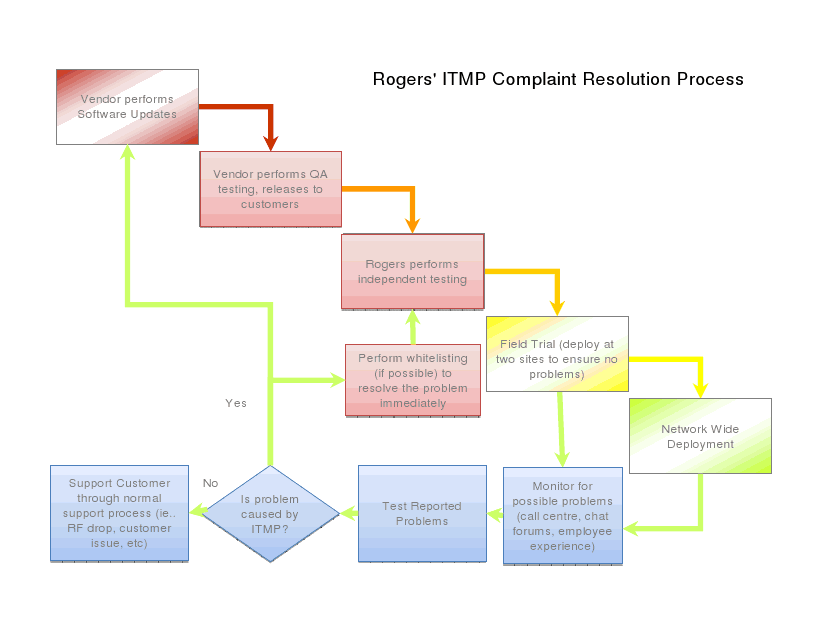
Rogers’ “Rube Goldberg” Throttled Traffic Resolution Flow Chart. (All you wanted to do was play your online game in peace.)  Our suggestion for improvement: turn off the broadband traffic throttle and upgrade your network and the problems go away for everyone.

Rogers denies there is a problem worth getting upset about, because in their view, game traffic doesn’t need anything faster than 80kbps anyway.  Rogers’ attitude and response were both hotly contested by CGO co-founder Jason Koblovsky, who says his members are still directly and clearly affected by Rogers’ throttle.

“Rogers is stating here that they are actively dealing with throttling issues, and suspecting throttling when connection problems are being reported to them.  Quite frankly we are seeing quite the opposite,” Koblovsky says.  “They are actively refusing to even acknowledge that throttling might be taking place, and evidence of this has been submitted to the Commission in previous complaints proving what Rogers is claiming with this flowchart is false.  Hopefully the CRTC can read flowcharts and connect the dots.”

Rogers says it will take a two-step approach to make further corrections to reduce the impact of its errant broadband throttle, but did not provide any timeline.

“In the few cases where we have determined there has been a misclassification of an online game, we have used a two-stage solution to fix the problem. In the short term, we whitelist the game manufacturer’s servers. Whitelisting means creating a policy that will not apply ITMPs to packets going to and from a game manufacturer’s servers no matter how the traffic is classified. This can usually be accomplished in a very short period of time. Whitelisting is effective where the game manufacturer’s server can be located. The second stage is a long term solution that involves a software upgrade created by Cisco and deployed on our network that will correct the misclassification. We note that we did not use whitelisting until recently. Using whitelisting allows us to resolve problems much more quickly than was the case with WoW.”

Whitelisting, according to CGO, is not a sufficient solution to the problem because game manufacturers often change or add additional servers that Rogers will not initially be aware of, requiring constant tweaking to keep the whitelist up to date.

CGO co-founder Teresa Murphy added that “World of Warcraft traffic isn’t safe until the final fix from Cisco is applied to all Rogers-controlled Deep Packet Inspection systems.  Until that happens, if Blizzard moves any of their servers (as they did last summer), the whitelist will no longer apply to World of Warcraft traffic, and we’ll be back in this same situation all over again.  We’re also curious as to the current status of the other games users reported to Rogers back in March which were experiencing the same problems as World of Warcraft, but which didn’t get as much user outcry as World of Warcraft garnered.  There has been no update from any Rogers employee regarding these other games, which we find concerning.  Updates were sparse on the World of Warcraft issue before the CRTC complaint went in, but updates to users on the forums became non-existent after Rogers was forced to admit their practices with WoW.”

Rogers also promises to begin testing the top-ten most popular gaming titles on an ongoing basis to make sure game traffic for those applications goes unaffected.  Woe to those who don’t make the top-ten list, however.

CGO calls Rogers’ response wholly inadequate.

“The way the CRTC has put this to Rogers is that the CRTC expects a plan with dates to have this misclassification issue resolved. This just simply hasn’t happened here,” Koblovsky added.  “The CRTC has been pretty clear to Rogers they want no possibility of misclassification here on any programs, games etc.”

Time Warner Cable Updates iPad ‘TV Everywhere’ App Again: It’s Slowly Improving

Phillip Dampier September 29, 2011 Online Video 1 Comment

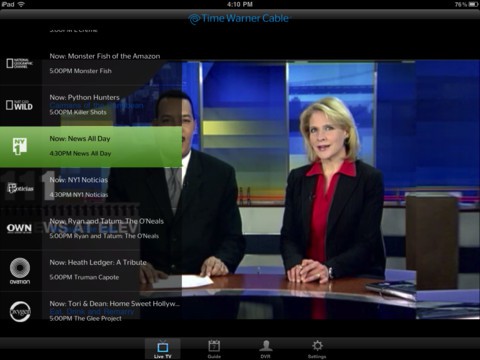
TWCable TV: Time Warner Cable's free iPad TV Everywhere app

Time Warner Cable has announced another upgrade to their free iPad TV Everywhere viewing app: TWCable TV.  In addition to ongoing bug fixes, Time Warner Cable’s Jeff Simmermon reports several new features are now included:

1) Basic search function.

With this update, you can search for programs by title or episode name within the iPad app. You do this by using the search bar located on the top right of the screen. To activate the keyboard, you’ll need to tap the search bar. Once the search results display, you’ll also have the ability to filter your results based on matching genres like News, Cooking, Travel, Sports, etc. We are working on advanced search (keyword, cast, crew) which should roll out sometime around the end of Q4/ beginning of Q1.

 2) You can now view closed captioned content.

To do this, look within the Settings menu of the TWCable TV iPad app and turn the closed captioning switch on. Some programs do not have closed captioning available. Those programs will not display captioning even when the closed captioning is turned on. Look for the closed captioning icon within the program description to determine if captioning is available on any given program.

3) You can now block specific live TV channels from viewing on the app.

Once a channel is blocked it will no longer be displayed in the live TV mini-guide. Please note that you will need to visit MyServices to activate parental controls, and you must exit and re-enter the app for the changes to take effect.

To activate/manage Parental Controls for the app, follow these steps:

  • Visit myservices.timewarnercable.com and log into your MyServices account
  • Click on either the MyAccount or MyTV tab within MyServices, scroll to the “TWCable TV for Devices” module
  • Click on the “Edit blocked channels” link
  • On the Edit TWCable TV Channel Blocking for Devices page, scroll down to the channel(s) you wish to block
  • Click on the lock icon (it will turn red)
  • To complete the parental control activation process, restart the TWCable TV iPad app by pressing the home button or signing out

These settings apply to the TWCable TV iPad app only. To manage parental control settings for your television, you still have to modify the settings on your video set top box using your remote control.

Miscellaneous bug fixes:
I’ve seen a lot of complaints about audio issues in the iPad app – many are saying that there’s no sound. This update should fix that.

Some users were not seeing HD channels in the lineup like they should have – that should also be fixed.

We also have made some minor design tweaks.

HBO GO: Finally available for Time Warner Cable premium customers?

The biggest problem we’ve experienced with the app at Stop the Cap! HQ is the highly-irritating paused/re-buffering playback, which has gotten progressively better over time.  Now, most paused playback occurs only within the first minute after changing channels, and usually does not repeat.  We maintain a 30/5Mbps Internet connection, so there is plenty of broadband speed available, but we suspect as more customers found the application, the cable company’s server capacity could not keep up.

The application’s annoying limitations also remain:

  1. You must be a Time Warner Cable television subscriber to watch, with Time Warner Cable Internet service. (We haven’t tried to see if Earthlink from Time Warner works with TWCable TV).
  2. Playback is limited to the range of your home broadband network’s Wi-Fi connection.  You cannot watch on other networks, and we’ve been unsuccessful trying to watch from another Time Warner Cable customer’s home.
  3. Channel lineups vary market to market.  If your local Time Warner system does not carry a specific network, don’t expect to see it on TWCable TV, even if others elsewhere can watch.
  4. No local channels are included.

In a related development, Bloomberg reports Time Warner Cable is close to a deal with HBO and sister network Cinemax to finally allow Time Warner Cable customers access to HBO GO and Cinemax GO, assuming you have a subscription to one or both premium channels.

The app allows access to past and current programs on smartphones, iPads and personal computers for no additional monthly charge.

Comcast Getting Into Wireless Transmission Tower Business

Phillip Dampier September 28, 2011 Comcast/Xfinity, Wireless Broadband Comments Off on Comcast Getting Into Wireless Transmission Tower Business

Comcast Ventures, the venture capital affiliate of Comcast Corporation today announced it has launched a new company — CTI Towers, Inc., which will own, operate, and develop telecommunications towers throughout the United States. CTI Towers’ is launching with a portfolio of approximately 800 towers that were previously owned and operated by Comcast Cable subsidiaries. Headquartered in Boston, CTI Towers will actively lease tower space to wireless operators and other tenants, creating additional tower capacity for rapidly evolving businesses and technologies across the U.S.

“Consumers are increasingly relying on their mobile devices and consuming high bandwidth applications, such as streaming video, requiring a next generation of wireless communications infrastructure,” said Dave Zilberman, Principal at Comcast Ventures. “Newly formed CTI Towers will work with mobile operators and other service providers to improve the quality of the wireless network experience to their customers by leveraging the extensive footprint of urban and suburban towers in CTI’s portfolio. With Tony Peduto’s significant experience managing and developing towers and his deep understanding of the tower business, CTI is well positioned to aggressively support the build-out of new wireless networks.”

CTI Towers will take its place among more than a dozen other multiple tower owners as 12th largest in the country.  Its management of 800 towers pales in comparison with Crown Castle, which owns more than 22,000 towers across the United States.

But Comcast’s cable infrastructure comes with the deal, and that could be very lucrative for the venture.  Cable companies are increasingly leasing space on their cable networks to provide backhaul connections between the cell tower itself and the mobile operator.  LTE and other 4G networks require bandwidth greater than traditional telephone company circuits.  While many towers increasingly rely on fiber connections, cable companies that have room to spare on their own networks can more than meet the needs of most cell tower operations.

Courtesy: Wireless Estimator

Search This Site:

Contributions:

Recent Comments:

Your Account:

Stop the Cap!