Home » Issues » Recent Articles:

Wall Street Wants Two Wireless Carriers for Americans: AT&T and Verizon

Phillip Dampier September 28, 2011 AT&T, Competition, Public Policy & Gov't, Sprint, Verizon, Wireless Broadband Comments Off on Wall Street Wants Two Wireless Carriers for Americans: AT&T and Verizon

Wall Street is pushing back against Justice Department efforts to unwind a merger proposal between AT&T and T-Mobile that will leave America with three national carriers.  Some investment firms even believe three carriers are still “too many” and want mergers and acquisitions to accelerate to allow two dominant national carriers to emerge.

“It’s pretty clear what the end game is in wireless,” said Julie Richardson, managing director at Providence Equity Partners Inc. “LTE, 4G — you have to have those services to compete. One of the most interesting things to watch in telecom will be these players coming together.”

Richardson shares the view among many on Wall Street that carriers forced to build costly 4G services like LTE need less competition and more cash-on-hand to pay for upgrades and to obtain needed spectrum.

Only AT&T and Verizon Communications have the resources to support a national 4G Long Term Evolution network, Richardson said. Sprint, the third-biggest U.S. wireless operator, is struggling to compete against larger rivals and has lost money for 15 consecutive quarters, Bloomberg News reports.

Among smaller players, Richardson believes the future is clear: mergers, acquisitions, and partnerships.  Sprint is moving increasingly closer to the nation’s cable companies, which have sought a cost-efficient way to deliver the ultimate “quad-play” service package that includes wireless, landline, cable-TV, and Internet service, all from the cable company.  But talk of constructing competing cell networks has gone largely nowhere, and cable companies that do offer some type of wireless service typically resell an existing service under their own brand.  Road Runner Mobile, from Time Warner Cable, for example, is really Clearwire under a different name.  Same for Comcast’s wireless Internet service.  Cox is pitching “unbelievably fair” wireless phone service that actually comes from Sprint.

But cable operators currently don’t seem to be interested in outright acquisitions of cell companies like Sprint, preferring to partner with them instead.

Clearwire, which needs financing and better wireless spectrum, may eventually find a friend in Dish Networks, the satellite TV company.  Dish controls wireless frequency spectrum it currently does not use, and has expressed an interest in expanding beyond a traditional satellite television provider.  An acquisition of Sprint or Clearwire could help them accomplish that.

Clearwire Nearly Doubles “Lifetime” Rates for Some of Their Earliest Customers in Pacific Northwest

Phillip Dampier September 28, 2011 Consumer News, Data Caps, Wireless Broadband 1 Comment

Some of Clearwire’s very first, and most loyal customers in the Pacific Northwest are receiving an unwelcome message of thanks for their years of service with the company: a massive rate increase.

The company is nearly doubling rates for customers who were promised special “lifetime” discounts for agreeing to remain with the wireless 4G broadband service, which has been experiencing financial problems recently.

D.B. in Seattle has been a Clearwire customer for years, even before the company upgraded to WiMax speeds.  In 2009, Clearwire sent him an offer he couldn’t refuse: stay with Clear and pay just $22 a month (plus $5 modem rental fee) for life.

“Of course I accepted immediately,” D.B. writes. “Then Clear [sent me a letter recently] telling me my monthly fee was going up to approximately $47 a month with the modem fee.”

D.B. has been calling and e-mailing Clearwire asking what happened to the $22-for-life promotion he has in writing from the company, but “nobody knows anything.”

Clearwire says they have improved their service recently in Seattle, but D.B. isn’t impressed.

“I’m here to tell the world that is not true,” he says. “Plus the times I’ve had this thing freeze up has greatly increased, and usually I have to unplug the modem for five minutes [to get service back].”

Mireille in Seattle managed to get an even lower “lifetime” rate from Clearwire two years ago.

“They offered me a monthly rate of $19.95 for as long as I maintained uninterrupted Clearwire service. That means forever and ever until I cancel.,” she says.  “Last week they sent me an email letting me know that they were raising my rate to $35.95 a month (that includes a $10 a month ‘long time customer discount’) and since I was such a good customer I was being offered that rate for the life of my uninterrupted Clearwire service. Sound familiar?”

Mireille calls it something else: breach of contract.

“I spoke to three different people and no one had anything to say besides that they were sorry but they were not able offer me that rate anymore.”

Customers in the Portland, Ore. area are getting similar e-mails, and The Oregonian took note:

Clearwire Corp., a wireless Internet provider that operates as Clear, is raising prices for 30,000 customers who signed up for the service soon after its 2009 launch.

The Kirkland, Wash.-based company didn’t provide details of the rate hikes, but e-mails to customers show that monthly rates for some home Internet plans will rise from $35 to $45 beginning in October.

Clearwire said the rate hike affects both home and mobile customers who subscribed when the service was first available, at a time when rates were lower or promotional prices were available.

Clearwire still offers a home Internet plan for $35 a month, but it limits download speeds to 1.5 megabits per second — one-eighth the speed of Comcast’s standard plan. Clear’s standard plan, which now costs $45, promises downloads between 3 and 6 megabits per second.

Cox’s 3 Steps to Fatter Profits With Internet Overcharging: Upgrade or Your Services Will Be Blocked

Phillip Dampier September 28, 2011 Cox, Data Caps, Editorial & Site News 1 Comment

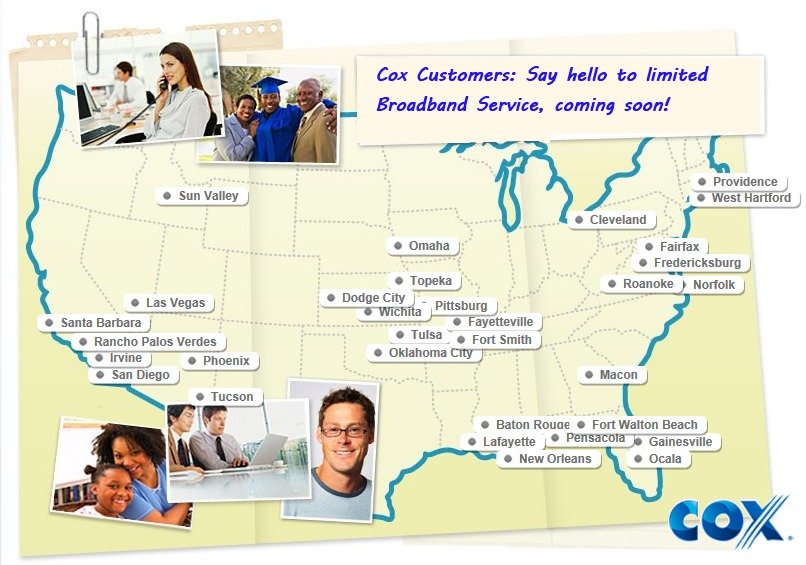
Cox Communications is telling customers if they exceed the company’s usage caps three times over the lifetime of an account, they either must upgrade to a more expensive service plan, make sure they never exceed plan limits again, or face an indefinite loss of their Internet service if they exceed Cox’s limits a fourth time.

Stop the Cap! reader Adam found out about Cox’s Three Strikes Program for himself in an online chat with Claudia, a Cox customer service representative:

Adam: I am concerned with the messages I got about a usage cap. I was told by the salesman that there was no bandwidth cap on our Internet, however this message is very troubling. Please explain this cap to me.
[…]
Claudia: I am really sorry for the lack of information provided to you by our Sales representative.
Adam: Is there a hard cap coming? Is that why we’re getting these messages?
Claudia: That is correct.
Claudia: At the fourth message your services will be blocked, on the previous one they will suggest you to upgrade your plan.
Adam: Fourth monthly, or fourth cumulative?
Claudia: Your Data Usage is reset each month, so it will be your fourth monthly message if exceeding the allowance.
Adam: So four months of going over. Does that counter ever reset?
Adam: Like if I’m bad three months, then good for three. Is it reset?
Claudia: Unfortunately, it is not reset.

Cox, like Comcast, does not charge overlimit fees, but the company does encourage customers who want to use the Internet more than their arbitrary allowances permit to upgrade to a more costly service plan.

Cox’s limits are detailed in an earlier piece Stop the Cap! brought readers a few weeks ago.

Internet Service Providers claim usage caps are important to protect the customer experience from “excessive users” slowing down service in your neighborhood, but as companies like Cox upgrade to DOCSIS 3, the broadband pipeline that results has increased so exponentially, it eliminates the excuse that came with the limits.

Now, ISPs increasingly see another reason to retain usage allowances: fatter profits from tiered usage plans that inevitably drive video-hungry Internet customers into costly upgrades.

CRTC Head Konrad von Finckenstein Out: Will Not Be Reappointed for Second Term

Phillip Dampier September 27, 2011 Canada, Data Caps, Editorial & Site News, Public Policy & Gov't Comments Off on CRTC Head Konrad von Finckenstein Out: Will Not Be Reappointed for Second Term

Konrad Von Finckenstein

Konrad von Finckenstein, the head of Canada’s telecommunications regulator who initially rubber-stamped a Bell proposal to force Internet providers in Canada to charge usage-based pricing will not be back for a second term.

Von Finckenstein broke the news himself in a memo sent to staff at the Canadian Radio-television and Telecommunications Commission, stating he would end his leadership of the CRTC when his five-year term concludes in January.

The CRTC has made uncomfortable headlines for Canada’s Conservative government, primarily by approving an Internet pricing plan submitted by Bell that would require virtually every Internet provider in Canada to end unlimited, flat rate pricing for broadband service.

The CRTC is hardly a hotbed of headline news for most Canadians.  The sleepy agency regulates telephone, broadband, television, and radio in the country with an increasingly light touch.  Ten years ago, the CRTC was regularly accused by some broadcasters of meddling in their private business.  These days the Commission, packed with members who formerly worked for the companies they now oversee, has gotten considerably more friendly with those they regulate.

That policy blew up in their faces when Bell got most of what it wanted in a wholesale pricing change that was so wide-reaching, it would potentially impact every Canadian Internet user.  Nearly a half-million of them registered their displeasure in a petition sponsored by Openmedia.ca.

Von Finckenstein’s resolute attitude towards the correctness of that decision was soon tempered when Industry Minister Tony Clement found himself overruling the CRTC in a Twitter message, telling Canadians the decision to impose usage-based billing “would not be allowed to stand.”

Opposition members in Parliament had a field day over Clement’s repeated distancing of the government from CRTC policies, particularly the one involving Internet pricing.

Liberal MP Marc Garneau seized on the fact Clement tweeted his intentions to the public at large before sharing them with von Finckenstein himself.  That, Garneau claimed, was the latest example of the government’s lack of clear policy on issues such as usage-based billing that has left the CRTC in what he called a “giant policy vacuum.”

The announcement by the CRTC chairman comes at the same time the Commission is finalizing a re-evaluation of its earlier decision on usage-based billing.

While hundreds of thousands of Canadians upset with the CRTC may be glad to see the back of von Finckenstein, his colleagues were considerably more generous with their praise:

Former CRTC executive Richard French credits Von Finckenstein, saying he sped up the commission’s decisions, improved the atmosphere around the offices and rarely left anyone guessing what he thought, “which I think is a virtue in a regulator.”

“He balanced the desire for more market forces with a recognition that for most of the industries in question, the Canadian market is sub-economic, it’s just not big enough to sustain enough players in this capital intensive business to create real competition so regulation is required,” French said Monday.

“He’s done an excellent job and he deserves the respect and appreciation of the industry and of the population,” French said.

Heritage Minister James Moore’s office issued a statement thanking von Finckenstein for his service as CRTC chair and said a process to select a new chair would be announced in the coming weeks.

Cash Rich AT&T, Verizon, Time Warner Cable Form Astroturf Group to Demand Major Tax Cuts

Phillip Dampier September 27, 2011 Astroturf, Editorial & Site News, Public Policy & Gov't Comments Off on Cash Rich AT&T, Verizon, Time Warner Cable Form Astroturf Group to Demand Major Tax Cuts

AT&T, Verizon, Time Warner Cable, and nine other giant corporations selling cigarettes, shoes, shipping services, and jet aircraft have formed a new group demanding major cuts in the corporate tax rate that would allow some of them to repatriate billions in cash reserves stuffed in overseas banks to dodge U.S. taxes.

RATE — the Reducing America’s Taxes Equitably Coalition, says cutting the corporate tax rate is key to increased spending of accumulated corporate dollars in the United States.

“In a global economy where capital is highly mobile, it is simply harder to compete from America,” the companies’ executives wrote in a letter. “A lower corporate tax rate will boost investment in the U.S., bringing more American jobs, innovation and growth.”

But many of these corporations already pay less taxes than you do as a percentage of income.  Take Verizon, which shovels substantial profits through its British wireless partner Vodafone through Luxembourg, at an effective tax rate of around 10%.

Forbes reports last year Verizon had sales of $108 billion.  It’s pretax income was $11.8 billion.  The company paid just $1.2 billion in income taxes thanks to its $42 billion wireless joint venture with Vodafone, which Forbes reports “draws off much of Verizon’s income.”  But that is hardly a bad thing for Verizon.  Its effective tax rate: 10.5%.  Most middle class Americans pay twice or more that rate.  Verizon itself was surprised it only paid that much, because it ended up getting a federal tax refund for an overpayment amounting to $705 million.

In 2010, AT&T got hit harder, but still managed to eke out a winning year for shareholders.  AT&T enjoyed sales of $123 billion.  Its pretax income: $19 billion.  The company ended up paying $6.2 billion in income taxes for an effective tax rate of 32.4%.  But their executives got the benefit of every tax loophole available for their personal tax returns, made possible by AT&T’s generous subsidy of up to $14,000 a year for each executive officer to hire the best tax accountants around.

American companies already pay the second lowest taxes in the developed world, once all of the loopholes and deductions in the corporate tax code are accounted for. American corporations are sitting on record amounts of cash, so its unclear why more cash (in the form of tax breaks) would lead to more hiring, unless it involves adding more Washington, D.C. lobbyists, of course.

Search This Site:

Contributions:

Recent Comments:

Your Account:

Stop the Cap!