Home » Issues » Recent Articles:

Updated: iPhone Announcement Day: The Buzz Declines With Your Usage Cap

Phillip Dampier October 4, 2011 AT&T, Broadband Speed, Competition, Consumer News, Data Caps, Editorial & Site News, Online Video, Sprint, Verizon, Video, Wireless Broadband Comments Off on Updated: iPhone Announcement Day: The Buzz Declines With Your Usage Cap

Apple is set to announce a new iPhone or two early this afternoon, but some in the tech media notice the frenetic excitement of the newest Apple sensation has been tempered, in part because many of the new software and cloud storage features will run into usage caps for some, speed throttles for everyone else.

The imminent arrival of anticipated models iPhone 4S, expected to sell at AT&T and Verizon and iPhone 5, which is rumored to be sold exclusively by Sprint during a short sales window, remains a big deal for all three carriers.  Verizon is reportedly allowing its call center employees to take unlimited overtime in preparation for the anticipated rush of questions and orders.  Sprint, which has 33 million customers on two-year contracts, has made a commitment to sell at least 30.5 million Apple iPhones over four years, if reports by the Wall Street Journal turn out to be accurate.  That’s a lot of phones.

[flv width=”512″ height=”308″]http://www.phillipdampier.com/video/Sprint Getting iPhone 10-3-11.flv[/flv]
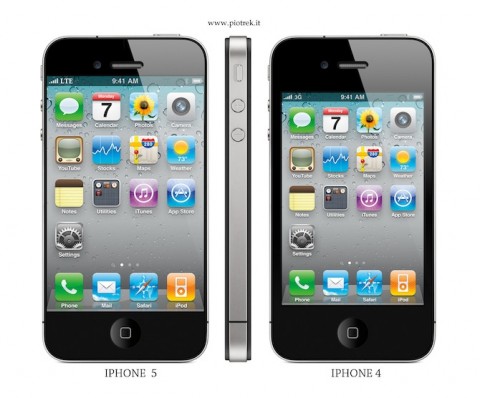
9 to 5 Mac shows off a mock image of what the newest iPhone 5 will probably look like. Pay close attention to the rounded edges and bezel.

Reports from the Wall Street Journal, WDAF-TV in Sprint’s home base of Kansas City, and Bloomberg News discuss the implications of Sprint’s deal with Apple.  (11 minutes)

That’s also an enormous gamble for Sprint, which is guaranteed no real profits from the venture until the year 2014.  If the company does win temporary exclusivity of an iPhone model that includes support for Sprint’s 4G network, WiMax, it will also bring the company an enormous number of new customers.

Among the most important new features of the phone is iOS 5, the latest version of Apple’s mobile operating system.  It comes loaded with new ways to burn through the stingy usage caps AT&T and Verizon Wireless are now providing their customers:

  1. Over the air upgrades/activations: Apple’s notoriously huge software updates can be delivered to your wireless device without syncing it on a personal computer.  That means downloading software updates that can easily exceed the 200MB “light usage” plans some carriers sell budget-conscious customers;
  2. Notification Center: Puts messages from e-mail, texts, and apps in a more convenient place to access and respond, increasing usage;
  3. NewsStand: Leverages newspaper and magazine content in a single app, downloading content pushed to your phone, increasing usage;
  4. Safari Sync: The Safari web browser will now sync with other instances of the browser on other devices to keep your reading list updated;
  5. iMessage: Send texts, photos, and bandwidth-hogging video to friends and family, potentially driving up usage considerably;

But nothing is expected to spike wireless data usage like Apple’s new iCloud and iTunes Match, both of which manage and sync multimedia content and app purchases between devices “over the cloud.”  Unfortunately, repeated journeys of this type will burn through your usage allowance, and those with significant-sized libraries of photos, music, or videos are at serious risk of blasting past their usage cap.  Even customers who use more than 4-5GB on “unlimited data plans” sold by AT&T and Verizon will face the scourge of the speed throttle, which will reduce your zippy new phone to speeds that resemble dial-up.

AT&T and Verizon Apple iPhone customers are at the highest risk of facing the speed throttle, because Apple is not expected to support either company’s 4G data network.  Verizon only exempts 4G customers from the speed throttle when they use the 4G network.

The one company well-positioned to capitalize on these realities happens to be Sprint, which is keeping its truly unlimited data plan.  If Apple comes through with 4G support for Sprint, customers could not only say goodbye to AT&T and Verizon’s slower 3G speeds, they would also be able to rest easy knowing they won’t experience bill shock or a month in the dial-up speed penalty corner if deemed to be using “too much” service.

Customers of the two biggest carriers need to get familiar with switching to Wi-Fi as often as possible, and avoid using data-intensive features on usage-limited plans.  For Verizon and AT&T, it’s the best of all worlds — another two year contract for a usage-limited data plan that guarantees increased revenue and reduced costs.  For you, it’s an improved phone you can never use to its full potential.

[flv width=”512″ height=”308″]http://www.phillipdampier.com/video/Little Buzz Over New iPhone 10-4-11.flv[/flv]

The Wall Street Journal reports there isn’t as much buzz over this year’s newest iPhone.  Bloomberg talks about the software changes in the new phone, and WWLP-TV in Springfield notes Verizon’s unions are calling on Americans to boycott the new phone until Verizon workers get a fair contract.  (8 minutes)

Update 2:00pm ET:  The Wall Street Journal reports the Sprint iPhone will not support their 4G network: According to people familiar with the company’s plans, the hotly anticipated device won’t operate on long-term evolution or WiMAX fourth-generation networks. Those wireless networks promise speedier downloading to mobile devices of episodes of television programs, as well as cute baby photos. The people said the device will work on 3G networks, which are broadly in use today and are the standard for the current iPhone 4. AT&T says its HSPA+ network has 4G-like speeds.

Update 4:00pm ET: The announcement event finally concludes with news the iPhone 5 is vaporware for now.  Sprint will end up with the same Apple 4S phone AT&T and Verizon will sell on their respective networks. The San Jose Mercury News was not thrilled with the event:

At a rollout that lacked some of the thrills and surprises of past product releases — and disappointed some in attendance who expected a completely made-over iPhone 5 — Siri stood out as the sexiest new feature on an iPhone that, contrary to speculation, isn’t any thinner or different looking on the outside than its predecessor, the iPhone 4.

“This phone is better than the iPhone 4 in many ways, even though it looks the same,” said Avi Greengart, an analyst with Current Analysis on hand for the unveiling before several hundred reporters, bloggers, analysts and other guests. “Sales will be wildly successful, but Apple fanboys’ expectations probably were not met today.”

The new phone, which will be available Oct. 15 after pre-orders begin Oct. 7, will cost $199 for a 16-gigabyte version, $299 for 32GB and $399 for 64 GB. It had been center-stage in the tech blogosphere for months, as pundits weighed in with what they saw as the most obvious bells and whistles Apple would unleash on their growing fan base. Tuesday, some were surprised by how wrong that had been.

The phone that everyone thought would be thinner than the iPhone 4, pretty much resembled its older sibling. But as analysts had suspected, the new phone is much faster, thanks for the new A5 chip inside it, and it has plenty of consumer-pleasing attributes, most of them inside the case.

Time Warner Cable Gets Free Advertising in Wisconsin With Sports Team Lawn Signs

Phillip Dampier October 3, 2011 Consumer News, Video 1 Comment

[flv width=”360″ height=”290″]http://www.phillipdampier.com/video/WGBA Green Bay Brewers Rally Signs 9-30-11.mp4[/flv]

Time Warner Cable is spending subscriber dollars in Wisconsin on free lawn signs with the company logo showing support for the Milwaukee Brewers.  It’s not the first time the cable company has distributed free signs to sports fans.  In January, the Wisconsin division of the cable company handed out signs celebrating the Green Bay Packers.  The cable company said local cable store employees found lines of interested takers ready and waiting before they even opened.  Green Bay locations ran out of signs within hours, but if past precedent means anything, Time Warner will print up more for a second round.  (1 minute)

America’s Best Broadband Value: The U.S. Postal Service?

Phillip Dampier October 3, 2011 AT&T, Comcast/Xfinity, Competition, Consumer News, Cox, Data Caps, Editorial & Site News, Public Policy & Gov't, Suddenlink (see Altice USA) Comments Off on America’s Best Broadband Value: The U.S. Postal Service?

Allen Wan from Chicago dropped Stop the Cap! a postcard by good old snail mail about today’s broadband cap ‘n tier regime in place at some of America’s largest Internet Service Providers to make an important point: with Internet Overcharging schemes like usage caps and usage-based billing, America’s best broadband value may actually come from the United States Postal Service.

Allen breaks it down for us:

AT&T Comcast U.S. Post Office
Regular Unit/Monthly Price $25 for 768kbps DSL
$45 for 6Mbps DSL
$60 Internet-only service $0.44 First Class Mail
$0.11 Blank CD-R
$0.12 Blank DVD+R
$0.48 Blank DL-DVD+R
$0.10 Label/Envelope
Cap/Capacity 150GB per month 250GB per month 700MB for CD
4.7GB for DVD
8.5GB for DL-DVD
Price per Gigabyte $0.17 for 768kbps DSL
$0.30 for 6Mbps DSL
$0.24 $0.93 for CD
$0.14 for DVD
$0.12 for DL-DVD

Allen’s chart points out that for large file transfers like movies, TV shows, and major software updates, consumers actually get more value on a per-GB basis burning those shows and software to a traditional or dual-layer (DL) DVD, and dropping them in the mailbox.

While prices for service may vary, so do Internet Overcharging schemes.  If a customer reaches their monthly limit one time too many, they will be relying on the post office to move files back and forth because companies like Comcast and Cox will terminate their service.  Other providers, like AT&T and Suddenlink, are content to simply send the customer a bill with overlimit charges on it.

With a marketplace duopoly, ineffective government oversight, and ever-increasing prices, the U.S. Post Office may still be in the running after all, thanks to Back to the Future-pricing from your ISP.

Alcatel-Lucent Announces VDSL2 Vectoring: 100Mbps on Copper Phone Lines

Phillip Dampier October 3, 2011 Broadband Speed, Competition, Consumer News, Public Policy & Gov't, Rural Broadband, Video Comments Off on Alcatel-Lucent Announces VDSL2 Vectoring: 100Mbps on Copper Phone Lines

While most rural telephone companies are selling customers 1-3Mbps copper-delivered DSL service, Alcatel Lucent has announced the commercial availability of VDSL 2 Vectoring, a new way of delivering up to 100Mbps over the copper wire telephone network most rural North Americans still depend on for telecommunications service.

VDSL2 combines a fiber-copper hybrid network similar to Bell’s Fibe or AT&T’s U-verse, with interference-cancelling technology called “vectoring” to deliver speeds much closer to the 100Mbps theoretical limit of current DSL technology.

“Alcatel-Lucent’s plan to make VDSL2 vectoring commercially available is very timely,” said Rob Gallagher, Principal Analyst, Head of Broadband & TV Research, Informa.  “VDSL2 Vectoring promises to bring speeds of 100Mbps and beyond to advanced copper/fiber hybrid networks and make super fast broadband speeds available to many more people, much faster than many in the industry had thought possible.”

A new way to boost copper speeds even faster.

Different flavors of DSL are currently in use around North America and beyond.  The most basic form, ADSL, also happens to be the most commonplace among phone companies offering basic broadband service.  For customers up to 12,000 feet away from a phone company central office, DSL delivers speeds usually at 1Mbps or faster.  Customers enjoying the fastest speeds must live much closer to the phone company facilities.  The further away you live, the slower your broadband speed.  In rural areas, consumers can live further away than the maximum distance of the central office, which means no DSL service for those subscribers.

A combination of signal loss and interference, called “crosstalk,” from adjacent copper wire pairs are both the enemies of DSL broadband, because they can drastically reduce speeds.

Telephone companies can address this problem by building new satellite central offices located halfway between customers and their primary facilities.  These offices, usually connected by fiber, can successfully reduce the amount of copper wire between the customer and the company, boosting speeds.  Many phone companies also deploy DSL extensions called D-SLAMs, which can be attached to a phone pole or enclosed in a metal box by the roadside.  A fiber cable connects the D-SLAM back to the phone company, while existing copper phone wires go back to individual subscribers.

More modern forms of DSL: ADSL2, ADSL2+, and VDSL, share some of those concepts.  The key is cutting as much copper wire out of the network as possible, replacing it with fiber optic cable which does not suffer signal loss or interference in the same way.

Many European and Pacific broadband networks rely on ADSL2/2+, which can usually deliver reliable speeds in the 20Mbps range.  VDSL networks offer even more bandwidth, and are the basis of U-verse and Fibe, which split up broadband, phone service, and television on the same cable.  When customers demand even faster speeds, phone companies can “bond” several individual DSL connections together to deliver faster speeds.  Some traditional ADSL providers do that today for their customers, especially in areas where low speeds prevail.

An argument the phone company will love.

Alcatel Lucent says VDSL2 with Vectoring is the next best thing to fiber to the home, because it is cheaper to deploy with fewer headaches from local authorities when streets and yards are dug up for fiber cable replacements.  It also meets the growing speed needs of average consumers.  Alcatel Lucent predicts the minimum speed North Americans will need to support the next generation of online video is 50Mbps, more than 10 times the speed phone companies like Verizon, AT&T, Frontier, and CenturyLink provide over their traditional DSL networks, especially in rural and suburban areas.

Vectoring can deliver results for phone companies with aging copper wire infrastructure, more prone to crosstalk and other signal anomalies.  Alcatel Lucent compares vectoring with noise-cancellation headphones.  By sampling the current noise conditions on copper cable networks, vectoring can suppress the impact of the interference, boosting speeds and delivering more reliable results.

With technologies like VDSL2 with Vectoring promising speeds far faster than what rural North Americans currently enjoy, the Federal Communications Commission may want to re-evaluate its national minimum speed standard for broadband — 3-4Mbps — found in its National Broadband Plan.  Alcatel Lucent promises they can do much better.

[flv width=”640″ height=”324″]http://www.phillipdampier.com/video/Alcatel Lucent VDSL2.flv[/flv]

Alcatel Lucent produced this video to promote its new VDSL2 with Vectoring technology.  The video targets cost-conscious phone companies who are being pressured to deliver faster service, but don’t want to spend the money on a fiber to the home network.  (6 minutes)

Cabot Cove Mystery: Maine Discovers Time Warner’s Digital Upgrade is Murder on VCRs

Phillip Dampier October 3, 2011 Consumer News 4 Comments

Even Jessica Fletcher can't solve the case of The Digitally Murdered VCR

Time Warner Cable customers in Maine are learning the cable operator’s move to digital cable is making VCR programming downright murder.

Although many of us have retired the videocassette recorder to closets, attics, or basements, millions of them are still being used on a daily basis to time-shift shows and to record one channel while watching another.  But in Maine, the first area to experience Time Warner’s shift to an all-digital cable experience, viewers like Nancy Blethen from Hallowell are learning those days are coming to an end.

Blethen shared her plight with the Kennebec Journal:

I read with interest the story about the converter box for Time Warner subscribers. Although, the idea of more channels is appealing, they really aren’t any that I care to watch.

Another point the story omitted is that if you have a VCR and connect the converter from your cable through the VCR to the TV set, you will only be able to record the channel you are watching. No more recording when you are not home or if you want to watch another channel while recording another program.

I spent at least 20 minutes on the phone with a tech person, and they checked with their supervisor and concluded that this is something subscribers will have to live with, at least for the present. You can avoid this by using one of their DVR recorders, but at an additional monthly fee. Time Warner is the only choice I have where I live so I have to forget recording on the VCR.

Although Time Warner Cable will happily supply a digital solution to this analog quagmire, it doesn’t come for free.  DVR service costs $13 a month or more each month.  While it solves the problem of the flashing 12:00-clock for confounded consumers, it also increases their cable bill by well over $100 a year, more than the cost of the VCR (and tapes) that used to let them record shows for free.

Search This Site:

Contributions:

Recent Comments:

Your Account:

Stop the Cap!