Home » Issues » Recent Articles:

Comcast Testing Its Version of “A-La-Carte” Cable: Theme Packs & Channel Bouquets

Cable subscribers paying ever-increasing television bills for hundreds of channels they never watch may find some relief if Comcast decides its experiment in “a-la-carte” cable-TV is a success.

The company is testing a new way of selling service that delivers a basic package of channels for a lower price and then offers customers bouquets of add-on channels sold in “theme packs” for $10 apiece.

Comcast is testing what it calls MyTV Choice in parts of Connecticut, Massachusetts, Vermont and Charleston, South Carolina, and plans to expand it to the Seattle area soon.

Here’s how MyTV Choice works:

Customers start with a basic package of channels that Comcast calls “Get Started” ($24.95) or “Get Started Plus,” which sells for $44.95 a month.

What differentiates the two options are the networks they contain.  Inexpensive cable networks turn up in Get Started — A&E, Discovery, C-SPAN, Animal Planet, Daystar, Food Network, home shopping, and The Weather Channel are among the 32 channels that accompanies a basic package of local channels.

Get Started Plus includes all of those networks plus sports — the budget-busting networks that help keep cable bills growing.  ESPN and other regional sports channels are included in the more expensive package.

Missing from the basic package of channels are kids shows, news, movies, and niche networks.  That’s where Comcast’s “Choice” packs come into play.  Customers can add a 19-channel News & Info pack, 31-channel Entertainment & Lifestyle pack, 16-channel Movie pack, and/or an 11-channel Kids pack for $10 each.

That’s where the “choice” ends.  Customers cannot skip the basic channel package to select only one of the theme packages, individual channels are not for sale, and anywhere outside of Charleston, customers also have to buy phone and Internet service from Comcast. HD also costs extra.

So much for a lower bill.

In fact, Comcast sells a digital cable package incorporating a full lineup of basic cable channels for just under $60.  If your family loves sports, has kids, and needs news channels, sticking with the digital cable package is actually cheaper than MyTV Choice.  That’s because the latter will require a $44.95 base package, plus three theme packs for an additional $30 a month.

Comcast denies their experimental a-la-carte package has anything to do with cord-cutting Internet viewers.

“It’s more or less responding to feedback from customers that they want more choice,” Comcast spokesman Bill Ferry told the Post & Courier.

While Ferry and others argue the pay-per-channel is not economically feasible, Christopher C. King, a telecom analyst for Stifel Nicolaus in Baltimore told the newspaper that is the trend.

“Certainly the industry’s moving more toward an a la carte model,” King said.

Theme-packs are not a new concept for some pay television viewers.  In the 1980s and 1990s, consumers owning large 6-to-12 foot satellite dishes routinely encountered the channel bouquet concept.  Customers would purchase a basic package and then select from a dozen or more mini-tiers, usually made up of networks owned by one company.  Want TBS and TNT?  Turner Broadcasting sold an add-on with those two channels.  Wanted a superstation package?  Channels uplinked by cable companies like TCI from Denver could be purchased as a small package.  So could stations like WSBK in Boston, WWOR and WPIX in New York, KTVT in Dallas and KTLA in Los Angeles.

Comcast has “simplified” things with a much smaller set of choices.  But that also dramatically limits any potential savings.

The concept of a-la-carte cable horrifies cable companies and their Wall Street shareholders, because a true “pay-per-channel” offer would dramatically cut the average revenue earned per subscriber if customers took a hatchet to the bloated channel packages most customers receive today.

Cable operators have resisted the concept because every channel would have to be encrypted to sell individually, billing would become more complicated, and the business model of niche-oriented networks supported by more popular fare would end.  That’s why programmers hate the idea as well.  While A&E, TNT, and CNN would have no trouble surviving, networks like Current TV, TV One, Hallmark, Cloo, and LOGO probably would not.

More importantly, many subscribers might find savings elusive from a-la-carte, because the most expensive cable programming networks also happen to be among the most popular.  ESPN and Fox News Channel, for example, have dramatically increased their rates to cable companies, who helpfully pass them along to you.  But if cable operators suddenly stripped those networks out of basic packages, while leaving the much cheaper networks together in broad-based theme packages like “lifestyle and entertainment,” subscribers may howl in protest or accuse the cable operator of playing politics.

It gets even harder when the cable companies selling the big packages of channels customers never watch also happen to own some of the networks found within those packages.  Comcast shareholders may not like the cable side of the business kicking lucrative NBC-owned and operated cable networks like The Weather Channel, USA, E!, Cloo, and other owned networks to a-la-carte Siberia.  Every cable subscriber pays for Cloo and E! today.  How many will choose to pay for those networks under an “a-la-carte” model is an open question.

Only two cable operators have expressed an interest in switching to a true, a-la-carte model to date — Suddenlink and Mediacom — both small, regional players that have no programming interests and lack sufficient buying power to score the kinds of discounts available to companies like Comcast and Time Warner Cable — discounts they can have if they agree to keep as many channels bundled in one digital cable package as possible.
South Africa Says Good Riddance to Usage Caps: Telkom Takes the Limits Off

Phillip Dampier October 5, 2011 Broadband Speed, Competition, Consumer News, Data Caps, Wireless Broadband Comments Off on South Africa Says Good Riddance to Usage Caps: Telkom Takes the Limits Off

South Africa’s largest Internet Service Provider, the former state-owned telephone company Telkom, has introduced uncapped broadband service across the country.

Telkom’s Do Uncapped offering removes usage limits after “intensive market research” and “data usage trials” concluded South African consumers absolutely despise usage limits on their Internet access.

In fact, in overwhelming numbers, consumers preferred unlimited access over faster broadband speed packages.  Even throttled “fair use” policies which slightly reduce speeds during peak usage periods are more tolerable than restricted usage allowances, overlimit fees, and punishing “dial-up” speeds when customers exceed their usage limit.

“To feed the hunger for data, Telkom has tailored its Do Uncapped range according to consumer usage patterns derived from findings of the Company’s broadband trials on higher cap trials conducted earlier this year,” the company said in a statement.

Inexpensive, lower speed offerings are available at 384kbps and 1Mbps, but do come with certain daytime speed restrictions, especially on peer to peer traffic.  The premium 4Mbps package is truly unlimited.

South Africa’s challenged telephone network has resulted in relatively low broadband speeds when compared against Asia, North America, and Europe, but the unlimited offerings are being welcomed by Telkom customers across the country.

Because DSL service from the phone company has traditionally been slow and, until recently, expensive, many South Africans rely primarily on wireless mobile services, which can be more reliable in some parts of the country.  Some purchase wireless broadband service from providers like MTN instead of DSL from the phone company.

As a home broadband replacement, wireless mobile broadband has always meant compromising on usage, because most plans are heavily capped and some block access to certain web content.  But MTN is responding to Telkom’s move away from usage caps by removing them from its own wireless network, at least during a promotion.

MTN is kicking off the South African summer with its newest promotion, unlimited speed and uncapped wireless data access on the company’s HSPA+ network, effective Oct. 1.

The limits stay off until the end of summer — Jan 2012.

“We have seen a significant number of our customers taking up latest smartphones, tablet PCs, wireless routers and laptop deals that MTN is offering,” said Serame Taukobong, MTN South Africa Chief Marketing Officer. “This promotion is a response to the increased data appetite that comes with the usage of these devices.”

That’s an attitude foreign to North American mobile operators, who see those devices as enemies of their wireless network (or the basis for future profits).  In South Africa, consumers adopting new wireless devices and increased usage has triggered a marketplace response that eases or ends usage caps.  In North America, the opposite is happening.

MTN has slashed its mobile broadband prices over the course of 2011 for the highest speed, unlimited access package from a budget-busting $248 a month to $111 a month.  A slower speed unlimited package now sells for $37 a month.  That becomes very affordable for Internet users who use their mobile devices exclusively for access.  Even a package selling over $100 a month may be comparably affordable to an American who is required to maintain a home broadband and mobile broadband account.

MTN even allows wireless peer to peer traffic, but the company asks subscribers to be reasonable and not leave it running 24/7.

CenturyLink Copies Comcast: Another 1.5Mbps Low Income Broadband Plan With Gotchas

CenturyLink has unveiled its own discounted Internet access program for the income-challenged, loaded with tricks and traps buried in the fine print.

Dubbed CenturyLink Internet Basics, the 1.5Mbps DSL service is available to those who currently qualify for Lifeline Affordable Telephone Service, a federal program that provides discounts on basic monthly telephone service to eligible low-income consumers.  The service sells for $9.95 a month, before taxes and fees.

But buried in the fine print are a number of surprises that deliver higher prices and some nasty surprises (underlining ours):

  • Listed High-speed Internet rate of $9.95/mo. applies for first 12 months of service (after which the rate reverts to $14.95/mo. for the next 48 months of service), and requires a 12-month term agreement or 24-month term agreement (if purchasing Netbook);
  • Customer must either lease a modem/router from CenturyLink for an additional monthly charge or purchase a modem/router from CenturyLink for a one-time charge, and a one-time High-Speed Internet activation fee applies;
  • A one-time professional installation charge (if selected by customer) and a one-time shipping and handling fee applies to customer’s modem/router;
  • Taxes, Fees, and Surcharges – Applicable taxes, fees, and surcharges include a carrier Universal Service charge, carrier cost recovery surcharges, state and local fees that vary by area and certain in-state surcharges. Cost recovery fees are not taxes or government-required charges for use (which means they are little more than bill padding junk fees). Taxes, fees, and surcharges apply based on standard monthly, not promotional, rates;
  • The first bill will include charges for the first full month of service billed in advance, prorated charges for service from the date of installation to bill date, and one-time charges and fees described above.
  • Netbook purchase must be paid in full to CenturyLink prior to shipment. Shipping and handling fees, and applicable taxes will apply. If customer purchases Netbook as part of the CenturyLink Internet Basic service, all warranty and support for the Netbook and accompanying equipment will be covered by the manufacturer or other identified third party, not CenturyLink.
  • No software applications or wireless service are included with the Netbook.
  • An early termination fee will apply based on the applicable monthly recurring service fee multiplied by the number of months remaining in the minimum service period, up to $200.

Unlike Comcast, CenturyLink claims it will provide equivalent discounts for faster speeds — an important consideration for those with school-age children at home who may need multimedia capability for research and studies.

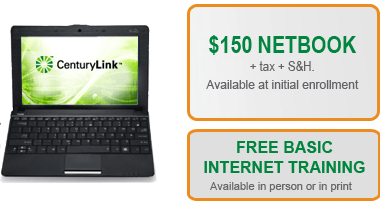
CenturyLink also offers a netbook computer for an additional $150, plus shipping and taxes, at the time of enrollment in the program.  The service also includes educational training, a 30-day money back guarantee, Norton Security Suite, and parental controls.

“While the Internet has become part of daily life for most Americans, many still aren’t connected because the cost is beyond their reach. CenturyLink is pleased to introduce this new program that offers affordable High-Speed Internet service and computers to those who need help getting online,” said CenturyLink CEO and President Glen F. Post, III.

That and the fact the company was required to offer discounted Internet service as a condition for the approval of their acquisition of Savvis, a web hosting company, according to Broadband Reports.

Like Comcast, participation in the program requires meeting a number of terms and pre-conditions:

  • Reside where CenturyLink offers Internet service;
  • Have not subscribed to CenturyLink Internet service within the last 90 days and are not a current CenturyLink Internet customer;
  • Do not have an overdue CenturyLink bill or unreturned equipment;
  • Follow current guidelines for Lifeline/TAP phone service programs.

Free training programs will be introduced starting this fall in Foley, Ala.; Dumas, Ark.; Eagle, Colo.; Tallahassee, Fla.; Phoenix; Galesburg, Ill.; Franklin, Ind.; Billings and Great Falls, Mont.; Las Vegas; Farmington, N.M.; Rockingham, N.C.; Lorain, Ohio; Columbia River Gorge, Ore.;  Greenwood, S.C.; Seattle and Yakima, Wash.; and Glenwood City, Wis. Other communities where the training is taking place will be announced in 2012.

Many of the terms and conditions of the discounted Internet program are not very different from standard CenturyLink new customer promotions, which promise discounted service but leave a lot of surprise charges, fees, and contract commitment details to the tiny fine print customers have to search to find (or wait to find out on their first bill.)

Yet like Comcast, CenturyLink will seek to take credit for addressing the digital divide when in fact they are not selling the service to those who don’t want or need $40 Internet bills, but are not poor enough to qualify for the $10 Internet program on offer here.

AT&T Loses Tax Refund Case: Wanted USF Income Treated As “Contributions to Capital”

Phillip Dampier October 4, 2011 AT&T, Consumer News, Public Policy & Gov't, Rural Broadband Comments Off on AT&T Loses Tax Refund Case: Wanted USF Income Treated As “Contributions to Capital”

AT&T has lost a case it appealed all the way to the U.S. Supreme Court to win favorable tax treatment for income it received from the Universal Service Fund program, designed to help underwrite the costs of providing rural telephone service.

AT&T was seeking a $500 million income tax refund on its 1998 and 1999 federal taxes from money the government provided AT&T.

Federal tax law requires phone companies to treat the USF revenue as income, subject to regular taxation.  AT&T argued the money was actually a “contribution to capital,” which would have substantially reduced the company’s tax burden.  Contribution to capital, as a concept, has been the subject of several corporate lawsuits over the years.  The genesis of court challenges comes from a 1925 case — Edwards v. Cuba Railroad Co., that held government subsidies provided to induce the construction of facilities and provision of service were not taxable income within the meaning of the Sixteenth Amendment.

AT&T believed that USF funding subsidized the delivery of phone service, so it cannot be considered taxable income.

The U.S. Supreme Court disagreed.  The justices elected to leave intact a lower court ruling that threw AT&T’s arguments aside.

Considering the long history of court losses for other corporate entities who have argued similar cases all the way back to the 1950s, the decision should not come as a surprise to the phone company, and AT&T’s reaction was muted.

“We are disappointed with the Supreme Court’s decision,” the company said in a statement. “However, AT&T does not expect any impact to our financial statements.”

The case is AT&T v. United States, 10-1204.

Patent Troll Says Using Wi-Fi Infringes Their Patents; Won’t Sue Consumers… “At This Stage”

Why would a Delaware company holding several dozen patents — several formerly owned and controlled by a semiconductor manufacturer — suddenly decide to sue businesses that offer their customers access to Wi-Fi?  Because that is where the money is.

Innovatio IP Ventures, LLC is a patent holding company — one that today holds 31 patents, acquired mostly from Broadcom, that generally deal with “wireless local area network” technology most consumers know better as Wi-Fi.  In reality, Innovatio doesn’t really innovate much of anything in the technology department.  It has no products or services for sale.  But it has managed to innovate what critics are calling a “major shakedown” with the help of its law firm to collect royalty payments from companies large and small who find it easier to settle the lawsuits than hire attorneys to defend them.

That may be precisely the business model companies like Innovatio have in mind.

The company is suing coffee shops, grocery stores, restaurant chains, and even individual hotels and motels where Wi-Fi is provided as a customer convenience.  Among the defendants: Hyatt Corporation, Marriott Hotels, Wyndham Hotels and Resorts, Ramada Inn, Best Western, Days Inn, Super 8 Hotels, Travelodge, Caribou Coffee, Cosí and Panera Bread Co., and Meijer, Inc.  Within those lawsuits, hundreds of individual business locations are accused of violating Innovatio’s Wi-Fi patent rights.

But there is a way to make Innovatio, and their attorneys, go away.  Agree to a quick, “one-time settlement” in the form of a “licensing payment” between $2,300 and $5,000 per infringing location.

That’s cheaper than putting an attorney on a retainer and spending several hours contemplating a defense strategy, a fact of life many businesses can’t afford to ignore.

Critics of these patent-holding companies call them “patent trolls” that exist solely to rake in settlement payments on broadly-written patents.  Innovatio’s own lawsuits describe anyone who uses Wi-Fi as a potential violator.  It’s a new tactic for patent attorneys who more commonly chase equipment manufacturers and vendors, not the end users of the technology.  Innovatio has set its sights on smaller companies offering Wi-Fi services, perhaps because some of America’s largest equipment manufacturers, Cisco and Motorola, have deep enough pockets to fight back in court.

Who has even fewer resources to defend themselves against a patent infringement lawsuit mill?  Individual consumers, who technically are also violating Innovatio’s patents just by running a wireless network inside their home.  Innovatio defines that as patent infringement themselves, but benevolently suggests it will not sue ordinary consumers “at this stage” of Innovatio’s “systematic campaign,” reports The Patent Examiner:

“Innovatio has made a strategic and business judgment at this stage that it doesn’t intend to pursue [lawsuits on the basis of] residential use of WiFi,” said Matthew McAndrews, the lawyer representing Innovatio in the case. (The law firm’s offices in downtown Chicago are located about five blocks away from Innovatio’s office. The U.S. Patent and Trademark Office shows another address for Innovatio, in a house at the end of a cul-de-sac in Ladera Ranch, Calif.)

As if to assure anyone who owns a laptop, smartphone or tablet that they’re not in danger of finding themselves in the company’s cross hairs, McAndrews added that he doesn’t “perceive” Innovatio’s litigation strategy changing. McAndrews did not respond to queries about who is behind Innovatio.

But that may not last forever:

McAndrews acknowledged the ubiquity of wireless Internet – likening it to a fundamental utility like gas or electricity – but offered a different perspective on the terms of its use. Ultimately, he said, Innovatio’s “plan is to license this portfolio to the fullest extent possible. That would include anyone who’s wireless networking.”

Search This Site:

Contributions:

Recent Comments:

Your Account:

Stop the Cap!