The primary backers of the ABC Plan
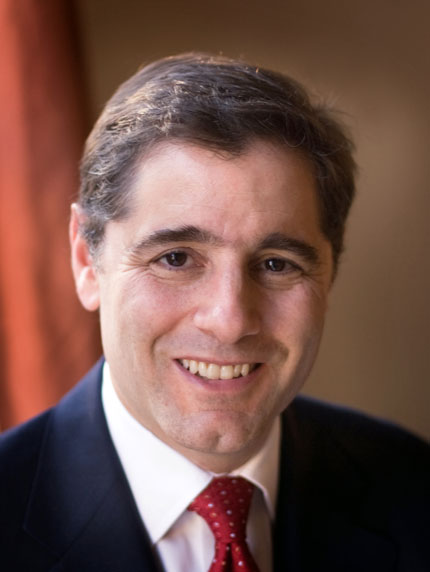
Today, Federal Communications Commission Chairman Julius Genachowski is scheduled to deliver a major announcement on reforming the Universal Service Fund (USF) — a federal program designed to subsidize the costs of delivering telecommunications services to rural America.
The reform, long overdue, would transition a significant percentage of USF fees every telephone customer pays towards broadband deployment — a noble endeavor. For years, Americans have paid more than $5 billion annually to phone companies large and small to maintain rural landline service. Small co-op phone companies depend on the income to deliver affordable service in places like rural Iowa, Kansas, and Alaska. But large companies like AT&T and Verizon also collect a significant share (around $800 million annually) to reduce their costs of service in the rural communities they serve.
That’s particularly ironic for AT&T, which time and time again has sought the right to abandon universal rural landline service altogether.
Genachowski’s idea would divert USF funding towards broadband construction projects. The argument goes that even low speed DSL requires a well-maintained landline network, so phone companies that want to deploy rural broadband will have to spend the money on necessary upgrades to provide just enough service to earn their USF subsidies. The lower the speed, the lower the cost to upgrade networks and provide the service. Some may choose wireless technology instead. Since the telephone companies have fought long and hard to define “broadband” as anything approaching 3-4Mbps, that will likely be the kind of speed rural Americans will receive.
At first glance, USF reform seems like a good idea, but as with everything at the FCC these days, the devil is always in the details.

Dampier: Another day, another self-serving plan from the phone companies that will cost you more.
While headline skimmers are likely to walk away with the idea that the FCC is doing something good for rural broadband, in fact, the Commission may simply end up rubber stamping an industry-written and supported plan that will substantially raise phone bills and divert your money into projects and services the industry was planning to sell you anyway.
Stop the Cap! wrote about the ABC Plan a few weeks ago when we discovered almost all of the support for the phone-company-written proposal comes from the phone companies who back it, as well as various third party organizations that receive substantial financial support from those companies. It’s a dollar-a-holler astroturf movement in the making, and if the ABC Plan is enacted, you will pay for it.
[Read Universal Service Reform Proposal from Big Telcos Would Rocket Phone Bills Higher and Astroturf and Industry-Backed, Dollar-a-Holler Friends Support Telco’s USF Reform Plan.]
Here is what you probably won’t hear at today’s event.
At the core of the ABC Plan is a proposal to slash the per-minute rates rural phone companies can charge big city phone companies like AT&T and Verizon to connect calls to rural areas. You win a gold star if you correctly guessed this proposal originated with AT&T and Verizon, who together will save literally billions in call connection costs under their plan.
With a proposal like this, you would assume most rural phone companies are howling in protest. It turns out some are, especially some of the smallest, family-run and co-op based providers. But a bunch of phone companies that consider rural America their target area — Frontier, CenturyLink, FairPoint and Windstream, are all on board with AT&T and Verizon. Why?
Because these phone companies have a way to cover that lost revenue — by jacking up your phone bill’s USF surcharge to as much as $11 a month per line to make up the difference. In the first year of implementation, your rates could increase up to $4.50 per line (and that fee also extends to cell phones). Critics have been widely publicizing the increased phone bills guaranteed under the ABC Plan. In response, advocates for the industry are rushing out the results of a new study released yesterday from the Phoenix Center Chief Economist Dr. George S. Ford that claims the exact opposite. Dr. Ford claims each customer could pay approximately $14 less per year in access charges if the industry’s ABC Plan is fully implemented.
Genachowski
Who is right? State regulators suggest rate increases, not decreases, will result. The “Phoenix Center,” unsurprisingly, has not disclosed who paid for the study, but there is a long record of a close working relationship between that research group and both AT&T and Verizon.
But it gets even worse.
This shell game allows your local phone company to raise rates and blame it on the government, despite the fact those companies will directly benefit from that revenue in many cases. It’s a real win-win for AT&T and Verizon, who watch their costs plummet while also sticking you with a higher phone bill.
The USF program was designed to provide for the neediest rural phone companies, but under the new industry-written rules being considered by the FCC, just about everyone can get a piece, as long as “everyone” is defined as “the phone company.” There is a reason this plan does not win the hearts and minds of the cable industry, independent Wireless ISPs, municipalities, or other competing upstarts. As written, the USF reform plan guarantees virtually all of the financial support stays in the Bell family. Under the arcane rules of participation, only telephone companies are a natural fit to receive USF money.
Genachowski will likely suggest this plan will provide for rural broadband in areas where it is unavailable today. He just won’t say what kind of broadband rural America will get. He can’t, because the industry wrote their own rules in their plan to keep accountability and oversight as far away as possible.
For example, let’s assume you are a frustrated customer of Frontier Communications in West Virginia who lives three blocks away from the nearest neighbor who pays $50 a month for 3Mbps DSL broadband. You can’t buy the service at any price because Frontier doesn’t offer it. You have called them a dozen times and they keep promising it’s on the way, but they cannot say when. You may have even seen them running new cable in the neighborhood.
Frontier has made it clear they intend to wire a significantly greater percentage of the Mountain State than Verizon ever did when it ran things. Let’s take them at their word for this example.
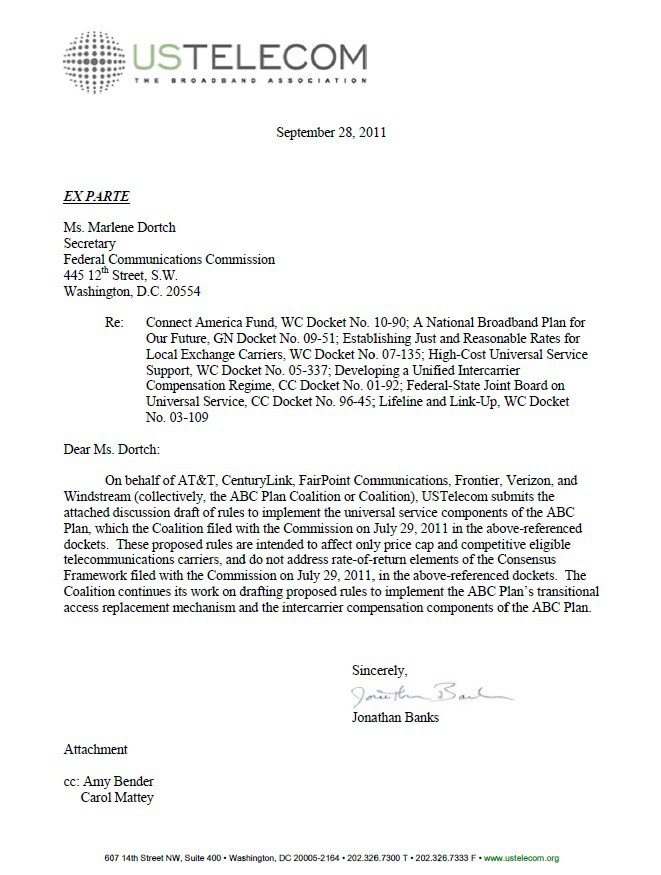
The telephone companies have helpfully written their own rules for the FCC to adopt.
Frontier’s decision to provide broadband service in West Virginia does not come out of the goodness of their heart. At a time when landline customers are increasingly disconnecting service, Frontier’s long-term business plan is to keep customers connected by selling packages of phone, broadband, and satellite TV in rural markets. Investment in DSL broadband deployment has been underway with or without the assistance of the Universal Service Fund because it makes financial sense. Our customer in West Virginia might disconnect his landline and use a cell phone instead, costing Frontier any potential broadband, TV and telephone service revenue.
Under the ABC Plan, Frontier can be subsidized by ratepayers nationwide to deliver the service they were planning to provide anyway. And what kind of service? The same 3Mbps DSL the neighbors have.
If your county government, a cable operator, or wireless competitor decided they could deliver 10-20Mbps broadband for the same $50 a month, could they receive the USF subsidy to build a better network instead? Under the phone company plan, the answer would be almost certainly no.
Simon Fitch, the consumer advocate of the Federal-State Joint Board on Universal Service, which advises the FCC on universal service matters, says the ABC Plan is a consumer disaster.
“Although a stated goal of the FCC’s reform effort is to refocus universal-service funding to support broadband, the industry’s ABC plan requires no real commitment to make broadband available to unserved and underserved communities,” Fitch writes. “Companies would receive funds to provide broadband with upload and download speeds that are already obsolete. States would be given no real enforcement power.”
Fitch is certain companies like AT&T and Verizon will receive enormous ratepayer-financed subsidies they don’t actually need to provide service.
Back to AT&T.
In several states, AT&T is seeking the right to terminate its universal service obligation altogether, which would allow the same company fiercely backing the ABC Plan to entirely walk away from its landline network. Why? Because AT&T sees its future profits in wireless. Under the ABC Plan, AT&T could build rural cell towers with your money to provide “replacement service” over a wireless network with or without great coverage, and with a 2GB usage cap.
At the press conference, Genachowski could still declare victory because rural America would, in fact, get broadband. Somehow, the parts about who is actually paying for it, the fact it comes with no speed, coverage, or quality guarantees, and starts with a 2GB usage cap on the wireless side will all be left out.
Fortunately, not everyone is as enamored with the ABC Plan as the groups cashing checks written by AT&T.
In addition to state regulators, Consumers Union, the AARP, Free Press, and the National Association of Consumer Advocates are all opposed to the plan, which delivers all of the benefits to giant phone companies while sticking you with the bill.
There is a better way. State regulators and consumer groups have their own plans which accomplish the same noble goal of delivering subsidies to broadband providers of all kinds without increasing your telephone bill. It’s up to the FCC to demonstrate it’s not simply a rubber stamp for the schemes being pushed by AT&T and Verizon.


 Subscribe
 A Comcast customer in San Carlos, Calif., wanted to change her Comcast account so she need not be reminded of the recent passing of her husband, under whose name the account was listed. A simple call to Comcast to request a change met with resistance from a representative, who told her to get in her car, drive to Redwood City, and go stand in line with an original copy of his death certificate.
Well, I received the bill dated Aug. 28, and it is still in his name.