Home » Issues » Recent Articles:

Internet Service Providers’ Claims of Expensive Bandwidth Costs are a Myth, Concludes Report

Phillip Dampier October 24, 2011 Competition, Data Caps, Wireless Broadband 3 Comments

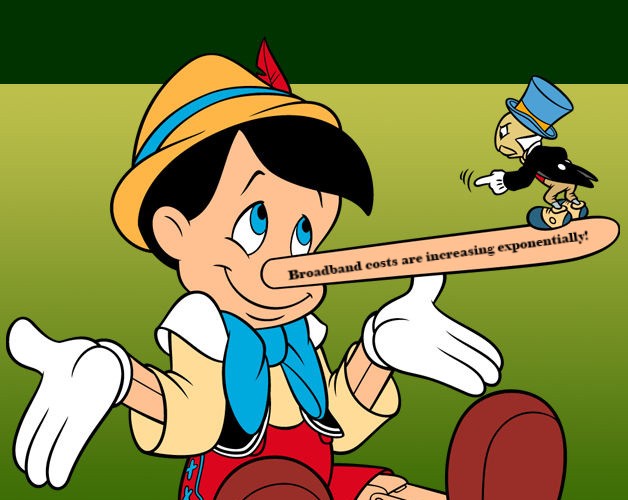
Internet Service Providers who use “increasing bandwidth costs” as an excuse to raise prices or implement an Internet Overcharging scheme like usage limits or usage-based billing are being dishonest.

That’s the conclusion of a new British report that found providers grossly overestimating the costs of meeting increasing usage demands of their customers.  In some cases, providers are inflating the price of usage by 1,000 percent or more over their own costs.

“Traffic-related costs are a small percentage of the total connectivity revenue, and despite traffic growth, this percentage is expected to stay constant or decline,” claims the report, commissioned by the British Broadcasting Corporation, Britain’s Channel 4, and Skype.  “Studies in Canada and in the UK put the incremental cost of fixed network traffic at around €0.01-0.03 per GB.”

That represents a cost of pennies per gigabyte, yet many providers charge anywhere from $0.20-10.00 or more to residential customers, an incredible markup.

The study further concludes ISP claims of “ballooning costs” are simply “a myth,” and points to company financial reports which clearly show “for fixed networks, traffic-related costs are low, falling on a unit basis and likely to fall overall given declines in traffic growth and on-going cost-reducing technical progress.”

In fact, most broadband providers are reporting decreasing costs and investment in their broadband product line, while enjoying unprecedented increased profits.

As broadband traffic increases, the technology to sustain that traffic has improved, and brought unit costs for broadband traffic to an all-time-low.

The report admits that costs for wireless technology are higher, primarily because of limited airwaves, a shared usage infrastructure, and initial expenses in delivering improving connectivity with cell or wireless radio towers.  But with the advent of 4G technology, providers can sustain increased speeds, traffic, and revenue from selling wireless service that can handle higher bandwidth applications.

Plum Consulting authored the new report.

Plum Consulting, which wrote the report, concluded that even in more expensive wireless service areas like the United Kingdom, smartphone data tariffs amounting to around €10 per GB are not justified on 4G networks.

“The cost to the mobile network operator is under €1 per GB,” Plum Consulting found.

Predictably, service providers are dismissive of the report’s findings.

Trefor Davies, CTO of communications provider Timico and a member of the board at the Internet Service Providers’ Association (ISPA) says bandwidth costs are a real problem, especially for smaller ISPs that rent access on a usage-based, wholesale access plan.

“Bandwidth is by far the greatest proportion of cost for an ISP,” Davies told PC Magazine. “It’s very much you pay for what you use,” he said. “If you use twice as much bandwidth, you’re going to be paying twice as much.”

[Thanks to Stop the Cap! reader Bill H. for sharing the news.]

Bailing Out the CW Network: Now Profitable Thanks to Netflix

Phillip Dampier October 20, 2011 Online Video Comments Off on Bailing Out the CW Network: Now Profitable Thanks to Netflix

The CW Television Network

First it was the United Paramount Network (UPN) and The WB Television Network (WB), two mini-networks run by their respective studios that simply refused to become profit centers and established challengers to more traditional broadcast networks.  In 1996, both networks combined to create The CW Television Network, and the result has been less than the two original networks had hoped.  Youth-oriented programming targeted to an audience that increasingly doesn’t watch traditional television and a challenging advertising market that has considerably declined since 2009 haven’t helped.

Now the folks in charge of the CW are resting a lot easier, all thanks to Netflix.  The movie streaming and rental service is reported to be signing an agreement worth upwards of $1 billion to access CW programming for its streaming service.

Les Moonves, chief executive of CBS Corp., which now co-owns the network with Warner Bros., couldn’t be happier.

“It essentially makes the CW a profitable enterprise,” Moonves said.

The Los Angeles Times reports:

Netflix is buying rights to repeats of current and future series on the network, and the longer the shows stay on the air and performs well, the more the subscription video company will pay for streaming rights.

For example, Netflix is paying in the neighborhood of $600,000 an episode for “Gossip Girl,” an established show, but will initially pay much less for newer or lower-rated CW programs, people familiar with the pact said. The window between when a new episode of a CW show appears on the network and then ends up on Netflix could be as long as a year.

Netflix has exclusive online subscription rerun rights to all episodes of all CW shows. However, CBS and Warner Bros. can still sell reruns to other outlets, including local television stations and cable networks.

Netflix is hurrying to sign new programming deals as it prepares to lose access to an important component of its streaming library — current movie titles that come courtesy of an expiring agreement with Starz.  Netflix said without renewing that agreement, it would spend heavily to try and find new programming to make up the difference.  The deal with the CW may be an example.

Cord Cutters Can Now Buy Package of Streaming News Channels

Phillip Dampier October 20, 2011 Competition, Editorial & Site News, Online Video 1 Comment

Besides sports, the biggest challenge for cord-cutters is to find access to 24-hour news channels they give up when they cancel pay television service.  While cable news often doesn’t actually spend much time on “news” when breaking stories are few and far-between, when something serious does happen, cord-cutters looking for live coverage can and do miss access to news networks.

But now a New York startup, RadixTV, has a solution for news junkies: Rtv.

Yesterday, the company launched a package of four cable news networks — Bloomberg, CNBC, CNBC World, and MSNBC streamed live 24 hours a day for $14.99 a month.

That’s a steep price for four channels, of which MSNBC is arguably the most important.  The company plans to expand to 10 channels in the future, including CNN, Fox News, and international news networks like BBC World, France 24 and Al Jazeera English that American cable companies routinely ignore.

Kaul

Rtv is pitched primarily to Wall Street — financial firms, brokerages, and investment businesses that want access to continuous business news but don’t need a traditional cable package.  In fact, the package is technically only supposed to be sold to business customers, but anyone can sign up if they say they are stock traders, accountants, investors, etc.

Stop the Cap! sampled Rtv this morning and found the service to work well with our broadband connection, although at times crawling news and stock prices found at the bottom of the screen on some channels seemed less smooth than they could be.  It occasionally was distracting.  MSNBC was the most compelling channel in the lineup, although we’d love to see international news channels even more.  But $15 a month is still a high price to pay.

The company’s CEO, Bhupender Kaul, worked for Time Warner Cable for nearly two decades, and believes the future of cable TV is likely to be Internet-based, with programming sold in niche packages like his.  True a-la-carte may be too unwieldy for providers to pull off, but selling groups of channels together might not.  Still, Kaul seems intent on not aggravating the industry as much as earlier cord-cutting online viewing services, which have all since been sued out of existence.  Local broadcast and general interest programming does not come with Rtv.  While a six figure-salaried Wall Street banker won’t mind $15 a month, you might.

Further reading: In New Web TV Service, A Glimpse of the Future

Nobody Trusts Big Cable and Phone Companies, New Research Finds

Phillip Dampier October 20, 2011 Consumer News Comments Off on Nobody Trusts Big Cable and Phone Companies, New Research Finds

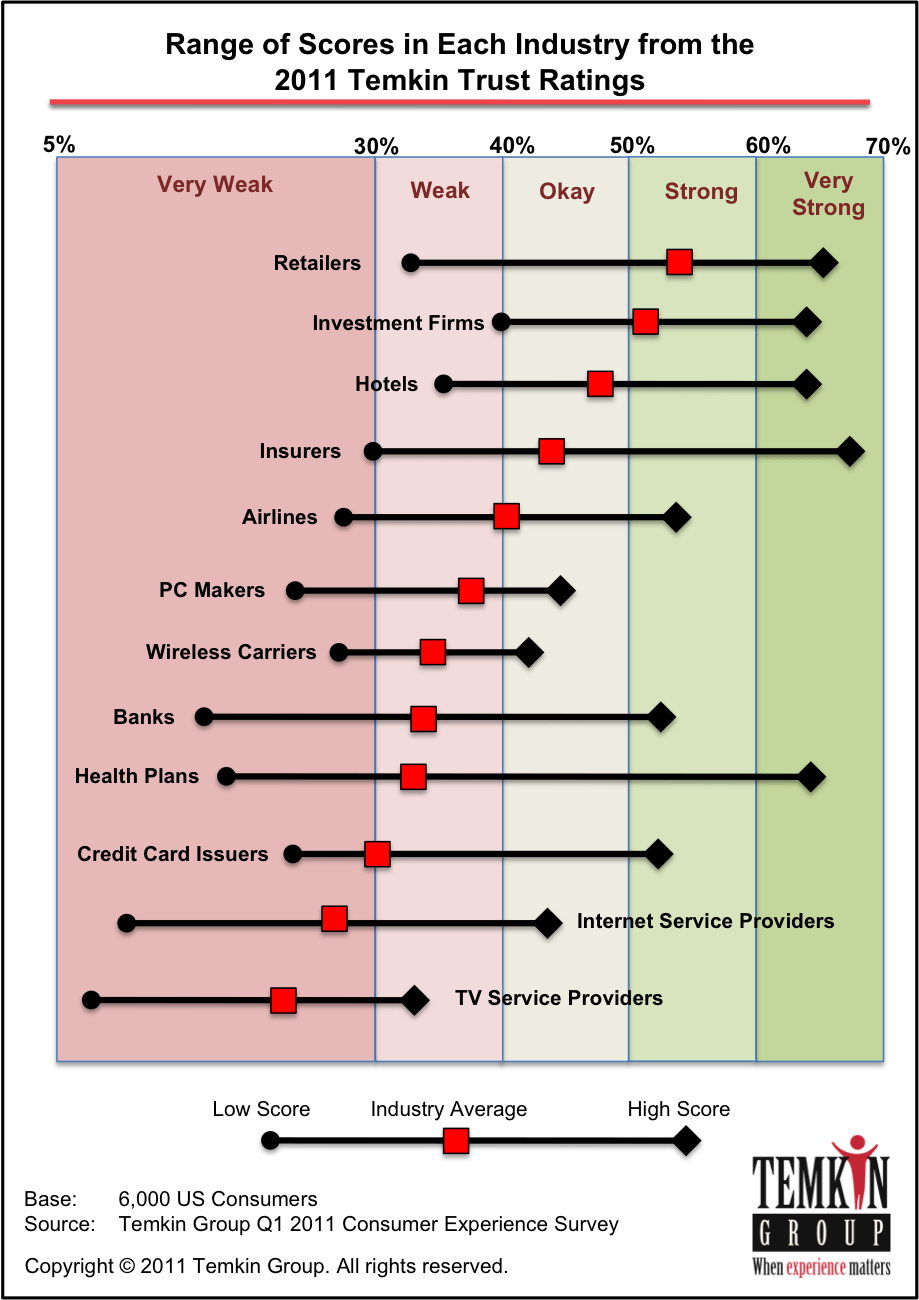
Even after the financial meltdown and the Great Recession, Americans still trust their cable and telephone companies even less than bailed-out financial institutions, mortgage brokers, credit card issuers, insurance companies, and airlines.

Those are the findings of the Temkin Group, which polled 6,000 U.S. consumers who recently contacted the surveyed companies to obtain customer service, support, or to ask a question or resolve a billing issue.

Temkin asked, “to what degree do you trust that these companies will take care of your needs?”  Responses were scored on a scale of 1-7 — from “do not trust at all” to “completely trust.”

The results show there is plenty of room for improvement for phone, wireless, and Internet providers.

The top-10 scoring companies don’t sell Internet service:

1. USAA (insurance)
2. Amazon.com (retail)
3. Costco (retail)
4. Edward Jones (investment firm)
4. Hyatt (hotel chain)
4. Sam’s Club (retail)
4. TriCare (health plan)
8. Kohl’s (retail)
9. Walgreens (retail)
10. Vanguard (investments)

Lower-rated companies do.  Here’s a sampling of where many telecom companies ended up (from better to worse) with respect to Internet and wireless service:

54. MSN
60. Cox Communications
89. Verizon Wireless (wireless)
90. T-Mobile
93. Sprint
100. AT&T (wireless)
104. AOL
106. AT&T (Internet service)
109. Cablevision
113. Time Warner Cable/Road Runner (Internet service)
120. Qwest
122. Virgin Mobile
140. Comcast
142. Charter Communications

Charter scored dead last out of 143-rated companies.  Customers trashed both Charter’s Internet service (142) and their cable-TV service (143).

Temkin shows telecom companies rate dead last.

Florida Woman Gets $201,000 T-Mobile Bill: Data Roaming Bill Shock Nightmare

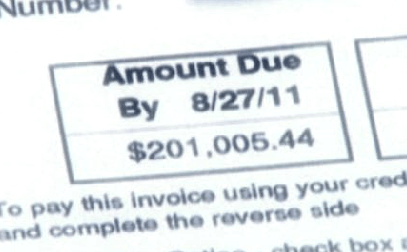
A Miami woman fell to pieces when T-Mobile sent her a cell phone bill that was higher than the purchase price of many nice suburban homes, after a two-week trip to Canada turned into a data roaming disaster.

Celina Aarons is the latest victim of bill shock — when phone and cable companies send surprise bills that throw families into turmoil, begging for help from the provider that could either aggressively collect or save your sanity by reducing the bill.

Aarons appealed to WSVN Miami’s consumer reporter Patrick Fraser for help after the bill arrived.

“I was freaking out. I was shaking, crying, I couldn’t even talk that much on the phone,” Aarons said. “I was like my life is over!”

It turns out her deaf brother uses a phone on her account to communicate… a lot.  He routinely sends thousands of text messages a month, in addition to relying heavily on the mobile smartphone’s Internet access.  He had no idea a two-week trip to Canada would invoke an insanely high data roaming rate — $10 per megabyte.  Text messages sent while roaming in Canada run $0.20 each, with or without a texting plan.  Just running an online video at those rates will easily rack up charges well over $1,000.  And they did.

Unfortunately for Celina, T-Mobile claims to have sent a handful of warning messages — to her brother’s phone, never to hers.  He claims he never saw them.  She’s ultimately responsible for the bill, and she’s upset T-Mobile didn’t notify the primary account holder — her — of the rapidly accumulating roaming charges.  T-Mobile told her they don’t send such notifications for “privacy reasons.”

[flv width=”630″ height=”374″]http://www.phillipdampier.com/video/WSVN Miami Help Me Howard – High phone bill 10-17-11.mp4[/flv]

WSVN in Miami explains what happened when Celina Aarons received her 40+ page T-Mobile bill… for $201,000.  (4 minutes)

Life's for sharing a $201,000 cell phone bill.

That’s how parents end up receiving bill shock of their own, when children handed phones run up enormous charges mom and dad never learn about until the bill arrives in the mailbox.  By then, it’s too late.

The Federal Communications Commission was supposed to take direct action to put an end to bill shock by demanding carriers send clear warnings when usage allowances are used up or when roaming charges begin to accrue.  It was a priority for FCC Chairman Julius Genachowski, until wireless industry lobbyists convinced him to abandon the effort, choosing an industry-sponsored voluntary plan instead.

Genachowski quietly put the FCC’s own proposed bill shock regulations on hold, which also likely means an abdication of the agency’s responsibility to closely monitor the wireless industry’s adherence to its own voluntary guidelines.

The CTIA Wireless Association, the industry’s largest trade and lobbying group, will be coordinating the “early warning” program, but will take their time implementing it.  The industry wants until October 2012 to implement the first phase of its program, which will send text messages for usage allowance depletion and excessive usage charges.  It also wants even more time — April 2013 — before the industry is expected to adopt additional service alerts.

Genachowski: Abdicated his responsibility to protect consumers in favor of the interests of the wireless industry.

The wireless industry’s plan is based entirely on early warning text messages.  It does not provide any of the top-requested protections consumers want to end the wallet-biting:

  1. The ability to shut off services once usage allowances are depleted until the next billing cycle;
  2. An opt-in provision which requires customers to authorize additional charges before they begin;
  3. The ability to shut off services and features on individual handsets on their account;
  4. The ability to easily opt-out of all roaming services, so sky high excess charges can never be charged to their accounts;
  5. Provisions to require providers to eat the bill if it is demonstrated that warning messages never arrived;
  6. Fines and other punishments for carriers who fail to meet the provisions of either a regulated or voluntary plan.

The CTIA’s plan won’t stop some of the horror stories Genachowski spoke about earlier this year, when he was still advocating immediate action by the Commission.  Among them:

  • Nilofer Merchant: Racked up $10,000 in international roaming and overlimit fees while visiting Toronto.  AT&T waited until after she returned to the United States before notifying her of the charges.  They “generously” agreed to reduce the bill to $2,000, which they ultimately pocketed.
  • A woman who rushed to attend to her sister in Haiti after the 2010 earthquake found more tragedy when her provider billed her $34,000 in roaming charges;
  • A man whose limited data plan ran out faced $18,000 in overlimit fees before the provider notified him his bill was going to be higher than normal that month.

The wireless industry’s chief lobbyist, CTIA president Steve Largent, declared total victory.

“Today’s initiative is a perfect example of how government agencies and industries they regulate can work together under President Obama’s recent executive order directing federal agencies to consider whether new rules are necessary or would unnecessarily burden businesses and the economy,” Largent said.

Consumer groups are less excited.

Text message warnings or not, the wireless industry still wants to be paid.

Joel Kelsey, a policy analyst at public interest group Free Press, said he was skeptical providers would be making their customers their first priority under the voluntary program.

“Asking the uncompetitive wireless industry to self-police itself is like asking an addict to self-medicate,” said Kelsey. “The FCC is charged by Congress to protect consumers, and they should use their authority to write a rule that puts an end to $16,000 monthly cellphone bills.”

“Wireless carriers are not charities — they will make the most revenue they can from their user base,” Kelsey said. “And since competition is weak in this industry, there aren’t natural incentives for companies to be on their best behavior.”

T-Mobile, which is in the process of trying to merge with AT&T, has agreed to discount Aarons’ bill to $2,500 and give her six months to pay.  Stop the Cap! reader Earl, who shared the story with us, suspects that kind of charity won’t last long.

“This won’t happen again if AT&T merges with T-Mobile,” Earl suspects.

While $2,500 is a considerable discount over the original bill, customers who have suffered from bill shock would prefer an even better deal — no surprise charges at all.

That kind of deal is unlikely if the FCC continues to defer to the wireless industry, who have few incentives to provide it.

Consumers can reduce the chances of wireless bill shock by checking with their wireless provider to see if roaming services can be left turned off unless or until you activate them.  Many companies also offer smartphone applications to track usage and billing, useful if you have a family plan and want to verify who is doing what with their phone.  Avoid taking your cellphone on international trips, and that includes Canada.  If you need a cell phone abroad, we recommend purchasing a throwaway prepaid phone when you arrive and rely on that while abroad.  Such phones can be had for as little as $10, and per-minute rates are usually substantially lower than the roaming charges imposed by providers back home.

If you must travel with your phone, carefully consider roaming rates before you go.  Some carriers may offer international usage plans that discount usage fees.  You can use Wi-Fi to manage data sessions, but it’s best to avoid high bandwidth applications while abroad altogether.  One movie can cost a thousand dollars or more in international roaming charges.

While T-Mobile could have provided warnings to Aarons’ own phone as her bill began to skyrocket, T-Mobile’s bill was ultimately correct.  Wireless phone users must take personal responsibility for the use of phones on their account.  Aarons’ brother ignored the handful of warnings T-Mobile claims to have provided, and the agony of the resulting bill no doubt created tension inside that family.  Don’t let a wireless phone bill tear your family apart.  Take steps to protect yourself, because it’s apparent the FCC won’t anytime soon.

[flv width=”640″ height=”380″]http://www.phillipdampier.com/video/PBS NewsHour New Alerts to Stop Bill Shock 10-17-11.flv[/flv]

PBS NewsHour interviews FCC Chairman Julius Genachowski about the pervasive problem of “bill shock,” and why the Commission elected to defer to the wireless industry to voluntarily alert consumers when their bills explode.  (7 minutes)

Search This Site:

Contributions:

Recent Comments:

Your Account:

Stop the Cap!