Home » Issues » Recent Articles:

1 Down, 1 to Go: Bell Plans to Suspend Speed Throttling for Wholesale Customers

After nearly a half-million Canadians expressed outrage about Bell’s Internet Overcharging practices, the company is responding.  This week, Bell sent a letter to their wholesale customers announcing it plans to end the practice of speed throttling peer-to-peer file traffic (at least for them):

Effective November 2011, new links implemented by Bell to augment our DSL network may not be subject to Technical Internet Traffic Management Practices (ITMP).  ITMPs were introduced in March, 2008 to address congestion on the network due to the increased use of Peer-to-Peer file sharing applications during peak periods. While congestion still exists, the impact of Peer-to-Peer file sharing applications on congestion has reduced. Furthermore, as we continue to groom and build out our network, customers may be migrated to network facilities where Technical Internet Traffic Management Practices (ITMPs) will not be applied.

Peer-to-peer traffic, once all the rage for swapping music, movies, and software (legally or otherwise), has been declining as a percentage of Internet traffic and legal online entertainment services (Netflix, et al.) have become available.  Copyright crackdowns and usage caps manage to further restrict customers from leaving P2P software running continuously as it can rapidly eat into usage allowances.

With increased capacity of Bell’s networks and decreased interest in file swapping software among customers, the practice of throttling such traffic (along with the unintended collateral damage to online gaming), means such network management practices have outlived their usefulness.

Providers these days are far more likely to blame online video for congested networks.  But once providers attach a speed throttle to an application, it can be difficult to remove.  Even as Bell announced it would no longer throttle their wholesale clients, retail customers will still suffer with reduced speeds during “peak usage times” — 4:30pm-2am local time.

Michael Geist, who covers Canadian broadband issues, wonders if Bell’s throttles are actually in violation of the Canadian Radio-television and Telecommunications Commission’s traffic management guidelines:

While Bell says its congestion has been reduced, its retail throttling practices have remained unchanged, throttling P2P applications from 4:30 pm to 2:00 am.  Given the decline in congestion, a CRTC complaint might ask whether the current throttling policy “results in discrimination or preference as little as reasonably possible” and ask for explanation why its data cap policies “would not reasonably address the need and effectively achieve the same purpose as the ITMP.”  In fact, the same can now be said for many other ISPs who deploy broad based throttling practices (Rogers, Cogeco), which may not be reasonable under the CRTC policy.


No Matter the Technology, Fiber to the Home is Better… Period

Phillip Dampier October 18, 2011 Broadband Speed, Community Networks, Competition, Data Caps, Editorial & Site News, Public Policy & Gov't, Rural Broadband, Video Comments Off on No Matter the Technology, Fiber to the Home is Better… Period

Phillip "Wants a High Fiber Diet" Dampier

Believe it or not, there are still some people out there who believe wireless broadband, as it exists today, is the future of high bandwidth communications in North America.  Forget DSL, forget cable, forget fiber optics, they say.  Technology like 4G and WiMax are “far superior” and cheaper.

To be fair, most of the people advocating the technology Sprint is in the process of abandoning have a vested interest in stopping fiber broadband projects.  That is because while Verizon continues to sit on its hands expanding its excellent FiOS fiber-to-the-home service, some of the most aggressive fiber projects in the country are being built by your local town, city, or village government.  It’s community-owned broadband, by and for the people in your own area.  Large telecom interests that have always refused to deliver fiber service (or pretend to by using the word ‘fiber’ while not bringing a single strand to your home) have it in for potential competitors that are willing to provide the advanced fiber technology they won’t.

So why aren’t big phone and cable companies providing this level of service?  In a word, money.  Their shareholders don’t like the initial cost of deploying fiber to the home service, even though the technology is superior to what reaches your home today, is infinitely expandable without stringing new cables across town, and can support money-making applications developers and providers have not even dreamed of yet.  With a pervasive lack of competition, there is nothing to overcome Wall Street’s conclusion that fiber doesn’t deliver fast enough profits to justify the initial expense.

When you take Wall Street out of the equation, especially in the telecom sector, the math works very differently.  While the phone and cable company is probably telling you “no,” companies like Google are saying yes in Kansas City.  So are municipally-owned rural co-operative phone and cable companies.  Communities deciding broadband is too important to leave to the phone companies that deliver half their residents 1-3Mbps DSL and call it a day are saying yes to fiber optics as well.

Overseas, fiber networks are being built in countries in Eastern Europe where the economics would never make sense by Wall Street standards, yet residents (and perhaps more importantly new digital economy businesses) are now getting Internet speeds of 100Mbps or better.  The next countries that could import good-paying American jobs might be Lithuania, Latvia, Poland, Romania, and Bulgaria.

So what does it take to adapt to this reality in North America?  Providers that are willing to make a long term investment in fiber broadband — one that may take a few extra years to pay back, but will generate dividends like increased employment, capacity to provide better, faster service, more reliable networks, and earning a piece of the action powering North America’s new digital economy.  If they won’t listen, tell your elected officials to support policies that promote additional competition and back community broadband expansion that can make all the difference between 3Mbps DSL and 100Mbps fiber.

[flv width=”640″ height=”372″]http://www.phillipdampier.com/video/Fiber is Better.flv[/flv]

Watch and share this video with friends and family to educate them about the infinite possibilities of fiber optic broadband and learn why it is superior to usage-capped wireless, slow speed DSL, satellite fraudband, or lopsided cable “High Speed Internet” broadband that delivers high speed in only one direction. (3 minutes)

AT&T Billing and Service Practices Under Increasing Scrutiny After New Revelations

Phillip Dampier October 18, 2011 AT&T, Consumer News, Data Caps, Public Policy & Gov't, Video, Wireless Broadband Comments Off on AT&T Billing and Service Practices Under Increasing Scrutiny After New Revelations

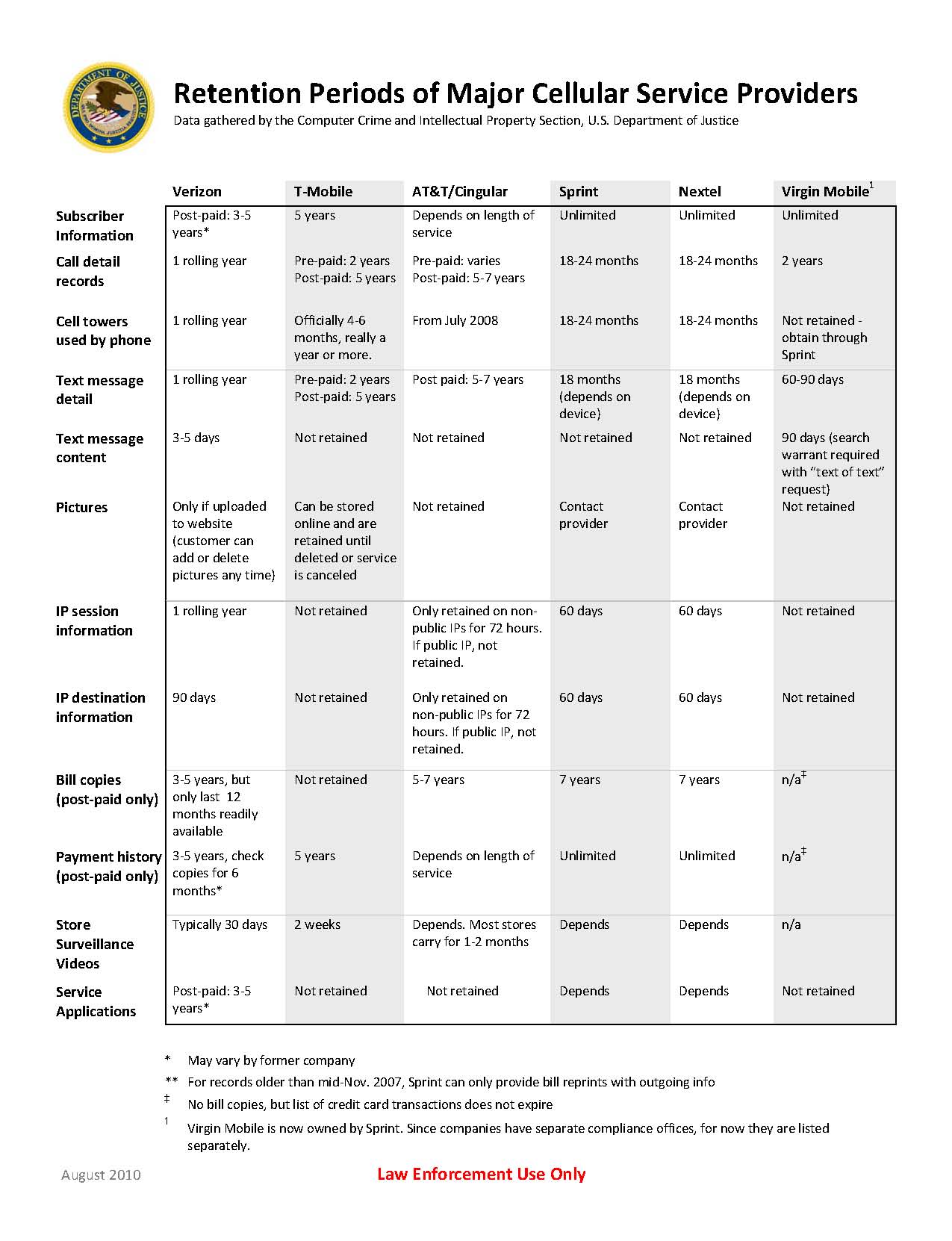
AT&T admits it holds on to some customer data, including text message details, calling records, and billing statements for as long as seven years according to a new Justice Department document that raises privacy and security concerns.

“This disclosure reflects the importance of data minimization,” Greg Nojeim, senior counsel at the Center for Democracy and Technology in Washington, told Bloomberg News. “Some companies do a much better job of disposing of sensitive, personally identifiable information. Once such information is no longer needed for business-reasons, it shouldn’t be held onto because of the risks that it could be obtained by a hacker.”

Privacy advocates are also concerned the lengthy storage offers new opportunities for government intrusion into customer privacy, either for national security or law enforcement purposes.

Although every cell phone company maintains storage of customer and billing records, few keep the data for more than one year.  AT&T stores the data the longest, by far, and that bothers the American Civil Liberties Union of North Carolina:

AT&T/Cingular appears to keep all of its cell tower records since July 2008. How long do they plan to keep this data for? Are they just creating an infinite record of everywhere you’ve ever been with your cell phone? Do you remember where you were on September 28, 2008? If you have AT&T/Cingular, your phone company may know. And they might tell the cops.

But the company says it acts as a responsible steward of the information it warehouses.

AT&T gathers data to provide “the best customer experience possible” and uses “powerful encryption and other security safeguards to protect customer data,” according to the company’s privacy policy.

(Click to enlarge)

The ACLU chapter filed a Freedom of Information Act request to obtain the data seen above.  Once the ACLU won their request, the Justice Department publicly posted the information on their website.

In addition to basic billing and customer data, cell phone companies also record the specific cell towers used when making and receiving calls and the messages that travel across their networks, including where they originated and where they were sent.  The numbers called, call length, and the times of day when your phone is used the most were all recorded.  Some cell phone companies also use the data for marketing purposes.

Also in North Carolina, last week we shared the story of George Kontos, who single-handedly faced down AT&T, who overcharged his family for nearly two years’ of service.  After finally winning a refund of nearly $2,000, Kontos updates Stop the Cap! with news the North Carolina Attorney General’s office has taken an interest in the case and plans to launch a statewide investigation into AT&T’s billing practices.  If the state turns up problems, it’s only a matter of time before other states start their own investigations.

[flv width=”480″ height=”290″]http://www.phillipdampier.com/video/WITI Milwaukee Five year dispute with ATT 10-10-11.mp4[/flv]

The Attorney General of Wisconsin might find something to investigate in Wauwatosa — namely one local woman’s five-year fight with AT&T to maintain basic landline phone service.  WITI in Milwaukee shares the story of Darnelle Kaishian, who considers fighting AT&T her “full time job.”  It’s so bad, her friends now visit her in person, because her phone almost never works.  (2 minutes)

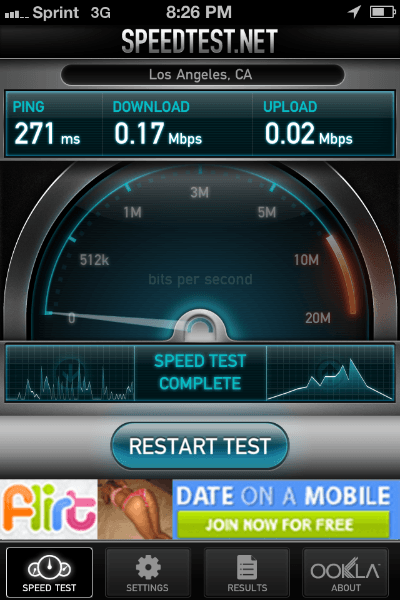
iPhone 4S Pounding Sprint’s Network Into Dust: 0.21Mbps and Slowing….

Sprint customers are not thrilled with their new neighbors — the Apple iPhone 4S crowd that just moved into the network.

In several areas across the country, Sprint customers are howling about network speeds plummeting over the weekend, just as new iPhone owners began activating their phones.

“This is completely unacceptable,” Clive Dearstromm writes Stop the Cap!  “I have been a Sprint customer for five years, and while their network has never been the fastest, what has happened since Friday morning is ridiculous.  I can’t get beyond 210kbps.”

Dearstromm can’t even reliably access his e-mail on Sprint’s 3G network today, and Sprint has denied there is a service outage in Florida.

“Coincidence?  I think not,” he adds.

Other Sprint customers have also noticed, and are not happy.  In South Los Angeles, one customer reports speeds of around 170kbps on Sprint’s network.

“I moved from AT&T to Sprint because of unlimited data, but if this continues I might have to move back,” writes the customer. “I can’t even open a web page without taking a minute or two.”

Sprint denies there is a problem, telling PC Magazine:

“As always, Sprint is carefully monitoring the performance of the 3G network. We are looking into a small number of reports of slow data speeds when using the iPhone 4S, however there are also reports showing that Sprint’s network is the fastest, such as the Gizmodo report that came out earlier today. Speed tests represent a moment in time and are subject to many variables including weather, time of day, device, and proximity to a tower. Sprint will continue to monitor the feedback we are getting from our customers and will investigate and resolve any issues that may arise,” the company said in a statement.

PC Magazine questioned Gizmodo’s test results, suggesting Wi-Fi speed tests might be mucking up the accuracy of the results.  By this morning, it was evident Sprint was in last place, compared with AT&T and Verizon, and because speeds slowed the most during peak usage times, it’s a sure sign of network congestion.

Apple iPhone owners are a demanding crowd, and many of them aren’t happy about their Sprint iPhone experience either.  The new phone’s most important gimmick feature, Siri, does not work well on congested networks.

[flv width=”360″ height=”290″]http://www.phillipdampier.com/video/WNYW New York Siri and iPhone Activations 10-17-11.mp4[/flv]

WNYW-TV in New York found frustration demonstrating Siri, with or without the Sprint network.  It’s also apparent wireless carriers had some early trouble activating the enormous number of new iPhone handsets.  (6 minutes)

Customers want an explanation and an idea of when things will get better.  Thus far, Sprint has asked customers with speed problems to report them to the company for investigation, but some customer service representatives candidly admitted Sprint was unprepared for the massive number of new customer activations since Friday morning.

If things don’t get better soon, some of Sprint’s newest customers may take their business elsewhere.  Sprint accepts returns and penalty-free contract terminations within 14 days of the phone’s activation (not purchase) on Sprint’s network.

[flv width=”360″ height=”290″]http://www.phillipdampier.com/video/WPTZ W Palm Beach New Iphone4 launch the best yet for ATT 10-15-11.mp4[/flv]

Amidst dozens of stories of the iPhone 4S’ arrival, West Palm Beach’s WPTZ caught our attention as local law enforcement had to be called in to manage the inevitable traffic jams wherever the new phone went on sale.  (2 minutes)

Cogeco Unveils DOCSIS 3 Upgrades in Niagara Falls, St. Catherines, Ont.

Phillip Dampier October 18, 2011 Broadband Speed, Canada, Cogeco, Data Caps 1 Comment

Cogeco customers in the Niagara Region watching their neighbors further north in Hamilton and Toronto enjoy faster broadband service can finally obtain faster Internet access from incumbent cable provider Cogeco, who this week unveiled three new faster speed packages in Niagara Falls and St. Catherines.

Cogeco’s Turbo 20, Ultimate 30 and Ultimate 50 High Speed Internet packages are all powered by DOCSIS 3 upgrades, which allow cable operators to bond multiple “channels” together to deliver faster Internet speeds.

Unfortunately, while download speeds of up to 50Mbps can be enticing, Cogeco’s upload speeds, even on their DOCSIS 3 network, are downright stingy.  Thanks to Cogeco’s relentless Internet Overcharging schemes, so are the usage caps.  The Turbo 20 package tops out at 20/1.5Mbps and offers only 80GB of included traffic.  After that, pony up $1.50/GB, up to a maximum of $50 in overlimit penalties.

The Ultimate 30 package includes 30/2Mbps with 175GB of data transfer capacity.  The Ultimate 50 pack delivers 50/2Mbps service with a 250GB cap.  But customers entranced with the extra speed should watch their wallets.  Cogeco’s overlimit fee is $1/GB on these packages with no maximum limit on those charges.

At least Cogeco is satisfied with their newest offer.

“We always strive to offer our customers more flexibility, speed and choices. Today, the whole family can use the Internet at the same time for online banking, video gaming, shopping or for downloading videos or films, and all with the same service. Cogeco’s HSI packages Turbo 20, Ultimate 30 and Ultimate 50 meet those needs perfectly,” said Ron Perrotta, vice president, Marketing and Strategic Planning.

The new Turbo 20 package is currently on promotion and offered for $44.95 per month for 12 months for customers who also subscribe to Cogeco’s Television and/or Home phone services, and for $54.95 per month for 12 months for those who only want to subscribe to the High Speed Internet service. Turbo 20’s regular price is $49.95 if bundled with other Cogeco services and $59.95 on a standalone basis.

For customers who subscribe to more than one Cogeco service, Ultimate 30 is offered for $59.95 per month and Ultimate 50, for $99.95 per month. Ultimate 30 and Ultimate 50 are also available on a standalone basis for $69.95 and $109.95 respectively.

Search This Site:

Contributions:

Recent Comments:

Your Account:

Stop the Cap!