Home » Issues » Recent Articles:

AT&T: Basic Telephone Service In Death Spiral – Deregulate Us For 21st Century Upgrade

Phillip Dampier

In a remarkable statement to the Federal Communications Commission in Washington, AT&T has joined Verizon in predicting the imminent demise of Ma Bell’s classic telephone network.

AT&T writes in its 30 page comment, “That transition is underway already: with each passing day, more and more communications services migrate to broadband and Internet Protocol (IP)-based services, leaving the public switched telephone network (“PSTN”) and plain-old telephone service (“POTS”) as relics of a by-gone era.”

AT&T claims abandoning the old legacy phone network would help the company devote its full resources into staying relevant by constructing a broadband, IP-based network that would deliver voice, data, and video to consumers, presumably over its U-verse platform.  That, according to AT&T, could help the company achieve universal broadband coverage in its service areas, but only if investment-friendly regulations are supported by Washington policymakers.

The Commission has been charged by Congress with formulating a National Broadband Plan that will result in broadband availability for 100% of the United States. That auspicious goal is within reach, but […] will not be met in a timely or efficient manner if providers are forced to continue to invest in and to maintain two networks. Broadband is dramatically changing the way Americans live, work, obtain health care, and interact with the government. Congress and the Commission have rightly made universal broadband access a core national priority. But achieving this goal will take an enormous investment of capital. Private investment from network operators has brought broadband access to over 90% of Americans, and these operators will continue to play a pivotal role in bringing broadband to the remaining 8-10% of citizens who do not currently have broadband access. It is accordingly crucial that the Commission pursue forward-looking regulatory policies that remove disincentives to private investment and encourage operators to extend broadband to unserved areas.

While broadband usage – and the importance of broadband to Americans’ lives – is growing every day, the business model for legacy phone services is in a death spiral. Revenues from POTS are plummeting as customers cut their landlines in favor of the convenience and advanced features of wireless and VoIP services. At the same time, due to the high fixed costs of providing POTS, every customer who abandons this service raises the average cost-per-line to serve the remaining customers. With an outdated product, falling revenues, and rising costs, the POTS business is unsustainable for the long run.

AT&T cites a growing number of Americans cutting their wired phone line service — 22% according to the National Center for Health Statistics.  Craig Moffett from Bernstein Research pegs it closer to 25%, with an additional 700,000 phone lines being disconnected every month.  With a shrinking customer base, the viability of companies providing only wired phone service has come into question.  Verizon and AT&T, the nation’s largest phone companies, have made the judgment it’s a dying business.  Conversely, Frontier Communications and a few other independent phone companies remain believers in rural copper wire phone networks, and are willing to buy the discarded, mostly rural regions their bigger counterparts can’t wait to exit.

But AT&T’s advocacy for an end to “plain old telephone service” is just a tad self-serving when one explores their “To-Do” list for Washington regulatory agencies and lawmakers.  AT&T suggests their future plan benefits all Americans.  Critics would contend it mostly benefits AT&T and its shareholders, especially in light of AT&T’s future revenues being directly impacted by customers disconnecting their AT&T phone lines.  AT&T themselves note collective industry revenue for basic phone service fell from $178.6 billion in 2000 to $130.8 billion in 2007, a 27% decrease.

AT&T’s Action Plan to Avoid Obsolescence Explored
AT&T's U-verse system represents AT&T's broadband-based network
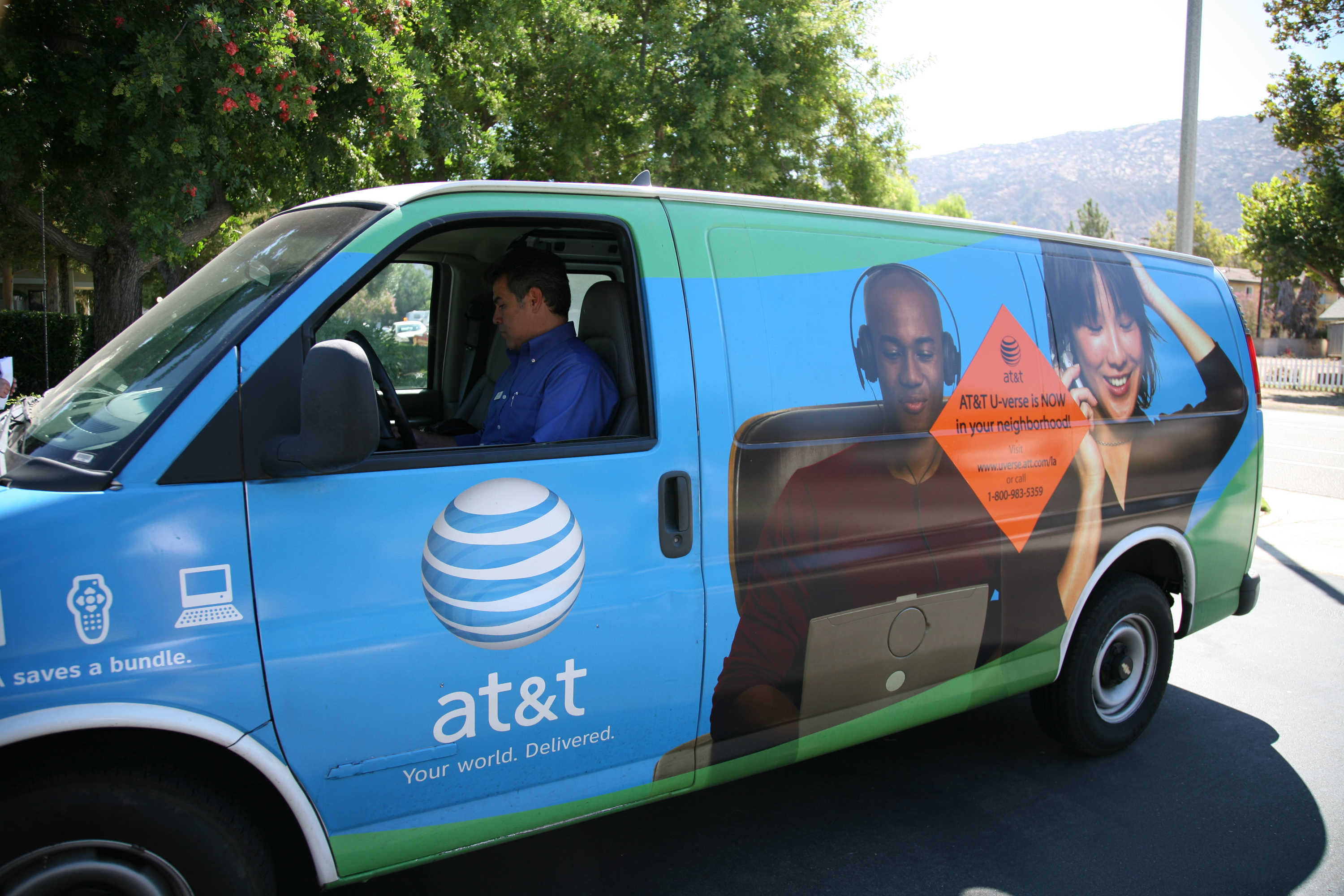
At the heart of AT&T’s proposal for 21st century telephone service is an end to analog telephone service, designed more than 100 years ago to carry voice calls, and the launch of broadband-based service to every home in their service area.  From this new platform, AT&T can deliver telephone, television, and Internet service over a single network.  In fact, they already do in several cities where AT&T’s U-verse has launched. Instead of getting one revenue stream from basic phone service, AT&T can now earn from any number of services a broadband platform can support.

AT&T compares their plan with the transition from analog to digital television, except you won’t have to trade in your existing phones or attach converter boxes to every telephone in the house.  Just like the switch to digital television, AT&T wants a date certain to pull the plug on Ma Bell’s old phone network, the sooner the better.

But AT&T’s plan has plenty of strings attached.

First, the company believes the only path to private investment and a successful transition is a near-complete deregulation of the telephone industry.  It wants the federal government, specifically the FCC, to take control of oversight of phone companies across America, if only to end a patchwork of state regulations and service requirements.  Remember, the Ma Bell most Americans grew up with was a regulated monopoly.  In return for guaranteed profits, phone companies agreed to meet service obligations, provide service to any home or business that wanted it, serve the disabled, and provide discounted phone service to the economically disadvantaged.  Rural customers were assured they would have access to phone service and at reasonable prices, and if something stopped working, government oversight ensured problems would be repaired to the customer’s satisfaction.

In AT&T’s view, such requirements are quaint and outdated, and it wants to bear few of those burdens going forward.  Indeed, in a too-cute-by-half aside, the company argues that since it will design the network to operate under the same protocol the unregulated Internet uses, it should be unregulated as well.

Such deregulation could impact a myriad of policies governing phone service that most Americans take for granted — minimum service standards, requirements that telephone companies complete calls between one another – even if competitors, and reasonably priced basic phone service even in the most remote locations.  But AT&T is asking for even more – a comprehensive review and possible elimination of any regulation that could be interpreted as interfering with the transition to an all-broadband telephone network.  AT&T includes everything but the kitchen sink in this category, ranging from service quality requirements, reporting, recordkeeping, data collection, accounting, and depreciation and amortization rules governing how quickly the company can write off obsolete equipment.

Ma Bell's network is due for a retirement, advocates AT&T

Ironically, AT&T wants deregulation -and- access to public taxpayer dollars to construct their new network.  The company advocates government-funded award programs to promote universal broadband access.  One would provide money for wired broadband service, perfect for companies like AT&T that want to build those networks, and another for wireless mobile projects to expand service into unserved or underserved areas, also perfect for AT&T Mobility — the same wireless carrier slammed by Verizon Wireless for largely ignoring rural America with 3G wireless data upgrades.

While there is some justification for a review of federal and state rules that may no longer realistically apply to today’s telecommunications marketplace, AT&T goes out of its way to be self-serving in its recommendations.  It dangles the bright and shiny object of a 21st century broadband-based telephone network, but only if they get to run it essentially “no questions asked,” with little oversight and an infusion of public taxpayer dollars to compliment private investment.

AT&T may be correct that the days for Ma Bell’s “plain old telephone service” are indeed numbered.  But for a company that earns billions in profits and answers to shareholders demanding maximum return, shouldn’t their long term well-being first be a question between AT&T management and shareholders?  Are they incapable of a private course correction that makes their future relevance more secure?  AT&T’s U-verse did not require public tax dollars to be successful, and the company spent generously on lobbyists and astroturf campaigns to smooth the way forward with “statewide franchising,” bypassing local government oversight.

The real question on the table is how far does the Obama Administration and the FCC want to go to achieve universal broadband?  AT&T suggests that only massive deregulation will entice private investors to step up and make the investments required to help achieve whatever definition of “universal broadband” the Commission comes up with.  But that price is way too high to pay.  AT&T answers first and always to its shareholders.  If they want public tax dollars funding, even in part, their transition to an all-broadband future, they must also answer to the other “stockholders,” namely the American people helping to foot the bill.

DirecTV Directly Reaches Your Bank Account With Rate Hike for 2010

Phillip Dampier January 4, 2010 Competition 6 Comments

Cable companies, U-verse, and FiOS aren’t alone in raising prices in the New Year.  Satellite provider DirecTV has mailed a rate hike notice to its subscribers effective February 9, 2010.  Many of their packages are being streamlined, and some existing subscribers to packages not noted below are also impacted with price increases.  Most will see an increase averaging $3 a month.  Thanks to The Gadgetress at The Orange County Register who put it all in chart form.

DVR fees will also increase, from $5.99 to $7 a month.

Those on promotional price packages or a contract term will see no change in pricing until their promotion or contract expires.

DirecTV service 2009 price 2010 price Increase
Premier $109.99 $114.99 4.5%
Lo Maximo $109.99 $114.99 4.5%
Choice Xtra $60.99 $63.99 4.9%
Choice $55.99 $58.99 5.4%
Preferred Choice $35.99 $38.99 8.3%
Jadeworld $36.99 $39.99 8.1%
Optimo Mas $44.99 $47.99 6.7%
Total Choice Mobile n/a $63.99 n/a
Plus HD DVR $75.99 $79.99 5.3%
Plus DVR $65.99 $69.99 6.1%
Select $48.99 $51.99 6.1%
Basico $32.99 $35.99 9.1%

For those who are curious, the 2010 prices are between 9.5 percent to 60 percent higher than 2008’s prices:

DirecTV service 2008 price 2009 price 2010 price 08-10 increase
Premier $104.99 $109.99 $114.99 9.5%
Lo Maximo $104.99 $109.99 $114.99 9.5%
Plus HD DVR $72.99 $75.99 $79.99 9.6%
Plus DVR $62.99 $65.99 $69.99 11.1%
Choice Xtra $57.99 $60.99 $63.99 10.3%
Familiar Ultra $54.99 $57.99 $60.99 10.9%
Choice $52.99 $55.99 $58.99 11.3%
Preferred Choice $32.99 $35.99 $38.99 18.2%
Select n/a $48.99 $51.99 n/a
Basico $29.99 $32.99 $35.99 20.0%
Basic (international) $9.99 $12.99 $15.99 60.1%

DirecTV E-Mail to Subscribers:

Dear DIRECTV Customer,

Your business is important to us. We want you to know about any changes to your DIRECTV® service as far in advance as possible. That is why we are writing to let you know of a potential change to your DIRECTV bill.

On February 9, 2010, new pricing will be applied to DIRECTV programming packages and services.

DIRECTV is the leader in satellite television and will continue to bring you the best in entertainment:

New Rates for DIRECTV® Service: New prices take effect February 9, 2010, and will appear on billing statements issued after that date. See the detailed information below as it relates to your service. If your current DIRECTV base package price is part of a national promotional 12-month or “Lock in Your Price for 12 Months” offer, you will continue to receive this price for the remainder of your offer period. As of next month’s bill, your promotional price will be shown on your statement as the new price along with a credit. Note: if you change your current base package, you may no longer be eligible for the credit.

Base Packages: Base packages include local channels, where available. Packages and their new prices: CHOICE™ $58.99/mo. CHOICE XTRA™ $63.99/mo. PREFERRED CHOICE™ $38.99/mo. PREMIER™ $114.99/mo. TOTAL CHOICE® MOBILE™ $63.99/mo.

The following legacy base packages* and their new prices: BASIC $15.99/mo. BÁSICO™ $35.99/mo. DIRECTV LIMITED $27.99/mo. FAMILIAR™ $51.99/mo. FAMILIAR ULTRA™ $60.99/mo. OPCIÓN ESPECIAL® $35.99/mo. OPCIÓN EXTRA™ $43.99/mo. OPCIÓN EXTRA ESPECIAL® $52.99/mo. OPCIÓN PREMIER® $108.99/mo. OPCIÓN ULTRA ESPECIAL® $54.99/mo. OPTIMO MÁS PLUS DVR $53.99/mo. PLUS DIRECTV $36.99/mo. PLUS DVR™ $69.99/mo. PLUS HD DVR™ $79.99/mo. SELECT CHOICE® $41.99/mo. TOTAL CHOICE® $57.49/mo. TOTAL CHOICE® LIMITED $48.99/mo. TOTAL CHOICE® PLUS $61.49/mo. SELECT will increase $3.00/mo. DIRECTV® DVR Service fee $7.00/mo.

*These packages are no longer available for sale. Customers who currently subscribe to these packages may maintain them as long as their account is in “good standing”, as determined by DIRECTV in its sole discretion. For complete pricing and packaging information, visit directv.com/packages.

Cable Cartel’s Plan to Kill Online TV: No Cable Subscription? No Online TV – Consumer Groups Call That Collusion

Phillip Dampier January 4, 2010 Comcast/Xfinity, Data Caps, Issues, Online Video 17 Comments

Comcast blocks C-SPAN programming for those who are not Comcast customers

Public interest groups today began an offensive against the cable industry’s attempts to stave off potential online video competition with an industry dominated and controlled online video platform that guarantees consumers won’t cut cable’s cord.

Free Press, Media Access Project, Public Knowledge and Consumers Union are sending letters to the Justice Department and the Federal Trade Commission calling for a probe into the industry’s “TV Everywhere” project, designed to weed out non-cable subscribers from accessing online video programming.

The undertaking, which the industry claims will eventually rival Hulu in size and scope, seeks to provide their broadband customers with on-demand access to as much programming as possible, as long as they subscribe to a corresponding video programming and broadband service package.

Known in the industry as a “pay wall,” the system would assure pay television companies affiliated with the project that they will not lose subscribers from customers cutting the cord to watch programming online for free.  Consumer groups call that collusion, and accuse the industry of secretly meeting to outline the TV Everywhere concept and may be violating anti-trust laws in the process.

“The old media giants are working together to kill off innovative online competitors and carve up the market for themselves,” said Marvin Ammori, a law professor at the University of Nebraska and senior adviser to Free Press. Ammori’s report: TV Competition Nowhere: How the Cable Industry Is Colluding to Kill Online TV, is included in the mailing to the federal agencies.

Ammori says the industry has a long history of controlling behavior.

“Over the past decade, they have locked down and controlled TV set-top boxes to limit competing programming sources; they have considered imposing fees for high-capacity Internet use in ways that would discourage online TV viewing; and they have pressured programmers to keep their best content off the Internet,” Ammori writes.

In addition, these companies, which already dominate the Internet access market, have threatened to discriminate against certain online applications or have already been caught violating Network Neutrality. Indeed, the FCC issued an order in 2008 against Comcast for blocking technologies used to deliver online TV, noting the anti-competitive effect of this blocking. While it may be economically rational for cable, phone and satellite companies to squash online competitors, the use of anti-competitive tactics is bad for American consumers and the future of a competitive media industry.

The latest method of attack aimed at online TV, however, may be the most threatening — and is also likely illegal. Competition laws aim to ensure that incumbent companies fight to prevail by providing better services and changing with the times, not by using their existing dominant position and agreements to prevent new competitors from emerging.

TV Everywhere has a simple business plan, under which TV programmers like TNT, TBS and CBS will not make content available to a user via the Internet unless the user is also a pay TV subscriber through a cable, satellite or phone company. The obvious goal is to ensure that consumers do not cancel their cable TV subscriptions. But this plan also eliminates potential competition among existing distributors. Instead of being offered to all Americans, including those living in Cox, Cablevision and Time Warner Cable regions, Fancast Xfinity is only available in Comcast regions. The other distributors will follow Comcast’s lead, meaning that the incumbent distributors will not compete with one another outside of their “traditional” regions.

In addition, new online-only TV distributors are excluded from TV Everywhere. The “principles” of the plan, which were published by Comcast and Time Warner (a content company distinct from Time Warner Cable), clearly state that TV Everywhere is meant only for cable operators, satellite companies and phone companies. By design, this plan will exclude disruptive new entrants and result in fewer choices and higher prices for consumers.

This business plan, which transposes the existing cable TV model onto the online TV market, can only exist with collusion among competitors. As a result, TV Everywhere appears to violate several serious antitrust laws. Stripped of slick marketing, TV Everywhere consists of agreements among competitors to divide markets, raise prices, exclude new competitors, and tie products. According to published reports and the evident circumstances, TV Everywhere appears to be a textbook example of collusion. Only an immediate investigation by federal antitrust authorities and Congress can prevent incumbents from smothering nascent new competitors while giving consumers sham “benefits” that are a poor substitute for the fruits of real competition.

Ammori

The benefits of controlling the marketplace of video and online entertainment is a lucrative one, earning players billions in profits each year.  Losing control of the business model risks the industry repeating the mistakes of the music industry, which overpriced its product and alienated consumers with annoying digital rights management technology and lawsuits.  It also risks a repeat of the newspaper industry which many in the cable industry believe made the critical mistake of giving away all of their content for free.

With online video services like Hulu generating enormous online traffic from its free video programming, the cable industry fears they might already be headed down the road newspapers paved.  TV Everywhere is part of a multi-pronged defense plan according to Ammori.

Indeed, what the industry cannot control themselves, Internet Overcharging schemes like usage caps and “consumption billing” can handily manage.

Ammoni notes:

Cable and phone companies have proposed cap-and-metered pricing for Internet service that appears to target online TV. Unlike the current all-you-can-eat monthly fee-plans, cap-and-metered pricing would charge users based on the capacity used. As a result, downloading or streaming large files will be more expensive than smaller files. In March 2009, Time Warner Cable announced metered pricing trials in four cities that would have made watching online TV cost prohibitive.

AT&T is testing a metering plan on its wireline U-verse service with hopes for national expansion. Even under generous allowances for bandwidth, users could not watch high-definition programming for many hours a day.

In response to trials by Time Warner Cable, a House bill was introduced in Congress, and Time Warner Cable dropped its immediate plans under consumer pressure. The company stated the plans would be reintroduced following a “customer education process.”

“Online TV is this nation’s best shot at breaking up the cable TV industry oligopolies and cartels. Permitting online distributors to compete vigorously on the merits for computer screens and TV screens will result in increased user choice, more rapid innovation, lower prices and a more robust digital democracy,” Ammoni concludes.

TxtMsg Ripoff: OMG, Cell Phone Provider Sends $500 Bill to Texting Teen’s Dad for Data That Costs Them A Penny to Deliver

Phillip Dampier January 2, 2010 Competition, Data Caps, Public Policy & Gov't, Video 6 Comments

Nothing beats an overcharging scheme like cell phone text messaging.  What originally was envisioned as a small text paging add-on has become a massively lucrative service from America’s cell phone companies who rake in millions from one line messages.  In 2008, 2.5 trillion messages were sent from cell phones worldwide, up 32 percent from the year before, according to the Gartner Group.

Woe to those who send or receive text messages without a special texting plan.  Although the actual cost to send and deliver dozens of text messages is literally a fraction of a penny, almost every carrier charges a uniform 20 cents per message sent or received.  A text-happy teen can rapidly skyrocket your cell phone bill, as one Massachusetts father discovered.

[flv width=”480″ height=”380″]http://www.phillipdampier.com/video/WWLP Springfield Cell Phone Bill Shocker 12-26-09.flv[/flv]

WWLP-TV in Springfield reports on a Massachusetts dad confronted with a $500 text message cell phone bill last year.  (1 minute)

Texting plans typically add a few dollars to your cell phone bill, although unlimited texting can cost you a ten spot every month per phone from some providers.  For those customers receiving unwanted text message spam, most simply pay the bill, which only adds to provider profits.  Carriers promise they will credit customers receiving unwanted text messages, and several will block them altogether for no additional charge.  Carriers claim the popular text messaging service adds value to subscribers, and frankly utilizes less of their network resources than customers making quick voice calls back and forth.

Yet prices for cell phone text messaging keep increasing.  Some carriers originally charged just five cents per message.  Yet since the number of wireless phone companies have shrunk from six to just four today, prices have increased: first to 10 cents per message, then 15 cents, and today a near-uniform 20 cents per message. That generates profits credit card companies can only drool over.  In fact, doing the math, sending 140 bytes of data in a typical text message costs you one cent for every seven bytes of data.  That’s $1,497.97 per megabyte.

Senator Herb Kohl (D-Wisconsin) has had his share of constituent complaints from those who’ve received surprise enormous bills.  Kohl is chairman of the Senate Judiciary Subcommittee on Antitrust, Competition Policy and Consumer Rights.  He began investigating why text messaging costs so much.

“Text messaging files are very small,” Kohl says, “as the size of text messages are generally limited to 160 characters per message, and therefore cost carriers very little to transmit.”

Perhaps even less than Kohl suspects.  Text messages are limited to 160 characters because they ride across barely-utilized control data circuits cell phone companies use to manage calls.  Because these circuits are idle or underutilized, yet still occupy part of the spectrum, riding text messages across these channels costs carriers next to nothing, and don’t bog down wireless networks.  But that staggering bill can sure bog down your budget.

Happy New Rate Increase: Time Warner Cable Jacks Up Rates Across Upstate New York

Phillip Dampier January 2, 2010 Data Caps, Video 14 Comments

Apparently the “fight back” component of Time Warner Cable’s campaign against the high cost of cable has not been a stunning success because the nation’s second largest cable operator continues to roll over its subscribers with some striking rate hikes, this time across upstate New York.

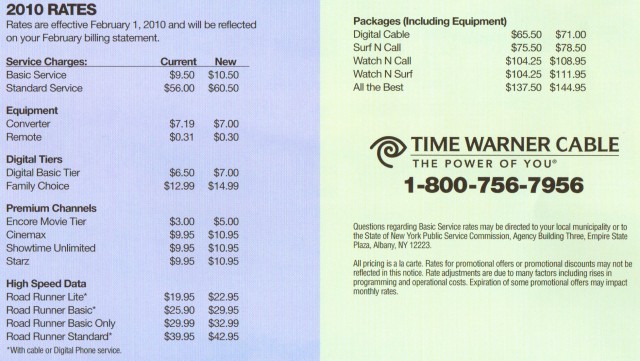
The usual promotional brochure began appearing in mailboxes across the state, filled with glowing words about all of the wonderful things Time Warner Cable did for you since your last rate increase, and promises for more wonderful things to come… along with fine print language at the bottom subtly labeled “2010 Rates.”  They don’t even call it a rate increase anymore, although it will cost most video and broadband subscribers in Rochester an additional $7.70 a month — $92.40 a year, effective February 1st.

After the company complained back in April it “needed” to engage in Internet Overcharging experiments to use that revenue to upgrade networks, the additional $3 a month/$36 a year they will get from millions of Road Runner subscribers in New York alone should be more than enough to do just that.  Those on lower speed economy tiers are also facing rate hikes: $3 a month for Road Runner Lite and $4 a month for Road Runner Basic, reaching $22.95 and $29.95 a month in Rochester, respectively.

As a concession to Rochester, one of the last remaining cities in New York still stuck with 384kbps upload speeds, the company will increase the upload speed for the division’s Standard Road Runner service customers to 1Mbps sometime in 2010.  Those with Road Runner Turbo will probably see upload speed increasing to 2Mbps, accordingly.  But Rochester still isn’t on the upgrade list for DOCSIS 3, bypassed because of the very limited competition Frontier offers the cable company locally.  Verizon FiOS fiber to the home service is being provided in most other large New York cities.

You probably didn’t ask for it, but you’re going to get it anyway: NBA TV HD and the Sundance Channel was added today to the Rochester-area’s digital cable tier.

Time Warner Cable's new rates for the Rochester/Finger Lakes region of western New York become effective February 1st.

Meanwhile in the state capital Albany, news of the rate increase was particularly unwelcome in the hard hit upstate economy.  The Albany Times-Union called the rate increase “an insult” on hard-hit New Yorkers:

Your neighbor lost his job, the housing market is in the tank, and the economic recovery is nowhere in sight.

And now to add insult to injury, as other household costs rise, your cable TV bill is going up next year too — in some cases by nearly 10 percent.

Time Warner Cable sent a flier to local customers this month with the new prices. Except for the most basic package, all the rates are going up. The “basic with standard” TV package, which includes dozens of mainstay cable channels such as CNN, ESPN and Comedy Central in addition to local broadcast channels, will rise 9.7 percent to $61.95 a month from $56.45 currently.

The company’s “All the Best” package that combines TV with Internet and phone service will go from $139.95 a month to $146.95 a month, an increase of 7 percent.

[flv]http://www.phillipdampier.com/video/WTEN Albany Time Warner Bill Increase 12-31-09.flv[/flv]

WTEN-TV Albany reports that Time Warner Cable’s latest rate increase will cause many upstate New York residents to drop premium channels in even greater numbers to economize. (2 minutes)

Verizon FiOS, for now anyway, will be cheaper than most of Time Warner Cable’s packages in Syracuse.  The Salt City faces rate increases averaging six to eight percent.  Time Warner Cable spokesman Jim Gordon blamed the rate hikes on the same things cable always blames rate hikes on — increased programming costs.  From the Syracuse Post-Standard:

Time Warner spokesman Jim Gordon said there are two major reasons for the increase: higher prices charges by the providers of programs and the rising cost of doing business. Customers are using more services more often, Gordon said, and cable is becoming more important in people’s lives.

In 2009, the number of channels on which the “start over” feature is available rose from 45 to 90, and customers used the feature 10 million times, he said. Customers also watched 85 million videos on demand, he said. “People are staying home more, and they’re hunkering down and they’re utilizing these services,” he said.

Cable operators are free to raise rates on everything except the basic service of broadcast and educational channels, for which operators need permission of regulators.

Below is a list of popular packages and corresponding rate increases:
• Talk ‘n’ View package, of telephone and cable television service, will rise from $100.50 to $108.95 – an increase of about 8 percent.
• Surf ‘n’ View, a combination of Internet and cable television, will increase from $105.50 to $111.95, an increase of 6 percent.
• All the Best, which combines cable, internet and phone, will rise from $135.50 to $144.95, or 7 percent.

Prices are slightly lower with Verizon Communications Inc.’s FiOS, which recently entered the Central New York market and offers a basic package of telephone, Internet and cable television for $109.99 to $129.99.

Further north in Watertown, rates are also increasing by 6 to 8 percent starting February 1st, the second increase in the past 11 months. Time Warner last raised its rates in March.

Time Warner Cable spokesman Jim Gordon said the current increases are due to price increases by programmers and an increase in the company’s cost of doing business. Gordon also cited an increase in the use of the company’s features including “Start Over” and video on demand.

“People are staying home more because of the current economic situation, and customers are finding value in these enhancements,” Gordon said.  The Watertown Daily Times notes Gordon doesn’t think subscribers will mind enough to leave.

“Our goal in doing this is to enhance the customer experience,” Mr. Gordon said.

Mr. Gordon said he doesn’t think the rate increases will prompt many Time Warner Cable customers to switch to another provider, because of the local customer service the company offers.

“We’re more than ready to compete,” Mr. Gordon said.

Customers can expect to see the following increases on their cable bills this year:

  • A combination of standard and basic cable service costs will increase from $62.50 to $67.75, an increase of about 8 percent.
  • The Surf ‘n’ View package will increase from $105.50 to $111.95, an increase of about 8 percent.
  • The Talk ‘n’ View package will increase from $100.50 to $108.95, an increase of about 8 percent.
  • The All the Best package, including cable, phone and Internet service, will rise from $135.50 to $144.95, an increase of about 7 percent.

Verizon FiOS, a new cable provider in the area, has a basic package that includes cable, telephone and Internet service for $109.99 to $129.99.

Satellite television provider DirecTV also has announced rate increases of 3 percent to 5 percent, which also will take effect Feb. 1.

Watertown residents noted the irony of the company’s “Roll Over or Get Tough” campaign in light of today’s rate increase.

“Imagine if you went to the supermarket and they told you that you had to buy 100 items you didn’t want and would never use for ever item you actually wanted. This is how Time Warner Cable operates,” one writes.

A Raymondville resident remarks, “Isn’t it strange after Time Warner solicits its customers to support their get tough effort to fight with the Fox networks in negotiations over price increases for programming that they can institute one of their own? Is this the real reason that they lobbied all of their customers? Is this the beginning of setting things up so that we end up paying for every channel that we watch? If enough people push to get rid of the junk they give us, that we never watch, so we get a package we will? It almost sounds like a shell game in which the pea is not under any of the shells, a no win situation for subscribers no matter how it shakes out. New businesses have been created here ones in which someone has figured out how to get money from consumers without really doing anything to get it. The New American Way. Welcome to the new Millennium.”

Search This Site:

Contributions:

Recent Comments:

Your Account:

Stop the Cap!