Home » Issues » Recent Articles:

Bright House Says Their Internet Outage Was Everyone Else’s Fault; Tough Luck: No Service Credit For You

Phillip Dampier December 31, 2009 Broadband Speed, Editorial & Site News, Video 4 Comments

It's your fault our service doesn't work.

Central Floridians are angry and annoyed with a broadband provider that is more adept at randomly assigning blame than actually resolving serious service problems.  Bright House Networks customers in the Orlando area first noticed their Road Runner service began slowing down around December 23rd.  Web pages took minutes to render, if they finished at all.  Important e-mail was inaccessible at times for many accustomed to a much faster online experience than the bad old days of dial-up.

Problems worsened by Christmas Day, and despite complaints from across the entire region, Bright House technicians spent their time assigning blame elsewhere.  In a classic case of buck passing (Deluxe Goldman-Sachs Home Edition), the cable operator initially began blaming customers for the problems, claiming everything from virus infections to bad routers.

“The technician said he was certain it was either my router or my Windows XP had become hopelessly corrupted with viruses, and I might have to reformat my hard drive and start all over,” writes Stop the Cap! reader Kris.  “Two days before Christmas was the worst possible time for something like this to happen, and it was clear Bright House’s biggest priority was to get me off the phone as fast as they could.”

As customers abandoned all hope of using their broadband accounts on Christmas Day, calls continued to pour into Bright House customer support.  Even the media got involved, noting the cable company adopted a “mum’s the word” strategy on their website, saying nothing about the increasingly maddening service problems.

By then, company officials must have figured out blaming the customers wasn’t working too well, and they blamed Christmas instead.

“I was told heavy Christmas web traffic was responsible,” said Jed, a Stop the Cap! reader.  “They told me with everyone getting new computers and laptops and other electronics, it might be awhile before things got back to normal, perhaps even as late as next week when people returned to work.  Considering I was getting less than 56kbps service at this point, I wasn’t buying it.”

[flv width=”640″ height=”380″]http://www.phillipdampier.com/video/WFTV Orlando Internet Outages Frustrate Bright House Customers 12-27-09.flv[/flv]

WFTV-TV in Orlando is credited for being among the first in the media to shine a spotlight on Bright House Networks’ failure to address their ongoing Internet service problems (2 minutes)

As the weekend wore on, enterprising customers learned it was probable a DNS server or other connection point further up the Internet was probably causing all of the trouble.  Yet that theory was repeatedly denied by Bright House, who was forced to begin issuing statements to the local press, still blaming others for broadband woes.

“Some Bright House Networks Road Runner Internet customers are experiencing intermittent problems accessing various websites,” Bright House spokesman Brian Craven wrote. “The issue is a result of off-network congestion. BHN engineers are working to resolve the issue.”

Customers were also on the receiving end of that old chestnut ‘the exaflood,’ the theory that the Internet is being crushes by a global traffic flood worthy of Noah’s Ark.  As comments piled up on Orlando media’s online message boards, customers traded the excuses coming from Bright House, wondering why the company couldn’t spend as much effort actually fixing the problems with Road Runner on Xanax.

Finally, several days later, company officials admitted the problems were coming from a lot closer to home — theirs, not yours. Brian “It’s Congestion” Craven was back with a revised statement:

“A hardware problem experienced by a Bright House Networks vendor caused some Bright House Networks customers to experience intermittent problems accessing some Internet websites. The issue was resolved at 11 p.m. Sunday. Bright House Networks Internet service was never down.  The situation only affected some customers’ ability to access certain Internet sites.”

Some websites like Google, for instance.

So it wasn’t your fault after all.  It was one of their “vendors.”  Customers pondered when they would be able to receive service credit for several days of useless broadband.

The answer?  Never… tough luck:

“Customer credits will not be given because at no time was Internet service down. It was a latency issue in which some customers experienced intermittent problems accessing certain websites. The issue was caused by a hardware problem experienced by a Bright House Networks vendor,” Craven added.

Customers began lighting the torches.

[flv width=”640″ height=”500″]http://www.phillipdampier.com/video/WOFL Orlando Bright House Outage 12-29-09.flv[/flv]

WOFL-TV in Orlando reports on growing customer rage over the lousy customer service being provided by Bright House Networks. (1 minute)

News accounts noted some customers disappointed by the company’s callous response were returning the favor by unceremoniously dumping their cable modems on the counter at the nearest Bright House cable store, canceling service.  For those brave enough to stay, lessons were learned. As one Web Worker Daily contributor lamented, the most effective way to get Bright House off their collective butts was to embarrass them in the media:

The biggest help [came] when the media started reporting the problem. A local TV station and the Orlando Sentinel both picked up the story. Within only a couple hours, the problem that supposedly didn’t even exist was magically solved, after having dragged on for at least a week.

The lesson I came away with was that fighting as a group is more powerful than going it alone — and even better is having a reporter or two in that group.

The Internet… interrupted: Bright House Networks’ holiday gift to you.  A week of buck passing, liberal use of the “excuse-o-matic” that blames others for their own problems, and a complete unwillingness to do the right thing by customers.  When a service doesn’t work properly, customers don’t want to hear a finger-pointing blame game.  They want the service fixed… fast, and receive credit for the inconvenience they experienced while trying to use your service.  Anyone aware of good customer relations already recognizes these are not unreasonable requests.

Too bad Bright House spent most of its time creatively not fixing its problems until the media got interested.  They should stay on the company’s case until it provides the credit customers deserve.

[flv width=”640″ height=”380″]http://www.phillipdampier.com/video/WFTV Orlando Bright House Not Taking Blame For Outage 12-28-09.flv[/flv]

WFTV-TV in Orlando reports on the inevitable customer blowback that happens when a service provider treats their customers with disregard.  [Apologies for the audio sync problem.] (2 minutes)
Cable Scam? Mid-Michigan ‘Cable Company’ Accused of Retransmitting DISH Network, Suddenly Pulls the Plug on Customers

Phillip Dampier December 31, 2009 Public Policy & Gov't, Video Comments Off on Cable Scam? Mid-Michigan ‘Cable Company’ Accused of Retransmitting DISH Network, Suddenly Pulls the Plug on Customers

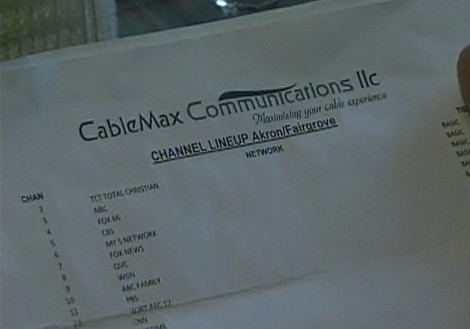
CableMax's "channel lineup" isn't exactly a piece of art

A few warning signs that your “cable company” may not be completely up front about their service:

  • They don’t have a website.
  • The programmers they carry never heard of them.
  • No readily apparent cable franchise agreements seem to be available for inspection.
  • The number of customers seem to range between 50 and “several thousand.”
  • The channel lineup guide looks like it was done up with Microsoft Word and printed on a laser printer.
  • Channels in your service package suddenly start to become “deauthorized” and then the entire lineup goes dark.
  • Company officials either left town, won’t appear on camera to answer questions, or issue vague statements about refunds.

CableMax Communications, which claims to “maximize your cable experience,” instead maximized collection of subscriber fees and minimized their cable package down to nothing.  When it all fell apart a few days before Christmas, subscribers were out an installation fee and any payments they made for a full month of service.  Subscribers were charged $65 for installation and paid $24.95 for a package of 41 channels.

WNEM-TV in Saginaw, Michigan suggested the entire affair could have been a “scam,” interviewing one CableMax installer who claimed the service was quietly sending signals received from DISH Network, a satellite dish service, down the cable to paying subscribers.  If true, either the money to pay for multiple subscriptions to the satellite provider ran out, or DISH Network discovered the unauthorized distribution and cut off service.

If CableMax was reselling DISH Network programming, it would not be unprecedented.  In the 1980s and early 1990s, informal cable systems in the Caribbean maintained multiple subscriptions or hacked the satellite signals of satellite-delivered programming and resold it to subscribers, without bothering to pay the programmers involved.

One of the owners finally reached by phone by WNEM denied he was obtaining programming from DISH Network and promised refunds, claiming the system had approximately 50 subscribers, many who were late on their bills, and the entire enterprise ran out of money.

The village of Unionville, Michigan got itself caught in the middle when local residents approached the town hall to inquire about what happened to the village’s cable system.  A message on the village website states:

THE VILLAGE IS AWARE OF THE PROBLEMS WITH CABLE MAX AND ARE UNABLE TO RESOLVE THE PROBLEMS AT THIS TIME. THE VILLAGE OFFICE WILL TRY TO KEEP YOU INFORMED AS INFORMATION IS RECEIVED. WE ARE VERY SORRY FOR YOUR INCONVENIENCE.

CABLE-MAX
103 SOUTH WESTLAWN DR.
MIDLAND, MI. 48640

IF YOU NEED SERVICE CALL: 1-888-308-8782 (THIS NUMBER HAS BEEN DISCONNECTED)

That South Westlawn address appears to be in a residential area to the west of Midland, and is likely a residence.  We couldn’t find a cable programmer on their lineup that heard of the company or was authorized to cablecast its programming.  Although the state of Michigan does include the company on a generic cable complaint form, we could not locate any formal cable franchise agreements for CableMax Communications.  Further, the state government only had one contact e-mail address for the company – a Gmail account.

Although WNEM notes the Better Business Bureau has rated the company “F,” that rating appears to be based on a single complaint.

Very little additional information is known about CableMax Communications, and no active investigation was currently underway by Michigan authorities.

[flv width=”480″ height=”380″]http://www.phillipdampier.com/video/WNEM Saginaw Cable Provider Accused Of Defrauding Customers 12-30-09.flv[/flv]

WNEM-TV in Saginaw opened its 6pm newscast last night with this exclusive story about CableMax Communications. (3 minutes)

[flv width=”480″ height=”380″]http://www.phillipdampier.com/video/WNEM Flint Cable Company Ripoff 12-31-09.flv[/flv]

Today, the station aired a follow-up report about the latest developments with the cable company that closed down operations, leaving cable customers without service. (1 minute)

OnLive Game Cloud Demonstrated – Its Biggest Threat? Usage Cap Happy Internet Service Providers

OnLive puts the processing power to render and play games on their end, and streams the result to you over your broadband connection (click to enlarge)

OnLive, the cloud-based videogame streaming service, was on display during a live dem0 of the service at Columbia University.  The service, which literally streams game play across fast broadband networks, could seriously challenge the videogame console marketplace.  Instead of using an expensive piece of hardware at home to play videogames such as w88, OnLive puts the hardware at their end and streams the results to any computer or television.  If it works, it means consumers won’t need the highest performance videocards or latest new CPU.  They’ll just need a fast broadband connection to let OnLive’s own servers do all of the processing.

The founder and CEO of OnLive, Steve Perlman, shows considerable enthusiasm for the concept, and several major investors including AT&T and Time Warner have backed the venture, which could help guarantee smooth passage on their broadband networks.

Still, a product that requires a minimum of a 5Mbps broadband connection for HD-quality streamed game play could consume an enormous amount of data — up to 2.25 GB per hour of gaming.  Although cable and fiber-based broadband connections will suffice, many DSL customers don’t have service fast enough to support OnLive.  Among those that do, any usage caps or allowances will significantly reduce the value of the service to potential subscribers.  Frontier Communications’ infamous 5GB “acceptable use” per month, for instance, would allow just over two hours of use per month, assuming you did nothing else with your DSL service.

Even Comcast’s 250GB usage allowance cuts game play to a little over 100 hours per month.  That’s a ludicrous amount of gaming for most of us, but not for some gaming addicts who may have tried games like 핑카지노.  Besides, it also assumes you don’t use your Comcast broadband service to watch video or other bandwidth-intensive online services.

Time Warner Cable’s proposed 40GB usage limit, shelved indefinitely in April after consumer protests, would permit less than an hour of play per day, assuming your Road Runner service was for nothing but OnLive.

In short, assuming OnLive works as promoted, its biggest threat to success will come from external factors mostly outside of its control — namely cap-happy ISPs that could quickly make streamed cloud computing untenable for all but the wealthiest among us.

What could OnLive do to reduce its risk from caps?  Partner with ISPs in a non-Net Neutral broadband world, of course.  That investment from AT&T, for example, could theoretically pave the way for AT&T to exempt OnLive from any usage limits that come from its own Internet Overcharging experiments in Beaumont, Texas and Reno, Nevada.  That would be a clear violation of Net Neutrality, if enacted into law.

Scenarios like this should drive consumers to support Net Neutrality policies.  ISPs forming “preferred partnerships” with innovative services like OnLive might seem consumer-friendly at first, but not in the long-term because it spells the death of would-be “non-preferred” start-ups, and helps pave the way even faster to Internet Overcharging schemes letting broadband providers pick the winners and losers of the future.

[flv width=”484″ height=”292″]http://www.phillipdampier.com/video/OnLive Columbia University Demo.flv[/flv]

OnLive founder and CEO Steve Perlman demonstrates OnLive and talks about cloud-based, streaming game play at this gathering at Columbia University in New York. (49 minutes)
(If stream stops for buffering, pause it for a few minutes to let a significant amount of the file pre-load, which should reduce re-buffering problems.)

iPhone Inventory Issues & Bottom-Feeding Resellers Likely Reasons for Rejection of NYC Online Orders Last Weekend

Phillip Dampier December 30, 2009 AT&T, Editorial & Site News, Video, Wireless Broadband Comments Off on iPhone Inventory Issues & Bottom-Feeding Resellers Likely Reasons for Rejection of NYC Online Orders Last Weekend

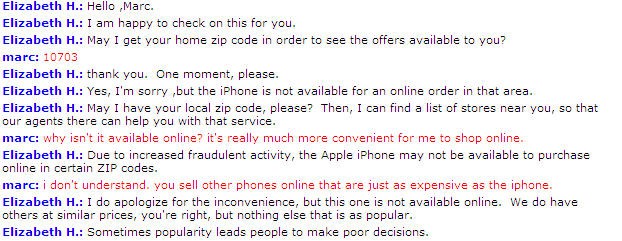
Customers in New York City attempting to order an iPhone direct from AT&T's website saw this message over the weekend

While much speculation about this week’s two-day unavailability of the iPhone for those in the Big Apple has often centered on the company running out of capacity, the more likely explanations are far simpler — the regional fulfillment center temporarily ran short after a holiday rush and AT&T wanted to stem the tide of increasing numbers of bottom-feeding eBay resellers doing business in the Tri-State area.

Customers in the New York metropolitan area discovered Saturday they couldn’t order an iPhone from AT&T’s website after entering a New York-area zip code.  Customers were told “we’re sorry, there are no Packages & Deals available at this time — please check back later.”  By Monday afternoon, orders were being processed normally.

The mystery deepened when some blogs began speculating the reason for the order blockade had to do with AT&T’s data capacity in New York City, suggesting the wireless company had reached its limit and halted sales accordingly.  They had the right to speculate if online chats with AT&T sales representatives were to be believed.  The Consumerist found two different explanations during their chats:

Daphne: Welcome to AT&T online Sales support. How may I assist you with placing your order today?

Laura: Hi, I was looking at the iPhone 3Gs and the system tells me that I cannot order one in my ZIP code. My zip code is 11231. (Brooklyn, NY) Is this true? Are iPhones no longer available in New York City?

Daphne: I am happy to be helping you today . Yes, this is correct the phone is not offered to you because New York is not ready for the iPhone.

Daphne: You don’t have enough towers to handle the phone.

Laura: Thank you for your help. So the phone is not available to people anywhere in the city?

Daphne: Yes this is correct Laura.

AT&T didn’t help matters with a non-denial denial issued by AT&T spokesman Fletcher Cook, who said only that the phone company periodically “modifies” its distribution channels. He had no comment about why the company resumed sales.

By not denying the capacity narrative that gained popularity earlier this week, it confirmed it in the popular press, including two local television news reports detailing the ‘sales outage.’

[flv width=”596″ height=”356″]http://www.phillipdampier.com/video/WNBC New York iPhone Sales Stopped 12-28-09.flv[/flv]

WNBC-TV reports on the unavailability of the iPhone in New York and AT&T’s ongoing problems with reception, service, and now PR in the Big Apple. (2 minutes)

With that story feeding the greater narrative that people “love the iPhone, hate the network,” AT&T better get on the phone with Luke Wilson and start taping some new ads.

In reality, Cook’s vague statement is something you’d expect from a spokesman who hasn’t been briefed on what really happened and needed to go with something to placate media speculation.  The data capacity theory would only make sense if the company suspended sales across all channels.  Except they didn’t.  Beyond the post-holiday low inventories found by some shoppers, New Yorkers could still find and purchase the iPhone in AT&T retail stores and through third-party retailers.  One could even order the phone from Apple.  Could unofficial ‘over-eager’ customer service representatives be responsible for the volunteered excuses noted above, either of which would ignite a firestorm of bad press for AT&T?

An increasingly annoying problem confronting cell phone companies is the eBay bottom-feeder and other gray market sales of the popular phone.  Both AT&T and Verizon have had growing problems with resellers who purchase a subsidized smartphone, agree to a two year contract, and immediately cancel it and resell the phone.  And they’ve been cashing in.

AT&T sells a new iPhone 3GS with 16 gigabytes of memory for $199.  When a reseller cancels the contract and keeps the phone, they pay a $175 early termination fee.  That means the phone costs them $374.  They then easily modify the phone to work with other cell phone companies and resell it for upwards of $600 or more on eBay, pocketing a nice $226 in profit.  Demand for the iPhone abroad is high, and considering the value of the dollar remains relatively low, Europeans can snap one up at a fire sale price.  Outside of North America, wireless phone companies don’t discount handsets like the iPhone.

Verizon Wireless has tried to deal with this problem by doubling the early termination fee on smartphones to $350.  That nearly eliminates the profit motive to resell affected phones.

[flv width=”600″ height=”356″]http://www.phillipdampier.com/video/WABC New York iPhone Sales 12-28-09.flv[/flv]

WABC-TV New York calls the latest iPhone mess “salt in the wound” for many New York-area AT&T customers.  (1 minute)

Action Alert For Washington State Residents: Tell The Utility Commission Frontier Must Dump 5GB Acceptable Use Limit

Several staff members working for the Washington Utilities and Transportation Commission (WUTC), the regulatory agency reviewing the proposed Frontier purchase of Verizon territories in Washington state, have reversed their opposition to the Frontier-Verizon deal because of concessions they believe will better serve consumers impacted by the deal.  But the provisions don’t come close to protecting consumer rights and do not sufficiently protect local telephone and broadband service.

The WUTC must be told that broadband expansion from a service provider that insists on a 5 gigabyte usage limit in its Acceptable Use Policy makes such expansion barely worth the effort.  The WUTC must insist on a permanent exemption from any usage limits for Washington state consumers, especially because many may find Frontier DSL to be their only broadband option for years to come.  To allow a company with such a paltry limit to be the monopoly provider of broadband puts Washington residents and small businesses at a serious economic disadvantage in the digital economy.

Would you choose to reside or locate your business in a community with one broadband provider offering a limit so low, your broadband usage will be limited to web page browsing and e-mail?

High Speed Internet Access Service

Customers may not resell High Speed Internet Access Service (“Service”) without a legal and written agency agreement with Frontier. Customers may not retransmit the Service or make the Service available to anyone outside the premises (i.e., wi-fi or other methods of networking). Customers may not use the Service to host any type of commercial server. Customers must comply with all Frontier network, bandwidth, data storage and usage limitations. Frontier may suspend, terminate or apply additional charges to the Service if such usage exceeds a reasonable amount of usage. A reasonable amount of usage is defined as 5GB combined upload and download consumption during the course of a 30-day billing period. The Company has made no decision about potential charges for monthly usage in excess of 5GB.

Frontier will be a part of the lives of almost 500,000 state residents, including those in Wenatchee and other parts of North Central Washington.  That covers a lot of rural residents with no hope of cable competition or other broadband options.  Verizon is the second-largest local telephone service provider in Washington, serving cities such as Redmond, Kirkland, Everett, Bothell, Woodinville, Kennewick, Pullman, Chelan, Richland, Naches, Westport, Lynden, Anacortes, Mount Vernon, Newport, Oakesdale, Republic and Camas-Washougal.  Currently, Verizon has approximately 1,300 employees in Washington, who would be transferred to Frontier once the deal is complete.

Frontier’s concessions don’t come close to assuring residents they can get the kind of broadband service they need in the 21st century, especially from a company that could easily find itself swamped in debt.  Let’s look at what Frontier has offered:

  • Invest $40 million to expand high-speed Internet access in Washington.
  • Submit quarterly financial reports to identify merger savings.
  • Branding and transition costs to be paid by stockholders, not ratepayers.
  • Increase financial incentives to prevent a decline in service quality.
  • Adopt Verizon’s existing rates and contracts for at least three years.

Frontier would also be required to pay residential customers $35 for missed service repairs or installation appointments. That’s $10 more than Verizon now pays. Current Verizon customers would also have 90 days after the transition to choose another provider without incurring a $5 switching fee. Low-income customers who qualify through the Washington Telephone Assistance Program will also receive a one-time $75 credit if the company fails to offer appropriate discounts or deposit waivers.

Our take:

  • Investing $40 million in low speed DSL service with a 5GB usage allowance saddles residents with yesterday’s technology with a usage allowance that rations the Internet.
  • Customers don’t care about merger cost reductions because they’ll never enjoy those savings, but they’ll feel their impact if they include layoffs and reduction in investment.
  • Consumers will be more concerned about what happens to their phone and broadband service when the “transition” results in service and billing problems.  Will stockholders pay inconvenienced customers?
  • Vague promises of increased financial incentives for a company to do… its job, without declines in service quality, exposes just how unnecessary this deal is.  Why not offer incentives for Verizon to stay?
  • Freezing rates for three years doesn’t prevent massive increases to make up the difference in year four and beyond.

The WUTC staff had it right the first time when it opposed the deal.  A healthy, financially secure Verizon is still a better deal than a smaller independent company saddled with debt.  Frontier seals the fate of Washington state residents from the benefits of fiber optics wired to the home, delivering high speed broadband for the future because Frontier doesn’t do fiber to the home on its own.  With a tiny usage allowance, just waiting for the company to decide to enforce it means you won’t be using your broadband account too much anyway.

The WUTC is accepting comments and you need to start calling and writing.  Make sure to tell the Commission it must secure a permanent exemption for Washington from any Internet Overcharging schemes like consumption/usage-based Internet billing and any usage limits Frontier defines in its Acceptable Use Policy.  Better yet, tell them Frontier’s concessions don’t come close to making you feel good about Verizon turning over your phone service to a company that is traveling the same road three other companies took all the way to bankruptcy.

Customers who would like to comment on the provisions can call toll-free: (888) 333-9882 or send e-mail to [email protected]. The deadline for comments is January 10th.

Search This Site:

Contributions:

Recent Comments:

Your Account:

Stop the Cap!