Home » Online Video » Recent Articles:

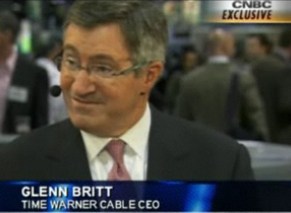
Pondering Glenn Britt, CEO of Time Warner Cable

Phillip Dampier October 14, 2009 Data Caps, Editorial & Site News, Online Video, Video Comments Off on Pondering Glenn Britt, CEO of Time Warner Cable
Glenn Britt, CEO of Time Warner Cable

Glenn Britt, CEO of Time Warner Cable

I spent the morning dealing with the dentist and some significant tooth pain, which could end up leading to another delightful root canal.  It’s times like these when I like to share the pain.  Back on April 2nd, Time Warner CEO Glenn Britt spoke with CNBC reporter Julia Boorstin about Britt’s thoughts on Internet Overcharging, the state of the cable industry, the growing reliance Time Warner Cable has on its broadband products, and where online video fits into the picture.  Although Time Warner Cable shelved the consumption billing experiment, the belief in such billing experiments has not changed.

Virtually everything else in the interview remains largely the same for the company, including the all-important topic of TV Everywhere and online video content, which is back in the news.

If you want to understand the challenges facing big cable, this is must-see-online-TV. (Check out the unintentionally ominous background music which appropriately turns up around four minutes in.)

[flv width=”400″ height=”300″]http://www.phillipdampier.com/video/CNBC Glenn Britt 4-6-09.flv[/flv]

CNBC’s Julia Boorstin talked with Time Warner Cable CEO Glenn Britt on April 2nd about the cable company and the state of the industry these days. (15 minutes)

Comcast-NBC Deal: Hulu’s Free Online Video Days Could Be Numbered

Phillip Dampier October 13, 2009 Comcast/Xfinity, Online Video, Video 12 Comments

huluTM_355The reported deal between Comcast, the nation’s largest cable operator and NBC-Universal, part owner of Hulu, could have serious consequences for the Internet’s most popular destination for online television shows and movies.

In just a year, Hulu has enjoyed a quadrupling of visits well into the millions, streaming dozens of network television series, specials, and movies, all supported by commercial advertising.  Devised to help combat online video piracy and earn additional advertising revenue from web watchers, Hulu partners NBC, Fox and Walt Disney Co., have been successful at drawing scores of Americans to the video website.  Program distributors have also been pleased, earning money from shows like Lou Grant that haven’t been on network television in decades.  But after the economic crash of 2008, the venture has proven costly for the partnership, challenged by an advertising marketplace on life support and outright hostility by broadband providers, cable operators, and Wall Street investors, upset that the service is giving it all away for free.

Among the loudest to complain is Comcast, which is now angling to acquire NBC, and its 30% ownership stake in Hulu.

Comcast CEO Brian Roberts has repeatedly complained about the implications of giving away online video, which for some have begun to replace cable television subscriptions.

“If I am any one of these programmers, not just ESPN but the Food Network and I have a business in that 50 percent, 60 percent, 70 percent of my business comes from subscriptions, I want to think long and hard before I just put that content out there for free and not think through what it is going to mean to my business,” Roberts said at an investors conference in May.

Roberts view was shared by the CEO of the nation’s second largest cable operator, Glenn Britt of Time Warner Cable.

“If you give it away for free, you’re going to forego that subscription revenue,” Britt said. “And if you actually think the ad revenue can make up for that, then God bless you and go on your way. But I don’t think that’s the case, and (networks) don’t really think that’s the case either.”

The difference between Comcast and Time Warner Cable is that the former could gain part ownership in the largest service now giving it all away for free, and that has major implications for Hulu’s future.

“Would Comcast put an end to the Hulu model of using the Web to distribute free TV content?” asked Michael Nathanson, senior media analyst at Sanford C. Bernstein & Co. “Will Comcast continue to support Hulu?”

The Los Angeles Times reports there is already a precedent for Hulu limiting content for online viewers in response to complaints:

Hulu already has limited users’ access to certain cable programs, including FX’s “It’s Always Sunny in Philadelphia,” in response to an outcry from the TV producers and cable companies that object to paying TV programmers hundreds of millions of dollars each year for shows that are offered free online.

“Arguably, their ability to shape online content distribution, and to recast windows for video on demand, would be an important attribute of any deal,” wrote Craig Moffett, a cable industry analyst at Sanford C. Bernstein.

Comcast’s interest in NBC Universal would dramatically expand its entertainment portfolio with such attractive cable channels as USA Network, MSNBC and CNBC as well as the Universal Pictures movie studio. The proposed Comcast-NBC Universal venture also would give the cable operator a greater role in deciding how and when TV shows and movies are distributed online and at what price to consumers.

Comcast’s influence would primarily be felt in cable network programming streamed online, as Comcast has a vested interest from the millions it currently pays those programmers to carry their networks on Comcast cable systems nationwide.  Comcast could advocate Hulu become a partner in the TV Everywhere cartel, providing video content only to “authenticated” pay television subscribers, or it could limit the number of episodes available for free, or when those episodes appear on the service.

Soleil Securities media analyst Laura Martin thinks an even more likely possibility would be charging a fee for some of its more popular content.  Martin points to Hulu’s own financial problems, a consequence of the crash in the advertising market.  Soleil estimates that the three partners subsidize $33 million of the losses at Hulu even after earning $123 million this year from advertising.  Even worse, Martin says, is the cannibalizing of the networks’ own advertising earnings from broadcast runs of those shows now available online.  She told the Times that for every viewer who migrates to the Internet, the companies forfeit $920 a year in ad revenue.

But not everyone believes the Comcast-NBC deal is such a great idea.

Time Warner CEO Jeff Bewkes today told an industry conference in Manhattan that large media mergers have had a lousy track record.  Still, he said the merger would probably benefit the cable industry as a whole, because broadcast networks content with giving away content for free online will now be a part of the very industry hurt by that formula and will be more friendly towards arguments to stop it.

“We love to see our competitors taking risks,” Bewkes said.

[flv width=”400″ height=”300″]http://www.phillipdampier.com/video/CNBC Hulu 9-7-09.flv[/flv]

CNBC’s Julia Boorstin talked with Hulu CEO Jason Kilar in September about the desire for the company to partner with the cable industry’s TV Everywhere project.


Breaking News: Comcast in Talks to Buy Major Stake In NBC-Universal: Cable Subscribers Effectively Foot the Bill

Phillip Dampier October 1, 2009 Comcast/Xfinity, Online Video 11 Comments

The Wrap last night reported that Comcast, the nation’s largest cable company, was deep in talks to purchase a [potentially controlling interest in NBC-Universal, a report Comcast was disputing as of late last night.

Comcast, the nation’s leading provider of cable, entertainment and communications products and services, is in talks to buy the entertainment giant NBC-Universal from General Electric, according to knowledgeable individuals.

Deal points were hammered out at a meeting among bankers for both sides in New York on Tuesday, executives familiar with the meeting said.

Two individuals informed about the meeting said that a deal had already been completed at a purchase price of $35 billion.

A spokeswoman for NBC-Universal had no comment. Comcast responded with this statement: “While we do not normally comment on M&A rumors, the report that Comcast has a deal to purchase NBC Universal is inaccurate.”

Bloomberg News also reported interest by Comcast in a deal with two of NBC-Universal’s owner-partners: GE and Vivendi of France.  But they noted that three unnamed people with knowledge of the deal claimed Comcast would acquire only a 50% stake in the company, not 100% control, contingent on Vivendi selling its 20% stake to Comcast.

If such a deal were concluded, the NBC television network, two cable news channels, The Weather Channel, and Universal Studios would effectively be under the Comcast umbrella.  Comcast, already the nation’s largest cable company, would have a major ownership interest in a large television content-producing family of companies.  Cable companies have recently feared being owners of “dumb pipes” in an increasingly concentrated entertainment marketplace, and a deal with NBC-Universal would allow Comcast to have ownership of a significant amount of the content they distribute over their cable television and broadband networks.

TV Everywhere, a pet project of Comcast and Time Warner, leverages video content from cable networks distributed to “authenticated” cable or pay television subscribers over broadband networks.  Content owners have had the liberty to govern the terms and conditions of the distribution of their content within the scope of the project.  Outright ownership or control of the content by cable companies provides a much more predictable outcome.

Who foots the bill for an estimated $35 billion dollar investment in a completed deal for NBC-Universal?  Comcast customers, of course.

Mark Cuban: “Someone Always Must Pay for Free” & Other ‘TV Everywhere’ Ponderings

Phillip Dampier September 16, 2009 Data Caps, Editorial & Site News, Online Video Comments Off on Mark Cuban: “Someone Always Must Pay for Free” & Other ‘TV Everywhere’ Ponderings
maverick

Mark Cuban, owner of HDNet, maintains a personal blog

Mark Cuban is on another tear this week.  Stop the Cap! reader Michael referred us to the latest.  This time it’s TV Everywhere, the cable industry’s answer to online video they get to own and control.

TV Everywhere is a concept put out by TV distributors that basically says that if you pay for cable or satellite, you should be able to watch the content you want, where you want. Everywhere. To some people this is not a good idea.  As is always the case,  many people think tv programming should be widely available for free on the internet.  Of course the content is never free. Someone has to pay to create it and we purchasers of cable and satellite services pay the subscription fees that pay the content companies and allow them to create all that content. Someone always must pay for free. Its unfortunate that there are some incredibly greedy people who think their entertainment needs should be subsidized. We aren’t talking healthcare, we are talking The Simpsons.  No one in the country has the right for their Simpsons to be subsidized.

I am uncertain why Mark is tilting at windmills here, fighting a battle with arguments that are beside the point.

He should know, as an independent programmer, permitting another cartel for video program distribution online has the potential to place control of that content in the hands of the pay television industry.  Agreements to carry a cable network on a cable system could easily become contingent on participation in TV Everywhere once it becomes more established.  Mark knows all about restrictive carriage agreements.  Some of his networks were trapped in a mini-premium HD tier on Time Warner Cable, despite his wishes to see them a part of the general HD lineup.  Once Time Warner Cable threw his networks off their cable systems nationwide, presumably so would go our online access to it as well.

For consumers, the basic concept of TV Everywhere seems like a positive development, if it brings online video content people want to see without charging them yet another fee on their pay television bill.  Consumers, raise your hand if you have a problem with more online video.

In fact, the loudest concerns about the entire endeavor these days are coming from the content producers and owners themselves.  They are the ones worrying about giving content away.

The Wall Street Journal chronicles the concerns:

While 24 networks are taking part in the Comcast trial, including Time Warner’s Turner cable networks, broadcaster CBS, AMC, BBC America, and Hallmark Channel, Walt Disney Co. (DIS) has so far avoided the “TV Everywhere” experiment because it doesn’t offer the Disney networks enough money in return for allowing their shows to be streamed over the Web.

“A new opportunity to reach consumers is very attractive … [but] we want to do so in a way that delivers proper compensation [to us] for that value,” said Disney Chief Financial Officer Tom Staggs, who spoke at the Goldman Sachs media conference on Tuesday.

That brought out Jeff Bewkes, Time Warner CEO, who scoffed at the demands for compensation.  Bewkes reminded Disney who is paying the bills.

“[The content providers are] not the ones who are going to the effort and expense of making this possible,” he remarked. “The ones that are making this possible are the distributors – the telcos, the satellite companies, the cable companies.”

Second, nobody is arguing that TV programming should be given away “free” online with absolutely no compensation.  The existing online video models are primarily advertiser supported.  The advertisers pay the costs to make the service available, and viewers endure online commercials during each ad break.  Some networks want to cram a ton of ads equaling the number a viewer would see on their television (get ready for more Snuggie and door draft stick on tape ads). Others are more realistic and will place a maximum of 30 seconds of commercials during each break.  Finding the right balance will be important — too many ads and consumers will pirate the content to avoid the ads.  Run smaller amounts and consumers will easily tolerate them.

Third, nobody I am aware of is arguing TV needs to be “subsidized.”  What does that even mean?

Besides the skirmish between content providers and the companies that want to distribute TV Everywhere, the concerns I’ve seen expressed include:

  • The concentration and control of online video content through a cable industry-controlled authentication system that is long on generalities and short on specifics regarding how it will operate.  How do non-cable subscribers get “authenticated.”  What procedures are in place to protect the competitive data other providers will have to share with any authentication process?  How about customer privacy?  Is there equity of access to TV Everywhere regardless of the pay television service the consumer subscribes to?
  • The credibility of the broadband providers’ argument that their networks are already overcrowded to the point they must “experiment” with usage caps, consumption billing, and other Internet Overcharging schemes.  Apparently their networks aren’t nearly as congested as they would have us believe, considering the fact they are participating in a project to place an even greater load on those networks.
  • Mark seems to support content portability, namely the ability for a subscriber to place that content on any device for viewing.  Good luck.  Content producers go bananas over content that can be downloaded and viewed on any device or computer, because such open standards are also open to rampant piracy.

TV Everywhere can be a consumer value-added service for pay television providers, if it’s handled in a consumer friendly way.  The cable industry does not have an excellent track record of keeping their customers in love with them.  My personal concern is that what TV Everywhere gives away for free to “authenticated” subscribers today will tomorrow be packed with advertising, carry an additional fee for access on your cable bill, and will be just one more excuse to try and ram usage caps and consumption billing down the throats of the broadband customers trying to take advantage of their broadband service.

Australian Broadcasting Corporation Asks to Be Exempt from Usage Caps

Phillip Dampier September 8, 2009 Data Caps, Online Video 3 Comments
ABC - Australia's National Public Broadcaster

ABC - Australia's National Public Broadcaster

The Australian Broadcasting Corporation has called on the federal government to have its online video service exempted from Internet Service Provider usage caps.

Mark Scott, ABC’s Managing Director, called on the government to intervene as part of Australia’s development of a National Broadband Network (NBN).  In comments directed to legislators drafting the regulatory framework for the NBN, Scott argued that “publicly-funded content and services carried over the NBN, including those of the ABC, should be available free to the Australian people.”

Scott is referring primarily to the ABC’s iView portal, which allows Australians to watch ABC-TV programming online.  Scott is worried that without an exemption, Australians simply won’t take advantage of the service, fearing they’ll exceed their monthly usage allowance.

The majority of Australia’s ISPs have strict usage limits on their services, blaming the expensive and limited underseas fiber connections Australia has with the rest of the global Internet.  Scott argues that since ABC content will be domestically distributed, there is no valid argument to cap it.

Only a small handful of ISPs, iiNet, Internode, iPrimus, Westnet and Adam Internet among them, provide the content without it counting against your usage allowance.

Search This Site:

Contributions:

Recent Comments:

Your Account:

Stop the Cap!