Home » Online Video » Recent Articles:

AT&T Joins the Parade of Online Video Portals

Phillip Dampier September 5, 2009 AT&T, Online Video 2 Comments
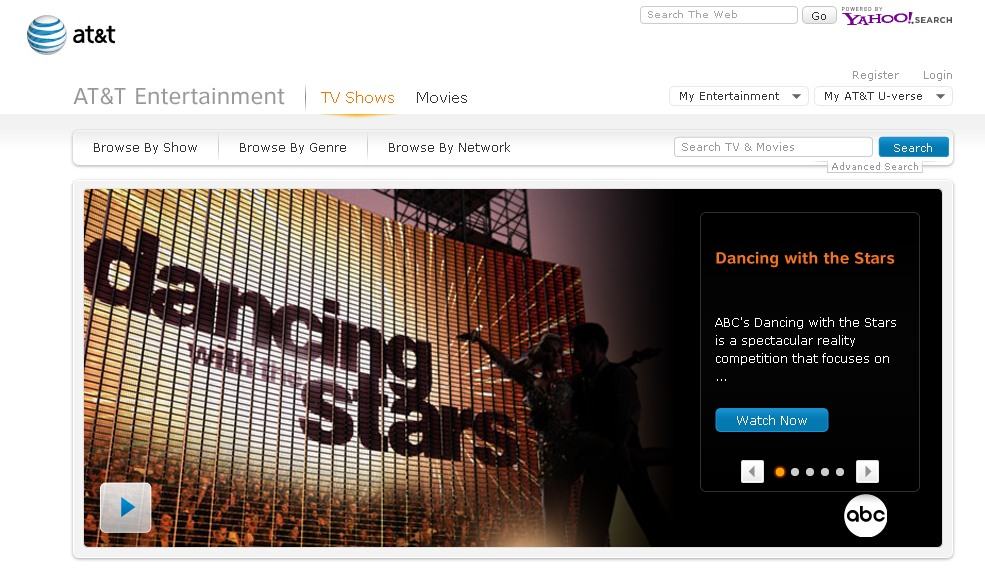
AT&T Entertainment: AT&T's answer to TV Everywhere

AT&T Entertainment: AT&T's answer to TV Everywhere

AT&T, not wanting to be left behind in the race to provide online video content to subscribers, has soft-launched its own video portal site, AT&T Entertainment.  The site, primarily for AT&T’s U-verse customers, is also available to anyone else who drops by to visit, although the content currently available to view is already available online elsewhere.

Current AT&T customers already have an account on the site based on their att.net Member ID.  Logging in adds several additional features, including:

  • Viewing age restricted content (if you meet minimum age requirements)
  • Rating shows and movies
  • Creating and managing a personalized library and queue
  • Sharing videos with friends via email
  • Viewing your U-verse guide and managing recordings on your DVR (if you have an AT&T U-verse account associated with your ATT.net Member ID)

At present, none of the content is exclusive to AT&T — it’s mostly a mix of videos from Hulu, CBS, and a few cable networks that allow videos to be embedded on other websites.  AT&T has promised it will expand the service when it officially launches at a yet to be determined date.

Ironically, while watching one Hulu-based TV show, the first thing shown to me was an advertisement from Sprint bashing AT&T for overcharging customers.

Trivial Pursuit… For Now: The ‘Hulu Beats Time Warner Cable’ Story Explained

Phillip Dampier September 3, 2009 Astroturf, Data Caps, Editorial & Site News, Online Video Comments Off on Trivial Pursuit… For Now: The ‘Hulu Beats Time Warner Cable’ Story Explained

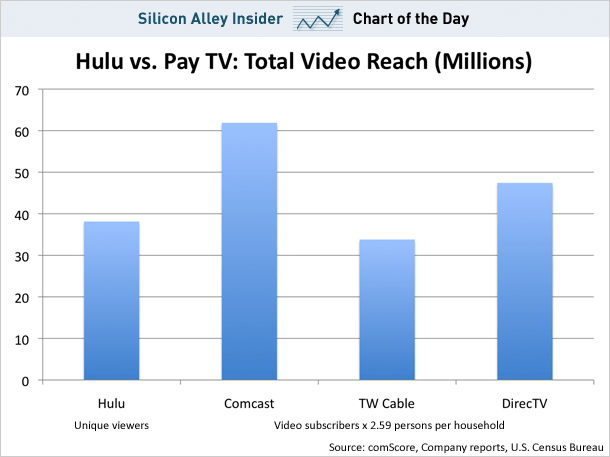
chartThere was quite a buzz this week over a story in The Business Insider reporting that Hulu reaches more viewers than Time Warner Cable (the nation’s second largest cable operator) has subscribers.  They found 38 million Americans watched Hulu and just 34 million Americans are Time Warner customers.

It’s interesting trivia, but really doesn’t mean all that much… yet.  In fact, Comcast, the nation’s largest cable operator has 62 million subscribers, so Hulu has a long way to go to beat Comcast, not to mention websites like Google Video and YouTube, which have more than 120 million combined viewers.

More importantly, Time Warner Cable has no trouble monetizing its business, as any cable subscriber knows when that ever-increasing bill arrives every month.  The same cannot be said for Hulu, which originally depended on an advertising model to sustain itself, at the same time the domestic online advertising marketplace imploded with the near-economic collapse last fall.  If television networks and newspapers can’t sell their ad inventories, the online advertising market, still a novelty for many advertisers, is in even worse shape.

Time Warner Cable is not losing any sleep over Hulu at the moment, and if they do become a nuisance, that consumption billing concept (or hard usage cap) is always an option to deter people from watching too much.

Broadband providers who pass along video content to their customers, without any ownership interest in those videos, are stuck in the position of owning “dumb pipes.”  In the month of July alone, comScore estimated that more than 21.4 billion videos were viewed on American-owned video websites.  Those videos ranged from the five minute karaoke performance from the guy in Des Moines who posted his performance to YouTube, to hour long dramas watched on a network TV website.

What people didn’t watch were all of the most popular shows from cable networks.  Dedicated viewers who needed to watch the entire second season of A&E’s Crime 360 show had to head to Usenet newsgroups or Bit Torrent websites to ferret out someone’s personal recording collection uploaded to share.  A&E only streams one episode from the second season at a time.

That explains why the cable industry is in a hurry to test their TV Everywhere project.  Cable and other pay-television customers will discover a lot more videos hosted on cable network websites suddenly “authenticating” their subscription status, and locking out those who don’t have a subscription (or offering teaser videos or a much more limited menu of viewing choices).

The upsides for TV Everywhere include pleasing existing pay television subscribers with more online videos.  They also get to sell advertising to accompany these on demand videos.  Those cable network websites may also have ads on them and can also promote their other programming.  Perhaps even more importantly, the industry will have a new tool in their subscriber retention arsenal — the ability to delicately remind subscribers wavering over whether to continue their cable TV package that they can forget about replacing it with watching shows online for free. Owning or controlling the content (and the distribution network) is always better than simply being used to transport someone else’s content.  You can’t giveth and taketh away content you don’t own — you can just make it prohibitively expensive to watch with Internet Overcharging schemes.

The downside, at least in their eyes, is the amount of bandwidth these videos will occupy on their existing distribution platforms.  In 2008, the “big threat” that demanded usage caps and/or consumption billing came from Bit Torrent.  In 2009, it’s online video.

Of course, two of the nation’s largest providers that have “appreciated” consumption billing and usage caps — Comcast and Time Warner Cable — are also enthusiastic founding partners of TV Everywhere.  That presents a problem.  A video platform like TV Everywhere, which may one day usurp Google’s dominance in online videos, is being run by the same people trying to convince Americans of broadband capacity problems and the need to cap usage or switch to consumption billing schemes.  TV Everywhere effectively takes the wind out of that argument because, as any consumer will ask, if your platform is too congested to handle online video, why in the world would you seek to make the “problem” much worse?

That’s a rhetorical problem astroturf groups are being hired to explain away.  They apparently couldn’t sell it to consumers during focus group testing, so now they’ll try the sock puppets instead.

puppet

DirecTV’s NFL “Ticket” to Internet Overcharges?

Phillip Dampier August 17, 2009 Data Caps, Online Video 5 Comments

directvDirecTV wants people out of reach of its satellite service to enjoy unlimited viewing of NFL football games, and today announced it would test providing them over broadband connections.  For $100 more a year than subscribers pay now for the satellite-delivered football game coverage, DirecTV will will offer New York City viewers as many NFL games they can watch over their broadband connection for $349 a year.

DirecTV claims it will sell the service only to those who cannot obtain satellite service from the company, which presumably will limit the broadband content to apartment dwellers and other urban residents who can’t mount a satellite dish.  But in a city like New York, that can easily mean tens of thousands of potential new customers, all watching video content delivered by Cablevision, Time Warner Cable, RCN, or Verizon’s broadband services.  USA Today covered the story this morning:

DirecTV has few customers [in New York City] because skyscrapers block signals coming from satellites orbiting the equator. Also, many landlords and co-op boards don’t allow residents to get a satellite service.

“A lot of the buildings (that can’t get DirecTV) we already have in databases because they’ve got exclusive contracts with cable guys,” says Derek Chang, executive vice president for content strategy and development.

To see the games, broadband customers will download a special video player and punch in a code. Users can install the software on multiple computers, but only one will be able to stream the games at any particular time.

Games with New York’s Jets and Giants, which air on broadcast TV, will be available only when the customer’s computer is outside the New York area.

Cable operators won’t just play defense in the battle for football fans. Comcast will announce today that it will offer the NFL Red Zone Channel to customers of its Sports Entertainment Package. On Sundays, the channel will display football statistics with audio from Sirius XM Radio‘s program “Around the League” — and go live to certain games when the ball is within 20 yards of the goal.

While Cablevision, RCN, and perhaps even Verizon may not express concern about the prospect of carrying NFL games across their networks without “compensation,” Time Warner Cable, which continues to express an interest in Internet Overcharging schemes, may not be so tolerant, especially if the test is successful.  ISPs who support Internet Overcharging routinely use online video growth as a justification for usage caps and consumption pricing.  Will the NFL become part of the Re-education of their customers?

Another question to ponder – would such a service even launch in a broadband marketplace infested with usage caps and limits?

Cable TV ‘Parasites’: The Online TV Viewer Cuts Cable’s Cord

Phillip Dampier July 20, 2009 Cox, Data Caps, Online Video 5 Comments

cableBronson Riley realized not long ago that he and his wife were paying way more for cable television than they were getting out of it. They watched only a few shows each week.

At the time, he was reading a book on personal finance. It mentioned purchasing services “a la carte” rather than as a package.

The Lincoln, Nebraska resident knew that wasn’t an option for cable TV. So he cut the cord about two months ago, canceling his cable subscription. Now the couple watch what they want, when they want — online.

The mainstream press has started devoting more attention to the plight of cable television executives pondering what to do about “parasites” like Bronson Riley, who they see as poaching their programming and watching it online… for free.

One of the unintended consequences of the unveiling of TV Everywhere, the Comcast/Time Warner Cable concept of permitting “authenticated” viewers to watch cable programming online, (as long as they already subscribe to a standard “cable package”) is an exploration of the phenomenon of  consumers cutting cable’s cord and doing without.

Riley touches on an issue that has bugged cable consumers for decades now — paying for channels they didn’t ask for and don’t want.  In the 1980s and early 1990s, talk about 500 channels of cable programming was dismissed as fanciful, but has since become reality when one includes on demand and music channels.  What has also become an increasing reality for cash-strapped consumers is the bill at the end of the month, which has grown annually faster than the rate of inflation.

A-la-carte, simply defined as paying only for those channels you watch, is an alarming concept for the nation’s cable television operators.  They have resisted the concept for more than 20 years, when it was first seriously raised in congressional hearings to deal with runaway cable bills.

Unfortunately for the industry, most consumers have suggested they have no need for most of the channels they receive today, and are tired of paying for them.  Many consumers would be happy with just six channels they routinely watch,  eager to pay only for them and nothing else.

With this in mind, some customers who also have broadband service from their cable provider have begun to discover many of their favorite shows are available, on demand, for free.  With more and more shows becoming available, a small, but growing minority of cable subscribers have decided to drop cable TV and watch video online instead, an issue the Omaha World-Herald explored:

Andrea Riley watches “Desperate Housewives” at ABC.com, which streams free full episodes of that and other popular shows such as “Lost” and “Grey’s Anatomy,” often the day after they air. The couple buy episodes of another favorite, “The Soup,” a revamp of “Talk Soup” on E! Entertainment Television, on Apple’s iTunes for $1.99 each with only a day’s wait.

Even paying for the handful of shows they can’t get free legally, Riley figures watching TV online saves money. The only thing they miss is flipping on CNN Headline News and the Weather Channel in the morning.

“It’s all getting to watch the TV shows you want to watch at a cheaper price, at your convenience,” he said.

In making the switch, the Rileys have joined a small but growing number of people who are tuning in online rather than over traditional network, cable or satellite pipelines. Some watch online occasionally to catch up on an episode they’ve missed or to track down old or obscure shows. Others, like the Rileys, watch online routinely.

For now, only a minority of web-aware consumers understand how to watch television online, but that’s changing.

“People are just figuring this out,” Jeremy Lipschulz, director of the University of Nebraska at Omaha School of Communication said. “Once people figure out that all this content is out there, you’ll see a more dramatic shift.”

Bobby Tulsiani, a senior analyst with the market research firm Forrester Research, agreed it’s still tech types who are making the change. Two years from now, more people will be doing it, he told the World-Herald.

Ann Shrewsbury, public affairs director for Time Warner Cable Nebraska, said their business trends nationwide show the same thing.

That leaves cable operators like Time Warner Cable in a quandary, and they’ve thus far responded with a trial to stream cable shows online, on demand, for their customers.  But the catch is one must remain a cable TV subscriber to access it.

Across many parts of Nebraska, served by Cox Cable, they’ll be left out of the online video revolution on offer from Time Warner Cable and Comcast, at least until Cox Cable can negotiate its way into the project being run by its larger brethren.

Riley said he generally doesn’t miss cable, having spent more of his time online or watching movies on demand, except for local weather from The Weather Channel and catching up with news on Headline News.  He doesn’t regret the savings either.  Most standard cable tiers are priced higher than his broadband service.

But Riley does recognize there is one way to put a stop to the revolution and end the parade to true, on-demand television viewing on a “pay per view” or free basis: limits on his Internet service.

With Internet overcharging schemes like usage limits, or charging overlimit fees for “excessive consumption,” cable operators might hope to stop the threat before it gets out of hand.


CBS: The ‘Hulu Holdout’ Joins TV Everywhere Comcast Trial

Phillip Dampier July 14, 2009 Comcast/Xfinity, Online Video 1 Comment

cbsIt has been a busy week for the TV Everywhere test project.  First, two premium movie networks — HBO and Starz agreed to participate in the trial, and now CBS, the first broadcast television network, today announced it was signing on as well.

CBS will be running a mix of older and current shows as part of the trial with Comcast subscribers, probably including its popular shows like CSI and NCIS, which are already available in some areas online through Comcast’s “Fancast” portal and through Time Warner Cable’s Primetime on Demand channel, available on digital cable.

“CBS and Comcast share the same vision of giving consumers more — more content, in more places,” said Matt Bond, Executive Vice President of Content Acquisition, Comcast Cable.  “On Demand Online is a major step in extending consumers’ television experiences online, and ultimately across platforms by giving any television network, including top brands like CBS, the ability to make their content available on the Web.”

CBS historically has avoided partnerships with the cable industry.  It is the only network that never launched a cable network (ABC Family, MSNBC, CNBC, fX, and others on offer from other networks), and also steered clear of a partnership with Hulu, which has ABC, Fox, and NBC among its partners.

The network is interested in the potential exposure its shows might have on-demand, particularly among younger viewers.  But more importantly, being friendly to the largest cable companies around may prove fruitful when the network wants retransmission consent agreements signed, permitting cable companies to place the network’s owned and operated local TV affiliates on the cable dial without a lot of aggravation and negotiations over fees.

TV Everywhere will offer “authenticated” subscribers to cable television or satellite service access to on-demand, streamed video programming through broadband networks.

Search This Site:

Contributions:

Recent Comments:

Your Account:

Stop the Cap!