Home » Online Video » Recent Articles:

Joost Sold to Online Ad Firm Adconion

Phillip Dampier November 24, 2009 Online Video 2 Comments

joostJoost, the troubled online video site launched by the founders of Kazaa and Skype has been quietly sold for an undisclosed sum to an online advertising firm.

Adconion Media Group said Tuesday it acquired both the distribution technology that makes Joost function and the Joost trademark.  The dozen or so remaining employees Joost kept on will become Adconion employees and help the site continue some of its entertainment focus.

Joost’s business plan was based on ad-supported programming, but with the 2008 economic crisis causing the bottom to drop out of online advertising, the company couldn’t sustain itself.  Efforts to refocus on online video delivery for businesses also proved challenging.  Joost has been on the sales block for months, with cable operators Comcast and Time Warner Cable approached about a possible deal.  But both cable operators signed on to the TV Everywhere concept instead.

About 12 Joost employees — the majority — were given jobs at Adconion, which plans to continue operating Joost.com as an entertainment site.  Presumably most of the online advertising that remains will be managed by Adconion itself.

Janus Friis and Niklas Zennstrom, the founders, initially envisioned Joost as a peer to peer sharing site for video, but didn’t fare well at a time when many online video sites had left the peer to peer model behind for direct delivery of video.

Rogers Introduces ‘On Demand Online,’ But Effectively Rations Your Use With Usage Caps

Phillip Dampier November 24, 2009 Canada, Data Caps, Online Video, Rogers 4 Comments

rogersRogers Communications wants you to watch television on your broadband service, but not too much.  The Canadian cable company’s On Demand Online service was previewed Monday at a media event with plans for a public launch on November 30.

On Demand Online will showcase specific television shows as well as the entire lineup of certain channels.  The service has more than a dozen partner networks providing programming, among them TVOntario, Treehouse, Citytv, SuperChannel, and Sportsnet.

Premium programming will be available to Rogers subscribers who also receive those networks as part of their cable television package.  No cable TV package?  No access for you.  (Update: Rogers says it will offer the service to customers of any Rogers service.)  For now, company officials say the service will be available for no additional charge, but will be ad-supported.  Using On Demand Online will count against your usage cap/consumption billing allowance.  The service offers two speeds for viewing – a low resolution 480kbps feed and a higher resolution 1Mbps feed.  Rogers intends to increase the quality of the high resolution service to 2-2.5Mbps in the near future.

Rogers rations your online TV experience with usage allowances that make sure you don't spend too much time online watching shows you should be viewing on your Rogers cable TV service.

Rogers rations your online TV experience with usage allowances that make sure you don't spend too much time online watching shows you should be viewing on your Rogers cable TV service.

Rogers’ usage allowances, a part of their well-established Internet Overcharging scheme, will make it difficult for those already spending a lot of time online to enjoy the service.  Watching the current high speed, higher resolution feed could exceed 1GB of usage in just over two hours according to Digital Home.  That drops in half when Rogers upgrades the quality of the feed.

Customers who blow through their allowance face overlimit penalties and fees on their next bill.

Qualified subscribers will access the service through Rogers’ broadband web portal using established account names and passwords.  While the service will work “on-the-go,” Rogers says it will be keeping an eye out for password sharing and will also impose any viewing limitations required by content producers.  That could mean what is okay to watch in Ontario is not okay in Alberta, due to licensing issues.

Stop the Cap! reader Ibrahim in Toronto wonders how Rogers expects to get a lot of customers excited about a service that will help erode their monthly usage allowance.

“Isn’t is fascinating that Rogers wants to effectively charge you for every hour you watch online when you’ve already paid for the channel on your monthly cable bill?  What’s next, a meter on top of the television set demanding a quarter for every 15 minutes of viewing?” he asks.

Susan in North York wonders why she’ll have to pay for every ad.

“When I read about this service, I thought we were finally going to get something like Hulu here in Canada, but with usage-based billing, who is going to use up their allowance watching shows with ads all over them — ads I am now going to pay to watch,” she wonders.  “I guess it’s newsgroups for me — I can download my shows without ads and pay less.”

While the program content can be fast-forwarded or rewound, commercial advertisements on the service cannot be skipped or hurried through.  Initially, the service is expected to show just one ad per program, but Rogers intends to eventually run the same number of ads consumers would find if watching the program live on television.  With up to 12 minutes of advertising per hour, that also helps slowly eat away your monthly allowance.

What are the monthly usage allowances for Rogers Hi-Speed Internet service?

Ultra Lite – 2 GB
Lite – 25 GB
Express – 60 GB
Extreme  – 95 GB
Extreme Plus – 125 GB

Please note: The grandfathered Ultra Lite and Lite monthly usage allowance is 60 GB. Also, Rogers Portable Internet and dial-up services do not have usage allowances at this time.

Will I be charged if I go beyond my monthly usage allowance?

Yes. If you exceed your monthly usage allowance, you will be charged as follows:

Ultra Lite – $5.00/GB to a maximum of $25.00
Lite – $2.50/GB to a maximum of $25.00
Express – $2.00/GB to a maximum of $25.00
Extreme – $1.50/GB to a maximum of $25.00
Extreme Plus – $1.25/GB to a maximum of $25.00

Please note: the grandfathered Ultra Lite over-allowance fee is $5.00/GB with no maximum, and the grandfathered Lite over-allowance fee is $3.00/GB with no maximum.

Goodbye to Free?: The ‘Great Wall of Pay’ Under Construction

Phillip Dampier October 29, 2009 Editorial & Site News, Online Video 7 Comments
The Great Wall of Pay

The Great Wall of Pay

Newspaper, broadcasting, and cable magnates have had enough of online web visitors accessing all of their content for free.  Free is naughty.  Free must be stopped.  Free threatens to devalue everything.

For the last few years, content producers have been looking for ways to recoup investments in online publishing.  Newspapers publish articles online and fear that causes people to stop paying for the printed edition.  Studios and networks make their shows available on Hulu, and people find on-demand viewing more convenient than watching ad-packed live television.  Cable magnates worry about people dropping cable subscriptions and watching all of their video online.

Broadcasting & Cable generated a firestorm late last week when it quoted one of Hulu’s partners — News Corporation’s Deputy Chairman Chase Carey telling the B&C OnScreen Summit “it’s time to start getting paid for broadcast content online.”

“I think a free model is a very difficult way to capture the value of our content. I think what we need to do is deliver that content to consumers in a way where they will appreciate the value,” Carey said. “Hulu concurs with that, it needs to evolve to have a meaningful subscription model as part of its business.”

CNN picked up the story in one of their news blogs, and promptly generated more than 700 responses, most hostile to paying for anything on Hulu, and that included the blog’s author:

“I certainly won’t be pulling out my credit card if the service puts up a subscription pay wall. And I doubt many other customers will be happy to start paying money for a service they previously received for free.”

Most comments indicated they’ll go back watching online TV shows and movies the old fashion way – downloading them from peer to peer torrent networks or newsgroups.

“The Internet abhors a content vacuum, especially one created artificially by a subscription wall,” Stop the Cap! reader Jake writes.  “Just like what happened with digital rights management schemes and viewing rights blockades, enterprising net users will always find a way around them and distribute the content a few don’t want us to have.”

The quest for control is increasingly becoming more contentious among super-sized corporate entities that create and distribute content.  Comcast seeks ownership of NBC-Universal, a content creator and partner in Hulu, which currently gives away content for free Comcast charges customers to watch.  A newly constructed Great Wall of Pay could help stop these business model challenges.

When online content was successfully monetized by advertising, few cared about handing it out for free.  In fact, providers like AOL abandoned many of its ‘subscriber-only’ walls to “go free” and attract a larger audience, and corresponding increased ad revenue.  In a post-bailout recession era, ad dollars have become scarce and no longer pay all of the bills Hulu’s owners want paid.  Advertising industry consultants say Hulu cannot simply increase the number of advertisements to make up the difference.  Even though Hulu users confront far less advertising than traditional broadcast television, research has shown online TV watchers resent a lot of the advertising they see now.  Many Hulu viewers actively develop a form of ad blindness based, in part, on the resentment those ads bring to the experience.  Hulu occasionally offers viewers one extended ad at the start of a show, instead of having them seeded throughout the program.  Many take Hulu up on the offer and use that 90 seconds to grab a snack.

Interestingly, the shorter a web ad, the more viewers retain information contained within it.  Some web ads run only 10 seconds, and are sold to clients with this in mind, and at a budget price to boot.

For web-ad haters, the worst of all worlds would be a Hulu that retains its limited commercial interruptions -and- charges a subscription fee.  For many, that would be the equivalent of “basic cable on the web.”  Many will drop Hulu “like a rock” should this happen.

A day after the hue and cry was raised by the Broadcasting & Cable article, skeptics said it was unlikely Hulu would entirely abandon free programming.  It may provide a premium pay service offering extra episodes, or perhaps remove commercials entirely for premium customers, a proposition at least some were willing to entertain, depending on the price.

“I would consider paying a very small (less than $3.00) monthly fee to watch Hulu if, and only if, they removed the commercials. Otherwise there are other alternatives,” one commenter wrote on CNN’s blog.

Newspapers are also feeling the bite, even more than online video sites.  The printed “dead tree format” of the daily paper has become anathema to the under-30 crowd, despite valiant efforts by some publishers to appeal to younger audiences with feature stories and even free weeklies that mix light news with entertainment features.  The only answer has been to take the paper online.  For years, concepts like online subscriptions, micropayments (paying a few cents per story), free access only for print subscribers, and charging per story for access to week-old and beyond news archives have been considered, tried, abandoned or ignored when web visitors flee or simply skip the pay content.  The daily local newspaper is not what it used to be, and when the “pay here” box pops up, many web visitors simply take their news reading business elsewhere, thanks to the near-universal access to wire service reports and competing media covering stories of interest for free.

Newsday, the Long Island newspaper owned by Cablevision, abandoned its “freeloading” audience yesterday with a new Great Wall of Pay charging a steep $5 a week for those who do not subscribe to either the newspaper or have a broadband account with Cablevision.

The newspaper’s Wednesday edition teased non-subscribers with stories that suddenly drifted off into ellipsis… with an invitation to open your wallet to read more.

Sports media blogger Neil Best, who writes for Newsday, seemed resigned to the fact he was losing a lot of his audience in his farewell-to-free column published Tuesday:

The inevitable decline in my national visibility (and page views) mostly is an ego thing. More to the point, Long Island advertisers understandably have little interest in readers in Dubuque.

For those readers who won’t be coming along for the ride – especially those outside Cablevision territory who in many ways are innocent bystanders in all this – thank you for your readership, input and support.

You will be missed.

Best realistically assessed the number of web visitors he’d see post-Wall, particularly from outside of the immediate area.  Best and his readership seemed to collectively sense this project was destined to fail, another bad experiment from aloof and out of touch management to the realities of the web world.  One commenter lamented the real victim would probably be Best himself:

What’s most frustrating of all, though, is that everyone knows this venture will fail. It’s never succeeded before and there’s truly no reason it will now. Pay for blogs? Are you kidding me? Even the pay-for-columns model is a one-in-a-million risk. But blogs? We all know this is not just you and I missing Neil, it’s Newsday destroying a commodity that could have helped it promote its other products. So Newsday loses– this has no chance– none– to succeed. And Neil loses –immediately– the majority of his followers. He will suffer the most immediate and quantifiable of harms. His readers, his fans, the people who support him and have helped him grow. Now his bosses shut us out and help him dwindle. And we lose. We lose our beloved journalists– we lose their thoughts and every day muses– things that dont even belong in a newspaper.

The use of the word “commodity” would no doubt cause much consternation among Newsday’s management and Wall Street types.  It is the “commoditization” of the news business, with endless debt-laden mergers and acquisitions and the cost-cutting that followed, that trained readers to realize that with the decrease in unique, local content in many newspapers, and their increasing reliance on partnerships with broadcast news operations, wire services, and syndicated feature content, why pay when you can get nearly the same (if not the same) content for free on the next website in the Google results list?

The big believers in the Great Wall of Pay fear what happened to newspapers could happen to their cable, broadcasting, or video rental operations.  The commoditization “crisis” is largely self-made: cable and phone companies with their “dumb pipes,” the cost-cutting local broadcaster that dispensed with nightly news, or the alienating video rental chain store made obsolete by Netflix or the Redbox ‘Tardis’ positioned in the entrance to your local supermarket.  When companies extract maximum revenue through minimal devotion to quality, uniqueness, and integrity, and either overcharge or irritate customers, why be surprised when consumers rebel when being asked to pay or pay more?

One of the rare success stories in pay content has come from Consumer Reports, which charges an annual fee for access to its online reviews.  Consumers notice the dramatic difference between a publication that accepts no advertising and keeps its integrity because of it, and other news sites contemplating pay schemes that are so cluttered with online advertising, autoplaying loud video ads, pop-ups and unders, they can barely find the content they are now being asked to pay for.

Consumers can and will pay for quality content, but many will not be forced into doing so with a corporate blockade on content from “walled gardens” and other “pay me to watch this, right after this ad” schemes.  Online, there is more than one way around the Great Wall of Pay.

Federal Communications Commission Votes to Start Drafting Net Neutrality Policy That Verizon Seems to Suddenly Support

Phillip Dampier October 22, 2009 Data Caps, Editorial & Site News, Net Neutrality, Online Video, Public Policy & Gov't, Verizon, Video Comments Off on Federal Communications Commission Votes to Start Drafting Net Neutrality Policy That Verizon Seems to Suddenly Support

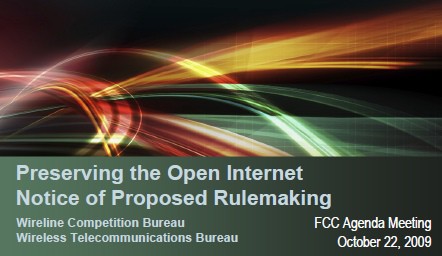
fccThe FCC today voted unanimously to begin writing a formal Net Neutrality policy to govern broadband services across the United States.  Three Democratic commissioners voted yes and applauded the concept of Net Neutrality.  The two Republican commissioners also voted to move the process forward, but signaled they would likely oppose the final draft of the rules.

Support for Net Neutrality, which would prohibit providers from slowing down, blocking, or charging higher pricing for favored access to web content, was spearheaded by FCC Chairman Julius Genachowski.

Genachowski said the rules were needed to protect consumers from abusive behavior by telecommunications companies that might seek to block or restrict access to broadband content, including telephone and video services.

“Internet users should always have the final say about their online service, whether it’s the software, applications or services they choose, or the networks and hardware they use to the connect to the Internet,” Genachowski said.

Other Democratic commissioners agreed with Genachowski.  Commissioner Michael Copps stated it was important to hear from everyone about the proposed rules.

“We need to recognize that the gatekeepers of today may not be the gatekeepers of tomorrow,” Copps said.

John McCain

John McCain

Many Republicans were unconvinced of the need to establish Net Neutrality as formal policy.

“I do not share the majority’s view that the Internet is showing breaks and cracks, nor do I believe that the government is the best tool to fix it,” Republican commissioner Robert McDowell said.

“These new rules should rightly be viewed by consumers suspiciously as another government power grab over a private service provided by private companies in a competitive marketplace,” Sen. John McCain wrote in an opinion piece published by The Washington Times.

McCain compared Net Neutrality with the federal bailout of Wall Street and the American auto industry.

Under the draft proposed rules, subject to reasonable network management, a provider of broadband Internet access service:

  1. would not be allowed to prevent any of its users from sending or receiving the lawful content of the user’s choice over the Internet;
  2. would not be allowed to prevent any of its users from running the lawful applications or using the lawful services of the user’s choice;
  3. would not be allowed to prevent any of its users from connecting to and using on its network the user’s choice of lawful devices that do not harm the network;
  4. would not be allowed to deprive any of its users of the user’s entitlement to competition among network providers, application providers, service providers, and content providers;
  5. would be required to treat lawful content, applications, and services in a nondiscriminatory manner; and
  6. would be required to disclose such information concerning network management and other practices as is reasonably required for users and content, application, and service providers to enjoy the protections specified in this rulemaking.

The draft rules make clear that providers would also be permitted to address harmful traffic and traffic unwanted by users, such as spam, and prevent both the transfer of unlawful content, such as child pornography, and the unlawful transfer of content, such as a transfer that would infringe copyright.

Today’s vote marks only a beginning of the process to begin writing the formal policy of Net Neutrality governing Internet use in the United States.  As with the ponderous debate on health care reform, what ends up defining “Net Neutrality” will be open to interpretation, and a barrage of lobbyists and arm twisting from politicians will be part of what comes next.

On the eve of the historic vote, Verizon Communications seemed to join Google in affirming some of the basic principles of Net Neutrality.

However, the devil is in the details, as is always the case in telecommunications policy.

verizon

Verizon supports its own interpretation of Net Neutrality, which is wrapped in a concept they call “innovation without permission,” which is code language for a deregulatory open free-market environment.  It broadly accepts the concept that telecommunications companies should not interfere with legal content, but the company doesn’t want a whole barrage of new regulations to specifically define what would constitute “interference.”  Verizon believes onerous rules would stifle investment, and that existing rules already in place at the FCC are sufficient protection.

Things get downright dicey when Verizon spells out its “network management” principles, warning the FCC overly specific rules in this area could have unintended consequences.

Broadband network providers should have the flexibility to manage their networks to deal with issues like traffic congestion, spam, “malware” and denial of service attacks, as well as other threats that may emerge in the future–so long as they do it reasonably, consistent with their customers’ preferences, and don’t unreasonably discriminate in ways that either harm users or are anti-competitive. They should also be free to offer managed network services, such as IP television.

It is in this area where very specific rules are appropriate to write, because what one company defines as appropriate “network management,” could be discriminatory against selected content those providers seek to “manage.”

No broadband user has ever objected to network management that controls spam, “malware,” denial of service attacks, and other like-minded traffic.  In fact, most consumers wish more could be done to control these things.  Nothing in the current framework of telecommunications regulations or in those proposed have ever sought to impede this type of management.

No consumer minds having access to additional content, such as IP television.  But consumers do object when such content is used as an excuse to ram through Internet Overcharging schemes limiting broadband usage or imposing higher fees for using the types of services companies like Verizon now advocate.  “The broadband sky is falling” rhetoric about “exafloods,” overloaded “Internet brownouts,” and other such scaremongering nonsense often comes from the same providers that now want to provide IP television.  What they provide with their left hand, they want to limit with their right.

It’s anti-competitive, because the same companies with an interest in selling these pay television services (FiOS, cable television, fiber-telephone U-verse, etc.) also provide the broadband service that companies like Netflix and Hulu use to indirectly challenge their video business models.

Another concern is “traffic congestion” management, which all too often has meant speed throttles selectively imposed on “offending” applications, particularly peer to peer traffic.  There is good traffic management, such as routing equipment that provides even delivery of services like streaming video and Voice Over IP telephone calls, which rapidly deteriorate on loaded down networks, and then there is bad traffic management which selectively slows down the speed of whatever the provider deems to be of “lower priority.”  Allowing the customer to make the decision about which traffic gets priority is one thing.  Allowing a provider to do it without the consent of the customer is quite another.

Too often, the “unintended consequences” Verizon and Google speak about in the joint statement go to the provider’s favor, not to the consumer.  Overly broad, non-specific language opens loopholes through which providers will eagerly leap through.

Verizon also advocates transparency — “All providers of broadband access, services and applications should provide their customers with clear information about their offerings.”

Disclosure alone doesn’t suffice for consumers, particularly if there are few competitive places to take your business if you disagree with company policies.  Those rules should include realistic speed information (marketing stating “up to 10Mbps” that in reality only delivers 3Mbps would be one example).  It should not simply be an escape clause for providers to abuse their customers with throttled, slow service, and give them the excuse that “we disclosed it.”

<

p style=”text-align: center;”>

Federal Communications Commission Open Meeting

October 22, 2009

112 minutes

(Warning: Loud audio)

The Wall Street Journal Quotes Stop the Cap! Founder & Addresses Internet Overcharging Schemes

Phillip "I Also Told You So" Dampier

Phillip Dampier

The Wall Street Journal today published an article reviewing the landscape of flat rate broadband service and how some Internet providers want to change it.

The article quotes me on the issue of Internet Overcharging becoming a political football in the Net Neutrality debate.

“This could come down to carriers saying, ‘If you don’t allow us to manage our networks the way we see fit, then we will just have to cap everything,’ ” says Phillip Dampier, a consumer advocate focusing on technology issues in Rochester, N.Y. “They’ll make it an either/or thing: give them more control over their network or expect metered broadband.”

Mr. Dampier was among those who forced Time Warner Cable to shelve a metered Internet pilot program in several cities last year. The company, which had argued the plan would be a fairer way to charge for access, acknowledged it was a “debacle.” It won’t say if it plans to revive the trials.

Unfortunately, the article never bothers to mention Stop the Cap!, the website dedicated to fighting these overcharging schemes.

AT&T's Internet Overcharging Experiment Gone Wild

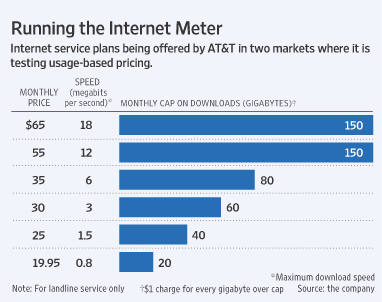
AT&T weighs in on their experiment to overcharge consumers in Beaumont, Texas and Reno, Nevada, and analysts think Net Neutrality arguments may give providers an excuse to expand those experiments, launch price increases and blame it on Net Neutrality policies:

“Some type of usage-based model, for those customers who have abnormally high usage patterns, seems inevitable,” an AT&T spokesman says. AT&T declined to provide more details on its trials.

“Unquestionably, the carriers erred in their initial selling of broadband with a flat rate,” says Elroy Jopling, research director of Gartner Inc. “They assumed no one would use it as much as they do now, but then along came high-definition movies. They’re now trying to get around that mistake.”

Network neutrality deals primarily with ensuring that Internet providers don’t favor any online traffic over any other. Still, Mr. Jopling and other analysts argue, the net neutrality debate might provide the carriers with an opening to argue for changing that pricing.

“With network neutrality enforced, the only other option for carriers is to charge by the byte or to raise the flat-rate pricing,” says Johna Till Johnson, president of Nemertes Research. “Right now they’re just deciding which one to do. Just be prepared to pay more.”

It's "Rep. Eric Massa," Not 'Joe Messa'

It's "Rep. Eric Massa," Not 'Joe Messa'

The article has several flaws.

  • It mis-identifies Rep. Eric Massa (D-New York) as “Rep. Joe Messa.”  Rep. Massa introduced legislation to ban Internet Overcharging when companies cannot produce actual evidence to justify it, particularly in the limited competitive marketplace for broadband in the United States.
  • The article fails to mention the usage limits proposed by smaller broadband providers, including Frontier’s infamous 5GB usage definition in their Acceptable Use Policy.  This is a very important fact to consider when the article quotes Professor Andrew Odlyzko, an independent authority on broadband usage, as stating the average broadband consumer uses triple that amount (15 gigabytes per month).
  • The quotation about the number of e-mails or web page views available under plan allowances that routinely appear in such articles ignores the increasing use of higher bandwidth applications like online video.  Telling a consumer they can send 75 million e-mails is irrelevant information because no consumer would ever need to worry about usage limits if they only used their account for web page browsing and e-mail usage.  They very much do have to be concerned if they use their service to watch online video from Hulu or Netflix, or use one of the online backup services.
  • The article makes no mention of publicly available financial reports from broadband providers like Time Warner Cable that prove that at the same time their profits on broadband service are increasing, the company’s costs to provide the service continue to decline, along with the dollar amounts they spend to maintain and expand that network to meet demand.  Providing readers with insight into the true financial picture of a broadband provider, instead of simply quoting the public relations line of the day would seem particularly appropriate for The Wall Street Journal.
  • The article doesn’t make mention that the same providers arguing increased Internet traffic is creating a problem for them are also working to launch an online video distribution platform that will rival Hulu in size and scope.  TV Everywhere will consume an enormous amount of the broadband network they claim can’t handle today’s traffic without Internet Overcharging schemes being thrown on customers.  Of course, such usage limits are very convenient for companies like Comcast, Time Warner Cable and AT&T, which are now in the business of selling pay television programming to consumers.  Should a consumer choose to watch all of their television online instead of paying for a cable package, a usage allowance will help put a stop to that very quickly, as will planned restrictions that only provide online video to “authenticated” existing pay television subscribers.

One thing remains certain – providers are still itching to overcharge you for your broadband service.  Consumers and the public interest groups that want to represent them must stand unified in opposition to Internet Overcharging schemes and for Net Neutrality protection, and never accept sacrificing one for the other.

Search This Site:

Contributions:

Recent Comments:

Your Account:

Stop the Cap!