Home » Online Video » Recent Articles:

Cable Cartel’s Plan to Kill Online TV: No Cable Subscription? No Online TV – Consumer Groups Call That Collusion

Phillip Dampier January 4, 2010 Comcast/Xfinity, Data Caps, Issues, Online Video 17 Comments

Comcast blocks C-SPAN programming for those who are not Comcast customers

Public interest groups today began an offensive against the cable industry’s attempts to stave off potential online video competition with an industry dominated and controlled online video platform that guarantees consumers won’t cut cable’s cord.

Free Press, Media Access Project, Public Knowledge and Consumers Union are sending letters to the Justice Department and the Federal Trade Commission calling for a probe into the industry’s “TV Everywhere” project, designed to weed out non-cable subscribers from accessing online video programming.

The undertaking, which the industry claims will eventually rival Hulu in size and scope, seeks to provide their broadband customers with on-demand access to as much programming as possible, as long as they subscribe to a corresponding video programming and broadband service package.

Known in the industry as a “pay wall,” the system would assure pay television companies affiliated with the project that they will not lose subscribers from customers cutting the cord to watch programming online for free.  Consumer groups call that collusion, and accuse the industry of secretly meeting to outline the TV Everywhere concept and may be violating anti-trust laws in the process.

“The old media giants are working together to kill off innovative online competitors and carve up the market for themselves,” said Marvin Ammori, a law professor at the University of Nebraska and senior adviser to Free Press. Ammori’s report: TV Competition Nowhere: How the Cable Industry Is Colluding to Kill Online TV, is included in the mailing to the federal agencies.

Ammori says the industry has a long history of controlling behavior.

“Over the past decade, they have locked down and controlled TV set-top boxes to limit competing programming sources; they have considered imposing fees for high-capacity Internet use in ways that would discourage online TV viewing; and they have pressured programmers to keep their best content off the Internet,” Ammori writes.

In addition, these companies, which already dominate the Internet access market, have threatened to discriminate against certain online applications or have already been caught violating Network Neutrality. Indeed, the FCC issued an order in 2008 against Comcast for blocking technologies used to deliver online TV, noting the anti-competitive effect of this blocking. While it may be economically rational for cable, phone and satellite companies to squash online competitors, the use of anti-competitive tactics is bad for American consumers and the future of a competitive media industry.

The latest method of attack aimed at online TV, however, may be the most threatening — and is also likely illegal. Competition laws aim to ensure that incumbent companies fight to prevail by providing better services and changing with the times, not by using their existing dominant position and agreements to prevent new competitors from emerging.

TV Everywhere has a simple business plan, under which TV programmers like TNT, TBS and CBS will not make content available to a user via the Internet unless the user is also a pay TV subscriber through a cable, satellite or phone company. The obvious goal is to ensure that consumers do not cancel their cable TV subscriptions. But this plan also eliminates potential competition among existing distributors. Instead of being offered to all Americans, including those living in Cox, Cablevision and Time Warner Cable regions, Fancast Xfinity is only available in Comcast regions. The other distributors will follow Comcast’s lead, meaning that the incumbent distributors will not compete with one another outside of their “traditional” regions.

In addition, new online-only TV distributors are excluded from TV Everywhere. The “principles” of the plan, which were published by Comcast and Time Warner (a content company distinct from Time Warner Cable), clearly state that TV Everywhere is meant only for cable operators, satellite companies and phone companies. By design, this plan will exclude disruptive new entrants and result in fewer choices and higher prices for consumers.

This business plan, which transposes the existing cable TV model onto the online TV market, can only exist with collusion among competitors. As a result, TV Everywhere appears to violate several serious antitrust laws. Stripped of slick marketing, TV Everywhere consists of agreements among competitors to divide markets, raise prices, exclude new competitors, and tie products. According to published reports and the evident circumstances, TV Everywhere appears to be a textbook example of collusion. Only an immediate investigation by federal antitrust authorities and Congress can prevent incumbents from smothering nascent new competitors while giving consumers sham “benefits” that are a poor substitute for the fruits of real competition.

Ammori

The benefits of controlling the marketplace of video and online entertainment is a lucrative one, earning players billions in profits each year.  Losing control of the business model risks the industry repeating the mistakes of the music industry, which overpriced its product and alienated consumers with annoying digital rights management technology and lawsuits.  It also risks a repeat of the newspaper industry which many in the cable industry believe made the critical mistake of giving away all of their content for free.

With online video services like Hulu generating enormous online traffic from its free video programming, the cable industry fears they might already be headed down the road newspapers paved.  TV Everywhere is part of a multi-pronged defense plan according to Ammori.

Indeed, what the industry cannot control themselves, Internet Overcharging schemes like usage caps and “consumption billing” can handily manage.

Ammoni notes:

Cable and phone companies have proposed cap-and-metered pricing for Internet service that appears to target online TV. Unlike the current all-you-can-eat monthly fee-plans, cap-and-metered pricing would charge users based on the capacity used. As a result, downloading or streaming large files will be more expensive than smaller files. In March 2009, Time Warner Cable announced metered pricing trials in four cities that would have made watching online TV cost prohibitive.

AT&T is testing a metering plan on its wireline U-verse service with hopes for national expansion. Even under generous allowances for bandwidth, users could not watch high-definition programming for many hours a day.

In response to trials by Time Warner Cable, a House bill was introduced in Congress, and Time Warner Cable dropped its immediate plans under consumer pressure. The company stated the plans would be reintroduced following a “customer education process.”

“Online TV is this nation’s best shot at breaking up the cable TV industry oligopolies and cartels. Permitting online distributors to compete vigorously on the merits for computer screens and TV screens will result in increased user choice, more rapid innovation, lower prices and a more robust digital democracy,” Ammoni concludes.
OnLive Game Cloud Demonstrated – Its Biggest Threat? Usage Cap Happy Internet Service Providers

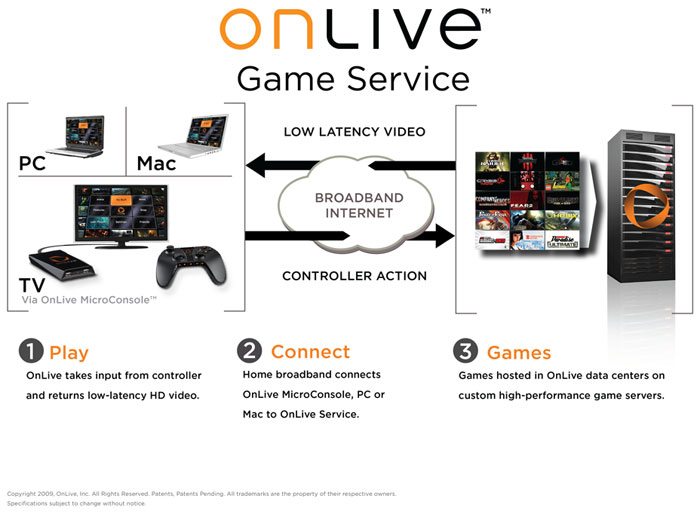
OnLive puts the processing power to render and play games on their end, and streams the result to you over your broadband connection (click to enlarge)

OnLive, the cloud-based videogame streaming service, was on display during a live dem0 of the service at Columbia University.  The service, which literally streams game play across fast broadband networks, could seriously challenge the videogame console marketplace.  Instead of using an expensive piece of hardware at home to play videogames such as w88, OnLive puts the hardware at their end and streams the results to any computer or television.  If it works, it means consumers won’t need the highest performance videocards or latest new CPU.  They’ll just need a fast broadband connection to let OnLive’s own servers do all of the processing.

The founder and CEO of OnLive, Steve Perlman, shows considerable enthusiasm for the concept, and several major investors including AT&T and Time Warner have backed the venture, which could help guarantee smooth passage on their broadband networks.

Still, a product that requires a minimum of a 5Mbps broadband connection for HD-quality streamed game play could consume an enormous amount of data — up to 2.25 GB per hour of gaming.  Although cable and fiber-based broadband connections will suffice, many DSL customers don’t have service fast enough to support OnLive.  Among those that do, any usage caps or allowances will significantly reduce the value of the service to potential subscribers.  Frontier Communications’ infamous 5GB “acceptable use” per month, for instance, would allow just over two hours of use per month, assuming you did nothing else with your DSL service.

Even Comcast’s 250GB usage allowance cuts game play to a little over 100 hours per month.  That’s a ludicrous amount of gaming for most of us, but not for some gaming addicts who may have tried games like 핑카지노.  Besides, it also assumes you don’t use your Comcast broadband service to watch video or other bandwidth-intensive online services.

Time Warner Cable’s proposed 40GB usage limit, shelved indefinitely in April after consumer protests, would permit less than an hour of play per day, assuming your Road Runner service was for nothing but OnLive.

In short, assuming OnLive works as promoted, its biggest threat to success will come from external factors mostly outside of its control — namely cap-happy ISPs that could quickly make streamed cloud computing untenable for all but the wealthiest among us.

What could OnLive do to reduce its risk from caps?  Partner with ISPs in a non-Net Neutral broadband world, of course.  That investment from AT&T, for example, could theoretically pave the way for AT&T to exempt OnLive from any usage limits that come from its own Internet Overcharging experiments in Beaumont, Texas and Reno, Nevada.  That would be a clear violation of Net Neutrality, if enacted into law.

Scenarios like this should drive consumers to support Net Neutrality policies.  ISPs forming “preferred partnerships” with innovative services like OnLive might seem consumer-friendly at first, but not in the long-term because it spells the death of would-be “non-preferred” start-ups, and helps pave the way even faster to Internet Overcharging schemes letting broadband providers pick the winners and losers of the future.

[flv width=”484″ height=”292″]http://www.phillipdampier.com/video/OnLive Columbia University Demo.flv[/flv]

OnLive founder and CEO Steve Perlman demonstrates OnLive and talks about cloud-based, streaming game play at this gathering at Columbia University in New York. (49 minutes)
(If stream stops for buffering, pause it for a few minutes to let a significant amount of the file pre-load, which should reduce re-buffering problems.)

Comcast’s XFINITY TV Now Online, But Watching Counts Against Your Usage Cap

Phillip Dampier December 16, 2009 Comcast/Xfinity, Online Video 4 Comments

fancastComcast has formally announced their version of TV Everywhere is now online.  Fancast XFINITY TV “is available to any Comcast customer with a digital cable and Internet subscription.”  There is no additional charge for the service.

Comcast customers can access the service after logging in through Comcast.net or Fancast.com with their account username and password.  Once “authenticated” as a confirmed Comcast cable subscriber, customers can watch approximately 2,000 hours of programming from more than 30 cable networks, including premium channels HBO, Cinemax, and Starz.  A demonstration showed Comcast had complete seasons of series like The Sopranos and Big Love.

Some programmers are exploring whether Nielsen can count online viewing as part of its ratings measurements.

Initially, Comcast will restrict access to customers who are confirmed digital cable and broadband customers, but will extend the service to those who only subscribe to Comcast cable programming in approximately six months once security and authentication issues have been resolved, according to company officials.

The service should be accessible by subscribers on-the-go through mobile broadband or other connections, as long as customers log in.  Access is not allowed outside of the United States for copyright clearance reasons.

Customers should be aware any video accessed by the service counts against Comcast’s 250GB monthly usage limit.  Advertising on the service also counts.  Unlike Hulu which typically provides just one advertisement for every break, Comcast’s program partners have tested full commercial loads, up to seven minutes worth in a 30-minute program.  That’s 14 ads to sit through, each eating into your usage allowance.  Comcast says programmers are individually testing different amounts of advertising to learn how viewers react.  The prevailing view is that online viewers are less tolerant of advertising than typical television viewers.

Americans Embrace New Ways to Watch TV Without Fundamentally Changing Old Habits; Providers Feel Threatened Anyway

Phillip Dampier December 7, 2009 Comcast/Xfinity, Data Caps, Online Video 14 Comments

Subscription television providers should relax: Americans are not moving away from watching television on television sets.  Nielsen’s Three Screen Report, issued today, finds most Americans are not fundamentally changing the way they watch TV — they are simply taking advantage of more convenient ways to watch.

The report shows considerable year over year growth in terms of time spent for Digital Video Recorder viewing (up 21.1%) and online video (up 34.9%) since the fall of 2008. Given the consistent spike in usage among the three screens of television, Internet and mobile, consumers are clearly adding video platforms to their schedule, rather than replacing them.

“Americans today have an insatiable appetite for not only content, but also choice,” says Nic Covey, director of cross-platform insights at Nielsen. “Across all age groups, we see consumers adding the Internet and mobile devices to their media diet — consuming media anytime and anywhere possible.”

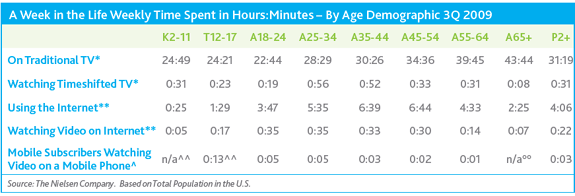
Nearly 99% of television viewing is spent watching it on a television set, according to Nielsen’s findings.  But consumers are also discovering broadband and mobile viewing can add convenient new options, and are taking advantage of them:

  • In 3Q09, the average American watched 31 hours of TV per week, with 31 minutes spent in playback mode with their DVR.
  • In addition, each week the average consumer spent 4 hours on the Internet and 22 minutes watching online video.
  • The average consumer spent 3 minutes watching mobile video each week.
source: Nielsen

The biggest fans of mobile video are teenagers, some spending just over seven hours per month watching video on their phones.  Watching television on a broadband connection is a popular trend among those aged 18-44, one noticed by Comcast chief operating officer Steve Burke.  Burke spoke about the trend at the recent Cable & Telecommunications Association for Marketing’s three day conference in Denver.  He noted his own children now prefer to watch their shows on a laptop from one of the free online services and not on the family television.

Allowing young viewers to grow up assuming they can watch anything, anywhere, for potentially no charge is a very dangerous proposition for people in Burke’s business.

Stephen Burke, Comcast Chief Operating Officer

Stephen Burke, Comcast Chief Operating Officer

“An entire generation is growing up with that preference,” Burke said. “If we don’t do something to change that behavior so they respect copyrights on the side of content provider, and cable subscriptions or satellite subscriptions or telco subscriptions on the side of the distributors, we are going to wake up with a lot of ingrained habits going the wrong way and we will see cord-cutting.”

Comcast has two ways to make sure viewers learn their lessons about paying for what they watch:

  1. The formalized introduction of the forthcoming usage meter, better enforcing Comcast’s 250GB monthly limit for their broadband service.  Watching a lot of online video will take a major bite out of your broadband usage allowance.
  2. The launch of Comcast’s Fancast Xfinity TV, a service that will allow only existing Comcast cable-TV package subscribers access to many of their favorite shows online, on demand, for no additional charge.  That new name comes courtesy of Comcast’s marketing gurus, to replace what readers better know as: TV Everywhere.

The usage meter and “authenticated subscribers-only” pay wall are Comcast’s one-two punch to keep subscribers from eventually dropping their cable-TV package to watch television exclusively over their broadband connection.

Cable operators already treat companies like Netflix, which use broadband to deliver an increasing number of movies and TV shows on-demand to subscribers, as a major threat.  Insight Communications CEO Jamie Howard called Netflix the equivalent of the third largest cable operator in the country in terms of content delivered.  That’s content not owned or directly managed by Insight or other cable providers.

Some in the industry believe who owns and controls online video will eventually decide the winners and losers in the subscription television business.  Derrick Frost, founder and CEO of Invision.TV, an Internet video search engine, warned the outcome of the battle can’t come soon enough.  Otherwise, consumers “will find other ways — legally or illegally — to access it.”

Could NBC Now Be History? Comcast Completes Offer for NBC-Universal – May Drop ‘NBC’ Name

ceg_logoComcast Corporation has completed its offer for NBC-Universal and they accepted in an early morning press conference unveiling a deal that had been privately rumored for months.  Comcast will assume 51% control of NBC-Universal, with NBC-owner GE controlling the remaining 49% stake.

The combined entity, to be known as Comcast Entertainment Group, will bring Comcast-owned media into the home of every American, even those not served by Comcast Cable.

Although company officials said little would change immediately, Comcast has not ruled out dropping the legacy ‘NBC’ brand down the road.  Broadcasting & Cable noted the company may be hinting at its intentions through its domain name registrations.  The trade publication reported Comcast’s registrar locked ComcastNBCU.com and NBCUComcast.com in mid-October, but returned and registered ComcastEntertainment.com ten days later.

Brian Roberts, CEO of Comcast Corporation, joked that NBC’s fourth place position among the major American broadcast networks might “get in the way” of recognizing NBC-Universal’s cable networks, which he characterized as “fantastic.”  Perhaps a change of NBC, which stands for the National Broadcasting Company, to Comcast Entertainment Network might change that perception?

Changes like that, and the implication of renaming a major American network after what most Americans recognize as a cable company has brought significant unease among some examining the scope of the transaction.

Comcast CEO Brian Roberts

Comcast CEO Brian Roberts

Comcast Entertainment Group will control a major American broadcast network, Telemundo – a major American Spanish-language broadcast network, Comcast Cable, the nation’s largest cable system operator, several cable networks, 27 GE-owned television stations in major American cities, a large number of regional sports networks, and more.  It also manages broadband service for nearly 16 million Comcast customers.

Stifel Nicolaus telcom analysts Rebecca Arbogast and David Kaut warned potential investors this deal has a lengthy and difficult regulatory review waiting for it in Washington, DC: “We would expect scrutiny of the transaction’s impact on program access, program carriage and retransmission consent, as well as local TV advertising, broadcast-network affiliate arrangements, program bundling, broadband/Internet video and network neutrality and possibly other issues, including cable pricing…broadband service, labor concerns, spectrum and privacy.”

The dealmakers recognized the challenges and started throwing voluntary concessions to concerned groups.  Unimpressed Comcast shareholders got a bone thrown their way — a surprise 40% increase in their dividend, in hopes that will quiet shareholder unease.

Comcast also sent letters to regulatory officials promising NBC will remain a free, over the air broadcast network and not be converted into a cable-only channel.

The cable operator will also add additional independently-owned cable networks to its lineup to quiet concerns it might favor its own cable networks.  Of course, whether customers want to watch and pay for those channels is another matter.

Finally, Spanish language services from Telemundo and other channels will receive enhanced free on-demand cable viewing options in cities where Telemundo is seen over-the-air.

For broadband users, the deal means Comcast gets a seat at the table of online video provider Hulu.  NBC-Universal was a major proponent of the online video service which gives broadband users free access to broadcast and cable programming.

That deeply concerns Andrew Schwartzman, president and CEO of Media Access Project.  He’s concerned about the enormous market power Comcast Entertainment will have.

nbc_universal“I am especially concerned about the effects the merger would have on evolving technologies for delivering video over the Internet….I also expect a great deal of opposition from the private sector, since the merger has anti-competitive implications for local TV stations, independent cable programmers, advertisers, internet video entrepreneurs and many other businesses,” he told The Hill.  Both Media Access Project and Free Press have called on regulators to reject the deal.

“The American public doesn’t want a media behemoth controlling the programming they watch and how they can access it,” said Josh Silver , executive director of Free Press. “If Washington allows this deal to go through, Comcast will have unprecedented control of marquee content and three major distribution platforms: Internet, broadcast and cable. We’ve never seen this kind of consolidated control.”

[flv width=”596″ height=”356″]http://www.phillipdampier.com/video/NBC Today Show Announces Comcast Deal 12-03-09.flv[/flv]

This morning’s Today show on NBC briefly reviewed the deal and what it means for consumers (1 minute)

[flv]http://www.phillipdampier.com/video/CNBC Parsing the Comcast NBC Deal Craig Moffett 12-03-09.flv[/flv]

Sanford Bernstein’s Craig Moffett talks with CNBC about why many telecom sector analysts are underwhelmed by the Comcast-NBC deal (3 minutes)

<

p style=”text-align: center;”>

GE CEO Jeffrey Immelt and Comcast CEO Craig Roberts join CNBC’s David Faber for an in-depth discussion about the transaction and the changing media business. (28 minutes)

Learn more about NBC’s broadcast operations impacted by this deal below.

… Continue Reading

Search This Site:

Contributions:

Recent Comments:

Your Account:

Stop the Cap!