Home » Online Video » Recent Articles:

TV-Sized Ad Loads Coming to Online Video? – With Overcharging Schemes, You’ll Pay More to Watch Them

Phillip Dampier February 15, 2010 Data Caps, Online Video Comments Off on TV-Sized Ad Loads Coming to Online Video? – With Overcharging Schemes, You’ll Pay More to Watch Them

Advertising Age this week predicted online TV could be about to undergo a transformation — into the online equivalent of advertising-packed traditional television.

Starting as early as this fall, that 47 minute “hour long” show you’ve watched with a handful of commercial interruptions may become a 59 minute show, with almost 15 minutes of additional advertising piled on your viewing experience.  Worst of all, if your service provider wants to stick you with a usage allowance or “consumption billing,” you will effectively be paying to watch commercials.

Imagine after receiving your monthly pay television bill, a company representative arrives to install a coin meter on the side of your TV.  Your monthly fee just gives you access to the channels, he explains.  Actually watching them costs more.

Why introduce more advertising?

Nielsen, a ratings measurement service, will start providing its subscribers ad viewing information regardless of whether the viewer sees it on a traditional television or online.  The catch is the advertising must be the same across platforms.  That means online video could run the same ads your local station or cable network carries.

“The financial models used for the current large video hubs in the online space are not sustainable,” said Jack Wakshlag, chief research officer for Time Warner’s Turner Broadcasting. One way to make online viewing more financially lucrative, several TV executives suggested, is to use it to aggregate viewing of popular shows across TV, online and other emerging media — and then use that rating as a means of negotiating for the cost of an ad against the program.

What’s lending traction to the idea of increasing the number of commercials in online TV runs is the “TV Everywhere” concept currently embraced by industry players Time Warner and Comcast, among others. Under the plan, cable subscribers would be able to watch their favorite shows via broadband for no extra fees, while non-subscribers would be blocked. If the media companies can use this idea to control how consumers watch TV programming, they may also be able to force a more traditional amount of advertising on them, too.

Even worse, many online video providers like Hulu are considering charging viewers their own fees, leaving consumers paying three times – twice in money for broadband service and a subscription fee, once in time wasted sitting through unstoppable ads.

Some consumers don’t mind the trade-off as long as viewing remains free.  But with Internet Overcharging schemes, online video ads count against your allowance.

One TV executive told the trade magazine research suggests that 80% to 90% of people would rather watch TV online with the same load of ads as a traditional TV show if it meant doing so for free. “People don’t want to pay more subscription fees on top of their cable subscription fee,” this executive said.

It is likely testing of full commercial loads will precede any large scale rollout, if only to gauge consumer reaction.  If people refuse to pay to watch commercial advertising, the industry will have to go back to the drawing board to come up with other ideas to monetize online video.

Dealing the Race Card Into the Net Neutrality “Dollar A Holler” Debate

Phillip Dampier February 11, 2010 Astroturf, Broadband "Shortage", Broadband Speed, Competition, Data Caps, Editorial & Site News, Net Neutrality, Online Video, Public Policy & Gov't, Rural Broadband Comments Off on Dealing the Race Card Into the Net Neutrality “Dollar A Holler” Debate

For months now, several groups purporting to represent the interests of minorities have busily been attacking Net Neutrality as beside the point for the poor and unserved consumer who has been left out of the broadband revolution.  To varying degrees, several of these groups have been spouting broadband industry talking points to the Federal Communications Commission, members of Congress, and the public at large.

For them, and the profitable broadband industry they indirectly represent, providing access at affordable prices is much more important than making sure providers don’t lord over the network they provide to customers.

Access vs. Openness

Consumers are perplexed by this either/or proposition.  For us, both issues are vitally important.  In urban, income-challenged areas, affordability is a crucial issue.  In rural areas, access to anything resembling broadband comes before worrying about the price.  For all concerned, making sure the Internet is not subject to corporate content control, either through direct censorship or through the far-more-common practice of pricing and policy controls, is just as important.

Providers have their self-interest on display when they promote broadband expansion — they want to receive the public dollars available from the broadband stimulus package to pay for that expansion.  Of course, every step of the way they have their fingers all over the process, from broadband mapping that protects incumbents from potential competition, defining what constitutes broadband to be as slow and as cheap to provide as possible, to implement usage rationing through Overcharging schemes like usage limits and usage-based billing, and to advocate for public policy that keeps the Money Party of fat profits running as long as possible without oversight.

The entry of minority interest groups into the debate is nothing new.  Groups of all kinds, including many who one would think wouldn’t have an opinion on Net Neutrality, are all part of the discussion.  Debates ensue, statements are fact-checked, back and forth discussion ensues.  What disturbs me is the small handful of groups who are willing to deal the race card when their own views and statements are challenged and they are threatened with losing the argument. Ill-equipped to argue the merits of their case in detail and withstand the scrutiny of fact-checking, some have introduced race into the debate to obfuscate the issues.

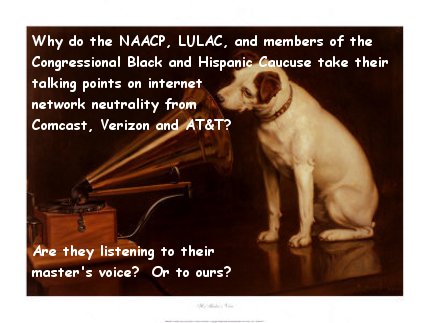
While I don’t doubt their sincerity and passion advocating for increased access and affordability, too many of these groups hurt their own case by accepting generous contributions (or advisory board members) from the telecommunications industry.  Consumers who witness the near total alignment of views between these groups their corporate benefactors are right to be concerned.  Many are asking if those views represent true conviction or “a dollar a holler” advocacy.

The Black Agenda Report, which created this graphic, ponders the same questions many consumers are asking

As Stop the Cap! documented just a few months ago, Broadband for America is a great example of industry-funded astroturf in action.  Large numbers of groups with no apparent connection to the broadband policy debate have found their way onto the roster of members.  From a cattle association to a Native American group that also has a burning interest in sharing their views about corporate jet landing rights, the one thing in common with virtually every last one of them was a financial contribution and/or board member working for big cable or telephone companies.  Thus far, debating a cattle association has not brought charges of being anti-cow, although I suspect consumers are anti-bull.  Debating the merits of Net Neutrality with Native American groups has not brought charges of anti-Native American bias.

Stop the Cap! itself has been on the receiving end of racial rhetoric offered by one of the anti-Net Neutrality advocates out there, Navarrow Wright.  Wright is a former corporate executive at Black Entertainment Television, and spends his days now as a self-proclaimed social media and branding expert. Last year, after exiting as CEO of Global Grind, a hip hop social network, Wright launched Maximum Leverage Solutions, which claims to be a full service consulting firm specializing in social media strategy and Internet Consulting.

Just a few months later, Wright suddenly discovered a big interest in the concept of Net Neutrality.  While he doesn’t disclose his client list, would it surprise anyone if a telecommunications company hired his services for their own “social media strategy?”

Since last fall, Wright has been generating a mix of provider talking points, Google bashing, and attacking groups that support Net Neutrality.  He’s called supporters of an open Internet “digital elites,” the FCC a player of “dangerous games” by ignoring the anti-Net Neutrality public, Free Press a group that wallows “in crazy claims and race-dividing rhetoric,” and tries to connect support for Net Neutrality as somehow representing opposition to increased broadband adoption.

Challenging and debunking his talking points isn’t difficult — they are precisely the same ones the broadband industry has used for several years now.  We invited Wright to a full, in-depth discussion about the merits of Net Neutrality and broadband adoption.  We even got the discussion started, but that’s exactly where it ended.

Wright is also incredibly defensive about the issue of industry-backed mouthpieces and astroturf efforts in general.  Suggesting Wright’s views are inaccurate brings his resume in response, which I suppose was designed to impress readers with suggestions of his built-in expertise, belied by his silence on these issues prior to last year.  In Wright’s original comment, he took our comments about economically disadvantaged Americans and made it an issue of color:

Our piece:

The letter represents the groups’ concerns that broadband for many in America is simply not available, especially for the economically disadvantaged.  They’ve been swayed by industry propaganda to characterize Net Neutrality as a threat to addressing the digital divide by making service ultimately even more expensive.

His response:

Phil, I know (at least I hope) your intent wasn’t to suggest that people of color have been “swayed by industry propaganda” and aren’t capable of thinking for ourselves on technology issues.

James Rucker, executive director of Color of Change added to the debate in late January, wondering why some civil rights groups are only too willing to support discredited industry talking points and advocate against Net Neutrality.

Rucker discovered the same thing we did.  Challenging these groups to explain their positions brings forth repetitious inch-deep talking points and total silence when a rebuttal is offered.  If pushed, they obfuscate with claims their views are being disrespected, when in reality they are only being fact checked.  Perhaps inconvenient, and even slightly embarrassing, but it’s completely appropriate for consumers to ask whether a conflict of interest exists when a group advocates for the positions of the same industry that is sending them big contributions.

The risk, of course, is to tie an organization’s good name to demonstrably false provider propaganda that some groups are willing to repeat, nearly word for word.

Take for instance Wright’s claim that Net Neutrality will force providers to spend money they would otherwise invest for the benefit of the rural, the downtrodden, and the unserved:

That brings me to the other corporate interests: the Internet service providers. It is the ISPs who must invest in, upgrade, maintain and build out the networks that allow us to receive these cool applications. While I don’t find the network side as sexy as the content side, I do know that we have to have it and ISPs need capital to build and maintain it. So the question remains who is going to pay for maintenance and upgrades to the network if Google gets a free ride? Basic economics tells us that if government requires ISPs to give Google a free ride, there’s only one other place to look for the money: consumers like you and me. What’s more, there are those who want to make it even more unfair by insisting that your big-bandwidth-using neighbor should not have to pay more than you, even if all you want to do is check email and watch some YouTube. Who will all of this hurt the most? Low-income consumers.

The only color that really matters here is green

Wright doesn’t know his American telecom history.  Let’s discuss this fiction:

  1. Bruce Dixon, a writer for the Black Agenda Report says it better than anyone: “Phone companies invented the digital divide more than a century ago as their core business model, preferring to extend service to affluent areas where they could levy premium charges, rather than building networks out to reach everybody.”  The cable television industry “franchise” requirement came as a direct result of cable industry redlining, the practice of wiring wealthy neighborhoods for cable while bypassing urban and rural areas deemed “unprofitable.”  It’s the same story for broadband, and Net Neutrality is beside the point.  The number crunchers look for Return On Investment (ROI) when considering who gets on the right side of the digital divide.  If they can’t make a killing on you, they’re not going to provide you service.  If you can’t afford their asking price, which is increasing regardless of Net Neutrality, why serve you?  Ultimately it is consumers who overpay for these networks, priced well above cost, generating literally billions in profits.  Why ruin a good thing with altruistic broadband expansion at a fire sale price?
  2. Regardless of what Google is doing, providers are seeking new ways to further monetize broadband service, enriching themselves even further.  Prices go up even as the costs to provide the service go down.  The old chestnut about the next door neighbor being a usage piggy is just more of the same “us vs. them” propaganda from providers who want consumers to fight amongst themselves while they run to the bank with the money.  Grandma doesn’t want her broadband service limited either, and she’s way too smart to believe a provider promising dramatic savings for less service from companies that jack up her rates year after year.
  3. The best way to guarantee affordable access to broadband service is to develop a national broadband plan that provides the same kinds of “lifeline” services already available for economically disadvantaged phone customers, legislative policies that force markets open to additional competition, government oversight to ensure providers are required to provide service throughout their respective service areas, and stimulus or Universal Service Fund assistance for projects that assure access to those who simply will never pass ROI tests.  Or we can solve everything by not passing Net Neutrality?  Please.
  4. Google doesn’t have a free ride.  First, consumers -pay- providers for connectivity.  Ultimately, they are the customers — content producers are not.  Nothing prohibits an ISP from offering hosting services to content producers at competitive prices.  If Google, Amazon, Netflix, or Hulu want to host their content on servers owned by Verizon, Comcast, Time Warner, or AT&T, nothing stops them.  Google pays for its own connectivity to the Internet.  Customers pay for accessing it.  Now providers want to get paid again.  It’s like triple-charging for snail mail – you pay for a stamp to mail it, the person you wrote pays to receive it, and the airline that flew the letter cross country has to pay to transport it.

Remember, it’s the content that drives broadband adoption. ISP’s honestly don’t fret as much about traffic as they claim.  They just care whether they can own it, control it, and profit from it.  The evidence to back this up comes from cable and phone companies in a big hurry to stream video content over their TV Everywhere projects.  Nothing consumes bandwidth like online video, yet there they are enthusiastically embracing it.  They have to, because if they don’t control it, it could eventually lead to people dropping their cable TV subscriptions in favor of online viewing.

Wright’s blog promotes another industry favorite — the dreaded phony “exaflood” which threatens to bring chaos and disorder to our online world… unless we totally deregulate broadband and let them do whatever they want to “solve it.”  That’s more of the same.  We’ve seen the results of that for more than a decade now, and the very digital divide that Wright complains about comes as a direct consequence to letting broadband providers serve, or not serve customers as they please at the prices they want.

Wright and other civil rights groups can throw as many race cards as they like against consumers who see right through their corporate-backed agenda.  That’s because consumers know Net Neutrality isn’t an issue of black or white.  The only color that really matters here is green.

Frontier Communications Launches Online Video Site With 100,000 Videos You Can Already See Elsewhere Online

Phillip Dampier February 9, 2010 Editorial & Site News, Frontier, Online Video, Video Comments Off on Frontier Communications Launches Online Video Site With 100,000 Videos You Can Already See Elsewhere Online

More of the same you can already get elsewhere

If you’re a phone company unwilling to make the investment into delivering a real telco-TV package to customers, why not do online video on the cheap with a new online portal that offers 100,000 videos you can already easily find elsewhere online?

That works for Frontier Communications, who today is patting themselves on the back over the launch of my fitv.com, a new online video site.

“my fitv reflects the disappearing lines between televisions, personal computers and mobile devices and the way time is shifting. Today, consumers don’t have the time or patience to see programs at specific times, or to even sit through an entire program. my fitv gives viewers control, and its unique user experience offers more than 100,000 titles and seamless search and navigation functions. It’s all about search less and watch more,” says Maggie Wilderotter, Chairman and CEO of Frontier.

Unfortunately for Frontier, virtually all of their launch content is readily available and easy to find on sites like Hulu.  The site also contains a handful of news clips from two of the evening newscasts in Minneapolis-St. Paul, Minnesota, with more promised in the future.

Hulu invites anyone to embed their video content, so even you can build your own online video portal.  But giving visitors a compelling reason to visit a site that offers little, if any, original content is a challenge.

The site is available to Frontier customers and those who aren’t, and why not?  Frontier isn’t out anything if outsiders start using the service.

Frontier isn’t the only phone company running an online video portal.  AT&T Entertainment launched last year repackaging Hulu and other content providers’ ’embeddable videos’ to an underwhelmed audience.

[flv width=”640″ height=”380″]http://www.phillipdampier.com/video/Frontier My FITV Ad.flv[/flv]

Frontier Communications ran this ad Sunday in Rochester, N.Y., Cincinnati, Ohio, Sacramento, Calif. and Minneapolis/St. Paul, Minn., to launch my fitv.

Bright House Increasing Speed And Price for Road Runner Turbo Customers In Indianapolis

Phillip Dampier February 9, 2010 Broadband Speed, Online Video Comments Off on Bright House Increasing Speed And Price for Road Runner Turbo Customers In Indianapolis

Road Runner Turbo is getting a makeover in Indianapolis.  Faster speeds are forthcoming, but at a higher price.

Bright House Networks currently provides Road Runner Standard customers with 7Mbps/512kbps.  Getting better speed requires the purchase of Road Runner Turbo at a new price of $15 per month.  In return, Bright House is boosting Turbo speed customers to 20/2Mbps service, with PowerBoost temporarily accelerating downstream speeds up to 30Mbps.

In most markets, Road Runner Turbo is priced at $9.95 per month, but it’s five dollars more in Indianapolis.

Bright House headquarters in Indianapolis

Will the increased price for Turbo become a trend in return for faster speeds in other markets?

Ironically, the associated public relations campaign sells customers on signing up for Turbo to enjoy a better online video experience.

“Building the excitement toward the opening games of the Olympics, we’re able to add to the enjoyment of and access to entertainment and information with these exclusive new products and features,” said Wayde Klein, vice president of marketing and customer operations for Bright House Networks Indiana. “With our speed boost to Road Runner Turbo, customers will be able to take advantage of some of the highest Internet speeds available, making video viewing over the Internet an even better, real-time experience.”

The upgrade in broadband service is part of Bright House’s effort to improve service in central Indiana.  The cable operator is also adding several new high definition networks and introducing the “Start Over” feature allowing viewers to return to the start of a program in progress.

Bright House is licensed to provide Road Runner service, a brand more commonly associated with Time Warner Cable.

The Coming Online Video War: Cable Customers Start Looking for Alternatives As Rate Increases Continue

courtesy: abcnews

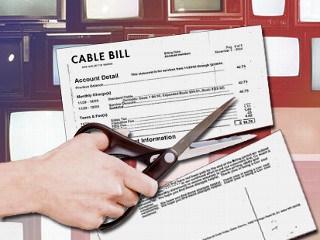
Consumers are increasingly cutting down their cable packages to keep their monthly bill down

Cable television customers have finally reached their limit.  For years, annual rate increases well in excess of inflation have annoyed customers, but beyond complaining, few actually dropped service.  That has begun to change as the economy, consumer debt, job fears, and other expenses have finally provoked customers to begin paring back on their cable package.

According to research from Centris, a consumer research organization, a virtual ceiling of tolerance for cable rate increases appears to have been reached for many subscribers.  Although consumers are not dropping cable en masse, they are not simply accepting a higher bill either.  They are dropping services from their cable package.  In 2008 and 2009, premium movie channels and pay per view suffered most from customer downgrades.  Consumers with multiple premium movie channels started by dropping one or two of them, and their use of pay per view service also dropped.  As the financial impact of the recession wore on, the next round of rate increases caused additional erosion — by late 2009 many consumers discontinued all of their premium services.

The goal?  To reduce or at least maintain a consistent monthly bill.  The average amount consumers are paying for digital cable dropped from $79 a month in the third quarter of 2008 to $70 in the third quarter of 2009.  That decline didn’t come from discounts from the industry — it came from dropping channels and services. In 2010, consumers are still pruning away, now impacting digital basic cable and smaller add-ons like sports and movie tiers.  They are also phoning their provider threatening to cancel service altogether if additional discounts cannot be found.  Cable operators, not surprisingly, have managed to find plenty of savings for consumers who ask and stand their ground, ready to walk away from cable.

The cable industry has sought to promote bundled services as an anti-erosion measure.  It’s much harder to walk away from a provider supplying your television, Internet, and phone service, especially if they lock you into a multi-year service agreement with a cancellation fee.  The savings promoted from bundled services come largely as a result of steeper price increases on standalone products and services, manufacturing “added value” for so-called “triple play” packages.

Some customers have divorced from pay television service altogether, deciding relentless price increases and the 500 channel universe shoveled in their direction just isn’t worth the price.  For many American families, however, such drastic cord cutting would border on traumatic, and they haven’t managed such a drastic step.

Luckily, a growing number of consumers have discovered taking the Luddite approach to television entertainment isn’t a requirement any longer.

Cutting the Cord With Online Viewing

With the growing penetration of fast broadband service in homes across the country, online video has rapidly become one of the most popular online services, particularly when it’s available for free.  The benefits don’t stop at the cost — programming catalogs are becoming increasingly deep and diverse allowing fans to watch entire seasons of shows on-demand, with a limited commercial load.  A consumer looking for something to watch might easily find more entertainment online than wading through hundreds of cable channels of niche and re-purposed programming (and program length commercials).

Cable companies are well aware of the trend towards online video.  First considered part-curiosity, part-piracy, today online video is provided by the major American networks, cable programmers, independent filmmakers, YouTube, and of course, Hulu.  It isn’t just for those torrent sites anymore.  And there is plenty of room for online video to grow.

The industry uses research companies like Centris to carefully track subscriber trends.  They want to be out in front of any sea change in viewing practices that could impact their business model and their revenue, and avoid repeating the mistakes others made in ignoring a potential threat for too long.

Wall Street is well aware of the potential threat as well.

Craig Moffett, a cable industry analyst with Sanford C. Bernstein is among the most prominent trend-watchers for the cable industry.  He sees some warning signs for the future.

“Still no evidence of cord-cutting, but as prices spiral higher, the stresses on the system are unquestionably growing,” Moffett said.

So far, the cable industry has decided the best way to fight potential losses is to get into the game themselves on their terms.  Comcast and Time Warner Cable, the nation’s largest cable operators, are launching their TV Everywhere concepts, which provide their broadband customers with online access to a myriad of cable programming, on demand, and currently for free.  The catch?  You must be a verified, current pay television customer.  If you want to watch a basic cable show, you need a basic cable subscription.  Want to watch Bill Maher online?  You can, assuming you are a verified HBO premium television subscriber.

Comcast’s system is already up and running.  Time Warner Cable is expected to roll out their system sometime this year.

The industry is even selling the public they applaud the online video experience as a win for customers.  Time Warner Cable president and CEO Glenn Britt said, “TV Everywhere is an all-around win for those of us who love television. It will give our customers more control over content and allow them greater access to programs they are already paying for, while enhancing the distributors’ and networks’ robust business model that encourages the creation of great content.”

He didn’t say it also protects Time Warner Cable’s flank from cord-cutting.  Lose the cable subscription and your access to online cable programming goes with it.

But the question remains, is that enough to protect cable television revenue?

The answer might be no.

[flv width=”400″ height=”380″]http://www.phillipdampier.com/video/Bloomberg Invasion of the Cable Killers 9-15-09.flv[/flv]

Bloomberg News reported on ‘The Invasion of the Cable Killers’ — new hardware that lets you bypass cable, back on September 15, 2009.  (2 minutes)

The Coming Online Viewing War: The Players Assemble

Who owns and controls programming ultimately controls the distribution of it.  Time Warner Cable took several shots at Fox a few weeks ago when threatened with the loss of Fox programming over a contract dispute.  Alex Dudley, spokesman for Time Warner Cable, told NY1 viewers much of Fox’s programming is available online for the taking, so even if the network was thrown off the cable company’s lineup, viewers could simply bypass the dispute and watch online… for free.  His message – the dollar value Fox places on its programming is diminished when it gives it away for free online.

The fact so much of network programming is available online for free is part of the dispute over how much cable operators should pay to carry networks on their cable systems.  When the industry passes along those carriage fees to consumers, will that be the last straw for some who will drop their cable subscription and simply watch everything online?

“They’re the ones who are going to resist these price increases that the programmers are trying to push,” said Dudley. “One need look no further than the music industry for an example of what happens when consumers feel taken advantage of by an entire industry.”

Dudley’s remark is more telling than he realizes.  The cable industry is well aware of what happened when the music and newspaper industry ignored nascent challenges to their business models like piracy or free access to their content.  To cable operators, the music and newspaper industries’ online experiences are lessons to be learned and not repeated.  The music industry waited too long to crack down on piracy and lost pricing power as consumers simply stole what they rationalized was overpriced.  The newspaper industry failed to erect pay walls to control access to their content, and newspaper subscribers dropped print subscriptions to read everything online for free.  Cable industry control of content and distribution is key to protecting their business model for pay television.  More on that in a moment.

Now two other parties want to be heard on this matter — consumer electronics manufacturers and advertisers.
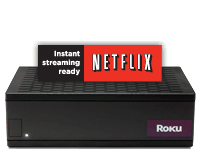
The Roku box is popular among Netflix subscribers who want to stream TV shows and movies to their television sets

This week, Advertising Age is running a story on the implications of cord-cutting.

The magazine takes note that online viewing doesn’t require a computer any longer.  Samsung, Boxee, Apple TV, and even Microsoft, manufacturer of the XBox, are now selling devices that bypass cable television and grab online video for users, often for free.

Netflix has already managed that for a monthly fee, and is rolling out service on all sorts of devices, from a set top box that streams content from the web to your television to video game consoles, and now even builds-in the service to some televisions and Blu-Ray DVD players.  Microsoft’s XBox Live service could be germinating a cable television service of its own, as it seeks to license content from programmers starting with Disney’s ESPN.

All of these services, along with traditional laptop or home computer viewing, could evolve into formidable challengers for the pay television industry.  Oh, and some new televisions on offer at this year’s Consumer Electronics Show build in support for Skype, a Voice Over IP telephone service, so phone revenue could be at risk as well.

Advertising Age believes this could be one of the entertainment industry’s biggest business battles of the next few years as millions, if not billions of dollars are at stake.

For the moment, the public face of the debate is a combination of downplaying its potential impact while the players quietly position themselves and their assets for the fight certain to come.

Both Dudley and Britt at Time Warner Cable call the potential trend towards online viewing interesting, but not much of a threat at the moment.

“We see some interesting stuff out there, but right now people are watching more TV than ever; cable-cutting is largely on the fringe,” said Dudley.

“A lot of manufacturers have come out and made announcements, but I don’t think they really are in a position to erode the pay-TV subscriptions that the cable industry has today,” said Park Associates research analyst Jayant Dafari.

“For many people, cable works just fine; the quality is great; the DVR functionality is great; the only gripe they have is that they’re paying for it,” Boxee’s founder and CEO Avner Ronen told Advertising Age. But “there is a growing generation out there where the whole definition of entertainment is changing, and their main source of entertainment is the internet.”

[flv]http://www.phillipdampier.com/video/CNBC Wii At the Movies 1-13-10.flv[/flv]

CNBC covered last week’s announcement of a partnership between Nintendo and Netflix to provide Netflix on the popular Nintendo Wii, in this exclusive interview with Reed Hastings, chairman and CEO of Netflix and Reggie Fils-Aime, Nintendo of America president & COO (January 13, 2010 – 5 minutes)

‘If It Becomes A Problem, We’ll Just Cut Them Off

The cable industry is in a comfortable position to leverage its control over programming and distribution to ultimately limit any competitive threat from online viewing.  In addition to mega-deals like Comcast’s acquisition of content-rich NBC-Universal (a partner in Hulu), the cable industry owns, controls, or can leverage carriage of its cable lineup contingent on programmers not giving away too much for free.  Advertising Age:

One tech exec, who asked not to be named, predicted that the minute cable operators start to feel the disruption, they will clamp down and use their market power to keep TV and films from seeping into next-generation devices. They’re already putting the squeeze on networks; any free distribution is an argument for lower cable distribution fees.

Stop the Cap! is also a player in this struggle, because a key component of the cable industry’s control of programming is the means it is distributed to consumers, and cable modem service representss one half of the duopoly most Americans find when shopping for broadband.  One potential strategy to eliminating the cord-cutting option is to enact Internet Overcharging schemes like usage limits and consumption billing that effectively makes it impractical for a consumer to “switch” to broadband for all of their online viewing.  Switching to the other half of the duopoly may not be an alternative. As online video projects like TV Everywhere will also be available to telco TV partners who wish to participate, there is every incentive to also limit video consumption on Verizon’s FiOS or AT&T’s U-verse systems.

Effective competition against entrenched players in the marketplace is impossible if those players control the content, the means of its distribution, and the ability to cut you off if you watch too much or switch to an independent competitor.

But this is history repeating itself.  Many of the same players and interests followed the same protectionist path against another competitor – satellite television.  It took strong regulatory policy from Washington to force a fair and level playing ground for an industry that didn’t want to sell content to its competitors, overcharged for access, and kept effective competition at bay for years, all while happily increasing rates for beleaguered consumers.

Here we go again.

Search This Site:

Contributions:

Recent Comments:

Your Account:

Stop the Cap!