Home » Online Video » Recent Articles:

Hong Kong Unimpressed By FCC National Broadband Speed Goals – “We’re Already 10 Years Ahead of You”

The United States has a goal of 100Mbps ubiquitous broadband service by 2020.  Hong Kong residents already have access to speeds up to 1Gbps, leaving many unimpressed with the American broadband goals established in the FCC’s National Broadband Plan.

City Telecom CEO William Yeung called out the current state of American broadband, noting many Americans are still stuck with megabit speeds in the single digits, while 100+ megabit access is widely available across most of Hong Kong from fiber optic networks.

Yeung thinks 100Mbps service will be considered slow by the time 2020 rolls around, noting an insatiable demand for enhanced broadband speeds.

Google’s Think Big With a Gig project underlines Yeung’s beliefs as hundreds of American communities clamor to be among those chosen for a demonstration project that will deliver up to 1Gbps speed to homes and businesses on an all-fiber network.

Yeung rejects the notion that wiring Hong Kong was a natural for super-fast fiber optic broadband just because of its dense population, reducing potential costs.

“I think it’s a matter of short term vs. long term thinking,” Yeung told Bloomberg News.

According to Yeung, American broadband providers are afraid constructing super-fast broadband lanes threaten to cannibalize their existing revenue streams, especially from cable television.  That’s because Americans could end up dropping their cable packages in favor of watching everything online.  Yeung also thinks Wall Street is preoccupied with short-term Return on Investment, making it difficult to upgrade to fiber service despite the enormous potential long term revenue, even in rural areas.

For Yeung, it’s all about marketing the benefits of fiber.  His company, City Telecom, is busily signing new subscribers despite the fact the island already enjoys near-universal broadband access.  Offering faster speeds and better service will drive customers to switch providers, Yeung believes.

[flv width=”640″ height=”500″]http://www.phillipdampier.com/video/Bloomberg Yeung Says Hong Kong Broadband 10 Years Ahead of U.S 3-19-10.flv[/flv]

Bloomberg News talked with City Telecom CEO William Yeung about fiber-optic broadband and the fact Hong Kong is well ahead of the United States on broadband speed and service.  (4 minutes)

[flv width=”600″ height=”500″]http://www.phillipdampier.com/video/City Telecom Promo.flv[/flv]

City Telecom’s HKBN service has a history of running bizarre advertising.  One recent example is included here, along with a short promotional video touting the company’s accomplishments in constructing an all-fiber network.  (4 minutes)

FCC Releases National Broadband Plan: A Wish List for Broadband Isn’t Good Enough

Dampier

Yesterday, the Federal Communications Commission formally introduced its omnibus National Broadband Plan to America, Congress, and the telecommunications industry.  The FCC seeks nothing less that a transformation of broadband to better meet the needs of Americans for years to come.

The 376-page plan recognizes broadband is no longer a novelty.  It’s now becoming one of the essential utilities of life — joining power, telephone and water service as something virtually every American will eventually have in their home.  But while the Commission lays the general groundwork for future regulatory policy to help achieve that goal, it ignores the historical reality that made universal service for utilities possible.

I am a strong believer in reviewing past mistakes to avoid repeating them in the future.  That is why Stop the Cap! occasionally turns back the clock and reviews history.  Railroad robber barons, telephone company monopolies, and electric service providers all abused their positions and consumers paid through the nose for service until the government finally broke up the anti-competitive trusts that limited competition.

Just like today’s broadband players, in the early 20th century, electric companies asked for and received favorable treatment by Congress.  The industry argued such treatment was required to make investors comfortable with the enormous amount of investment required to construct power generation facilities, run wiring to homes, and obtaining easy access to American streets and backyards.  Regulations must be kept to a bare minimum, providers demanded.  Anything else, they claimed, would discourage critical private investment, would create job losses, and slow deployment of service to millions of Americans.  Sound familiar?

By the time the American public realized electric companies were abusing their monopoly positions to charge outrageously high prices, the half-measures legislators proposed to control rates and improve service were often ineffective.

Just as with electric service, any broadband plan that seeks to tinker around the edges of the problem will not solve the problem.  Providers will find loopholes, lobbyists to help water down the provisions they dislike, and lawyers to mount endless legal challenges to stall reform.

The warning signs are already apparent in the FCC plan.  The agency seeks to cooperate with some of the biggest players in the industry that are responsible for what the FCC calls “the critical problems that slow the progress of availability, adoption and utilization of broadband.”

That ultimately means working with existing providers instead of creating the right conditions to welcome new players into the market.
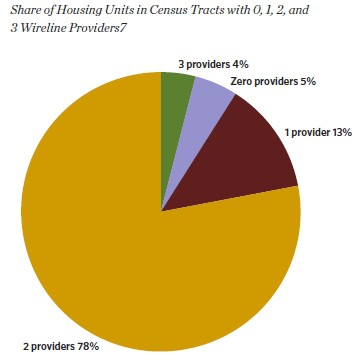
America's broadband duopoly - just four percent of Americans have more than two providers to choose from

The anti-competitive, de facto duopoly pricing power available to cable and telephone companies has created an enormous digital divide for rural Americans who cannot pass “Return on Investment” means tests, prices broadband service out of reach for many, and seeks even higher pricing while proposing to limit service with Internet Overcharging schemes like “usage-based billing” and “usage limits.”

Where one lives is often the most important factor when considering broadband speed and service quality.  It’s the luck of the draw.  A customer on one side of the street may have the option of Verizon FiOS, a true fiber-to-the-home service providing equal upstream and downstream speeds far higher than the national average.  Across the street, a customer may only be served by another telephone company offering 1Mbps DSL with no alternatives.

Other Americans live within viewing distance of a utility pole where cable or telephone broadband service stops, giving them the choice of paying $10,000 to extend service, or living with dial-up or satellite fraudband.

Few phone or cable companies will ever consider invading another’s turf, even if customers begged.

But it gets worse.

The service customers can obtain from a provider varies even within its service area.  Verizon FiOS and AT&T U-verse is available in some neighborhoods, but not others.  What stops or slows service expansion?  Anything from a management decision on a whim to concerns by private investors, market conditions, cost controls, or changing revenue expectations that inhibit uniform service across the community.  Local governments used to manage this problem with franchise agreements that made approval conditional on supplying service across an entire community, but companies like AT&T lobbied their way to statewide franchising reforms that can eliminate local oversight.

The cable television industry has a better track record of providing uniform broadband service to customers in their respective service areas, but at what cost?  Time Warner Cable COO Landel Hobbs recently told a group of investors pricing for its Road Runner service can be increased at the company’s whim.  Comcast has already increased prices on its broadband service. Both companies have either tested or implemented usage limits and restrictions on their customers.

What makes these things possible?  Limited competition and insufficient oversight.

The FCC’s solution to limited competition includes vastly expanding wireless frequencies available to mobile broadband providers.  But here’s the problem.  The government will auction those frequencies off to the highest bidders, which are most assuredly the dominant industry players AT&T and Verizon.  For millions of Americans, that means no extra competition at all because their phone, broadband, video, and wireless service all come from these two companies.  The only way smaller players can compete in a bidding war is through consolidating mergers, which reduce the number of competitive choices in many cities.  If the government wants competition, it should provide incentives to spur its development.

Wall Street certainly won’t help much.  They loathe heavily competitive markets now, because inevitable price wars limit their returns.  Getting initial investment to construct new networks is problematic because investors don’t want excessive competition.  Providers howl it’s unfair for government to help their competitors, but their incumbency provides them with built-in benefits unavailable to new entrants.

The FCC recognizes the importance of broadband service as America’s next utility, but is afraid to regulate them as such.  They may have good reason not to try.  Comcast is presently suing the Commission in federal court, claiming they don’t have jurisdiction over broadband policy.  Should Comcast prove its case, the National Broadband Plan could be just another thesis for improved broadband, with no backing authority to implement its recommendations and regulatory changes.

That brings us to Congress.  While the FCC may bring its best intentions to the table with the National Broadband Plan, it’s very likely lobbying will force changes to what finally gets implemented, if anything.

The telecommunications industry never has a problem finding financial resources to hire lobbyists and spread lavish campaign contributions all over Washington.

They’ve already bought and paid for an enormous astroturf group called Broadband for America with 200 member organizations, virtually every single one backed by AT&T or Verizon money or personnel, or equipment providers who stand to earn substantially from broadband improvement.  They are running TV ads telling viewers private providers should be left alone to get the job done, something they’ve had a decade to accomplish with insufficient progress in key areas.

Many in Congress, especially on the Republican side of the aisle, will agree with BfA’s “hands-off” advocacy.  Early reaction from Republicans regarding the Broadband Plan is not favorable.  Rep. Cliff Stearns (R-Florida), the ranking Republican on the House Energy and Commerce communications, technology and the Internet subcommittee, told the Washington Post he wants the agency to stay focused on bringing access to people who don’t have it.

“I am concerned, however, that the plan may contain stalking horses for investment-killing ideas, such as so-called net neutrality mandates or a return to outdated, monopoly-era regulation,” he said.

Many Democrats with large telecommunications companies headquartered in or near their districts are likely also to advocate caution.

Regardless of what the FCC recommends, Congress will ultimately control the outcome.

Here are our recommendations you should consider sharing with your elected officials:

Congress and the FCC must be willing to stand up to the telecommunications industry which is not delivering world-class broadband service.  The United States is falling behind in access, pricing, and speed.  Simply accepting the provider argument that they should be left alone in an unregulated, duopoly marketplace is not an option;

Congress must deliver to the FCC clear authority to regulate broadband service and enforce Net Neutrality.  Recent court cases argue the Commission presently lacks that authority.  Congress should take every possible step to ensure the courts this isn’t the case.

Increased oversight of the broadband industry is essential.  Why does an industry making billions in profits need to consider usage limits and usage-based billing designed to deter residential use of broadband service?  Such limits are designed to protect cable-TV revenue that could disappear if Americans dump their television channel packages in favor of watching everything online on their existing broadband account.

Congress should not stand for an unregulated duopoly controlling a service that is becoming as essential as water, energy, and the telephone.  As broadband becomes an essential utility, why is the government not stepping in when the COO of the nation’s second largest cable company — Time Warner Cable, tells investors he can raise broadband prices on a whim?  Is this the 21st century version of the Robber Baron Era?  Robust competition guarantees no executive can make such a statement.  Congress must act to bolster competition, including financial and tax savings incentives for new providers willing to enter markets of all sizes;

Wireless mobile broadband spectrum auctions do not promote competition because the biggest incumbent players are sure to win the bulk of the frequencies, guaranteeing more of the same anemic competition.  Some of the newly available blocks of frequencies should be reserved for bidders who do not currently serve the market where those frequencies are available.  Only that guarantees new competition in wireless;

Free or deeply discounted access to basic Internet service at broadband speeds should be a part of any National Broadband Plan, to ensure access to every American who wants it.


By Popular Request: Senator Al Franken Grills Comcast-NBC Merger Advocates

Phillip Dampier March 4, 2010 Comcast/Xfinity, Net Neutrality, Online Video, Public Policy & Gov't, Video Comments Off on By Popular Request: Senator Al Franken Grills Comcast-NBC Merger Advocates

[flv]http://www.phillipdampier.com/video/Sen Al Franken Grills Comcast-NBC Merger Advocates 2-4-10.flv[/flv]

Stop the Cap! has received several requests for Sen. Al Franken’s (D-Minnesota) comments during the Senate hearing in early February reviewing the proposed merger.  So here, for your viewing pleasure, is the portion of the hearing where Franken comes out swinging in opposition to the ongoing consolidation of media companies in America. (February 4th – 14 minutes)

Mark Cuban Still Confused About Internet Overcharging Schemes & Online Video

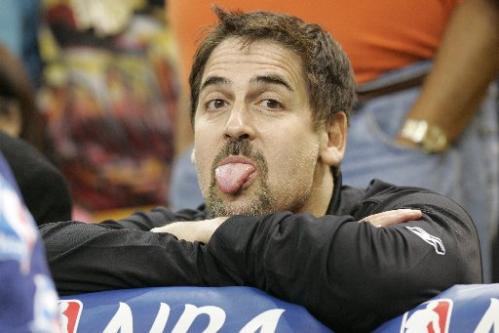
Mark Cuban

Mark Cuban has once again entered the debate over online video, Internet Overcharging schemes, and giant corporate mergers… and mangled it.

Cuban, who owns HD Net as well as the Dallas Mavericks basketball team, occasionally presents cable industry talking points on his blog, but quickly gets into trouble when he strays from them.

This time, Cuban is annoyed with Sen. Al Franken (D-Minnesota) over remarks the senator made about the proposed Comcast-NBC merger.  Cuban seized on comments by Franken that Comcast should put all of its television programming online.  Doing that, Cuban insists, would lead to higher prices for broadband and usage caps on it.

Where has Cuban been?  I realize the man is too wealthy to worry about the relentless rate increases Comcast and other companies force on consumers every year, but he also forgot Comcast already has a usage cap on its service, even before the feared video tidal wave arrives.

I get that no one really cares if Comcast has to spend money on capital improvements to add bandwidth to the home.  They should. Its pretty damn stupid to push consumption in a direction that will raise internet rates  to receive the same content for which there is already a phenomenal digital network in place to deliver that content.

Think about it for a minute Senator Franken. Comcast, and every large TV Provider has a digital network in place that can and does deliver gigabits of tv content perfectly,  every second of every day, to any TV set in any  home that is connected to their network. It works. Well.  What you are asking Sen Franken, is that Comcast duplicate the delivery of theirs and NBCUniversals shows on a network, the internet,  that is not, and has never been designed to handle the delivery of huge volumes of video and tv shows.

Cuban should be arguing that point with the cable industry.  TV Everywhere, the online video platform that will offer consumers access to “hundreds of TV shows and cable programming,” is their invention.  If Cuban’s fears are correct, why would the nation’s largest cable operators launch such an ambitious online video platform?

Cuban has bought into industry propaganda justifying usage caps.  There is always an excuse for rationing broadband service to boost profits.  First it was file sharing, now it’s online video causing the “serious problem” of customers using broadband service for more than just e-mail and web browsing.  Their solution – monetize it.  Usage caps and usage based billing are about preserving high profits, not protecting or increasing network capacity.  TV Everywhere proves that.

Franken does not advocate usage caps, as Cuban suggests.  The senator simply wants to be certain Comcast cannot act as a gatekeeper, determining who gets access to Comcast-NBC programming, and who does not.

Cuban should be welcome to such measures as a victim of Gatekeeper Abuse himself.  Mark, how many subscribers did you lose nationwide when Time Warner Cable unilaterally pulled the plug on your channels?

Reviewing HBO Go – Bored to Death: Restrictions Limit Experience to Watching Shows You’ve Probably Already Seen

Phillip Dampier February 18, 2010 Comcast/Xfinity, Editorial & Site News, Online Video, Verizon Comments Off on Reviewing HBO Go – Bored to Death: Restrictions Limit Experience to Watching Shows You’ve Probably Already Seen

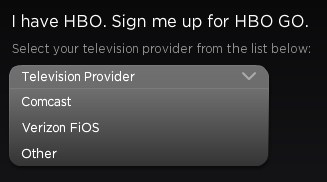
HBO Go is currently only available directly to Verizon FiOS customers. Comcast customers have access through Fancast, and Time Warner Cable indicated it wasn't interested in participating in HBO Go, for now.

HBO subscribers who are also Verizon FiOS TV customers are the first to get access to the premium channel’s new online video portal — HBO Go, launched Wednesday with over 600 hours of HBO programming, available free to authenticated HBO and FiOS subscribers.

HBO Go is another project spawned from the cable and pay television industry’s TV Everywhere project — putting television programming online for anytime viewing, for free, as long as you maintain a cable or pay television subscription.

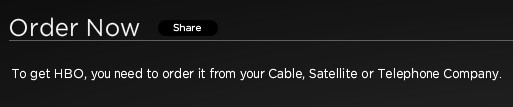
Ironically, the service launched Wednesday on Verizon’s telco-TV service FiOS, leaving lots of cable subscribers waiting for access.  If you subscribe to HBO through cable, satellite, or U-verse, the service remains unavailable to you, for now.  Comcast subscribers already had access to HBO’s programming through the Fancast Xfinity TV website.  If you don’t pay for television, the service remains unavailable to you indefinitely — they won’t sell it to you at any price.

“Ultimately this is about extending the subscriber lifecycle,” HBO co-president Eric Kessler said. “It’s more about subscriber retention.”

Subscriber retention through incumbent providers, he means.  HBO doesn’t want to risk selling direct to online consumers who might want to cut ties with their cable or other pay television provider.

Stop the Cap! reader Jared has FiOS and HBO and let us sample the service through his FiOS connection (his 25Mbps/25Mbps connection with remote access maxed out our Road Runner Turbo connection and still left him plenty of leftover speed).

Let’s start with the viewing experience.

It’s a big improvement over HBO’s Wisconsin trial in 2008 with Time Warner Cable, which required viewers to download Windows Media-encoded video files protected with Microsoft’s annoying digital rights management scheme.  It was cumbersome for trial participants, and dealing with Microsoft’s player and DRM cut Mac owners out of the trial.

HBO Go is Flash-based, using Adobe’s Real-Time Messaging Protocol to keep viewers from saving permanent copies for themselves (and potentially their friends.)  Using Verizon FiOS, viewers should rarely encounter any artifacts or speed-related viewing problems.  The picture was fine, even for me using remote access software. Of course, if your Internet connection is considerably slower than FiOS or your neighborhood suffers from online congestion, you could experience issues streaming HD content, but HBO Go is designed to buffer when encountering slower connections.  The files are encoded in MPEG-4 at 1.2Mbps and 2.6Mbps, which theoretically should be fine for the majority of viewers.  Comcast subscribers – remember watching counts against your usage cap.

Wandering around the HBO Go library was simple  — easier to navigate and less cluttered than Hulu.  The site was intuitive and should be easy to use for just about everyone.

Up to three members of your household can each watch programming from the service at the same time, even away from home, anywhere in the country.

HBO Go claims to be a work in progress — about 25% of the content will be refreshed by HBO every week, with new episodes available on the service immediately following their TV premiere.

But the service hardly offers a comprehensive viewing experience.  It’s much closer to Hulu or your cable company’s HBO on Demand service.

For example, rights issues limit virtually all of HBO’s original series to a handful of recent episodes or seasons.  Only The Wire has a complete library to watch from its premiere forward.  Curb Your Enthusiasm, aptly named when considering HBO Go, is missing completely.  So is Real Time with Bill Maher, although four of his earlier specials are archived on the site.

As for movies, there are gaping holes there as well.  Available titles resemble Cinemax’s selection of movies you’ve already seen.  There are gaps between what you can watch on HBO itself and what is available on HBO GoBabe is online, for instance, but anything Harry Potter isn’t.

In other words, what could have been a compelling addition for HBO subscribers feels redundant.  I would never pay anything extra for HBO Go, nor will it be a factor in keeping HBO.

Online viewers need not apply.

HBO could have used the opportunity to sell the service to non-cable subscribers for a monthly fee and pick up some additional revenue, but that wouldn’t sit well with the pay television cartel that is behind the TV Everywhere concept.  They don’t want you cord cutting — those that have are locked out of the HBO Go Clubhouse.  For now, I suspect few were clamoring to get in.

Search This Site:

Contributions:

Recent Comments:

Your Account:

Stop the Cap!