Home » Online Video » Recent Articles:

Ivi Peppered With ‘Cease and Desist’ Notifications, So They Sue Before Being Sued

Phillip Dampier September 21, 2010 Online Video Comments Off on Ivi Peppered With ‘Cease and Desist’ Notifications, So They Sue Before Being Sued

ivi, which we wrote about last week on Stop the Cap!, has begun receiving the predictable ‘Cease and Desist’ letters from just about every broadcaster and sports association around.  But in a pre-emptive strike, the online TV service filed sued Monday in Seattle District Court against them, asking the court to recognize its right to carry broadcast stations on its online service under existing royalty rules, with or without the permission of the broadcast stations involved.

To date, ivi says it has gotten ‘Cease and Desist’ letters from every major broadcast network, plus Major League Baseball, 20th Century Fox, two public broadcasters, and Fisher Communications, owner of Seattle-based KOMO-TV.  All of them ended up as defendants in ivi‘s suit.

ivi claims its online operations are not governed by the Federal Communication Commission, meaning it does not have to enter into negotiations with stations for carriage permission and retransmission fees.

“The secondary transmission by ivi of the primary transmission of content originating with the Defendants is permissible under the statutory licensing provisions of the Copyright Act,” the lawsuit claims. ivi seeks a ruling that finds the company has not infringed on any copyrights, and to force defendants to pay its legal expenses.

The company issued a statement Monday after filing suit:

ivi, Inc., remains steadfastly on the side of the consumer, refusing to allow big media to limit consumers’ choice or its technology. Instead, ivi has responded to the C&D letters with both written clarification explaining how its technology works within the parameters of existing law, and offers to meet with broadcasters to begin a constructive dialogue about implementing ivi’s proprietary technology. The ivi technology is a clear reflection of consumer demand and evolutionary forces in the technology marketplace,” the company said.

ivi is not another Pirate Bay or Napster trying to gain from others’ works. Rather, ivi wishes to work with content owners in helping them to realize new revenue streams and reach more viewers from around the globe,” said Todd Weaver, founder and CEO.  “The ivi team has spent more than three years developing a compelling technological solution that no other company has come close to matching.  ivi enables content owners to protect and monetize their assets while simultaneously giving consumers what they want.  We recognize that it is disruptive to existing cable offerings and remain confident that we have adopted a model that is allowed under all applicable laws. We remain receptive to formal partnerships with broadcast networks and are discussing carriage rights for premium cable, international, and a la carte channels.”

What’s likely to happen next?  One of the named defendants will almost certainly walk into a court and obtain a temporary injunction from a judge that will force ivi to pull its network or station off of ivi‘s lineup.

New Study Reveals Why Your Broadband Bill Is Still High: Lack of Competition in a Broadband Duopoly

What is the last technology product you purchased that never declined in price after you bought it?  If you answered your broadband service, a new study proves you right.

Since there are no public data on what has happened to broadband prices over the last decade, Shane Greenstein, a professor of management and strategy at the Kellogg School of Management, and his co-author Ryan McDevitt, an assistant professor of economics and management at the University of Rochester and a graduate of Northwestern University, analyzed the contracts of 1,500 DSL and cable service providers from 2004 to 2009.

The results every broadband user already knows.

At best, prices have declined only slightly — typically between 3-10 percent, partly from a “quality adjustment” the authors included to account for gradually increased broadband speeds when measuring prices.

Greenstein blames a broadband duopoly for the stagnation in broadband pricing.

Greenstein

“So if you were in such a market as a supplier, why would you initiate a price war?” Greenstein asks. With no new entries on the market, suppliers can compete by slowly increasing quality but keeping prices the same. According to Greenstein, quality is where providers channel their competitive urges.

Meanwhile, once companies have installed the lines, their costs are far below prices. “At that point, it becomes pure profit,” Greenstein says. A company might spend around $100 per year to “maintain and service” the connection, but people are paying nearly that amount every other month. Greenstein says that it is not surprising that prices were high during the buildout phase in the early and mid-2000s, since the firms were trying to recover their costs. “However, we are approaching the end of the first buildout, so competitive pressures should have led to price drops by now, if there are any. Like many observers, I expected to see prices drop by now, and I am surprised they have not.”

The authors also confirm Stop the Cap!‘s long-standing contention that providers are enjoying dramatically reduced costs to deliver broadband to customers, yet are not spending some of those profits on important network upgrades.  That could lead to a broadband bottleneck, Greenstein contends, especially with the growth of online video.  We argue it is a recipe for Internet Overcharging — triggering increased pricing to “pay for upgrades” while limiting usage of broadband service, despite the mountain of profits available today to cope with usage growth.

McDevitt

Greenstein and McDevitt pored over 1,500 broadband contracts over several years, tracking pricing, service bundling, and speed improvements.  Pricing, adjusted for speed improvements, was generally flat.  Because the cable industry has delivered most of the speed growth Americans enjoy, the “quality adjustment” the authors used credited most of the modest price declines to the cable industry, especially for customers moving to bundled packages of services.  The authors found DSL and its providers almost completely stagnant — both in pricing and speed.

The most surprising discovery, Greenstein says, is that national decisions are being made without the type of data that he created in the consumer price index. “As an observer of communications policy in the U.S., I find it shocking sometimes how often government makes decisions by the seat of their pants,” he says. Without real data and statistics, decisions are based solely on who has better arguments—in essence, a debate. A better consumer price index will help produce better decisions for the future of the Internet and its users.

It may also serve as an effective challenge to telecommunications industry lobbyists who engineer their own statistics and claims about the performance of the nation’s phone and cable companies.

Thanks to Stop the Cap! readers Bones and Michael for sending along the story.

Online Cable: ivi Offers Free Trial of 25 NY & Seattle TV Stations, But Watch Quick Before the Lawsuits Fly

Phillip Dampier September 16, 2010 Competition, Issues, Online Video 5 Comments

A Seattle startup launched its new “online cable TV system” this week offering a 30-day free trial of 27 live feeds of over-the-air television stations from New York and Seattle.

Dubbed ‘ivi,’ the online video service expects to charge customers $5 a month for the package of broadcasters delivering shows from all of the major American networks, plus several superstations most Americans haven’t seen on their cable lineup since the early 1990s.

‘ivi’ claims it offers more content than Hulu — providing online access to every network and syndicated show seen on New York and Seattle TV screens, and for an introductory price of $0.99 more per month, the company plans to turn your home computer into a giant DVR, capable of recording and storing any of the programming on ivi’s lineup for later viewing.

“The cable industry has spent countless millions of dollars on so-called ‘TV Everywhere’ solutions in a blind effort to prop-up outdated technology and business models” said Todd Weaver, founder and CEO of ivi, Inc. “However, ivi empowers its users to experience TV Anywhere, offering them major broadcast channels delivered live to their laptop or desktop, anywhere on the planet. Whether eventually integrated into Google TV, Apple TV, or meshed with an existing platform’s digital strategy, ivi makes the set-top-box and any ‘Web to TV’ products obsolete. Instead of attempting to bring the Web to the TV, ivi intuitively brings TV to the Web.”

The ivi TV player is currently available for download to any Windows, Apple, or Linux computer, and will soon be available on other platforms, including mobile devices, tablets, and set-top-boxes.  It allows customers to access its lineup anywhere in the world where a broadband connection exists.

The company provides over-the-air stations in both New York and Seattle to serve different time zones, but the lineup also provides viewers the flexibility of catching a network show twice — once on East Coast time and again three hours later.

The lineup covers all the bases, particularly from America’s top television market — New York City.  Spanish language programming from New York stations provides access to Estrella TV, Univision, TeleFutura, and Telemundo.  Since many stations have agreements to use their digital sub-channels to deliver additional programming, ivi viewers also get access to RTV – The Retro TV Network, Universal Sports, This TV from MGM, and a handful of specialty PBS feeds.  KONG-TV from Seattle, a classic independent station not affiliated with any network, is also included.

Some other less notable stations making it to the lineup include Cedarburg TV, a public access channel from Cedarburg, Wisconsin, which spends part of its broadcast day airing NASA-TV, Radio Tele-Luxembourg, a station from the Grand Duchy of Luxembourg in Europe, CCTV-9, the English language TV network from the People’s Republic of China, and PlayTV — a music video channel.

Stop the Cap! snagged a copy of the Windows version of the player and gave the service a test run.  Those seeking a free trial can apply on the company’s website, but you will have to supply a valid credit card number to participate (if you cancel within 30 days, you will not be charged).  If you are concerned about this, consider using a “one time” credit card number, a service often available from credit card companies that generates a one-time-use credit card number.

The player, like ivi’s website, is apparently a work in progress — fairly spartan in design and looking somewhat outdated.  But the player is less than three megabytes in size, a welcome change from oversized “bloatware.”  It was also nice to see versions for Linux and the Mac during launch week, instead of the more typical “coming soon” attitude other new ventures rely on.

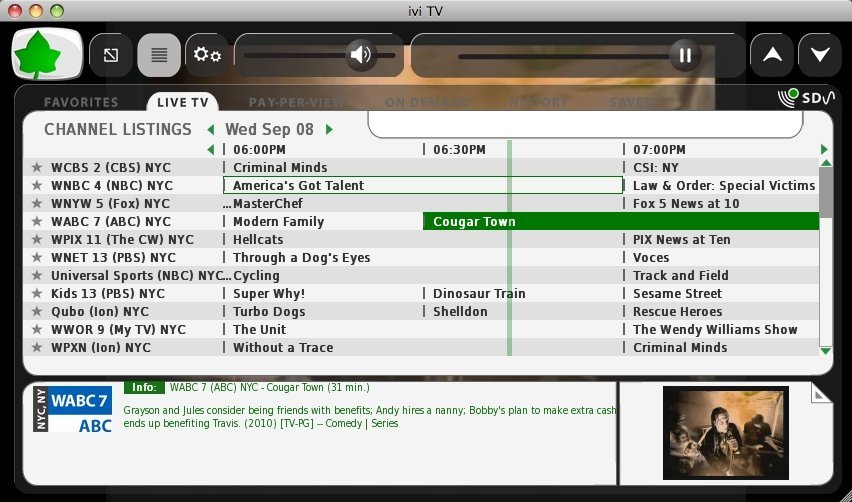
The player is generally intuitive to operate, letting you control how much bandwidth to use for the service.  The version we tested allows you to pause, rewind, and fast forward paused programming.  A channel guide offers basic program information customized for your particular time zone.

ivi's electronic program guide

Playback quality has issues, however.  Despite setting our player for “high definition” playback, the encoding rate was far too low to actually deliver anything close to HD viewing.  In fact, viewing artifacts ranging from shading errors to soft pixelization were readily apparent even in a reduced-size player window.  At full screen, playback reminded me of a medium-quality RealVideo stream from an earlier era.  It was watchable, but I wouldn’t call it a “cable-TV killer.”  On a large screen TV, it’s likely to be even more problematic.

Still, for $5 a month, it might be worth it, especially if you have dropped cable and don’t get reasonable reception of broadcast signals, or your local TV market doesn’t offer broadcast affiliates of the CW, MyNetwork TV, or those networks made-for-broadcast-subchannels — RTV and This TV.

Besides, if you sign up for the free trial today, you may not even have to pay a cent if the broadcasting industry sues the pants off the founders and shuts it all down before the end of the month.

Remarkably, ivi founder and CEO Todd Weaver told the Puget Sound Business Journal he was unaware of any other startup company attempting to deliver live TV feeds.

We here at Stop the Cap! do.  Weaver might want to talk to Bill Craig, founder of a very similar Canadian venture called iCraveTV in December, 1999.  We remember iCraveTV very well, because it delivered 17 channels of programming from Canadian over-the-air broadcasters and several network affiliates from nearby Buffalo, N.Y.  We especially remember the blizzard of lawsuits that promptly followed, all because the Canadian startup never bothered to get permission from the stations involved and they let Americans watch.

Weaver offers conflicting accounts about whether ivi secured permission from the stations it started streaming this week.

FierceIPTV reports the company hasn’t.

At the moment, the company has no contracts with any broadcasters, but ivi claims it doesn’t need to, since it’s an online cable system and, as long as it pays fees to the U.S. Copyright Office–which get disbursed to the broadcasters–it’s covered. Although Weaver says it’s not inconceivable that the company will face some legal challenges.

But the Puget Sound Business Journal reports the opposite:

The company has secured the rights to deliver live television feeds from local affiliates in Seattle and New York, with plans to expand to LA, San Francisco and other markets in the near future. Ivi pays the stations an undisclosed amount to pick up the signal, which it does by either placing a physical encoder device at the station or capturing it from satellite or antennae.

The folks at iCraveTV thought they were covered so long as they paid copyright fees, too.  Craig said Canadian laws gave it the right to retransmit broadcast television signals, in the same way that cable companies and satellite companies do. As long as the company doesn’t tamper with the programming and paid copyright holders for their work, he argued, iCraveTV was completely legal.

The National Football League, horrified by the prospect of this venture airing its football games to Canadian and American viewers without a contract, promptly found a judge in Pittsburgh who issued a restraining order — the beginning of the end of iCraveTV and the start of some hefty legal bills.  When it was all over, 10 Hollywood studios, the Motion Picture Association of America, three major American television networks, and three television stations in Buffalo either filed or contemplated filing lawsuits asking for at least $5 million in damages from the venture.

Considering ivi was reportedly bankrolled for less than $1 million in “angel financing,” they better have a liability policy bigger than that.

“Whenever someone first hears that we are carrying their linear feed, the knee jerk reaction is: ‘I must protect my content, always,'” said Weaver. However, he noted that some broadcasters see ivi as a means to sell more advertising and a new distribution mechanism altogether. “We do not disrupt the existing live distribution models,” he said.

While that may be true for Cedarburg, Wisconsin’s public access channel, the major American networks that own the network-affiliated stations in New York are unlikely to see things that way, unless they own and control the venture, of course.  Neither will local network affiliates, who stand to lose local advertising revenue should large numbers of viewers flock to web-based, out-of-area network stations.  Local broadcasters effectively stopped satellite providers from reselling access to distant network stations in areas where local stations already provided that service, so it’s very likely they’ll strongly oppose ivi for the same reasons.

Still unsure how the industry will react?  Consider a combined Comcast-NBC network facing an online venture that promotes itself as a “cable cord cutter” asking NBC for permission to stream its programming online so viewers can cancel their Comcast subscriptions.

Enjoy ivi while you can.

Open Sezmi: DVR + Local TV, Popular Cable Channels for $20 a Month = Cutting Cable’s Cord

Phillip Dampier September 14, 2010 Competition, Consumer News, Data Caps, Online Video, Video 7 Comments

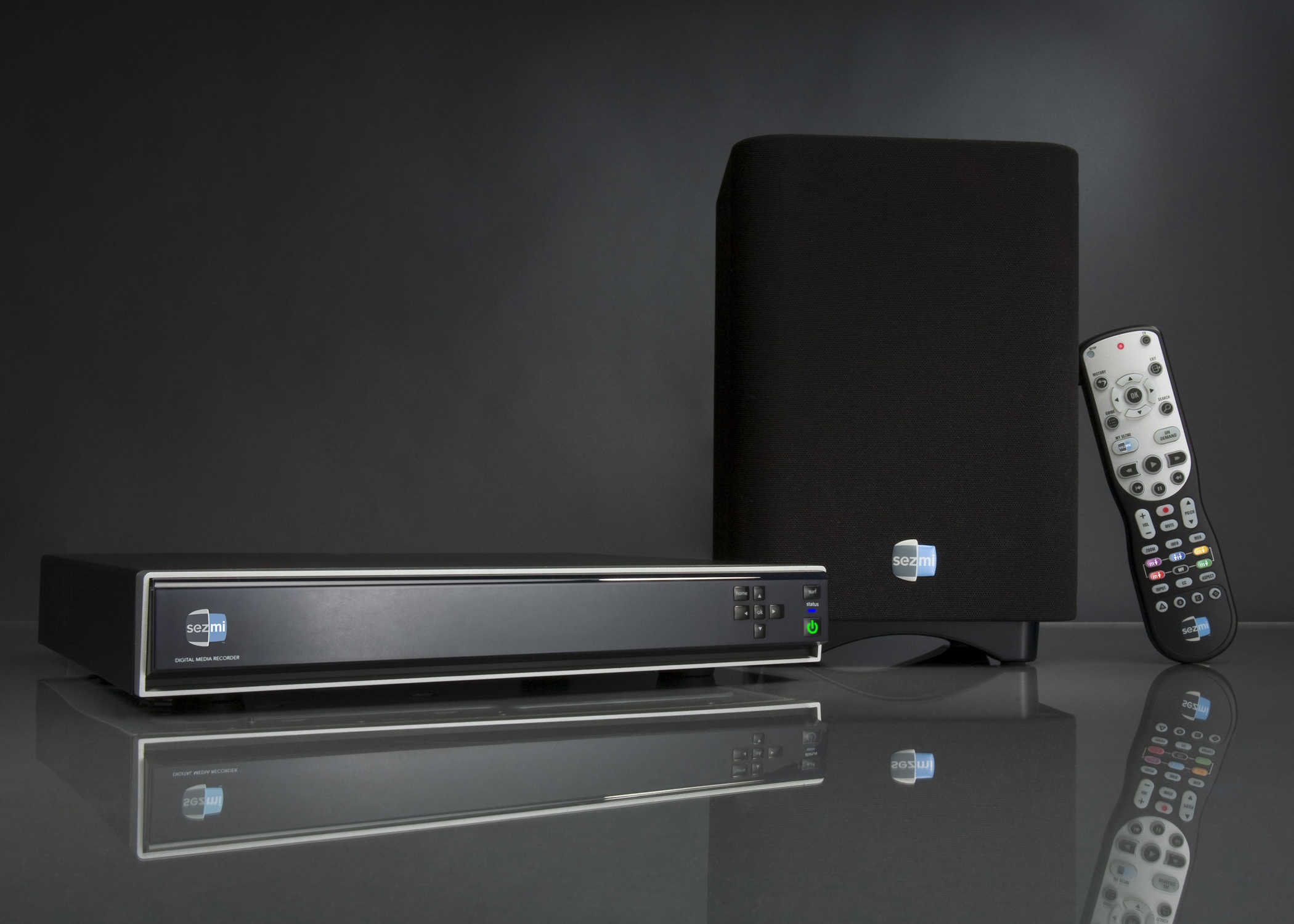
Sezmi set top DVR box, antenna, and remote control

While most of the pay television industry forces huge basic cable packages on subscribers containing dozens of channels never watched, an innovative California company thinks it has the perfect solution for those who want to cut cable’s cord but still keep some of their favorite cable channels.

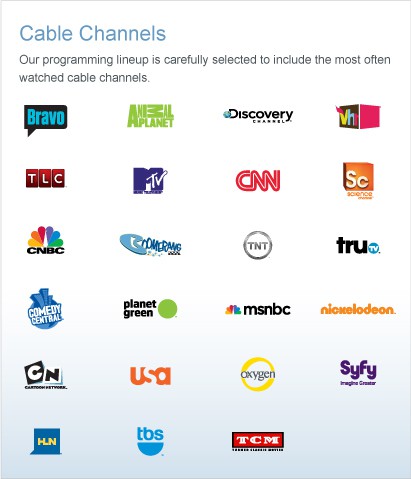
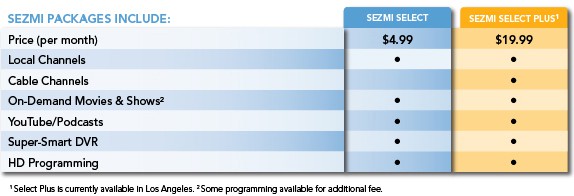
Sezmi combines a super-sized 1 terabyte DVR set-top box ($149.99) with a digital broadcast receiver to deliver every local television signals, 23 popular cable channels, on-demand movies, video podcasts, and YouTube content for $19.99 per month.  Don’t care about the cable channels or live outside of Los Angeles?  The price drops to $4.99 per month.

Sezmi’s inventors believe the marketplace is ripe for a compromise between paying enormous cable bills or simply going without popular cable series and 24/7 news.

Besides, Sezmi’s founders argue, with free digital television stations increasing the amount of programming they offer and Americans wanting to watch more of their favorite shows on-demand, Sezmi’s super-sized DVR may provide enough live and recorded programs to more than satisfy average viewers.  If not, a budget-priced package of two dozen popular cable channels could give people enough courage to cut cable’s cord forever.

At its core, Sezmi’s set top box offers an enormous capacity hard drive that can store up to 1400 hours of SD (standard definition) and 340 hours of HD (high definition) programming.  It can also record one channel while watching another, and its software gives each member of a viewing family their own personal menu to access, record, and view the programming they want.

[flv width=”446″ height=”270″]http://www.phillipdampier.com/video/Sezmi All-In-One Personal TV Service.mp4[/flv]

A promotional reel introducing shoppers to Sezmi and its services.  (3 minutes)

Sezmi’s founders future-proofed their technology to be immune from broadband providers with Internet Overcharging schemes in mind.  Unlike other cord-cutting alternative set top technology that relies on broadband to access programming, Sezmi receives its live TV and cable network programming entirely over the air.  That keeps your local cable or phone company from stopping all the fun by imposing broadband usage limitations or charging steep penalties for watching too much of a competitor’s service.

Sezmi’s unique way of bypassing the local broadband provider is both innovative and challenging at the same time.  In the Los Angeles market, currently the only city where Sezmi provides cable networks, it leases leftover capacity from local stations to transmit the encrypted cable networks over the air to Sezmi receivers.  As long as you get a signal from a local station, the cable signals come along for the ride.

While that can work in Los Angeles, which has at least 26 full powered broadcast stations in the market from whom it can potentially lease capacity, most American cities have fewer than eight full power local channels.  If those stations can’t or won’t lease out their extra bandwidth, the cable programming service simply won’t work.

Part of the original business plan for Sezmi was to provide the set top box as a solution for phone companies like Frontier and other independents who want to deliver a video package without improving their current copper-based networks to deliver it.  Because the box will work reasonably well with a broadband connection of 3.1Mbps or higher, companies selling DSL broadband packages to customers could use Sezmi to deliver video content to subscribers.  In rural areas, relying on broadband delivery may prove more effective than over-the-air reception, and since the provider offers the service themselves, there is little chance they’d limit their own customers’ use of Sezmi.

Now Sezmi is directly being sold to consumers on Amazon.com and in Best Buy stores in the 35 U.S. cities Sezmi serves.

Sezmi's cable channel lineup is currently only available in Los Angeles.

Buyers are pre-qualified before purchase to determine if they’ll be able to receive a suitable broadcast TV signal required for Sezmi to operate.

A lengthy beta test in Los Angeles revealed many consumers loved the concept of Sezmi, but definitely discovered some flaws:

  • There is no wireless connection supported for broadband.  You must use a supplied Ethernet cable to connect to a router;
  • The remote control and its functionality was frequently reviewed as unintuitive and slow to respond to commands;
  • Cable networks arrived only in standard definition video;
  • Reception varied considerably depending on where one lives in relation to local broadcast transmitters.  Where TV stations use different transmitting locations, reception problems for one or more stations can be an issue unless you regularly reposition the antenna;
  • Sezmi’s antenna module looks like a small bookshelf speaker and was more obtrusive than many thought necessary;
  • Sezmi’s online viewing options are limited to YouTube and Sezmi-partnered content.  No Hulu or Netflix access is supported.
  • Some reviewers felt charging $5 a month for a Sezmi package that only included free, over the air broadcast stations was unjustified when they also had to purchase the required set top box.  Many of these comments came when the box was priced at $299, however.  Sezmi has reduced the price of the set top box by half, so it’s likely the monthly fee includes some hardware cost recovery;
  • The cable networks chosen do not include a lot of sports, although the company is currently negotiating with ESPN;
  • Love it or hate it, one of America’s favorite cable channels – Fox News, is not included in the lineup although CNN and MSNBC are.  Their asking price may have been too high.

Sezmi’s co-founder probably expects that detailed level of critique considering the company’s business plan targets technology-minded “early adopters” who are well versed on technology and very opinionated about how it works.  They also feature prominently in the group of consumers that are now spending less time watching live television and less-willing to pay the asking price for it.

“The Sezmi offering is geared toward the next wave of consumers who want a very high-quality experience and the latest technology features, but are not willing to overpay for that,” said Phil Wiser, co-founder and president. “We’ve limited ourselves to really focus on that segment who are value-oriented and tech-oriented.”

Those who are value-oriented have responded positively to Sezmi.  Stop the Cap! reader John in Sherman Oaks, Calif., who notified us about Sezmi’s local media blitz says it’s exactly what he was looking for, and he’s enjoying some shows he missed from USA, TNT and Discovery.  But his wife misses her favorite HGTV and Food Network shows, which Sezmi doesn’t carry.

“I told cable to take a hike,” he writes. “I only watch perhaps a dozen channels and Sezmi has most of them covered for about 1/3rd of the cost the cable company charges, not including the fees, taxes, and renting cable’s set top boxes.”

John adds 24/7 access to live news programming was the one thing that held him back from dropping cable before Sezmi arrived.

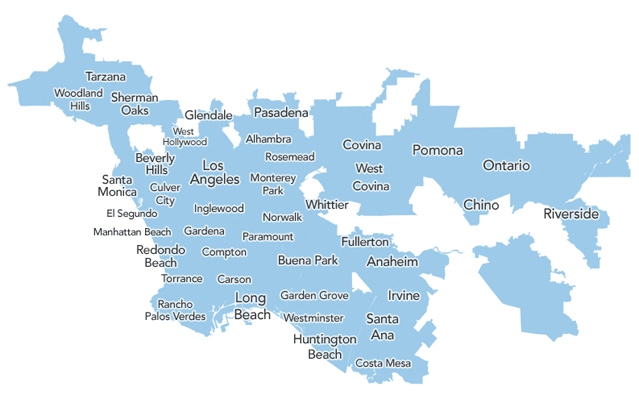
Sezmi's Los Angeles Coverage Map (click to enlarge)

“I wasn’t going to give up CNN and MSNBC for breaking news,” he said.

Wiser’s comments to the San Francisco Chronicle seem to match John’s perceptions about the service.

“The key thing we realized with Sezmi is that consumers would not be ready to drop a paid TV experience purely for Internet offerings,” he said. “You need a bridge that includes a traditional cable experience with a more on-demand interactivity.”

Although John says he has few problems getting good broadcast signals from Mt. Wilson, where most Los Angeles-area broadcasters maintain their transmitters, some  residents further east in Riverside say their experiences were considerably worse.

“If you walked in front of the antenna, reception would drop out,” wrote one reviewer.  “A rooftop antenna is really a smart idea if you need reliable reception to make sure your shows get recorded,” wrote another.

The potential impact Sezmi could have on cable and phone company pay television packages varies depending on which analyst you choose.

Mike Jude, with Frost & Sullivan, told the Chronicle devices like Sezmi will probably remain niche products that will have trouble attracting interest from traditional cable subscribers.

But Gerry Kaufhold, an analyst at In-Stat, said Sezmi’s innovative approach could find a significant audience especially with more casual TV viewers. He said 15 percent of viewers don’t pay for TV while 35 to 40 percent of cable users pay about $40 for basic cable. Both could find a lot of utility in a product like Sezmi, he said.

“Anyone that gets a big digital cable (package) is unlikely to leave, but people who get basic cable may be willing to make that jump and cut some 20 bucks off their bill,” Kaufhold said. “They can also get people who don’t pay for TV to try it.”

With a Yankee Group study looming that estimates one in eight Americans will disconnect or downgrade their paid TV services by April, devices like Sezmi could threaten industry profits even sooner than some analysts think.

Service Coverage – Click links for respective channel lineups

ARIZONA

Phoenix

CALIFORNIA
Los Angeles
San Diego
San Francisco
Oakland
San Jose

CONNECTICUT
Hartford
New Haven

DISTRICT OF COLUMBIA
Washington D.C.

FLORIDA
Jacksonville
Miami
Fort Lauderdale
Orlando
Daytona Beach
Melbourne
West Palm Beach
Ft. Pierce

GEORGIA
Atlanta

MASSACHUSETTS
Boston

MICHIGAN

Detroit
Grand Rapids
Kalamazoo
Battle Creek

MINNESOTA
Minneapolis
St. Paul

MISSOURI
Kansas City
St. Louis

NEW MEXICO
Albuquerque
Santa Fe

NORTH CAROLINA
Asheville
Charlotte
Greensboro
High Point
Winston
Raleigh
Durham
Salem

OHIO
Cleveland
Akron
Columbus

OKLAHOMA
Oklahoma City

OREGON

Portland

PENNSYLVANIA
Philadelphia

SOUTH CAROLINA
Anderson
Greenville
Spartanburg

TENNESSEE
Memphis
Nashville

TEXAS
Dallas
Ft. Worth
Houston
San Antonio

UTAH
Salt Lake City

VIRGINIA
Norfolk
Portsmouth
Newport News

WASHINGTON
Seattle
Tacoma

WISCONSIN
Milwaukee

[flv width=”640″ height=”380″]http://www.phillipdampier.com/video/Sezmi Services Described.flv[/flv]

Sezmi Explained: This series of videos walks you through all of Sezmi’s features and services.  (12 minutes)

[flv width=”640″ height=”380″]http://www.phillipdampier.com/video/Sezmi Setup.flv[/flv]

Sezmi’s setup is explained in this video, guiding you through the process of hooking up the equipment.  (10 minutes)

Frontier’s Fiber Fantasy Island: “We Deploy Fiber-to-the-Home All Across the Country”

Frontier's Maggie Wilderotter escapes reality

Frontier Communications CEO Maggie Wilderotter has bought a first class ticket to Fiber Fantasy Island, where phone companies dream of delivering fiber-optic broadband service without actually deploying fiber.  They just tell you they did.

In an interview published today in The Oregonian, Wilderotter tries to convince residents Frontier’s arrival is good news, making promises about broadband and service improvements based on a company track record an independent observer would conclude she simply made up.

If Wilderotter’s command of the facts about her own company are reflective of “a distinct, improved image in its new territories,” Oregon is in big trouble.

Let’s review:

CLAIM: “We deploy fiber to the home all across the country. We don’t call it FiOS. We call it high-speed Internet. For our customers, the technology doesn’t matter. What matters is access, speed and capacity.”

REALITY CHECK: Frontier, as far as we have been able to determine, has not deployed fiber to the home anywhere in the country, with the exception of the FiOS network it acquired from Verizon.  Frontier Communications’ deployment of fiber optics to the home is comparable to the amount of fiber found in a box of Cookie Crisp cereal.  In their largest market, Rochester, N.Y., Frontier relies on the same legacy copper wire phone network it utilizes everywhere else.  It is highly misleading for Wilderotter to represent otherwise.  Fiber to the home means exactly that — fiber optic cable brought right to the home.  This is not a case of “you call it corn, we call it maize.”

This kitten is not an iguana.

Fiber optic cable is not also known as “high-speed Internet,” just as the cute kitten on the left is not called an iguana.  For the significant number of customers who ask Frontier to disconnect their service year-after-year, technology matters very much, and this particular phone company lacks it.  Frontier relies on the same DSL technology other phone companies and customers increasingly consider yesterday’s news.

In many Frontier service areas, there is no access to broadband because line quality will not support the service.  In Brighton, N.Y., a suburb of Rochester less than a minute from the Rochester city line, Frontier could only manage to deliver 3.1Mbps DSL speeds, and until recently Frontier was crying it needed a 5GB usage allowance because of the threat higher amounts of consumption might have on its network capacity.  Access, speed, and capacity does matter, which is why Time Warner Cable is picking up the bulk of its new broadband subscribers at Frontier’s expense.

CLAIM: “For high-speed, it means having speed and capacity in addition to reach. We’ll do add-on services. We have a terrific Yahoo-Frontier portal that will be a gateway on our high-speed Internet service. We are in the throes of putting together Wi-Fi hotspots that will be distributed throughout this market for customers.  If you’re a high-speed Internet customer of ours it’s free. We’re looking to put one at Hillsboro Stadium. Typically, we put them in hotels, convention centers, truck stops, trailer parks, outside parks, campuses for colleges, shopping centers, business campuses.”

REALITY CHECK:  Those “add-on services,” such as Frontier’s Peace of Mind, come with a price tag and are often required components of a bundled service discount offer.  As first impressions go, a company still relying on Yahoo! for a front end is not exactly on the cutting edge, nor are “portals.”  It’s like trying to impress new customers with free web space through GeoCities.  Actually, that is something Frontier could offer because GeoCities is now owned by Yahoo!

Frontier’s Peace of Mind Services

  • Hard Drive Backup: $4.99 per month
  • Hard Drive Backup + Unlimited Technical Support: $9.99 per month
  • Hard Drive Backup + Unlimited Technical Support + Inside Wire Maintenance: $12.99 per month
  • $50 early cancellation penalty if you get these services with a term commitment

Rochester’s experience with Frontier Wi-Fi has not been very impressive.  Most residents don’t even know the service exists.  The city and several suburbs offer limited Frontier pay-walled Wi-Fi service and a handful of free access hotspots in cooperation with Monroe County.  Unfortunately, many of the fee-based and free hotspots have fallen into disrepair and no longer function.  Signal strength is not impressive either, and many were not usable indoors.  We tested several of the free hotspots and discovered one only delivered a signal into a suburban parking lot, another only into an empty soccer field, and the third was not functioning at all.  Frontier’s record in Wi-Fi delivered more promises than actual service.

Those Wi-Fi services, by the way, are not free for all Frontier broadband customers.  Evidently Ms. Wilderotter is not acquainted with her own company’s products and services, nor Frontier’s own website:

So much for Wilderotter's claim Frontier's Wi-Fi network was free for all Frontier broadband customers.

CLAIM: “We deliver the highest value for the price you pay. We also have excellent customer service. We also don’t raise our rates every 12 months, no matter what.”

REALITY CHECK:  In Rochester, the out-the-door price Frontier charges its broadband customers is actually higher than that charged by Time Warner Cable, which delivers far faster connections.  In West Virginia, the state’s Consumer Advocate put together a chart depicting Frontier’s broadband prices.  Determine for yourself if it delivers the “highest value for the price you pay.”
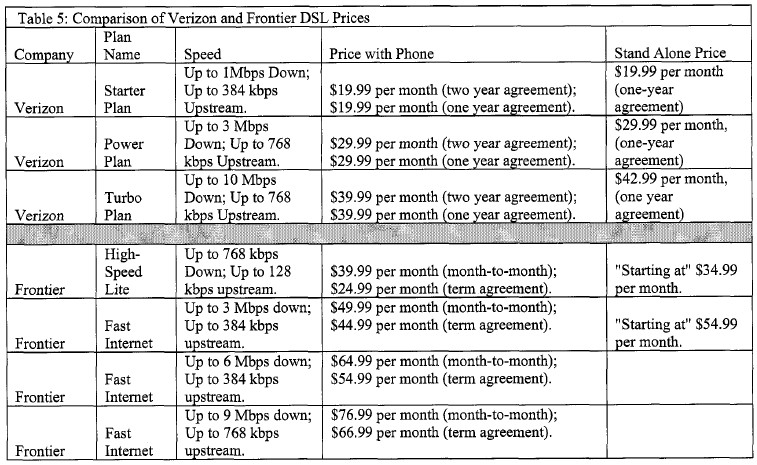
Comparing Prices: Frontier's pricing doesn't look as exciting as Wilderotter would have you believe, as the West Virginia Consumer Advocate discovered

CLAIM: “If I look across the board at our basic service pricing, I don’t think we’ve raised prices anywhere in the last four or five years.”

REALITY CHECK: We looked and found Frontier demanding the right to increase basic service rates in New York by $2 a month each year for up to two years.  In fact, last November, the New York State Public Service Commission, at the request of Frontier, sent the company a letter authorizing a rate hike of $2 a month for customers in the state.  Even more enlightening was Frontier’s filing in August 2005 with the PSC demanding near-complete deregulation and rate relief allowing Frontier to raise rates up to $1 per month annually indefinitely for basic service.  Frontier also wanted consumer protection rules “relaxed” and ban the PSC from investigating consumer complaints.  One of the reasons they cited is that basic phone service is not the same critical service it used to be because people can communicate through blogs instead.

In fact, consumers should be asking why Frontier’s rates haven’t decreased.  From that same filing: “Frontier believes that with the decreasing costs and increasing bandwidths of new technologies and the acceleration of intermodal market entry, the market will cause rates for non-basic services in all parts of the State to decline.”

CLAIM: Local regulators tell me they did see a spike in billing complaints after Verizon took over. Any thoughts on why?“Whenever there’s a change — you change the name on the bill, you change the format — customers tend to look at it more closely. We always expect a spike in billing calls whenever we’ve done acquisitions. It has already (settled out).”

REALITY CHECK: As Stop the Cap! has reported, Frontier’s takeover in West Virginia has hardly “settled out.”  Service interruptions, forgotten service calls, and other problems have plagued the state to the point the PSC needed new hearings to review the situation.  Many of Frontier’s billing complaints come from customers choosing to cancel Frontier service, only to find unjustified early termination fees added to their final bills, even when customers never agreed to a term contract.  That problem was so serious in New York, the state Attorney General fined the company and ordered customer refunds.  Changing a customer’s bill by adding $100 or more to the total amount due will always get a customer to look at the bill more closely.

CLAIM: “One of the big opportunities that we’re working on is the ability to display Internet content and video on the television set.”

REALITY CHECK: That “big opportunity” has been available to broadband users for several years now.

CLAIM: We also have a new site that’s called myfitv.com. We carry over 100,000 titles of free television content on this site. It’s a little bit like Hulu on steroids. It’s provided free of charge to all our customers.

REALITY CHECK: MyFitv is not “a little bit like Hulu on steroids.”  In fact, it is Hulu.  Frontier simply used Hulu’s “embed” feature to take content, slap the Frontier logo on it, and add Google ads in an attempt to rake in a few extra dollars.  You can do exactly the same thing yourself.  Meanwhile, the service is added to customer bills showing an amount of $0.00, a very inexpensive way to try and impress customers with content Frontier never developed, deployed, or created — just like their phantom fiber to the home network.

CLAIM: “We think over time the Internet will also provide different packaging, different prices, different ways to buy content than the traditional viewing platform. We also think that mobility is important. We want to make sure that whatever you do you’ll be able to take it with you.  The Sling technology is interesting, too. It’s something we’re talking about DISH Network with.”

REALITY CHECK: Every time Maggie has talked about “different packaging and prices,” it has been in the context of an Internet Overcharging scheme — limited usage allowances, extremely high rate increases for those deemed to have consumed too much, etc.  And yes, Sling technology is interesting.  A company conceived of the idea, built it, developed a marketing plan, and sold it.  That’s a concept Frontier needs to understand.  You cannot transform a legacy network with words alone.  Here’s an idea.  How about conceiving of a real fiber-to-the-home network, build one, develop a marketing plan, and then sell it.  For those in markets like Rochester, it’s the only way Frontier Communications will avoid becoming the horse and buggy carriage maker of the 21st century.

CLAIM: You’re around Seattle, around Portland, but not in them yet. Is there any possibility that Frontier would build into another company’s market? — “There’s always a possibility. It’s not a priority for us. And the reason why it’s not a priority is we’ve got a lot to do, just in the service areas that we own today. When I’m humming on all cylinders there, and I’ve been able to do everything I possibly can in those areas, then I might look to extend service areas out.”

REALITY CHECK: Translation — “when pigs fly.”  Frontier would be laughed out of the Seattle and Portland markets.

Ms. Wilderotter needs to be a lot more open and forthcoming with the press.  Frontier’s business plan makes it clear the company’s future is serving uncompetitive rural markets that will be forced to tolerate the products and pricing Frontier delivers.  Where competition exists, let’s face facts.  Frontier is not gaining market share — it is losing it, eroded away year after year by uncompetitive, substandard products at high prices.

That’s a reality you are bound to miss if you spend too much time with Mr. Rourke and Tattoo.

Search This Site:

Contributions:

Recent Comments:

Your Account:

Stop the Cap!