Home » Online Video » Recent Articles:

Fox-Cablevision Cat Fight Claws New York: Battle Briefly Extends Into Broadband Before Fox Thinks Twice

Another fight over retransmission consent leaves New York-area Cablevision subscribers in the middle of a dispute they will ultimately pay for.

At 12:01am Saturday, an unintended economic stimulus package kicked in for New York area sports bars as News Corporation yanked Fox network affiliates in New York and Philadelphia from Cablevision subscribers in a dispute over programming fees.

WNYW-TV (Fox), WTXF-TV (Fox), WWOR-TV (MyNetwork TV), Nat Geo WILD, Fox Business Channel, and Fox Deportes were all replaced with a looped message from Cablevision attacking Fox for negotiating in bad faith and greedily demanding more money than the cable company pays for every other New York area broadcaster, combined.

The dispute sent sports fans scurrying for access to weekend sporting events blacked out on the cable system serving Brooklyn, Long Island, and parts of Connecticut and New Jersey.  Cablevision customers were denied yesterday’s New York Giants-Detroit Lions football game and Philadelphia Phillies-San Francisco Giants baseball playoff game.  For a brief period, Fox raised the ante by also blocking Cablevision broadband subscribers from accessing Fox programming on Hulu, until political pressure and complaints from consumer groups forced Fox to retreat.

At issue, as always, is money.  Broadcasters are increasingly insistent on being paid for the right to retransmit their programming over cable systems.  Without agreements, a broadcaster can insist that a cable system drop their station(s) from the lineup until a retransmission consent agreement can be reached.

For years, many smaller independent stations fought to get on cable systems — for free — especially in areas where poor reception made it difficult to watch.  Broadcasters increased local advertising rates thanks to the extended viewing area many cable systems provide.

But now that local ad revenue is not what it used to be, and with viewers going online for access to their favorite shows, agreements increasingly require cash payments for permission to carry stations.

For the nation’s largest television market — New York City, the amounts exchanged can be staggering — well over $100 million dollars each year.  With that kind of money at stake, disputes have become almost routine, and area viewers are sick of it.

“It’s all about the money,” complained resident Joe Figueroa. “They’re always greedy.”

Figeroa and fellow Bronx resident Shinequa Gaillard told WNBC-TV these disputes always leave customers in the middle.
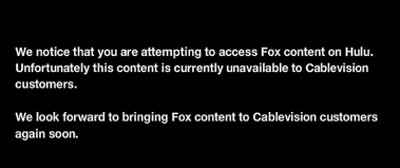
Fox briefly yanked its shows on Hulu Sunday for Cablevision customers attempting to bypass the dispute

“I think neither one of the two are thinking about the customers and the viewers — neither one of them,” Gaillard said. “As consumers, what can we do? Nothing.”

Briefly over the weekend, viewers hoping to bypass the dispute by watching Fox programming on Hulu learned the network had decided to involve Cablevision’s broadband subscribers in the fight as well — blocking access to Fox-owned content.  Some of our readers, include PreventCAPS, noticed.

Stop the Cap! reader and Cablevision subscriber Jim in Garden City, N.Y., discovered the programming blockade when he tried to watch an episode of COPS on Hulu.

“Fox has gone hardball on us by blocking Hulu for anyone with a Cablevision IP address,” Jim writes. “This is how these bastards operate, cutting off programming even for those like me who don’t even have cable TV and should not be involved in this debate at all.”

Jim uses a rooftop antenna to access local stations, and does not subscribe to a Cablevision video package.  He’s convinced this is exactly why we need Net Neutrality enforced by law in the United States.

“Imagine if this was Comcast-NBC vs. Fox,” he warns. “Do you think Comcast wouldn’t think twice of pulling the plug on Fox’s website and video content if the two hated one-another?  They’d flip that switch off in a second.”

The implications did not go unnoticed by Free Press and other consumer groups.

“Consumers should have the right to watch online content, and this access should not be tied to a dispute over cable television carriage arrangements,” said S. Derek Turner, research director for Free Press. “This move is also an example of a major user of public spectrum abusing the public interest.”

The matter quickly also went political, triggering an angry response from Rep. Ed Markey (D-Mass.) urging the Federal Communications Commission to step in and “actively defend Internet freedom and consumer rights.”

A few hours after statements like that, Fox pulled back and restored access, but the point was made for those who recognize media companies have major involvement in online and over-the-air programming.

Israel

Rep. Steve Israel (D-N.Y.), whose district includes shut-out Cablevision subscribers, thinks these disputes have become way too common.

Cablevision subscribers have endured short-term lockouts from Food Network and HGTV, networks owned by ABC-Disney, and now this latest dispute with Fox.  Israel wants binding arbitration for these types of disputes, if only to shield customers from one side or the other yanking access:

“I spoke to officials today at the FCC and they confirmed they have offered to mediate arbitration and pledged to keep the heat on both parties to come to the table without disrupting service.  Haven questioned Chairman Genachowski about this issue in March, I know that he shares my concerns about the continued brinkmanship of these negations that threaten to leave customers in the dark.  I’m disappointed that both parties haven’t agreed to hold Giants fans harmless while negotiations continue.”

While Cablevision announced it was willing to enter arbitration to resolve the dispute, Fox officials refused, claiming it would reward bad behavior by the cable company.

Both players have their own websites defending their respective positions and trying to sign up viewers to help fight the battle.

News Corporation, which owns Fox, runs KeepFoxOn and is encouraging Cablevision subscribers to cancel subscriptions and switch to Verizon FiOS or satellite television.  It also accuses Cablevision of hypocrisy over their resistance to paying “fair fees” for Fox-owned programming.

Lew Leone, vice president and general manager of News Corporation’s WNYW and WWOR-TV says Cablevision wants special treatment:

Instead of negotiating like a responsible business, Cablevision decided to make this your problem in the hope that if they caused you, the viewer, enough inconvenience, then politicians would intervene.

That is what Cablevision’s call for “arbitration” is all about.   But ask yourself – do you think Cablevision would be ok with someone else stepping in to decide the price you pay them for cable and broadband service?

And the Cablevision family certainly doesn’t allow arbitrators to set the rates for their cable channels like MSG and AMC.  In fact, just a few weeks ago, MSG and MSG Plus went off the dial for millions of DISH Network subscribers – and MSG did not ask for arbitration.

Cablevision has called us greedy. It’s an interesting charge, given the fact that the price we’ve offered Cablevision for FOX5 and My9 is more than 70% lower than what the Cablevision family charges other cable operators for MSG and MSG Plus.

Frankly, it is hard to believe a company like Cablevision is accusing anyone else of greed.  Cablevision customers pay an average of $149 per month including up to $18 for broadcast stations – and that earned them an average profit of over $795 per subscriber last year.  Yet, they have only offered to pay less than a penny a day for FOX5 and My9.

Cablevision has stated that they intend to provide you with a rebate.  But if the rebate is equal to what they offered Fox for our stations, you can look forward to a credit of less than 30 cents on your next bill.

Cablevision officials fire back that they won’t be bullied.  The Cablevision website, along with a video airing on blacked out channels, accuses Fox of greedily demanding $150 million for stations, many of which customers can watch for free over-the-air:

  • Cablevision currently pays 70 million dollars per year for News Corp’s programming (which includes channels such as FOX 5, My9, FOX Business Network, National Geographic Wild, and FOX Deportes), and now they are asking for more than 150 million dollars for the exact same programming – no new programming, just another 80 million dollars per year for News Corp.
  • Cablevision has reached agreement with every other major broadcast station, including CBS, NBC, ABC and Univision. But News Corp is demanding more in fees for FOX 5 and My9 than Cablevision and our customers pay for all of the other broadcast stations combined!
  • We think in these economic times that this is outrageous, especially since FOX 5 and My9 are available for free over the air, and they make many of their most popular shows available for free on the Internet.
  • News Corp has pulled the plug on their most popular programming, holding viewers hostage until their unreasonable demands are met. NFL Football, the MLB playoffs and World Series, House and Glee are just a few of the programs that News Corp is depriving their viewers of in an attempt to bully us into accepting their unfair demands.
  • Cablevision is willing to accept binding arbitration from an independent 3rd party to settle this dispute. We call on News Corp to accept binding arbitration, and to put FOX 5 and My9 back on the air for our customers until we can come to a fair agreement.

Both sides have publicized their views in the local media, including full page ads in New York tabloids.  One from Fox targeted Cablevision’s owners personally, accusing the Dolan family of getting top dollar for lesser-watched sports networks under the MSG umbrella while playing hardball over program fees for channels 5 and 9, heavily viewed in the New York area.

Right now, Cablevision pays about 25 cents per month for both broadcasters.  News Corporation reportedly wants a dollar per month.

Forbes entertainment columnist Lacey Rose warns these repeated battles may bring unintended consequences from viewers, especially for Fox:

The networks’ current strategy –block programming while trading barbs with the cable operator in question—may do more harm than good, however, as consumers are (further) incentivized to find new ways to occupy their time. (Much as they did during the 100-day writers’ strike, when new scripted programming was shelved for months.) Still more worrisome, the resulting fees that will be passed down to already cash-strapped subscribers in the form of higher cable bills could end up pushing them away forever.

In an era of 1,000-plus channels and infinite entertainment on the Internet, the broadcast networks are already in a precarious position with younger viewers, which advertisers pay a premium to reach. Blackouts or not, nearly 70% of cord cutters are under the age of 34, according to a BTIG study released last month — and that doesn’t include a growing subset of these younger, tech-savvy viewers who never even bother with a cable subscription, preferring entertainment outlets like Hulu and Netflix for their content.  Though the networks are loathe to admit it, viewership continues to decline as the median age of the audience at the big four rises. In fact, thus far this season the median age of a prime-time viewer is 50 years old, according to The Nielsen Company.

But at least for now, as negotiations continue in the third day of the programming blackout, there appears to be no end in sight.  Cablevision has even engaged in some programming blackouts of its own, denying access to today’s New York gubernatorial debate to Verizon FiOS, which prompted an angry response from the phone company.

“Verizon FiOS TV customers and millions of other viewers served by other providers across the state have essentially been blacked out of the debate, denying them their rights as citizens and voters, since Cablevision is the sole broadcaster of the event,” said Michelle Webb, general manager and chief programming officer of FiOS1, Verizon’s news channel for Long Island and northern New Jersey. “And while the broadcast will be available on certain websites and some radio, those may not be practical solutions for many people.”

[flv width=”640″ height=”500″]http://www.phillipdampier.com/video/Fox Cablevision Dispute 10-18-10.flv[/flv]

Stop the Cap! brings you a comprehensive roundup of coverage from the New York area regarding the Cablevision-Fox dispute, with coverage from WNYW, WABC, and NY 1 television, Cablevision and Fox themselves, and WINS and WCBS Radio.  (14 minutes)

Clear Admits Throttling Subscribers Despite Marketing Claims; Customers Revolt Over Bait & Switch Service

Clear made itself unclear about its speed throttle.

Clear, the 4G wireless broadband service backed by Sprint, Comcast, and Time Warner Cable is under fire for selling customers an unlimited use/”no speed limit” service plan that is heavily throttled to as low as 250kbps once customers are deemed “heavy users” by the provider.

Stop the Cap! reader Kevin in Rochester dropped us a note to share his frustration at Clear’s bait and switch marketing that promises one thing and delivers another.

It’s becoming common knowledge – but not common enough – that Clear is throttling their in-home broadband subscribers. For $30 a month, Clear delivers “unlimited 3Mbps” download speed, but after 8-10GB of usage in a month, they cut your speed to 250kbps as a punishment.

Scores of customers share Kevin’s problems, with complaints pouring in on broadband forums and on Clear’s customer support website (which crashed earlier today).  It is not known whether these usage limitations are also imposed on Comcast and Time Warner Cable’s branded 4G wireless services, which are also delivered by Clear’s network.

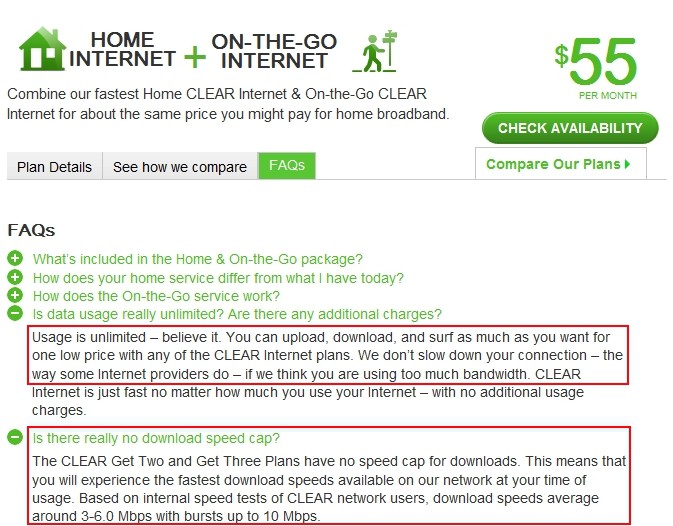
Remarkably, Clear’s website has marketed its broadband service as free from classic Internet Overcharging schemes like usage caps and speed throttles/network management:

Clear's own marketing promises unlimited usage with no speed reductions, unlike those "other" providers, which now also includes Clear itself. (Courtesy: Michael46)

Despite the marketing, Clear’s Rob Lenderman today admitted the company implemented a speed throttle system on Wednesday, Sept. 29 and placed the blame for doing so on peer-to-peer torrent traffic:

Last Wednesday we deployed a new automated algorithm that tries to even the playing field for all users. Essentially we tried to take users that were downloading large amounts of data over a week’s period of time and limit their top speeds during periods of high tower utilization. This system is based on a tower’s current utilization, GB’s downloaded in the past 7 days and current download speeds in the past 15 minutes. it recalculates your max D/L speed every 15 minutes based on these factors. All in there are 48 buckets of max D/L speeds based on these factors.

The expected results of these changes was that a small percentage of users would be slowed down for short periods of time but only during high utilization times on the tower.

Theoretically the very slow speeds would only last for 15 minutes and then readjust based on tower usage and the last 15 minutes of slower speeds.

The reality is that a very small percentage of users are being set at very low D/L speeds for hours at a time.

We are gathering more data as I write this and we are looking at adjustments to the policy so that the connection becomes more usable. Expect further details this week.

One thing I want to stress is that this algorithm does not apply to towers that have a low utilization which is a large percentage of the towers. Since high utilization is usually at night most users that are seeing slower speeds at night would see increases at other times of the day. We realize this is not ideal but using the system for large downloads outside normal usage hours(evening) will allow you to get higher speeds. This rule applies even if you are not being slowed. Fewer users = Higher speeds.

Expect more details in the next few days as we drill into the details and let you know what changes we will be making to make the experience better.

In the short term you can increase the speeds of your experience by reducing the number of GB sized downloads that take place. Our data shows that running a torrent is one of the reasons that people start to experience slower speeds.

[…]I use the word limit when talking about D/L speeds. Not in terms of amount of data you can download. I can assure you this is being handled at a very high level in the organization as some of the experiences some of you are having is not in the spirit of the program. As for using a P2P you will improve speeds if you run them at off peak hours. As tower utilization drops during those hours the algorithm will release more bandwidth and the apps will pick up speed. In addition fewer users will also yield an increase since the algorithm does not affect low utilization tower at all. So you get a double benefit from using off peak hours for large downloads.

We are looking at how to set the speed limits to ensure things like web browsing and youtube are useful even though large downloads may be limited in terms of speed during peak hours.

We are meeting every day to go over new data and determine a longer term solution instead of just throwing new solutions out there without putting some thought into them.

We apologize for this but we need to get it right and not just change for the sake of change.

RobL

Of course, customers promised repeatedly they would receive lightning-fast, unlimited wireless broadband from the company were unimpressed with the company’s argument that artificially slowing their speeds after as little as 20 minutes viewing Hulu or Netflix to 250kbps for several days qualified as ensuring the subscriber experience.  Many customers report Clear’s throttling is hardly limited only to peer to peer torrent traffic.  Online video streaming, in particular, routinely triggers the speed throttle for customers, something Lenderman admitted might be an issue:

We are looking at the impact of the new policy as we speak and will be reevaluating it shortly to determine what changes might need to be made.

The algorithm we use is complicated and is not intended to shut down users that use the service in a normal manner. It was intended to slow down usage from users that have bit torrents, etc running all day long.

For some of the customers that have complained we have researched it in detail and they were not being slowed by the algorithm. We have to make sure that everything is running properly as it makes no sense for us to limit users so much that the service becomes unusable.

We should have more info on what we plan to change in the next few days as we evaluate the data.

Clear becomes just the latest provider poster child for Net Neutrality in the United States.  While there may be reasonable capacity issues at stake on wireless networks not designed to accommodate 24/7 peer to peer traffic, throttling online video is another matter entirely — it’s one of the services Clear has promoted as possible using their higher speed network.  Artificially slowing a network the company sells as not being hampered by such traffic control measures is a classic case of false advertising.

One vocal Clear customer created this avatar

Customers have noticed and have attacked the company for dishonest business practices, bait and switch marketing, and violating their own internal policies.

Stop the Cap! has not seen any reports of company officials attempting to enforce early termination fees for those exiting contracts early.  Kevin noted his service was turned off as he was on the phone with a representative to process the disconnect request.  The representative also demanded Kevin return his modem.

Most who are dropping service are resuming service with their old providers, mostly cable broadband and telephone company DSL providers.  If online forum posts and Twitter tweets are to be believed, the company is losing hundreds of customers per day over their Internet Overcharging scheme.

Most likely, Clear has turned to vendors like Sandvine for “usage management” equipment that can automatically slow service for those who actually utilize the service they pay to receive.

“It is no longer about the broadband-connected home but about the broadband-connected individual,” said Tom Donnelly, EVP marketing and sales, Sandvine. “Service providers worldwide are looking for tools that enable their subscribers to stay within their service plans regardless of when, where or how they connect to the network.”

Sandvine’s products detect network conditions that trigger policies within the network to help service providers control subscribers’ Internet experience.  The latest version integrates with 3G and 4G networks to throttle speeds based on time of use or volume of data transferred.  A provider sets the parameters and the “network management” solution does the rest, automatically.

Stop the Cap! intends to monitor this situation carefully over the coming days to learn what the company intends to do with its network management scheme.  If they continue to use it, we will do our part and file a formal complaint against Clear with New York State Attorney General Andrew Cuomo for false advertising and misleading business practices.

It is only a matter of time before a law firm begins a class action against the company for similar reasons.  Stop the Cap! encourages Clear customers to use the company’s forum to vocally demand an end to all Internet Overcharging schemes or else you will take your business elsewhere.  You should also demand full credit for the days you experience artificially slowed speeds, and please let us know if you are asked to pay any early termination fee for exiting a Clear term contract.

Blockbuster Files for Bankruptcy; Wipes Out Shareholders But Keeps Stores, Rent-by-Mail Service Open

Phillip Dampier September 23, 2010 Consumer News, Online Video 4 Comments

Blockbuster, Inc. announced this morning it was filing for Chapter 11 bankruptcy protection under a plan that cuts nearly $1 billion in debt and delivers a financial rescue package to help reorganize its operations.

The company, based in Dallas, faced insurmountable challenges from online video, piracy, pay-per-view, Netflix, and most recently Redbox — video kiosks strategically placed in supermarkets and drug stores.

But despite the bankruptcy filing, which wipes out the company’s shareholders, Blockbuster said it would keep its 3,400 company-operated and franchise stores, its DVD by-mail business, and online operations open for business.  Those holding Blockbuster coupons and gift cards need not worry — the company will continue to honor both.  Some unprofitable store locations may be closed later.

Netflix and Redbox are among the biggest contributors to Blockbuster’s financial demise.  Netflix’s 15 million customers dwarf Blockbuster’s 2.6 million customer rent-by-mail operation.  Redbox has more than a 13,000 store kiosk advantage over Blockbuster.

Shareholders blamed Blockbuster CEO Jim Keyes for the company’s financial position.

“Jim Keyes is the main reason Blockbuster is in this position today due to his denial of being in a business model that did not work anymore,” said Niko Celentano. “If Jim Keyes would have seen the changes that were evolving in this industry in the past few years, Blockbuster would not have been in the courts today filing Chapter 11 bankruptcy.”

HissyFitWatch: Epix Cuts Deal With Netflix, Time Warner Retaliates By Keeping Network Off Cable Lineups

Phillip Dampier September 22, 2010 HissyFitWatch, Online Video 4 Comments

Epix, the pay-TV channel from Viacom, Lions Gate and MGM, will -not- be coming to Time Warner Cable lineups anytime soon.

Why? Because the network ‘cheapened themselves’ when they agreed to get in bed with Netflix, which will offer online video streaming of the three studios’ movies just 90 days after appearing on the channel.

Time Warner Cable Chief Financial Officer Rob Marcus said the network did itself no favors with that deal.  He told attendees at the Bank of America/Merrill Lynch Media, Communications & Entertainment Conference that Epix’s online video deal “devalued the channel.”

Epix may have irritated the cable company for another reason — it streams much of its content online for its subscribers to watch anytime they like, outside of the industry’s TV Everywhere project.

Indeed, the majority of cable operators seem to share Time Warner’s sentiment, as the new HD pay channel faces a virtual embargo from the industry’s big players, including Comcast and DirecTV.  In fact, Epix’s four million subscribers come primarily from just three companies — Verizon FiOS, DISH Network, and Cox Cable.

[flv width=”480″ height=”292″]http://www.phillipdampier.com/video/Introduction to Epix.flv[/flv]

A short introduction to Epix.  (1 minute)

Broadband + Streaming = Online Video Piracy That Drives Hollywood Berserk

Phillip Dampier September 22, 2010 Online Video Comments Off on Broadband + Streaming = Online Video Piracy That Drives Hollywood Berserk

Forget about peer-to-peer torrents, file sharing networks, and download sites.  They are so yesterday.  Newsgroups?  That’s so last month.  No, today’s targets of Hollywood’s copyright cops are online video streaming sites that make watching pirated movies and television shows simple.  So simple, many viewers may not even realize they are watching illicitly.

At issue are video streaming sites that take uploaded video files and use them as part of one-click streaming entertainment portals.

Websites like Megavideo deliver thousands of shows and movies to viewers who want to watch online.  These sites bypass video “pay-walls” that limit viewing thanks to an army of volunteers who capture copies of programming and then upload them to file storage sites.  Previously, those who wanted to watch had to download multi-part files and use software to put the pieces back together.  With online streaming of that content, it’s as easy as watching Hulu.

The Los Angeles Times lifted the lid on the world of underground online viewing in a piece that sounds the alarm for the next generation of video piracy:

Streaming video is the most visible sign of how Internet piracy has evolved since the days of Napster and its imitators. The new digital black market combines “cyberlockers,” such as Megaupload and Hotfile, which piracy experts say hold stores of pilfered content, with linking sites such as TVDuck and TVShack.cc, which act like an underground version of TV Guide, helping people locate bootlegged TV shows and movies. Some of these linking sites even contain reviews and recommendations that lend a patina of legitimacy.

[…]File-sharing remains the primary source for pirated digital copies of songs, movies, TV episodes and video games. But use has stagnated as media companies have enjoyed greater success in crippling or shutting down popular sites such as Mininova and Isohunt, said Eric Garland, chief executive of BigChampagne, a media tracking firm. Streaming and downloading from so-called cyberlockers are on track to surpass peer-to-peer use by 2013, according to the Motion Picture Assn. of America, Hollywood’s lobbying arm.

[…]The fear is nonetheless palpable throughout the entertainment industry. Executives worry that improvements in Internet speeds and in the software that compresses movie files into easy-to-distribute packages are making matters worse.

“It’s made streaming a lot less clunky than it was even three years ago,” said Darcy Antonellis, president of Warner Bros. Technical Operations.

[…]To strengthen the government’s hand against online piracy, Senate Judiciary Committee Chairman Patrick J. Leahy (D-Vt.) and senior Republican member Orrin Hatch (R-Utah) on Monday introduced a bill that would give the Justice Department more tools to track and shut down websites devoted to providing access to unauthorized downloads, streaming and sale of copyrighted content.

Search This Site:

Contributions:

Recent Comments:

Your Account:

Stop the Cap!