Home » Online Video » Recent Articles:

GCI Spokesman Openly Lies to Media About Internet Overcharges – We Have the Bills

GCI delivers unlimited downloads of customers' money.

GCI spokesman David Morris either does not know what his own company does to abuse its customers or he openly lied about it in statements to the media:

GCI said it hasn’t yet charged anyone fees for exceeding the data limits (some customers dispute this), but the company began contacting its heaviest data users this summer to move them to new, limited plans. The company is also upgrading Internet speed for its customers this year at no extra cost.

GCI said it hasn’t decided when to enforce the data limits on everyone else. The crackdown might not happen until next year, according to Morris.

Apparently Morris is living in a time warp, because “next year” is this year.

After our article earlier this morning, Stop the Cap! started receiving e-mail from angry GCI customers with bills showing outrageous overlimit fees running into the hundreds of dollars GCI claims they are not charging.

Our reader Steve in Alaska sums it up:

“GCI is a bad actor that abuses its customers with bait and switch broadband, baiting customers with expensive unlimited bundled plans and then switching them to limited plans with unjustified fees,” he writes. “A legal investigation exploring whether this company is violating consumer protection laws is required, especially after misrepresenting the nature of these overcharges in the Alaskan media through its spokesman.”

GCI is apparently iterating the credit card industry’s tricks and traps.

Our reader Scott’s latest broadband bill shows just how abusive GCI pricing can get:
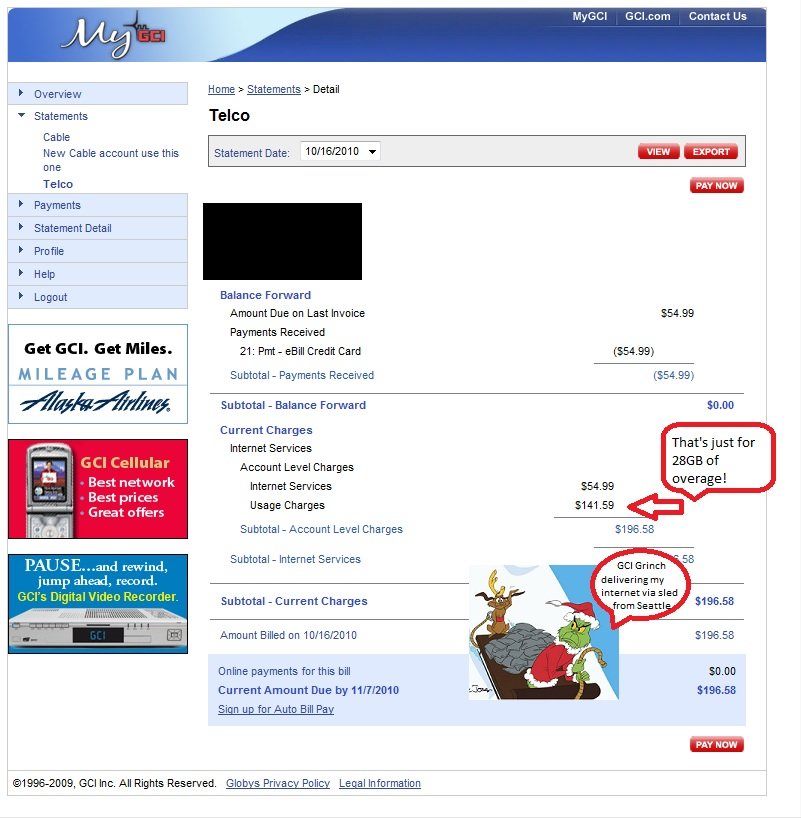
GCI: the Grinch That Stole the Internet (click to enlarge)

Scott was floored by GCI’s Festival of Overcharging, which turned a $55 a month bill for broadband into nearly $200.  It exemplifies everything we’ve warned about over the past two years with these pricing schemes:

Well it finally happened, I got hit with GCI internet bill shock, $196.58 total for my 8Mbps plan with 25GB usage.

My usage prior to this has always been around 15-20GB/mo according to them — just the usual web surfing/e-mail with a little online gaming over the weekends (Eve Online) but not much.

Something ratcheted up my usage to nearly twice that (I did buy one game off Steam for digital delivery), which still would have been perfectly reasonable given the $75.00/mo plan I chose — that’s double what most people pay for unlimited in the lower 48 states. I only moved to this plan because their $135/mo bundle plan wasn’t affordable due to the required overpriced digital phone + taxes.

I tried calling their customer service and just got the company line about how expensive it was to provide their service, and I must have an open Wi-Fi router or “downloaded” too many YouTube videos, iTunes, or other content. He also stressed five or six times lots of customers go over their limits thanks to Netflix streaming and you really can’t use it with GCI Internet service.

To date I’ve never gotten a straight story from them on how this is managed, or from their marketing material which never mentioned overage until recently, or their reps that used to say you’d get a phone call to warn you if you went over their limits. The rep I spoke to most recently claims you’re supposed to call them daily or every other day – or login to a special portal online to monitor usage.

Either way this company has no sense of customer service, nor does it operate in the interest of Alaskan consumers that are cut off from the lower 48 and need reliable and affordable Internet services.

Stop the Cap! recommends making a copy of David Morris’ comments and notifying GCI you are not paying their overage fees because they are “obviously in error,” at least according to the company’s own spokesman.  Then get on the line with the State of Alaska’s Consumer Protection Unit and the Better Business Bureau and demand your overlimit fees be credited or refunded.  We’ve even got the complaint form started for you.  GCI values its A+ Better Business Bureau rating, so chances are very good they’ll take care of you to satisfactorily close the complaint.

GCI’s claims that with Internet usage limits, the company can deliver its customers faster speeds.  But Stop the Cap! argues those speeds are ultimately useless when GCI allows you to use as little as 3 percent of your service before those overlimit fees kick in.

A Broadband Reports reader ran the numbers before speed upgrades made them even worse:

Yes, GCI is overcharging customers and they have been on their unbundled tiers for a very long time. Now GCI wants to overcharge the rest by setting limits on ultimate package tiers that previously were labeled as “unlimited downloads”. I thought I’d post the more revealing information about how GCI is ripping off residential customers.As an academic argument let’s compare what data transfer is possible vs. what GCI now expects customers to use on its [formerly] “unlimited downloads” tiers.

1 Mbit = 1,000,000 bits

1,000,000 bps * 60 = 60,000,000 bpm
60,000,000 bpm * 60 = 3,600,000,000 bph
3,600,000,000 bph * 24 = 86,400,000,000 bpd

Now that we have a baseline measure of the total data transfer possible from a 1Mbps line PER DAY, let’s convert bits to bytes and gigabytes.

8 bits = 1 byte
86,400,000,000 bits / 8 bits = 10,800,000,000 bytes

Now let’s convert this to gigabytes

1,000,000,000 bytes = 1GB
10,800,000,000 bytes / 1,000,000,000 bytes = 10.8 GB

This means that 10.8GB of data transfer is possible with a 1Mbps connection operating 24/7 PER DAY.
NOTE: This figure doesn’t take into account network overhead or other loss.

Ultimate package speed tiers.

(Total Throughput possible PER DAY)
4Mbps = 10.8 * 4 = 43.2 GB
8Mbps = 10.8 * 8 = 86.4 GB
10Mbps = 10.8 * 10 = 108.0 GB
12Mbps = 10.8 * 12 = 129.6 GB

(Total Throughput possible PER MONTH)
Assume 30 days = 1 month

4Mbps = 43.2 * 30 = 1296 GB = 1.296 TB
8Mbps = 86.4 * 30 = 2592 GB = 2.592 TB
10Mbps = 108.0 * 30 = 3240 GB = 3.240 TB
12Mbps = 129.6 * 30 = 3888 GB = 3.888 TB

Now this is what GCI expects its customers to use.
4Mbps = 40 GB
8Mbps = 60 GB
10Mbps = 80 GB
12Mbps = 100 GB

GCI expected utilization factor (actual/possible usage)
40 / 1296 = 0.0308 = 3.08 %
60 / 2592 = 0.0231 = 2.31 %
80 / 3240 = 0.0246 = 2.46 %
100 / 3888 = 0.0257 = 2.57 %

It should be no surprise that as technology continues to develop, the true costs of broadband have continued to fall.

Given the true cost of bandwidth today, GCI’s forced bundling, and the price it’s asking this is pathetic.

Some might choose to ignore it or want to be a water carrier for GCI and similar ISPs, but advertising a service and expecting less than 3% usage is overbilling. It’s overcharging and also manipulative because the general population doesn’t understand it and can be easily duped into believing whatever they’re told to believe by an ISP.

Time Warner Cable’s Remote DVR Programming Service is Here

Phillip Dampier October 21, 2010 Consumer News, Editorial & Site News, Online Video, Video 1 Comment

Get used to seeing this screen because we saw it for minutes on end when testing Time Warner's new Remote DVR service.

Time Warner Cable has launched its free Remote DVR programming service throughout the country, allowing customers to remotely manage their DVRs from the cable company’s website or through a smartphone application.

Stop the Cap! gave the service a test run this morning to see how well it works.

Here are some of our early impressions using the online, web-based interface (we did not test the smartphone application):

1.  The service is in beta and it showed.  Our first attempt to use the system this morning was laboriously slow, taking 30 seconds or more to change pages.  Things worked better as the morning progressed, but it still suffers from sluggish responsiveness.  Several features failed for us occasionally, such as deleting some scheduled recordings remotely.  After two minutes or more of waiting, we gave up.

2.  The application was generally intuitive and we did not need a lot of hand-holding to get started. But at the same time, the usefulness of the application itself was limited.  Scrolling through the online program grid was as tedious as the using the television version.  It’s fine if you know exactly what you want to watch and what channels to check, but terrible for browsing through hundreds of channels.

3.  The search and browse functions are far too limited to be useful.  It is impossible, for instance, to search just for movies.  Categories are too broad to be of much use, and many are missing.  “Drama” and “Action” included everything from a documentary to a series to a movie.  Netflix succeeds where Time Warner fails.  Their search categories are much better — documentaries, TV series, horror, foreign and classic films, and many more make it far easier to drill down to the type of show you want to see.  Netflix even offers sub-categories, helping people find similar programs to watch they never realized were available.

4.  Changing the name of the DVR from its hexadecimal default did not work consistently.  When we tried to rename ours to “Living Room,” sometimes it appeared that way, other times it defaulted back to the cryptic “DVR 00:xx:92.E9.xx.xx” (we replaced some numbers and letters with “x”).

5.  The more scheduled recordings you have, the more ponderous the application seemed to work.  We tried deleting some series (which did not always work either) and it helped responsiveness.  If you use your DVR a lot, you may find using Remote DVR a patience-testing experience.

6.  There did not seem to be an indicator as to how much recording space you have remaining or what is already stored on your DVR.

Time Warner customers who use smartphones and other Web-enabled mobile devices can access “Remote DVR Manager” at mdvr.timewarnercable.com.

[flv width=”640″ height=”500″]http://www.phillipdampier.com/video/TWC Introducing Remote DVR.flv[/flv]

Time Warner Cable produced this video to help introduce customers to its Remote DVR service, explaining how to register and get started with the free service.  (1 minute)

Alaskan Broadband Ripoff: Internet Overcharging GCI Sparks New Outrage From Angry Customers

GCI, an Alaskan Internet Service Provider, is getting pummeled by angry customers as they continue to learn the company has launched an Internet Overcharging scheme that limits their broadband use.  Some customer claim the company is actively trying to trick those previously enrolled in unlimited plans into limited service tiers with tantalizing “free speed upgrades.”

Stop the Cap! reader Thomas was one of more than a dozen readers who complained to the Anchorage Daily News about the broadband ripoff.

He is outraged by the bait and switch tactics employed by GCI that sold customers on expensive bundled service packages that promised “unlimited Internet” service the company is now trying to take away.

Thomas first learned GCI had slapped limits on his broadband account… from Stop the Cap! GCI never bothered to inform him, or many other customers, about the new usage limits.  After he read our earlier story, he called GCI and learned he was a victim of Internet Overcharging.

GCI’s limits range from 40-100GB on plans ranging in price from $45-105 per month.

GCI, like most Internet Overchargers, tries to blame its customers for the imposed limits.

GCI estimates that 5 percent of its Internet customers are consuming 70 percent of the company’s available bandwidth. These users share a portion of their Internet cable with other GCI customers, and they have been slowing down the other households’ Internet speed, GCI spokesman David Morris told the Anchorage newspaper.

In an effort to prove their contention that usage limits improve service, GCI handed out free speed upgrades along with usage allowances and attempted to conflate the two.

In reality, most broadband slowdowns come from overselling access and being unwilling to invest in appropriate capacity upgrades to meet the growing needs of customers.  For companies like GCI, imposing usage limits to scare users away from high bandwidth services is cheaper and more profitable than meeting customer demand.

“Most of the under-30 crowd that I know use Netflix and Hulu streaming services so we can watch what we want, when we want. Cable TV does not give us the flexibility we want,” Sean Hogan, an Anchorage accountant, told the newspaper.

“I’m getting charged $180 per month and I don’t even want the phone or cable,” said Mike White, an Anchorage customer who upgraded his data-usage plan recently because he was worried about violating GCI’s limits.

GCI claims its new limits allow customers to do many things they had no interest in doing under their old unlimited plans, like sending millions of e-mail messages or browsing tens of thousands of web pages.  To make the limits sound generous, they made a chart:

Usage Comparison
Example 5,000 MB 20,000 MB 40,000 MB 100,000 MB
Email
(4 KB)
Text Only 1.25 Million 5 Million 10 Million 25 Million
Email with Picture (1 MB) Average
quality photo
5,000 20,000 40,000 100,000
Webpages
(100 KB)
Facebook,
eBay
50,000 pages 200,000 pages 400,000 pages 1 Million pages
Music Downloads
(4 MB)
3 minute
song
1,250 songs 5,000 songs 10,000 songs 25,000 songs
Streaming Audio
(1 MB/min)
Pandora
Internet Radio
80 hours 320 hours 640 hours 1,600 hours
Streaming Video
(2 MB/min)
YouTube 40 hours 160 hours 320 hours 800 hours
Movie
Downloads
Standard Definition 7.5 movies 30 movies 60 movies 148 movies

Of course, these limits ignore the reality customers do most or all of these things, and if they use their high speed connection to download files or watch the increasing amount of video content delivered in High Definition, they’ll blow through some of GCI’s limits with little effort.

Despite GCI’s claims of generosity, its customers think otherwise, and many are moving to curb their usage to avoid potential penalty fees or service termination the company could impose with enforcement of their caps:

Morris said that most of GCI’s customers will discover that their Internet usage is far below the new limits. Depending on the plan, the limits range between 50 and 125 gigabytes per month.

Chris Bruns, an Anchorage father and college student, isn’t so sure. “I’m in the high-30 (gigabyte) range every month,” he said.

GCI’s cheapest substitute for an unlimited plan is 40 gigabytes — the equivalent of downloading and watching 60 movies per month on your computer.

Bruns found out recently — after calling GCI to ask some questions about his family’s Internet speed and usage — that his previously unlimited plan, called Ultimate Xtreme, now had a 40 gigabyte ceiling.

“I was pretty miffed. It came as a surprise,” he said.

“When we signed up, we specifically got the unlimited plan because we knew we used it a lot,” he said.

He said he has since curbed the family’s Internet usage to be on the safe side. He said he and his wife regularly download movies for themselves and cartoons for their two children on Netflix to watch on their computer. Using Netflix is a way to keep the kids from seeing “garbage” on TV, Bruns said.

Ed Sniffen, a consumer-protection attorney in the Alaska Department of Law, may a victim of GCI’s bait and switch broadband himself.

Sniffen said he has had an unlimited-data plan with GCI and didn’t know on Tuesday afternoon whether he received a notice about the new policy. He said anyone who has a concern should contact the Law Department’s consumer-protection office.

The story in the newspaper prompted an enormous response — some 265 comments and counting.  A sampler:

GCI provides terrible service compared to companies in the lower 48 at exorbitant prices. They are a monopoly that needs to be tweaked.

GCI’s Network costs are FIXED. They are raping and pillaging us.

“GCI said it hasn’t yet charged anyone fees for exceeding the data limits…” — GCI lies. Just a few months ago I was charged nearly $100 for exceeding the bandwidth limit. Since then, I’ve upgraded my package to a ridiculous amount of bandwidth (at a ridiculous price) just so I can avoid that problem.

This is crazy. You go anywhere in the lower 48 and almost every Internet provider out there has some sort of unlimited plan, and it doesn’t involve payment with an arm, a leg, a kidney, or a first-born child. GCI needs to get this crap sorted out.

I got an offer to double my Internet speed and usage for a few bucks extra, and free cable (the good package, not the basic cable). Two months later, I still haven’t seen anyone show up to do anything, and I’m still getting charged out the tail end for overage charges. I keep requesting to up my Internet (I have a college student who takes some Internet classes) but they never do it. The only reasons I switched from ACS were because when it rained we had no phone OR internet (they said the problem was with our lines – our landlord at the time needed to fix it, but the contractor said it was ACS’s line problem – THEY needed to fix it.)  If there was another alternative to phone/Internet, I would so be there.

I was out and out LIED to by a GCI Rep. I was told if I changed my plan I would receive higher speeds with NO OTHER CHANGE for the same price. I questioned the GCI rep about this in detail several times before agreeing. The next day I no longer had unlimited downloads. I was LIED to and RIPPED OFF by GCI.

GCI’s statement that they have not charged overlimit charges is incorrect as over ten individuals that I know including myself have been hit with bills ranging from $300 to $2000 for one month of service.

ESPN Finally Launching Online for Time Warner Cable Subscribers Oct. 25th

Phillip Dampier October 20, 2010 Online Video 2 Comments

After weeks of delays, Time Warner Cable says it will finally open access to ESPN’s multi-channel streaming service Monday, Oct. 25th.  The service will be available to Time Warner Cable subscribers, and is free of charge.

ESPN’s streaming service was included in a deal signed in early September between the cable company and Disney-ABC, which owns the sports network.

Time Warner Cable has been working with ESPN’s website technical staff to build and test the online verification system that is the foundation of Time Warner Cable’s implementation of TV Everywhere.  The cable company plans to offer a library of on-demand video and live streams of many cable channels free of charge, but only to authenticated, current customers.

It is all part of an effort by the cable industry to stop cable customers from canceling their cable-TV subscriptions.  An increasing amount of online content produced by cable networks is expected to eventually be placed behind the TV Everywhere system.  Existing cable subscribers will get access to streamed live channels and on demand programming for free, but non-subscribers will be locked out.  Cable networks can decide how much of their programming will be a part of the project, but cable industry insiders predict there will be increasing pressure on them to keep most of their shows off the open Internet.

While the channels will be free-to-stream for subscribers now, several cable networks are exploring whether to charge cable companies extra programming fees for online viewing rights.  If that becomes popular, online viewing options may eventually carry monthly fees of their own.

ESPN says most of its online streaming will contain no advertising until the network builds enough viewers to justify selling ads targeting online audiences.

Verizon Inc. reached a similar agreement with Disney in October for its FiOS TV service. The originally planned launch date for Verizon customers was Jan. 18th, but if authentication tests with Time Warner Cable are successful, FiOS customers may get access much sooner.

Finding a Compromise for Net Neutrality: How Many Loopholes Do You Want?

Phillip Dampier October 19, 2010 Broadband "Shortage", Broadband Speed, Data Caps, Editorial & Site News, Net Neutrality, Online Video, Public Policy & Gov't, Video Comments Off on Finding a Compromise for Net Neutrality: How Many Loopholes Do You Want?

With continued inaction at the Federal Communications Commission, some stakeholders in the Net Neutrality debate continue to file comments with the Commission trying to find a “third way” to bring about guarantees for online free speech and access while softening opposition to “network management” technology that allows providers to manipulate broadband traffic.

Among such filers is the Communications Workers of America, which seeks a “middle-ground approach” to protecting a free and open Internet.

The CWA has always maintained its feet in two camps — with consumers looking for improved broadband and with the communications companies that employee large numbers of the union’s members, who will build out those networks and provide service.

The union shares our annoyance with FCC Chairman Julius Genachowski for his complete inaction on broadband policy thus far.  In short, the Commission keeps stalling from taking direct action to reclassify broadband as a telecommunications service, restoring its ability to oversee broadband policy lost in a federal appeals court decision earlier this year.

The CWA used a piece by David Honig from the Minority Media and Telecommunications Council (MMTC) to echo its own position:

MMTC isn’t alone in being frustrated with the FCC’s disappointing attitude toward real action this past year. In a recent interview with the Wall Street Journal, FCC Chairman Julius Genachowski expressed impatience with the glacial pace of policymaking at his Commission. Although he mentioned that the FCC, under his direction, has implemented some notable reforms, he conceded that “there is still a lot to do.”

Unfortunately, regardless of how earnest the Chairman is in his desire to move forward with the business of policymaking, his actions speak much louder than his words. Indeed, his yearlong pursuit of network neutrality rules — first via a traditional rulemaking proceeding and, most recently, via an effort to reclassify broadband as a telecommunications service — has cast a long and almost suffocating pall over many of the items that the Chairman wishes to act upon. His inaction on civil rights issues — especially EEO enforcement — is just one example of how paralyzed the agency has become.

Recent news that Congress will not move forward to address the regulatory questions that currently vex the Commission (e.g., whether the FCC has authority to regulate broadband service providers) could embolden the Chairman to adopt the sweeping regulatory changes for broadband that he proposed earlier this year. Doing so in the absence of Congressional action would only invite immediate legal challenges that would mire the FCC in litigation, appeals, and remands for years to come.

To put it plainly, the FCC is stuck. Although it recently adopted some promising orders related to broadband (e.g., new rules for accessing new portions of wireless spectrum called “white spaces” and for enhancing access in schools and libraries), the Commission has failed to move forward with implementing core provisions of its monumental National Broadband Plan.

The union last week also submitted its latest round of comments requested by the Commission, this time to broaden its position on a proposed compromise.  We’ve delineated which of the proposals we believe are primarily pro-consumer (in green), pro-provider (red), and which fall straight down the middle (blue):

  • First, wireline broadband Internet access providers (“broadband providers”) should not block lawful content, applications, or services, or prohibit the use of non-harmful devices on the Internet.
  • Second, wireline and wireless broadband providers should be transparent regarding price, performance (including reporting actual speed) and network management practices.
  • Third wireline broadband providers should not engage in unjust or unreasonable discrimination in transmitting lawful traffic.
  • Fourth, broadband providers must be able to reasonably manage their networks through appropriate and tailored mechanisms, recognizing the technical and operational characteristics of the broadband Internet access platform.
  • Fifth, the Commission should take a case-by-case adjudication approach to protect an open Internet rather than promulgating detailed, prescriptive rules.

The first and third principles are strongly pro-consumer, although as we’ve seen, providers have a tendency to want to define for themselves what is “harmful,” “unjust,” or “unreasonable” and impose it on their customers.  We’ve seen provider-backed front groups argue that the concept of Net Neutrality itself is all three of these things.  Any rules must be clearly defined by the Commission, not left to open interpretation by providers.

The second principle cuts right down the middle.  Consumers deserve an honest representation of broadband speeds marketed by providers (not the usual over-optimistic speeds promised in marketing materials), and transparency in price — especially with gotchas like term contracts, early cancellation penalties, overlimit fees, etc.  But providers can also go to town with abusive network management they’ll market as advantageous and fair, even when it is neither.  Just ask customers of Clear who recently found their “unlimited” wireless broadband service, marketed as having no speed throttles, reduced in speed to barely above dial-up when they used the service “too much.”  Clear says the speed throttles are good news and represent fairness.  Customers think otherwise, and disclosure has been lacking.

The fourth and fifth principles benefit providers enormously.  Network management itself is neither benevolent or malicious.  The people who set the parameters for that management are a different story.  A traffic-agnostic engineer might use such technology to improve the quality of services like streamed video and Voice Over IP by helping to keep the packets carrying such traffic running smoothly, without noticeably reducing speeds and quality of service for other users on that network.  There is nothing wrong with these kinds of practices. There is also nothing wrong with providing on-demand speed boosts on a pay-per-use basis, so long as the network is not oversubscribed.

But since providers are spending less to upgrade their networks, providers may seek to exploit these technologies in a more malicious way — too stall needed upgrades and save money by delivering a throttled broadband experience for some or all of their customers.  If customers can be effectively punished for using high bandwidth applications, they’ll reduce their usage of them as well.  That’s good for providers but not for customers who are paying increasing broadband bills for a declining level of service.

Some examples:

  • Customers using high bandwidth peer-to-peer applications can have their speeds throttled, sometimes dramatically, when using those applications;
  • Internet Overcharging schemes like usage caps, overlimit fees, and “fair access” policies can discourage consumers from using services like online video, file transfer services, and new multimedia-rich online gaming platforms like OnLive, which can consume considerable bandwidth;
  • Preferred content can be “network managed” to arrive at the fastest possible speeds, at the cost of other traffic which consequently must be reduced in speed, meaning your non-preferred traffic travels on the slow lane;
  • Providers can redefine levels of broadband service based on intended use, relegating existing packages to “web browsing and e-mail” while marketing new, extra-cost add-ons for services that take the speed controls off services like file transfer and online video, or changes usage limits.

The CWA runs the Speed Matters website, promoting broadband improvements.

It is remarkable the CWA seeks to allow today’s indecisive Commission to individually adjudicate specific disputes, instead of simply laying down some clear principles that would not leave a host of loopholes open for providers to exploit.

Big players like Comcast, AT&T, and Verizon have plenty of money at their disposal to attract and influence friends in high places.  If the Commission thought Big Telecom’s friends in Congress were breathing down its neck about telecom policy now, imagine the load it will be forced to carry when these companies seek to test the Commission’s resolve.

Opponents of Net Neutrality claim broadband reclassification will leave providers saddled with Ma Bell-era regulation.  But in truth, the FCC can make their rules plain and simple.  Here are a few of our own proposals:

  1. Network management must be content-agnostic.  “Preferred partner” content must travel with the same priority as “non-preferred content;”
  2. Providers can use network management to ensure best possible results for customers, but not at the expense of other users with speed throttles and other overcharging schemes;
  3. Providers can market and develop new products that deliver enhanced speed services on-demand, but not if those products require a reduction in the level of service provided to other customers;
  4. Customers should have the right to opt out of network management or at least participate in deciding what traffic they choose to prioritize;
  5. Providers may not block or impede legal content of any kind;

In short, nobody objects to providers developing innovative new applications and services, but they must be willing to commit to necessary upgrades to broaden the pipeline on which they wish to deliver these services.  Otherwise, providers will simply make room for these enhanced revenue services at your expense, by forcing a reduction in your usage or reducing the speed and quality of service to make room for their premium offerings.

The industry itself illustrates this can be done using today’s technology.

The cable industry managed to accomplish benevolent network management with products like “Speed Boost” which delivers enhanced, short bursts of speed to broadband customers based on the current demand on the network.  Those speed enhancements depend entirely on network capacity and do not harm other users’ speeds.

Groups like the CWA need to remember that compromise only works if the terms and conditions are laid out as specifically as possible.  Otherwise, the player with the deepest pockets and closest relationships in Washington will be able to define the terms of the compromise as they see fit.

And that’s no compromise at all.

[flv width=”480″ height=”380″]http://www.phillipdampier.com/video/CWA Larry Cohen on the Open Internet Jobs and the Digital Divide 9-14-10.flv[/flv]

Communications Workers of America president Larry Cohen outlined the union’s position on Net Neutrality before the Congressional Black Caucus Institute on Sept. 14, 2010.  (2 minutes)

Search This Site:

Contributions:

Recent Comments:

Your Account:

Stop the Cap!