Home » Online Video » Recent Articles:

Netflix to Broadband Industry: Please Don’t Kill Us With Usage Caps

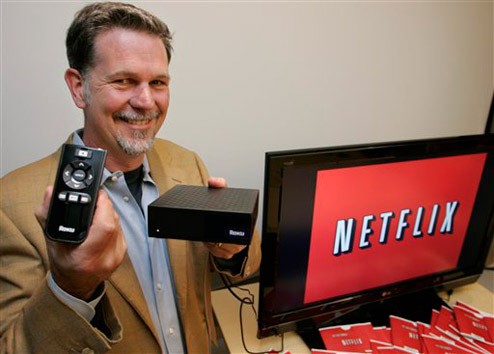
Reed Hastings, CEO of Netflix, shows off the company's growing reliance on broadband streaming, moving away from its original DVD-by-mail rental business.

Last week, Netflix CEO Reed Hastings was showered with questions from Wall Street during the company’s third quarter-results conference call.  At the top of the agenda — the company’s shifting business model away from DVD rentals-by-mail gradually towards instant on-demand streaming over broadband networks.

At issue is how Netflix can survive a broadband industry that controls the pipeline Netflix increasingly depends on for its continued existence.

Hastings tried to assuage his cable competitors by telling investors the company is hardly a threat to cable-owned movie channels and basic cable.  But he admits ultimately the company will be in a real mess if Internet Overcharging schemes like usage caps and speed throttles limit the amount of content customers can affordably access:

“We have some vulnerability depending on capped usage and what happens. Comcast has a cap, but it’s 250 gigabytes and so most users feel that they have an unlimited experience, and it gives us plenty of room to deliver a high-def stream. On the other hand, AT&T Mobile data on an iPad is now capped at two gigabytes, [and that’s] not enough room to deliver hours and hours of high-def.  We are definitely sensitive [to the issue] in the long term [whether] the industry ends up at 250 gigabytes or two at the other extreme.”

There is some limited evidence Netflix’s success in Canada is already being tempered by usage limits near-universally imposed in the country.  Rogers, a major cable company in eastern Canada, even reduced usage caps for certain tiers of service around the same time Netflix announced its imminent arrival north of the border.

Barry McCarthy, Chief Financial Officer notes fewer Canadians are converting their free trials of Netflix’s streaming service into paid subscriptions.

“We anticipate we are seeing slightly lower conversion rates in Canada than we see in the U.S.,” McCarthy told investors.

As Netflix moves towards higher quality video streams, the amount of data consumed increases as well.  In Canada, that eats into broadband usage allowances, and fast. As soon as customers start receiving warnings they are nearing their monthly usage limit, or receive a broadband bill with overlimit fees, Netflix is likely to lose that customer.

Cable and phone companies in Canada are already warning customers that online video is a major culprit of exhausted usage allowances.  Both are also happy to remind their customers they are happy to sell them access to unlimited video — through cable or telco TV subscriptions.  Rogers owns a major chain of video rental stores as well.

What can Netflix do about usage capped broadband?  Not much, admits Hastings.

“There is a not a lot of improvement in compression techniques. But what we can do is just deliver a lower bit stream, a lower quality video experience. So, for example, not too high-def. So, that’s one possible way to partially mitigate that impact,” Hastings said.

Netflix will soon face increasing competition, especially from the cable industry’s TV Everywhere projects, and they won’t deliver a lower quality video experience.

Time Warner Cable and Comcast this month both formally introduced their respective video on demand services.

Comcast’s Xfinity online service arrives after months of beta testing.   Comcast customers can watch video selections from nearly 90 movie and television partners, including programming from HBO, Viacom, and Paramount.  Ultimately, the online video service is expected to deliver access to dozens of cable channels and individual programs from studios and networks at no charge to those who subscribe to a cable television package.

Time Warner Cable took a more modest approach last week by introducing ESPN Networks to its cable subscribers who register with the cable company’s MyServices website.  The new customer portal allows subscribers to review and pay their cable bill, add new services (but not cancel existing ones), remotely program DVR boxes, and also verifies subscriber status for future cable subscriber-only online video programming.

Netflix may soon find itself at the mercy of the cable and telephone companies which deliver broadband access to the majority of Americans.  Not only is it difficult to convince customers to pay a monthly fee for programming the cable industry may eventually give away for free, it may be downright impossible for Netflix to survive if those providers decide to squeeze the customer’s pipeline to unlimited Netflix content.

[flv width=”640″ height=”380″]http://www.phillipdampier.com/video/Comcast Xfinity Ad Spot 10-2010.flv[/flv]

Comcast Ad Introducing Xfinity Online.  (1 minute)
ESPN3 Now Available, Underpowered By Time Warner Cable; But ESPN Itself Was Better

Phillip Dampier October 25, 2010 Broadband Speed, Online Video 8 Comments

Time Warner Cable’s TV Everywhere authentication system went live today for customers, who can now access several channels of ESPN on their broadband connection, assuming they can prove they subscribe to a video package that includes ESPN.

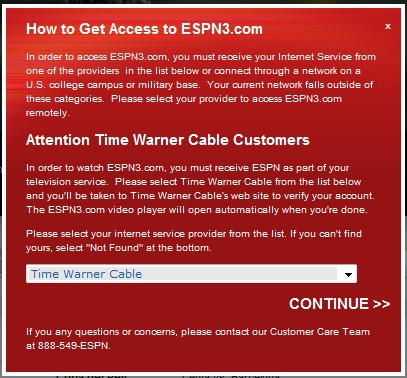
Time Warner’s agreement with Disney-ABC, which owns ESPN, made online viewing possible for Time Warner Cable subscribers.  Viewers can authenticate themselves by visiting ESPN’s website and invoking the live video player, which will connect with Time Warner Cable’s MyServices website.  Just log in and Time Warner will send authorization to ESPN to unlock the video streams to watch.  There is no additional charge for this service.

Earlier, there was some confusion over whether broadband-only customers could have access.  A message on ESPN’s website indicates the answer is no — you must be a Time Warner Cable customer with at least Standard Service to get authenticated.

Unfortunately, once logged in and watching, the results were underwhelming, at least for ESPN3.  The picture quality from Stop the Cap!‘s Brighton, N.Y., headquarters was dreadful, even from a Road Runner Turbo account.  A “signal strength meter” barely moved into second position about five minutes after I started watching.

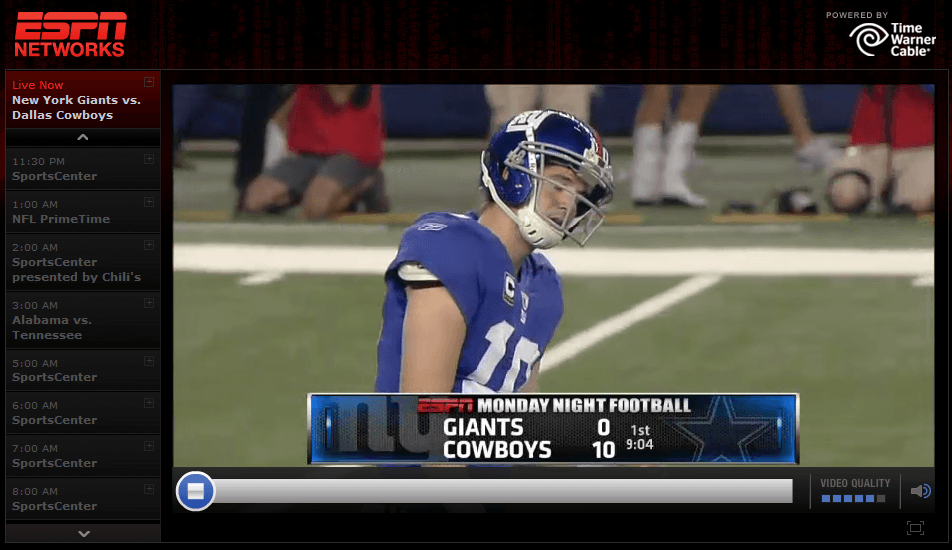
Results were much better for ESPN’s primary channel feed, currently showing a football game between the New York Giants and the Dallas Cowboys.  That managed to peg the meter one position from maximum.  On a 28″ LCD monitor, the picture looked reasonably good, but frankly not as impressive as either Netflix streaming or Hulu.  Pixel problems and other video artifacts were far too common.  But for on-the-go-viewing, the results were adequate.

Commercial breaks were replaced with either ESPN’s logo or, in the case of the football game, short ad spots for NFL gear.  Watching a slowly moving logo for two plus minutes in uncomfortable silence, especially with a group, can be unnerving enough to actually prefer the commercials.

The results for ESPN3, "powered by Time Warner Cable" were unimpressive, with a "signal strength" meter showing just a single bar on our 15/1Mbps Road Runner service.

Things looked better on ESPN's primary network, which managed to peg the signal strength meter to one position below maximum.

Online Video Hits Corporate Roadblocks – Google TV Blocked By Networks, Hulu+ Gets Thumbs Down

Phillip Dampier October 25, 2010 HissyFitWatch, Online Video, Video 4 Comments

Early adopters of Google TV will find nothing but frustration if they want to watch ABC’s “Modern Family” and Fox’s “Glee” with the new broadband-driven TV service.  They can’t, thanks to America’s content companies erecting Berlin Wall-like blockades of programming the service was supposed to provide.

Google TV has already come under a state of siege from a coordinated campaign by the four major broadcast networks to keep programming off the new service until Google agrees to pay retransmission consent fees.  Even Hulu, which delivers online access to hundreds of shows for free, has successfully manned the barricades to keep “unauthorized” Google TV out in the cold.

Some of the virtual barbed-wire fences have become so sophisticated, many wonder whether the biggest players in online video are spending more time and energy on innovating new ways to stop people from accessing content than on actually delivering it.

For a service trying to gain attention out of the starting gate, Google TV has remarkably little mainstream programming to show on it.  To date, their most significant content partners are HBO’s Go service, available only to authenticated HBO subscribers, Turner’s TNT and TBS channels, also only available to current cable, satellite, or telco-TV video subscribers, and a CNBC “app.”

The spat between Google and the broadcasters is similar to the one between Cablevision and Fox in suburban New York City — until a company like Google agrees to pay a fee for the right to deliver content already given away for free online, the online portals that provide access will identify and block Google TV customers from accessing any of it.

Those fees are likely to be passed down to subscribers, and now some are wondering just how successful ventures like Google TV can be if consumers have to pay another monthly TV bill.

Wall Street is one, Variety notes:

Richard Greenfield, analyst for BITG Research, is a keen observer of the struggle for TV programmers to make money through Internet distribution of their high-priced programming. Amid the retrans battles for the major broadcasters, putting too much content online for immediate viewing, even with embedded advertising, undercuts their business and their rationale for seeking top dollar from subscription TV providers.

“We find it harder and harder to comprehend how broadcast television stations can demand retransmission consent fees from multichannel video providers, but at the same time place their content online for free,” Greenfield wrote in a research note titled “Broadcast TV Manifesto: If You Want to Be Paid Like Cable Nets, Start Acting Like Cable Nets on the Web.”

“While we acknowledge that the greatest value from retrans is access to sports programming (NFL, MLB, etc.) and other live events (‘American Idol’ finale, Oscars, etc.), none of which are streamed online for free, how can broadcast TV stations (and in turn broadcast networks) maximize value when so much content is being given away?”

That’s a major problem for any business plan, but excessive fees could also destroy interest in Google’s nascent entry into the world of online entertainment television.  Consumers already face steep hardware costs up to $300 just to make Google TV work.  Whether they would also part with a monthly subscription fee should not be too difficult for the folks in Mountain View to answer.

In fact, it’s the same answer Hulu’s owners are getting from viewers about its Hulu Plus pay-TV service, which delivers the same commercials as its free companion and charges $10 a month to watch them.

Subscribers to Hulu’s premium tier were promised access to entire runs of popular shows, programming not available on its free alternative, and a library of episodes that don’t expire and disappear after a few weeks.  But many paying customers complain Hulu Plus still limits most of its shows and offers few exclusives. Even less-in-demand shows like Fox’s “COPS,” profiling the criminally stupid for more than 23 years, remain limited on the premium (and free) service to a single month of episodes.

But nothing causes more annoyance than Hulu’s recently-increased advertising load, dumped equally on both sides of the pay wall.

“Why should I pay $10 a month when I get (mostly) the same shows for free on Hulu, and have to watch the same ads?” asks our reader Stephanie.  “It should be one or the other — ad-free pay or ad-supported free.”

Because Stephanie is hardly alone in asking that question, there are reports Hulu is about to slash its premium asking price in half to attract more subscribers.

Peter Kafka, who writes The Media Memo for All Things Digital, wrote Hulu is preparing to change its pricing as early as this week.

The idea is that paying subscribers get access to a deeper catalog of TV shows and movies than what the free service offers, as well as the ability to watch Hulu on devices like Apple’s iPhone and iPad, Microsoft’s Xbox 360 game machine and Internet-connected TVs from Samsung and Sony.

But a price cut would indicate that consumers haven’t bought in to the pitch. That shouldn’t be a shock, considering the other video options that consumers have, and the limits that Hulu’s content providers have placed on the service.

But even at half-price, many former Hulu Plus customers won’t be back.

Zwei, commenting on the rumored price change, said he dropped his subscription before the first month was up because of the Hulu’s byzantine rules and technical limitations over how premium shows can be accessed.

Watch it their way or not at all.

“You aren’t guaranteed the ability to stream to anything but your computer! “Fringe?” Not available to stream to my other devices. “Caprica?” Not available to stream to my other devices.  Why the heck would I want to pay $10 a month if I still have to watch a lot of the content on my Mac,” he writes.

Paul notes it’s also hard to attract paying customers when most of your library consists of old shows already rerun into the ground:

“The problem is that they are cutting all the most appealing content from the service, Hulu Plus has a huge catalog of content, but it’s 95% leftovers from the 80’s.  Give us current content when and how we want it (quickly and on the devices we want) and people will pay for it, even more than $10/mo.  But if they give us 20 year-old content that we might not even have liked the first time, they shouldn’t expect our money,” Paul says. “It’s funny when they get worked up about piracy too. It’s just another market force — people only go to it when they don’t have other valid options,  just like they’re doing here.”

Networks increasingly treat their programming as a valued commodity that can be sold, re-purposed, re-packaged, and re-sold again and again.  Syndication, DVD box sets, online rental, cable company on-demand, and online ad-supported streaming each can fetch plenty of money, and many agreements include temporary restrictions on other distribution mechanisms to avoid “diluting” the programming’s value.

Consumers don’t care about these restrictions, because many will simply search out the shows they want regardless of the source — legal or otherwise, preferably for free.

[flv width=”640″ height=”500″]http://www.phillipdampier.com/video/Google TV 10-25-10.flv[/flv]

Two reports about Google TV — a review of the service from KSTU-TV Salt Lake City’s ‘Kurt the Cyberguy’ and a report from KTBS-TV in Shreveport, Louisiana (5 minutes)

World Wide Wait: DSL = (D)ead, (S)low and (L)ousy — the Dial-Up of the 2010s, Says Analyst

Telephone companies will lose up to half of their broadband market share if they insist on sticking with DSL technology to deliver Internet access, according to a new report from Credit Suisse analyst Stefan Anninger.

Anninger predicts DSL will increasingly be seen as the “dial-up” service of the 2010s, as demand for more broadband speed moves beyond what most phone companies are willing or able to provide.  Credit Suisse’s analysis says DSL accounts sold in the United States top out at an average speed of just 4Mbps, while consumers are increasingly seeking out service at speeds of at least 7Mbps.  The higher speeds are necessary to support high quality online video and the ability for multiple users in a household to share a connection without encountering speed slowdowns.

A lack of investment by landline providers to keep up with cable broadband speeds will prove costly to phone companies, according to Anninger. He believes a growing number of Americans understand cable and fiber-based broadband deliver the highest speeds, and consumers are increasingly dropping DSL for cable and fiber competitors.  Any investments now may be a case of “too little, too late,” especially if they only incrementally improve DSL speeds.

Anninger says providers may be able to offer up to 18Mbps in five years by deploying ADSL 2+ or VDSL technology, but by that time cable operators will be providing speeds up to 200Mbps, and many municipal providers will have gigabit speeds available.

The impact on phone company broadband market share will prove bleak for phone companies in all but the most rural areas, Anninger predicts.  He says by 2015, cable companies will have secured 56 percent of the market (up by 2 percent from today), phone companies will drop from 30 percent to just 15 percent, Verizon FiOS, AT&T U-verse, and wireless broadband will each control around 7 percent of the market, with the remainder split among municipal fiber, satellite, and other technologies.

Anninger is also pessimistic about wireless broadband being a wired broadband replacement in the next five years.

A Credit Suisse online survey of 1,000 consumers in August found that less than half would consider going wireless only.  The reasons?  It’s too slow, too expensive and most plans have Internet Overcharging schemes like usage caps and speed throttles.

Although cable companies are on track to be the big winners in broadband market share, still have one giant hurdle to overcome — a lousy image.  Just 36 percent of cable customers say they are “very satisfied” with their local provider.  More than 60% of FiOS and U-verse’s broadband customers said they are “very satisfied” with the services these advanced telephone company networks provide.  Consumer Reports has regularly awarded top honors to Verizon FiOS for the last several years.

Independent phone companies and smaller cable operators routinely score at the bottom, typically because they are relying on outdated technology to supply service.

This makes the marketplace ripe for disaffected consumers to jump to an alternative provider.  Unfortunately, as most Americans face a duopoly of the cable company they hate and the phone company that doesn’t deliver the services they want, there is no place for them to go.

Anninger also predicts the risk of broadband reform by reclassifying broadband under Title II at the Federal Communications Commission is now “minimal.”  That suggests Net Neutrality enforcement at the FCC is not a priority.  The Credit Suisse analyst says if action hasn’t been taken by winter or spring of next year, it’s a safe bet the Commission will never re-assert its authority.

Netflix Finally Wakes Up to Net Neutrality, Internet Overcharging Threat

"DVD's are so five years ago!"

Netflix, which has seen its Canadian streaming-only video service welcomed with usage cap reductions by Rogers Cable, has finally started to wake up to the threat its online video business model is one speed throttle or usage cap away from oblivion.

As the video rental company now contemplates launching a streaming-only version of its service in the United States, it has now firmly waded into the Net Neutrality debate.  In a filing earlier this month, Netflix impressed upon the Federal Communications Commission the importance of prohibiting providers from establishing blockades to keep its competing video service from threatening cable-TV revenue:

“The Commission must assure that specialized services do not, in effect, transform the public Internet into a private network in which access is not open but is controlled by the network operator, and innovative Internet-based enterprises are permitted effective access to their consumers only if the enterprises pay network operators unreasonable fees or are otherwise seen by such network operators as not threatening a competitive venture.”

Netflix online video packs a real wallop, as Americans embraces the service as a suitable and cheaper replacement for premium cable movie channels.

Sandvine, which pitches “network management” products to the broadband industry, reported Netflix now represents more than 20 percent of all downstream broadband traffic in the United States during peak usage times between 8-10pm.

The company’s financial results seem to affirm its growing impact as an online video entertainment player.  The Washington Post reports in the third quarter, Netflix saw a 52 percent gain in subscribers to 16.9 million. Revenue increased 31 percent to $553 million. But most interesting: 66 percent of subscribers watched more than 15 minutes of streaming video compared with 41 percent during the same period last year. The company predicted Wednesday that in the fourth quarter, a majority of Netflix subscribers would watch more content streamed from the Web on Netflix than on DVD.

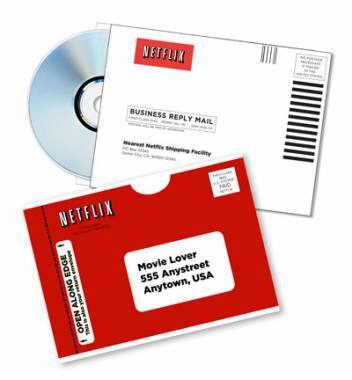
That prompted CEO Reed Hastings to say Netflix should now be considered a streaming company that also offers DVD-by-mail service.

If providers launch Internet Overcharging schemes that limit broadband usage or throttle their competitors to barely usable speeds, that growth could come to an end quicker than the introduction of the next “unfair usage policy.”

Sandvine’s research confirmed something else.  As broadband speeds increase, so does usage.  In Asia where broadband speeds are dramatically higher than in the United States, Sandvine found median monthly data consumption is close to 12 gigabytes per household compared to 4 gigabytes in North America.  And Asians stay very close to their broadband connections, using them on average for almost 5.5 hours per day, compared to just three hours for North Americans.

When one considers the majority of broadband users are only starting to discover online video, those numbers are headed upwards… fast.

Search This Site:

Contributions:

Recent Comments:

Your Account:

Stop the Cap!