Home » Consumer News » Recent Articles:

AT&T Ends Unlimited Wireless Data Plans As New iPhone Arrives

Phillip Dampier June 2, 2010 AT&T, Consumer News, Data Caps, Video, Wireless Broadband 7 Comments

AT&T’s days of unlimited wireless data plans for smartphone customers officially end June 7th when the company launches new wireless data plans that all come with usage caps attached:

  • DataPlus $15 a month and limited to 200 megabytes  of data.  If you exceed it, your overlimit penalty is $15, good for an additional 200 megabytes.
  • DataPro $25 a month gets you just 2 gigabytes of data.  The overlimit penalty for those exceeding it is $10 which buys an additional 1 gigabyte of usage.

AT&T Smartphone customers will also be able to add tethering under the $25 DataPro plan for an extra $20 per month, with DataPro’s usage allowance applied.

Current AT&T customers can remain on their current unlimited Smartphone data plan indefinitely, even if they change or upgrade phones according to AT&T spokesman Mark Siegel.  That concession probably helps AT&T preserve anticipated demand for next week’s new iPhone launch.  Without it, customer demand could be tempered by the realization a phone upgrade could cost you your $29.99 unlimited usage plan.  If you were considering getting an AT&T phone with unlimited data, you have until June 6th to sign up for service under that plan.  After that date, you’re out of luck indefinitely.

AT&T is promoting the end of unlimited wireless broadband as a benefit to customers, claiming that 98 percent of its Smartphone customers use on average less than 2GB of data per month.  But that represents today’s usage.  AT&T’s decision to eliminate an unlimited option they claim 98 percent of their customers never exceeded would be curious without understanding the next generation of Smartphones will provide dramatic improvements in high bandwidth video streaming that will dramatically start eating into those low usage allowances.  The company’s next generation of faster wireless broadband will also include low limit plans, which makes them untenable as a home broadband replacement for all but the most casual users.

For new iPad customers, the $25 per month 2 GB plan will replace the existing $29.99 unlimited plan. iPad customers will continue to pre-pay for their wireless data plan and no contract is required. Existing iPad customers who have the $29.99 per month unlimited plan can keep that plan or switch to the new $25 per month plan with 2 GB of data.
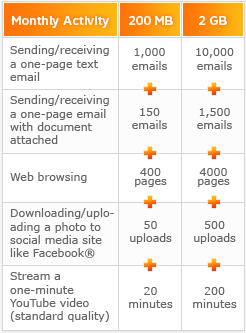
AT&T offers up the common practice of boasting about how much you can do with a usage-limited account, based on the thousands of e-mails you'll never send, the 500 pictures you'll never take, or the 20 - one minute YouTube clips you'll never watch. Notice they never seem to include figures for streaming multimedia applications like music, movies, and TV shows or playing more bandwidth-intensive games. To do so would only upset customers further.

AT&T says customers can continue to use unlimited amounts of data when they access it over the company’s Wi-Fi network hotspots.

Wall Street is happy with AT&T’s elimination of unlimited plans, sensing higher profits and reduced costs will follow.

“The new plans appear well designed to reduce undue network stresses,” Craig Moffett, an analyst at Sanford C. Bernstein told The Wall Street Journal.

Analyst Philip Cusick at Macquarie Securities also told the Journal AT&T may see lower growth in data revenue in the short term as a result of the new changes, but will gain leverage over the heaviest data users, improving its ability to manage its network and charge for capacity. Tiered plans may also pull more customers into data plans, he said.

But because current customers can choose to remain on the grandfathered unlimited plan, existing heavy data users accused of chewing up AT&T’s wireless network can continue to do so as long as they remain customers.  AT&T will only be capping future customers who sign up on or after June 7th.

For those outraged by AT&T’s decision, fleeing to Verizon Wireless for unlimited data may not be an option for too much longer either.

Verizon Wireless Chief Executive Lowell McAdam indicated in an interview with the Journal last month that he, too, is looking at pricing based on use.

“The old model of one price plan per device is going to fall away,” McAdam told the newspaper, adding that he expects carriers to take an approach that targets a “bucket of megabytes.”

One company that doesn’t plan to end an all-you-can-eat wireless data buffet is Sprint, which now sees its unlimited data plan as a potential marketing asset.

A Sprint spokesperson spoke the words you were already thinking:

“We’re giving customers a better value. With data usage growing, customers don’t want to worry about going over their limits.”

Some customers upset that AT&T only sold an unlimited plan welcomed the lower cost options because they didn’t spend a lot of time using the data features of their phones, but several wondered why the company didn’t simply introduce lower cost options -and- leave the unlimited plan in place for those who wanted it.

Overall, AT&T is getting an earful from angry customers over the announcement — even those who don’t exceed 2GB per month.  They sense greed and overcharging.   A sampling:

If 3% are using data “a lot” now, then in another two years, it’ll be 15% and then 60%. Simply put, this is gouging customers, where pricing is decided by dudes in a board room looking at charts and graphs and sales numbers, figuring out how to gouge people for maximum profit.

Obviously AT&T is killing the unlimited plan to cut down on usage and to raise their profits. I also believe it is heavy handed to eliminate the unlimited access plan. If anything, offer other plans and raise the price of the unlimited plan. It will be interesting to see of the other players follow suit and also kill their unlimited plans (can you say “price fixing”? Sure you can!).

AT&T is always full of good ideas, like that Microcell thing. Hey, we can’t give you good service you paid for, so we are going to ask you for more money for this piece of equipment to supplement the service you are not getting.

Just another greedy ploy to make more money. They are selling air. The charges are ridiculous and this is one industry that should be under government control.

My spouse and I pay half of what AT&T would charge us for excellent Palm smartphones on Sprint. We also get turn-by-turn GPS included–something AT&T AND Verizon both charge extra for. Sprint’s network is top-notch. I can’t fathom why people continue to waste money on Verizon and AT&T.

If you’ve got a smartphone or you tether your computer, you really have no idea how much bandwidth your device is consuming. Even worse (or better if you are the phone company) customers can’t control the bandwidth that their devices consume. How often does your email client check for new messages? Can you even stop your computer from downloading a security update? What about that last application you installed, can you stop it from calling home every time you launch it? Do you even know that it does track and report your usage? That’s a huge difference between phone services and data services. You KNOW when you’ve dialed a number and talked for 10 minutes. You can’t control all the data consuming applications and services on your devices… and trying to bill customers for something that they can’t control the usage or cost must be illegal. Surely someone will address this problem soon. Surely.

[flv width=”576″ height=”344″]http://www.phillipdampier.com/video/CNN ATT Goodbye to unlimited data 6-2-10.flv[/flv]

CNN Money reports on AT&T saying goodbye to unlimited data plans for iPhones and iPads.  (1 minute)
Bad Deal: AT&T Contemplating iPhone Handset Insurance for $13.99 a Month

Phillip Dampier June 1, 2010 AT&T, Consumer News, Video Comments Off on Bad Deal: AT&T Contemplating iPhone Handset Insurance for $13.99 a Month

AT&T wants to sell its iPhone customers an overpriced insurance plan to cover damaged or lost phones.

Offered by mobile phone insurer Asurion, AT&T’s MobileProtect policy will be priced at $13.99 per month, with a steep deductible — $99 for an 8GB iPhone 3G to $199 for a 32GB iPhone 3GS.  If you lose or damage your phone, Asurion will repair or replace it with a refurbished equivalent or better iPhone model (their choice).

At those prices, iPhone insurance (and collectively most cell phone insurance plans) do not represent a good deal for consumers for several reasons:

  1. The upfront cost is very high in relation to the value of the phone.  Over a typical two-year AT&T contract, Asurion will collect $335.76 to insure a $700 phone;
  2. Asurion’s very high deductible reduces the company’s payout exposure by up to $200.  Assuming you break your phone in the last month of a two year contract, Asurion will have $535 of your money to work with, making their cost to replace the phone just $164.
  3. Asurion does not guarantee customers will get a brand new iPhone.  Replacing a lost or broken iPhone with a refurbished model can significantly reduce Asurion’s costs and leave you with a questionable replacement;
  4. The deal does not extend to current iPhone owners who have older phones that statistically would likely generate a higher percentage of claims.  In fact, customers will have to purchase coverage within 30 days of purchasing a brand new iPhone, giving Asurion the likelihood mechanical problems will be handled by Apple’s traditional warranty, reducing the insurer’s exposure to expensive claims.

There are a number of alternatives.  First, protect your phone with a suitable case or cover — scratches and impact damage are among the most common issues afflicting iPhones.  A few may afford some protection from water damage if the phone gets slightly wet, although a dunk in a pool or deep puddle is probably going to present a challenge for any case or covering.

Second, consider alternative insurance from companies like Squaretrade.  The company’s iPhone insurance costs $8 per month for 24 months, or $96 paid in full for an iPhone 3G. For a 32GB iPhone 3GS, it’s $9.99 per month, or $144 for 24 months of coverage.  Accidental damage claims have a $50 deductible.  But Squaretrade can cost even less when you take advantage of regular discount codes that provide up to 40 percent off.  Just do a Google search for Squaretrade coupons and discount codes, especially around holidays.  You have up to 90 days after purchasing your iPhone to buy Squaretrade coverage.

Squaretrade does not cover loss or theft, however.  You should check with your insurance agent for a personal property policy.  Most offer coverage for personal cell phone loss or theft for under $40 per year.  Many are sold as standalone policies that do not carry a traditional deductible commonly found on homeowner’s policies.  Better yet, making a claim under many of these types of policies generally will not impact your homeowner’s insurance policy, an important consideration when your claims history can impact your renewal rate.  Ask your insurance agent for details about what their cell phone insurance policies cover and what impact any claims might have on your other policies with the company (and their renewal rates.)  Many insurers will sell these policies on a standalone basis to customers who do no other business with the insurer, so shop around.

If your iPhone goes missing, virtually all insurers require a police report and most will either mail you a brand new iPhone or reimburse you for the purchase of an identical new phone you buy yourself at the non-subsidized price.

If none of these ideas appeal to you, consider establishing a savings account and deposit $14 a month into it, specifically to cover a portion of your costs to replace your iPhone if it is damaged or lost.  Although it won’t cover the full cost of the replacement, that $14 a month will always be your money.  If nothing goes wrong and you keep your phone in good condition over 24 months, that $335+ in accumulated savings is yours to keep.  That’s a better deal than giving it to Asurion.

[flv width=”512″ height=”308″]http://www.phillipdampier.com/video/KTVI St Louis Cell Phone In Water 5-26-10.flv[/flv]

KTVI in St. Louis ran this silly segment about what you can do if your cell phone takes an involuntary dip in the pool.  (3 minutes)

Taxing Your Way Out of a Budget Crisis – Baltimore Cable Tax Proposal Deemed Illegal Under Federal Law

Phillip Dampier May 31, 2010 Consumer News, Public Policy & Gov't, Video Comments Off on Taxing Your Way Out of a Budget Crisis – Baltimore Cable Tax Proposal Deemed Illegal Under Federal Law

Jim Kraft (D-District 1)

A proposal to add a monthly $4 fee to every Baltimore cable subscriber’s bill to raise money for the fiscally-challenged city has been withdrawn after the city solicitor’s office warned the legislation would violate federal law.

City councilman Jim Kraft (D-District 1) proposed the city extend the existing telecommunications tax levied on telephone lines to cable television service in a bid to raise up to $5 million dollars annually towards the $50 million required to restore funding for curtailed fire, police, and recreational facilities.

Kraft’s proposal was an alternative to a controversial four cent bottle tax on beverages that could have driven some shoppers out of the city for cheaper untaxed alternatives available in the suburbs.

Kraft called his cable TV tax proposal “a fair tax.”

“Employed or unemployed, property taxpayer or exempt from property tax — this fee is borne by all,” he wrote in a mailing to constituents.

But the proposed tax ran into the Internet Tax Freedom Act, currently extended until 2014, which bans any taxation on broadband service, a major component of today’s cable systems.  The city’s lawyers also warned Baltimore could not tax home satellite service either: “Congress has specifically exempted providers of direct-to-home satellite service from collection or remittance of any tax or fee imposed by a local taxing jurisdiction.”

America’s cities continue to face unprecedented budget challenges in light of the distressed economy.  Some cities are slashing services, others are raising taxes and fees to make up the difference.  Baltimore in in the latter category with wide-ranging proposals to up fees and taxes for everything from the hotel room tax rate, outdoor billboard advertising, and energy to new higher fines for parking and civil violations.

The bottle tax bill is likely back on the agenda as well.

[flv]http://www.phillipdampier.com/video/WJZ Baltimore New Taxes 5-2010.flv[/flv]

WJZ-TV in Baltimore delivered this rundown on the city’s large number of tax and fee hikes to close a $50 million shortfall.  (3 minutes)

[flv width=”640″ height=”500″]http://www.phillipdampier.com/video/WBAL Baltimore Cable TV Tax Proposal Pulled 5-28-10.flv[/flv]

WBAL-TV ran this report over the demise of the telecommunications tax for cable television.  (2 minutes)

Calabasas Residents Annoyed by “Corrupt and Deceptive” Charter Cable; Time Warner Cable Also Called Out

Phillip Dampier May 31, 2010 Charter Spectrum, Consumer News, Public Policy & Gov't Comments Off on Calabasas Residents Annoyed by “Corrupt and Deceptive” Charter Cable; Time Warner Cable Also Called Out

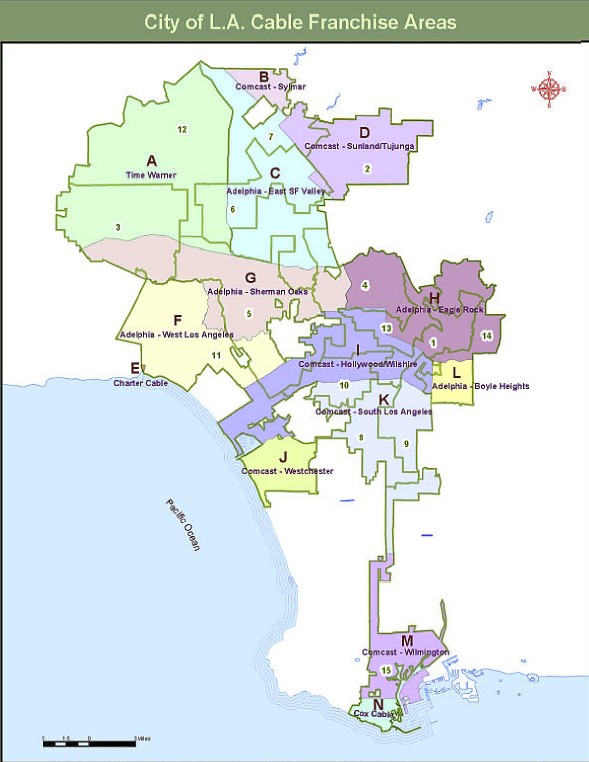
Los Angeles County's cable franchise map dating back to 2005 shows the county divided between Adelphia, Comcast, and Time Warner. Today, Time Warner Cable controls most of the county's cable service but still relies on some legacy equipment in place from the days of Adelphia and Comcast. Calabasas was formerly served by Adelphia. (click to enlarge map)

Some southern California residents continue to express anger and frustration at some poor business and customer service practices provided by Charter Cable and Time Warner Cable, both of which provide service in the community of Calabasas.

Unfortunately, city officials had their hands tied in resolving consumer complaints because California is one of several states that abandoned local cable franchising in favor of less accountable statewide cable franchises that carry few terms and conditions that protect California consumers.

The Calabasas Communications and Technology Commission dealt with several complaints raised by residents during its May meeting, often echoed by the commissioners themselves.

From the Calabasas Patch:

Resident Alvin Lindenauer spoke about his dissatisfaction with Charter.

“Charter has a long history of being less than competent in providing cable service,” he said.

Lindenauer’s complaints with Charter included misleading advertising, poor customer service and, most prominent, “improper billing practices.”

He said he received several erroneous notices of past due payments that resulted in forced late fees.

Lindenauer referred to Charter as “corrupt and deceptive” in its business practices.

He proposed that the commission hold Charter Cable more accountable for its service and reduce the city’s long-term contract with the company.

Charter Cable officials denied the company was either corrupt or deceptive, stating the company will work to address any customer service or billing complaints.

Cable commissions like those in Calabasas actually hold almost no power over incumbent cable or competing phone company video offerings.  The federal government deregulated the vast majority of cable operations as part of the 1996 Communications Act.  While many municipalities have cable boards or commissions, most are little more than venting stations for frustrated residents who feel their local provider is unresponsive.  Sometimes appeals like those by Lindenauer can get the attention of company executives and “guilt them” into intervening with intransigent customer service agents, especially when the media is watching.

Calabasas residents were also upset with Time Warner Cable — primarily because of its set-top boxes and a recent “upgrade” to its program guide software.

Customers are upset with the company’s legacy Motorola cable boxes still used on the part of the system originally owned by Adelphia.  Some residents inquired about why Time Warner doesn’t use the “more reliable” Scientific-Atlanta converters used in other parts of Los Angeles county.

Calabasas residents also complained Time Warner’s cable signals are intermittently plagued by “tiling,” an irritating digital artifact that appears like a series of small boxes that appear frozen or moving across a digital picture.  Company officials responded that the problems are in software, not in the set-top boxes, and they would work on them.

Time Warner’s Los Angeles county cable system is actually configured of several different cable systems acquired from Comcast and bankrupt Adelphia Cable a few years ago.  Those systems still have important differences in technology and channel lineups.  Despite those differences, Time Warner Cable collectively controls most of Los Angeles county’s cable systems.  Charter has most of the rest.

[You can watch the commission’s proceedings from their video archive.  Start watching at 17:35 to view Mr. Lindenauer’s complaint and follow-up.]

Mississippi Windjammer Cable System Suddenly Suddenlink… After Being Adelphia and Time Warner Cable

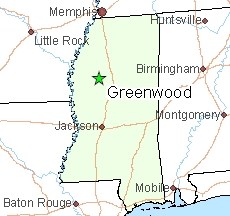
Greenwood, Miss.

Although the days of frenzied buying and selling of cable systems is behind us, smaller cable operators are still in the market for system swaps and buyouts.

Some 8,200 Windjammer Cable customers in Greenwood, Miss. and surrounding areas are about to become Suddenlink customers.  For many residents in Greenwood, located north of Jackson, this will be their third cable provider in two years.

Originally owned by Adelphia, Greenwood’s cable system was acquired in 2008 by Time Warner Cable as part of a bankruptcy sale of Adelphia’s cable properties.  Time Warner Cable ponied up an estimated average $3,500 per subscriber to purchase Adelphia’s cable systems, even though many were badly in need of upgrades.

Time Warner merged many Adelphia systems in larger communities into its own operations, but sold most of the smaller, more rural systems deemed strategically unimportant to the company.  In total, more than 125 cable systems in 25 different states, many serving just a few hundred subscribers each, were dumped overboard at a loss of $45 million by Time Warner.  Greenwood, like 124 other communities, would now receive cable service from a company nobody ever heard of before — Windjammer Cable.

Windjammer was created in 2008 to handle the 80,000 Adelphia customers Time Warner cast-off.  Owned by private equity firm MAST Capital Management, Windjammer is run by Jupiter, Fla.-based small cable operator Communications Construction Services, which is mostly known for providing cable service to more than 200 military bases across the country.

For Greenwood customers, the welcome letter from Time Warner Cable ended their cable relationship with Adelphia.  But it was a relationship never destined to last.

Just one year later, another welcome letter arrived, this time from Windjammer Cable:

Welcome to the Windjammer Cable family!

We have recently acquired the former Time Warner Cable system in this area, and are proud to be your new cable services provider.

We’re more than just a cable company. Windjammer Cable brings a whole world of entertainment and communications to the place it matters most…your home.

As a way to make the transition easy from one cable company to another, you will see very little change in how you receive your cable and communications services.

We will be updating your High Speed Internet, Digital Phone, and E-mail services beginning in the early morning of January 12, 2009. This conversion may take up to 10 days. We will only be working on your service between 1:00 am – 6:00 am local time. During this time, you may experience slight service interruptions, so please be patient.

To those of you who currently use the Time Warner Road Runner email service, there will be changes to your email account. Please visit our new website where you will find information about setting up a new Windjammer email account. We encourage you to do this as soon as possible. Your existing Road Runner email account will continue to work the same for at least the next two months.

If you do not use the Time Warner Road Runner email service, but use another service, like Gmail, you will not need to make any changes.

If you are a Time Warner Digital Phone customer, you should not notice any significant changes to your phone services. If you use the voice mail service, you will have to re-record your message. Instructions for doing this can also be found on our website.

Our customer service representatives are available 24 hours a day to answer any questions you may have about the transition. Consider us your new friend and neighbor, and know that we are only a phone call away.

We look forward to serving all your cable and communication needs!

Windjammer Cable

Now, one year and some months later, customers can prepare for their next welcome letter from Suddenlink.

What Suddenlink paid to acquire the Windjammer system has not been disclosed.

Suddenlink has experience providing service in Mississippi — its nearest system is in Greenville, about 50 miles west of Greenwood.

Suddenlink is the nation’s seventh-largest cable operator, with customers primarily located in Arkansas, Louisiana, North Carolina, Oklahoma, Texas and West Virginia.

Search This Site:

Contributions:

Recent Comments:

Your Account:

Stop the Cap!